Results by title
702 books match the query 'America' and 63 start with a
Ancient Households of the Americas
Conceptualizing What Households DoJohn G. Douglass
University Press of Colorado, 2012
Several different cultures-Iroquois, Coosa, Anasazi, Hohokam, San Agustín, Wankarani, Formative Gulf Coast Mexico, and Formative, Classic, Colonial, and contemporary Maya-are analyzed through the lens of household archaeology in concrete, data-driven case studies. The text is divided into three sections: Section I examines the spatial and social organization and context of household production; Section II looks at the role and results of households as primary producers; and Section III investigates the role of, and interplay among, households in their greater political and socioeconomic communities.
In the past few decades, household archaeology has made substantial contributions to our understanding and explanation of the past through the documentation of the household as a social unit-whether small or large, rural or urban, commoner or elite. These case studies from a broad swath of the Americas make Ancient Households of the Americas extremely valuable for continuing the comparative interdisciplinary study of households.
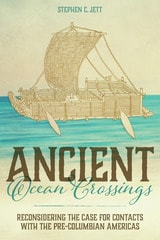
Ancient Ocean Crossings
Reconsidering the Case for Contacts with the Pre-Columbian AmericasStephen C. Jett
University of Alabama Press, 2017
In Ancient Ocean Crossings: Reconsidering the Case for Contacts with the Pre-Columbian Americas, Stephen Jett encourages readers to reevaluate the common belief that there was no significant interchange between the chiefdoms and civilizations of Eurasia and Africa and peoples who occupied the alleged terra incognita beyond the great oceans.
More than a hundred centuries separate the time that Ice Age hunters are conventionally thought to have crossed a land bridge from Asia into North America and the arrival of Columbus in the Bahamas in 1492. Traditional belief has long held that earth’s two hemispheres were essentially cut off from one another as a result of the post-Pleistocene meltwater-fed rising oceans that covered that bridge. The oceans, along with arctic climates and daunting terrestrial distances, formed impermeable barriers to interhemispheric communication. This viewpoint implies that the cultures of the Old World and those of the Americas developed independently.
Drawing on abundant and concrete evidence to support his theory for significant pre-Columbian contacts, Jett suggests that many ancient peoples had both the seafaring capabilities and the motives to cross the oceans and, in fact, did so repeatedly and with great impact. His deep and broad work synthesizes information and ideas from archaeology, geography, linguistics, climatology, oceanography, ethnobotany, genetics, medicine, and the history of navigation and seafaring, making an innovative and persuasive multidisciplinary case for a new understanding of human societies and their diffuse but interconnected development.

Animation and America
Wells, Paul
Rutgers University Press, 2002
In Animation and America, Paul Wells looks afresh at this unique art, discussing the distinctiveness of the cartoon form, as well as myriad other types of animation production. Insisting upon the "modernity" of the genre, Wells examines its importance as a barometer of the social conditions in which it is made and which it reflects. This book is not a standard history of animation in America, but rather uses animation as a way of discussing social and political change. Wells concentrates on the ways in which the form continues to grow, experiment, and remain subversiveand, increasingly, gaining acclaim and recognition. Now in the vanguard of visual culture, animation occupies an important position in representing both the outcomes and impacts of new technologies, and it also has laid the foundations for a new understanding of social and artistic practice.
Another Face of Empire
Bartolomé de Las Casas, Indigenous Rights, and Ecclesiastical ImperialismDaniel Castro
Duke University Press, 2007
Separating historical reality from myth, Daniel Castro provides a nuanced, revisionist assessment of the friar’s career, writings, and political activities. Castro argues that Las Casas was very much an imperialist. Intent on converting the Indians to Christianity, the religion of the colonizers, Las Casas simply offered the natives another face of empire: a paternalistic, ecclesiastical imperialism. Castro contends that while the friar was a skilled political manipulator, influential at what was arguably the world’s most powerful sixteenth-century imperial court, his advocacy on behalf of the natives had little impact on their lives. Analyzing Las Casas’s extensive writings, Castro points out that in his many years in the Americas, Las Casas spent very little time among the indigenous people he professed to love, and he made virtually no effort to learn their languages. He saw himself as an emissary from a superior culture with a divine mandate to impose a set of ideas and beliefs on the colonized. He differed from his compatriots primarily in his antipathy to violence as the means for achieving conversion.
Antislavery
The Crusade for Freedom in AmericaDwight Lowell Dumond
University of Michigan Press, 1961
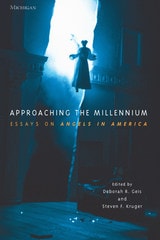
Approaching the Millennium
Essays on Angels in AmericaDeborah R. Geis and Steven F. Kruger, Editors
University of Michigan Press, 1997
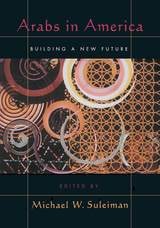
Arabs in America
Building a New Futureedited by Michael W. Suleiman
Temple University Press, 1999
In this volume, editor Michael Suleiman brings together 21 prominent scholars from a wide range of perspectives -- including anthropology, economics, history, law, literature and culture, political science, and sociology -- to take a close look at the status of Arabs in North America. Topics range from the career of Arab American singer, dancer, and storyteller Wadeeha Atiyeh to a historical examination of Arab Americans and Zionism. The contributors discuss in Detroit, a group of well-educated Jordanian men, and the Shi'a Muslims -- to illustrate the range of Arab emigre experience. More broadly, they examine Arab American identity, political activism, and attempts by Arab immigrants to achieve respect and recognition in their new homes. They address both the present situation for Arab Americans and prospects for their future.
Arabs in America will engage anyone interested in Arab American studies, ethnic studies, and American studies.
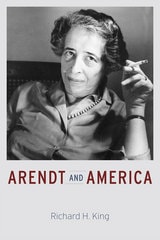
Arendt and America
Richard H. King
University of Chicago Press, 2015
Situating Arendt within the context of U.S. intellectual, political, and social history, King reveals how Arendt developed a fascination with the political thought of the Founding Fathers. King also re-creates her intellectual exchanges with American friends and colleagues, such as Dwight Macdonald and Mary McCarthy, and shows how her lively correspondence with sociologist David Riesman helped her understand modern American culture and society. In the last section of Arendt and America, King sets out the context in which the Eichmann controversy took place and follows the debate about “the banality of evil” that has continued ever since. As King shows, Arendt’s work, regardless of focus, was shaped by postwar American thought, culture, and politics, including the Civil Rights Movement and the Cold War.
For Arendt, the United States was much more than a refuge from Nazi Germany; it was a stimulus to rethink the political, ethical, and historical traditions of human culture. This authoritative combination of intellectual history and biography offers a unique approach for thinking about the influence of America on Arendt’s ideas and also the effect of her ideas on American thought.
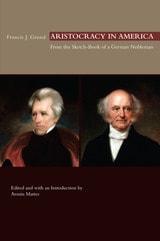
Aristocracy in America
From the Sketch-Book of a German NoblemanFrancis J. Grund, edited with an introduction by Armin Mattes
University of Missouri Press, 2018
Francis J. Grund, a German emigrant, was one of the most influential journalists in America in the three decades preceding the Civil War. He also wrote several books, including this fictional, satiric travel memoir in response to Alexis de Tocqueville’s famous Democracy in America. Armin Mattes provides a thorough account of Grund’s dynamic engagement in American political life, and brings to light many of Grund’s reflections on American social and political life previously published only in German. Mattes shows how Grund’s work can expand our understanding of the emerging democratic political culture and society in the antebellum United States.
Aristotle's Voice
Rhetoric, Theory, and Writing in AmericaJasper Neel
Southern Illinois University Press, 1994
In this book, Jasper Neel’s sure-to-be-controversial resituating of Aristotle centers around three questions that have been constants in his twenty-two years of teaching experience: What does itmean to teach writing? What should one know before teaching writing? And, if there is such a thing as "research in the teaching of writing," what is it?
Believing that all composition teachers are situated politically and socially, both as part of the institution in which they teach and as beings with lived histories, Neel examines his own life and the life of composition studies as a discipline in the context of Aristotle. Neel first situates the Rhetoric as a political document; he then situates the Rhetoric in the Aristotelian system and describes how professional discourse came to know itself through Aristotle’s way of studying the world; finally, he examines the operation of the Rhetoric inside itself before arguing the need to turn to Aristotle’s notion of sophistry as a way of negating his system.
By pointing out the connections among Aristotelian rhetoric, the contemporary university, and the contemporary writing teacher, Neel shows that Aristotle’s frightening social theories are as alive today as are Aristotelian notions of discourse.
Neel explains that by their very nature teachers must speak with a professional voice. It is through showing how to "hear" one’s professional voice that Neel explores the notion of professional discourse that originates with Aristotle. In maintaining that one must pay a high price in order to speak through Aristotle’s theory or to assume the role of "professional," he argues that no neutral ground exists either for pedagogy or for the analysis of pedagogy. Neel concludes this discussion by proposing that Aristotelian sophistry is both an antidote to Aristotelian racism, sexism, and bigotry and a way of allowing Aristotelian categories of discourse to remain useful.
Finally, as an Aristotelian, a teacher, and a writer, Neel responds both to Aristotle and to professionalism by rethinking the influence of the past and reviving the voice of Aristotelian sophistry.

Arthur Miller's America
Theater and Culture in a Time of ChangeEnoch Brater, Editor
University of Michigan Press, 2005
Arthur Miller's America collects new writing by leading international critics and scholars that considers the dramatic world of icon, activist, and playwright Arthur Miller's theater as it reflects the changing moral equations of his time. Written on the occasion of Miller's 85th year, the original essays and interviews in Arthur Miller's America treat the breadth of Miller's work, including his early political writings for the campus newspaper at the University of Michigan, his famous work with John Huston, Clark Gable and Marilyn Monroe on The Misfits, and his signature plays like Death of a Salesman and All My Sons.

At the Moon's Inn
Andrew Lytle
University of Alabama Press, 2009
At the Moon’s Inn, first published in 1941, provides a fictional account of De Soto’s famous Spanish expedition to La Florida and through the southeastern United States between 1539 and 1543. The novel begins in Spain in 1538, where De Soto and his chief lieutenants, veterans of the campaigns in South America, pledge themselves to a new enterprise to explore and exploit La Florida. The narrative follows them on their voyage to Cuba, where they rest and obtain additional supplies, then set sail for the area now known as Tampa Bay. Lytle’s brilliant historical novel takes the readers with the conquistadores through the hot, humid land, where despite their advantage in military technology they found they must rely on the Indians for food. The author explores the cultural confrontation that seriously weakened the Indians, while the Spaniards’ dreams of gold gradually turned to hopes of survival in the hostile environment.
Drawing his facts from the 1939 United States De Soto Commission Report and from the surviving historical chronicles of the expedition, Lytle weaves a fascinating tale that brings to life the history of Spanish efforts to establish a controlling presence in the New World during the first half of the 16th century.
In his introduction, Douglas Jones places At the Moon’s Inn within the context of the documentary record, as well as within the framework of its distinguished author’s career.

Awakening to Race
Individualism and Social Consciousness in AmericaJack Turner
University of Chicago Press, 2012