Results by title
434 books match the query 'Criticism & Theory' and 54 start with a
As for Protocols
Edited by Re'al Christian, Carin Kuoni, and Eriola Pira
Amherst College Press, 2025
Edited by Re’al Christian, Carin Kuoni, and Eriola Pira, an opening score by Raven Chacon and contributions by Salome Asega, Carolina Caycedo with Lupita Limón Corrales, Raven Chacon, Jesse Chun, Asia Dorsey, Taraneh Fazeli and Cannach MacBride, Pablo Helguera, Emmanuel Iduma, Mary Maggic, Shannon Mattern, V. Mitch McEwen with Nadir Jeevanjee, Rashaun Mitchell with Silas Riener, Romy Opperman, Rasheedah Phillips, Leanne Betasamosake Simpson with Maria Hupfield, Ultra-red with Robert Sember, and Underground Resistance.
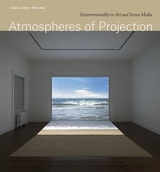
Atmospheres of Projection
Environmentality in Art and Screen MediaGiuliana Bruno
University of Chicago Press, 2022
Projection has long been transforming space, from shadow plays to camera obscuras and magic lantern shows. Our fascination with projection is alive on the walls of museums and galleries and woven into our daily lives. Giuliana Bruno explores the histories of projection and atmosphere in visual culture and their continued importance to contemporary artists who are reinventing the projective imagination with atmospheric thinking and the use of elemental media.
To explain our fascination with projection and atmosphere, Bruno traverses psychoanalysis, environmental philosophy, architecture, the history of science, visual art, and moving image culture to see how projective mechanisms and their environments have developed over time. She reveals how atmosphere is formed and mediated, how it can change, and what projection can do to modify a site. In so doing, she gives new life to the alchemic possibilities of transformative projective atmospheres. Showing how their “environmentality” produces sites of exchange and relationality, this book binds art to the ecology of atmosphere.
Autonomy
The Social Ontology of Art under CapitalismNicholas Brown
Duke University Press, 2019
Avant-Garde Museology
e-flux classicsArseny Zhilyaev
University of Minnesota Press, 2015
The museum of contemporary art might be the most advanced recording device ever invented. It is a place for the storage of historical grievances and the memory of forgotten artistic experiments, social projects, or errant futures. But in late nineteenth and early twentieth-century Russia, this recording device was undertaken by artists and thinkers as a site for experimentation.
Arseny Zhilyaev’s Avant-Garde Museology presents essays documenting the wildly encompassing progressivism of this period by figures such as Nikolai Fedorov, Aleksandr Rodchenko, Kazimir Malevich, Alexander Bogdanov, and others—many which are translated from the Russian for the first time. Here the urgent question is: How might the contents of the museum be reanimated so as to transcend even the social and physical limits imposed on humankind?
Contributors: David Arkin; Vladimir Bekhterev; Alexander Bogdanov; Osip Brik; Vasiliy Chekrygin; Leonid Chetyrkin; Nikolai Druzhinin; Nikolai Fedorov; Pavel Florensky; R. N. Frumkina; M. S. Ilkovskiy; V. I. Karmilov; V. Karpov; Valentin Kholtsov; P. N. Khrapov; Yuriy Kogan; Natalya Kovalenskaya; Nadezhda Krupskaya; S. P. Lebedyansky; A. F. Levitsky; Vera Leykina (Leykina-Svirskaya); Ivan Luppol; Kazimir Malevich; Andrey Platonov; Nikolay Punin; Aleksandr Rodchenko; Yuriy Samarin; I. F. Sheremet; Andrey Shestakov; Natan Shneerson; Ivan Skulenko; M. Vorobiev; N. Vorontsovsky; Boris Zavadovsky; I. M. Zykov.