Results by title
681 books match the query 'English language' and 61 start with a
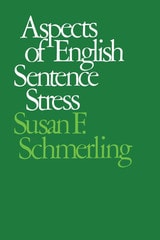
Aspects of English Sentence Stress
By Susan F. Schmerling
University of Texas Press, 1976
Aspects of English Sentence Stress is written within the conceptual framework of generative-transformational grammar. However, it is atheoretical in the sense that the proposals made cannot be formulated in this theory and are a challenge to many other theories. The author's concern is not with the phonetic nature of stress; rather, using a working definition of stress as subjective impression of prominence, she attempts to formulate general principles that will predict the relative prominence of different words in particular utterances—what might be called the syntax of stress. She supports her arguments with a large amount of original data and provides the basis for new ways of thinking about this area of linguistic research.
Schmerling begins with a detailed review and critique of Noam Chomsky and Morris Halle's approach to sentence stress; she shows that their cyclic analysis cannot be considered valid, even for quite simple phrases and sentences. Next, she reviews discussions of sentence stress by Joan Bresnan, George Lakoff, and Dwight Bolinger, agreeing with Bolinger's contention that there is no intimate connection between sentence stress and syntactic structure but showing that his counterproposal to the standard approach is inadequate as well. She also examines the concept of "normal stress" and demonstrates that no linguistically significant distinction can be drawn between "normal" and "special" stress contours.
In generating her own proposals concerning sentence stress, Schmerling takes the view that certain items which are stressable are taken for granted by the speaker and are eliminated from consideration by the principles governing relative prominence of words in a sentence. Then she examines the pragmatic and phonological principles pertaining to items that are not eliminated from consideration. Finally, the author contends that the standard views, which she shows to be untenable, are a result of the assumption that linguistic entities should be studied apart from questions concerning their use, in that it was adoption of this methodological assumption that forced linguists to deny the essentially pragmatic nature of sentence stress.
Accessible to anyone who is familiar with the basic concepts of generative-transformational grammar, Aspects of English Sentence Stress presents provocative ideas in the field.
Aspects of Old English Poetic Syntax
WHERE CLAUSES BEGINMary Blockley
University of Illinois Press, 2001
Distinguished by a remarkable combination of erudition and lucidity, Aspects of Old English Poetic Syntax provides new insight into the rules that govern syntactic relationships and indicates how these rules differ for prose and verse. Blockley considers the functions of four of the most common and most syntactically important words in Old English, as well as such features of clauses as verb-initial order, negative contraction, and unexpressed but understood subjects. Picking up where Bruce Mitchell's classic Old English Syntax left off, Blockley shows how such common words and structures mark the relationships between phrases and clauses.
Blockley also considers how the poetic tradition compensated for the loss in written texts of the syntactic functions served by intonation and inflection. Arguing that verse relied instead on a prescriptively regulated, unambiguous syntax, she suggests principles that promise more complex and subtle interpretations of familiar texts such as Beowulf as well as a wealth of other Old English writings.
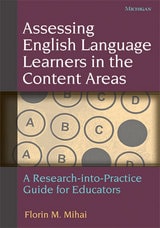
Assessing English Language Learners in the Content Areas
A Research-into-Practice Guide for EducatorsFlorin M. Mihai
University of Michigan Press, 2010
Assessing English Language Learners in the Content Areas: A Research-into-Practice Guide for Educators seeks to provide guidance to classroom teachers, staff developers, and test-item designers who want to improve ELL assessment outcomes, particularly in the areas of math, science and social studies. The first two chapters of the book establish the background for the discussion of content-area assessment for ELLs, examining several important characteristics of this rapidly growing student population (as well as critical legislation affecting ELLs) and providing a description of various forms of assessment, including how ELL assessment is different from the assessment of English-proficient students. Important assessment principles that educators should use in their evaluation of tests or other forms of measurement are provided.
Other chapters review ELL test accommodations nationwide (because, surprisingly, most teachers do not know what they can and cannot allow) and the research on the effectiveness of these types of accommodations. The book analyzes the characteristics of alternative assessment; it discusses three popular alternative assessment instruments (performance assessment, curriculum-based measurement, and portfolios) and makes recommendations as to how to increase the validity, reliability, and practicality of alternative assessments. The book proposes fundamental assessment practices to help content area teachers in their evaluation of their ELL progress.
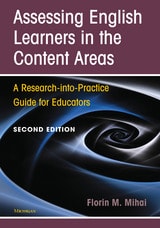
Assessing English Learners in the Content Areas, Second Edition
A Research-into-Practice Guide for EducatorsFlorin M. Mihai
University of Michigan Press, 2017
Significant modifications in education legislation since the publication of the first edition have necessitated this new volume, which includes updated EL demographics as they relate to the Common Core Standards and Every Student Succeeds Act and revised state-by-state test accommodation information. New to this edition is information about the assessment of language arts (in addition to math, science, and social studies). The Second Edition also features new research-based recommendations for large-scale and classroom-based assessments.
Like the previous edition, the first two chapters of the book establish the background for the discussion of content-area assessment for ELs, examining several important characteristics of this rapidly growing student population and providing a description of various forms of assessment, including how EL assessment is different from the assessment of English-proficient students. Important assessment principles that educators should use in their evaluation of tests or other forms of measurement are provided.
Other chapters review EL test accommodations nationwide (because, surprisingly, most teachers do not know what they can and cannot allow) and the research on the effectiveness of these types of accommodations. The book analyzes the characteristics of alternative assessment and makes recommendations as to how to increase the validity, reliability, and practicality of alternative assessments. The book proposes fundamental assessment practices to help content area teachers in their evaluation of their students’ progress. Two extensive appendixes outline TESOL Proficiency Standards and academic vocabulary for the content areas.
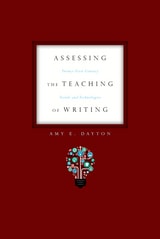
Assessing the Teaching of Writing
Twenty-First Century Trends and TechnologiesAmy E. Dayton
Utah State University Press, 2015
Although fraught with politics and other perils, teacher evaluation can contribute in important, positive ways to faculty development at both the individual and the departmental levels. Yet the logistics of creating a valid assessment are complicated. Inconsistent methods, rater bias, and overreliance on student evaluation forms have proven problematic. The essays in Assessing the Teaching of Writing demonstrate constructive ways of evaluating teacher performance, taking into consideration the immense number of variables involved.
Contributors to the volume examine a range of fundamental issues, including the political context of declining state funds in education; growing public critique of the professoriate and demands for accountability resulting from federal policy initiatives like No Child Left Behind; the increasing sophistication of assessment methods and technologies; and the continuing interest in the scholarship of teaching. The first section addresses concerns and advances in assessment methodologies, and the second takes a closer look at unique individual sites and models of assessment. Chapters collectively argue for viewing teacher assessment as a rhetorical practice.
Fostering new ways of thinking about teacher evaluation, Assessing the Teaching of Writing will be of great interest not only to writing program administrators but also to those concerned with faculty development and teacher assessment outside the writing program.
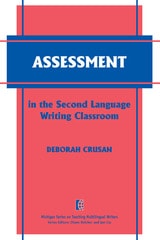
Assessment in the Second Language Writing Classroom
Deborah Crusan
University of Michigan Press, 2010
Assessment in the Second Language Writing Classroom is a teacher and prospective teacher-friendly book, uncomplicated by the language of statistics. The book is for those who teach and assess second language writing in several different contexts: the IEP, the developmental writing classroom, and the sheltered composition classroom. In addition, teachers who experience a mixed population or teach cross-cultural composition will find the book a valuable resource. Other books have thoroughly covered the theoretical aspects of writing assessment, but none have focused as heavily as this book does on pragmatic classroom aspects of writing assessment. Further, no book to date has included an in-depth examination of the machine scoring of writing and its effects on second language writers.
Crusan not only makes a compelling case for becoming knowledgeable about L2 writing assessment but offers the means to do so. Her highly accessible, thought-provoking presentation of the conceptual and practical dimensions of writing assessment, both for the classroom and on a larger scale, promises to engage readers who have previously found the technical detail of other works on assessment off-putting, as well as those who have had no previous exposure to the study of assessment at all.
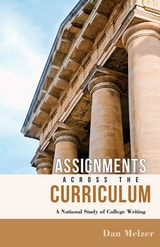
Assignments across the Curriculum
A National Study of College WritingDan Melzer
Utah State University Press, 2014
In Assignments across the Curriculum, Dan Melzer analyzes the rhetorical features and genres of writing assignments through the writing-to-learn and writing-in-the-disciplines perspectives. Presenting the results of his study of 2,101 writing assignments from undergraduate courses in the natural sciences, social sciences, business, and humanities in 100 postsecondary institutions in the United States, Assignments across the Curriculum is unique in its cross-institutional breadth and its focus on writing assignments.
The results provide a panoramic view of college writing in the United States. Melzer's framework begins with the rhetorical situations of the assignments—the purposes and audiences—and broadens to include the assignments' genres and discourse community contexts. Among his conclusions is that courses connected to a writing-across-the-curriculum (WAC) initiative ask students to write more often, in a greater variety of genres, and for a greater variety of purposes and audiences than non-WAC courses do, making a compelling case for the influence of the WAC movement.
Melzer's work also reveals patterns in the rhetorical situations, genres, and discourse communities of college writing in the United States. These larger patterns are of interest to WAC practitioners working with faculty across disciplines, to writing center coordinators and tutors working with students who bring assignments from a variety of fields, to composition program administrators, to first-year writing instructors interested in preparing students for college writing, and to high school teachers attempting to bridge the gap between high school and college writing.
Attitudes De Se
Linguistics, Epistemology, MetaphysicsEdited by Neil Feit and Alessandro Capone
CSLI, 2013
Audience Expectations and Teacher Demands
Robert Brooke and John Hendricks
Southern Illinois University Press, 1989
The audience—the community of readers who will use the texts a writer produces—must be an important influence on the writer for his or her work to be effective.
Robert Brooke and John Hendricks examine the difficult task of teaching "writing for an audience" in a classroom where students know that the teacher, not the addressed audience, assigns the grade.
The authors describe in detail a particular writing class, taught by Brooke and observed by Hendricks, that attempted to teach writing for an audience. By combining the experiences from their study with student reactions to the class, they draw some conclusions about the dynamics of teaching writing and about learning in general.
Authoring
An Essay for the English Profession on Potentiality and SingularityJanis Haswell and Richard Haswell
Utah State University Press, 2010
Autobiographical Writing Across the Disciplines
A ReaderDiane P. Freedman and Olivia Frey, eds.
Duke University Press, 2003
The editors’ introduction presents a condensed history of academic writing, chronicles the origins of autobiographical criticism, and emphasizes the role of feminism in championing the value of personal narrative to disciplinary discourse. The essays are all explicitly informed by the identities of their authors, among whom are a feminist scientist, a Jewish filmmaker living in Germany, a potential carrier of Huntington’s disease, and a doctor pregnant while in medical school. Whether describing how being a professor of ethnic literature necessarily entails being an activist, how music and cooking are related, or how a theology is shaped by cultural identity, the contributors illuminate the relationship between their scholarly pursuits and personal lives and, in the process, expand the boundaries of their disciplines.
Contributors:
Kwame Anthony Appiah
Ruth Behar
Merrill Black
David Bleich
James Cone
Brenda Daly
Laura B. DeLind
Carlos L. Dews
Michael Dorris
Diane P. Freedman
Olivia Frey
Peter Hamlin
Laura Duhan Kaplan
Perri Klass
Muriel Lederman
Deborah Lefkowitz
Eunice Lipton
Robert D. Marcus
Donald Murray
Seymour Papert
Carla T. Peterson
David Richman
Sara Ruddick
Julie Tharp
Bonnie TuSmith
Alex Wexler
Naomi Weisstein
Patricia Williams