Results by title
775 books match the query 'Germany' and 53 start with a
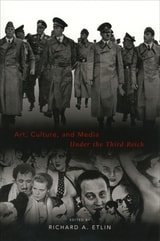
Art, Culture, and Media Under the Third Reich
Edited by Richard A. Etlin
University of Chicago Press, 2002
Contributors address nearly every facet of the arts and mass media under the Third Reich—efforts to define degenerate music and art; the promotion of race hatred through film and public assemblies; views of the racially ideal garden and landscape; race as portrayed in popular literature; the reception of art and culture abroad; the treatment of exiled artists; and issues of territory, conquest, and appeasement. Familiar subjects such as the Munich Accord, Nuremberg Party Rally Grounds, and Lebensraum (Living Space) are considered from a new perspective. Anyone studying the history of Nazi Germany or the role of the arts in nationalist projects will benefit from this book.
Contributors:
Ruth Ben-Ghiat
David Culbert
Albrecht Dümling
Richard A. Etlin
Karen A. Fiss
Keith Holz
Kathleen James-Chakraborty
Paul B. Jaskot
Karen Koehler
Mary-Elizabeth O'Brien
Jonathan Petropoulos
Robert Jan van Pelt
Joachim Wolschke-Bulmahn and Gert Gröning
Articulating Difference
Sex and Language in the German Nineteenth CenturySophie Salvo
University of Chicago Press, 2024
Drawing on a wide range of texts, from understudied ethnographic and scientific works to canonical literature and philosophy, Sophie Salvo uncovers the prehistory of the inextricability of gender and language. Taking German discourses on language as her focus, she argues that we are not the inventors but, rather, the inheritors and adapters of the notion that gender and language are interrelated. Particularly during the long nineteenth century, ideas about sexual differences shaped how language was understood, classified, and analyzed. As Salvo explains, philosophers asserted the patriarchal origins of language, linguists investigated “women’s languages” and grammatical gender, and literary Modernists imagined “feminine” sign systems, and in doing so they not only deemed sex-based divisions to be necessary categories of language but also produced a plethora of gendered tropes and fictions, which they used both to support their claims and delimit their disciplines.
Articulating Difference charts new territory, revealing how gendered conceptions of language make possible the misogynistic logic of exclusion that underlies arguments claiming, for example, that women cannot be great orators or writers. While Salvo focuses on how male scholars aligned language study with masculinity, she also uncovers how women responded, highlighting the contributions of understudied nineteenth-century works on language that women wrote even as they were excluded from academic opportunities.
Auschwitz, Poland, and the Politics of Commemoration, 1945–1979
Jonathan Huener
Ohio University Press, 2003
Few places in the world carry as heavy a burden of history as Auschwitz. Recognized and remembered as the most prominent site of Nazi crimes, Auschwitz has had tremendous symbolic weight in the postwar world.
Auschwitz, Poland, and the Politics of Commemoration is a history of the Auschwitz memorial site in the years of the Polish People’s Republic. Since 1945, Auschwitz has functioned as a memorial and museum. Its monuments, exhibitions, and public spaces have attracted politicians, pilgrims, and countless participants in public demonstrations and commemorative events.
Jonathan Huener’s study begins with the liberation of the camp and traces the history of the State Museum at Auschwitz from its origins immediately after the war until the 1980s, analyzing the landscape, exhibitions, and public events at the site.
Based on extensive research and illustrated with archival photographs, Auschwitz, Poland, and the Politics of Commemoration accounts for the development and durability of a Polish commemorative idiom at Auschwitz. Emphasis on Polish national “martyrdom” at Auschwitz, neglect of the Shoah as the most prominent element of the camp’s history, political instrumentalization of the grounds and exhibitions—these were some of the more controversial aspects of the camp’s postwar landscape.
Professor Huener locates these and other public manifestations of memory at Auschwitz in the broad scope of Polish history, in the specific context of postwar Polish politics and culture, and against the background of Polish-Jewish relations. Auschwitz, Poland, and the Politics of Commemoration will be of interest to scholars, students, and general readers of the history of modern Poland and the Holocaust.