Results by title
754 books match the query 'International relations' and 52 start with a
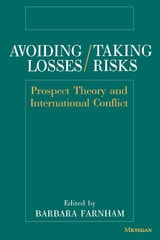
Avoiding Losses/Taking Risks
Prospect Theory and International ConflictBarbara Farnham, Editor
University of Michigan Press, 1995
This volume is a comprehensive examination of the benefits and potential pitfalls of employing prospect theory---a leading alternative to expected utility as a theory of decision under risk---to understand and explain political behavior. The collection brings together both theoretical and empirical studies, thus grounding the conclusions about prospect theory's potential for enriching political analyses in an assessment of its performance in explaining actual cases.
The theoretical chapters provide an overview of the main hypotheses of prospect theory: people frame risk-taking decisions around a reference point, they tend to accept greater risk to prevent losses than to make gains, and they often perceive the devastation of a loss as greater than the benefit of a gain. The three case studies---Roosevelt's decision-making during the Munich crisis of 1938, Carter's April 1980 decision to rescue the American hostages in Iran, and Soviet behavior toward Syria in 1966-67---generally support these hypotheses. Nevertheless, the authors are frank about potentially difficult conceptual and methodological problems, making explicit reference to alternative explanations, such as the rational actor model, which posits the maximization of expected value.
Contributors to the volume include Jack Levy, Robert Jervis, Barbara Farnham, Rose McDermott, Audrey McInerney, and Eldar Shafir.

Azerbaijan's Geopolitical Landscape
Contemporary Issues, 1991–2018Edited by Farid Shafiyev
Karolinum Press, 2019