936 books match the query 'LGBTQ+ Studies' and 62 start with a
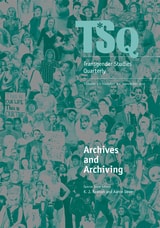
cover of Archives and Archiving

Archives and Archiving

K. J. Rawso and Aaron Devor, special issue editors

Duke University Press, 0

The humanization of the archival craft is particularly compelling for transgender-related archives and archiving. As attention to transgender phenomena continues to increase, the need for thoughtfully conceived and ethically executed trans archival practices becomes all the more pressing. Yet the very basis of this undertaking relies on a daunting definitional and epistemological challenge: in the context of archives, what counts as transgender? This issue of TSQ will investigate practical and theoretical dimensions of archiving transgender phenomena and will ask what constitutes “trans* archives” or “trans* archival practices.”
[more]
cover of Are You Two Sisters?: The Journey of a Lesbian Couple

Are You Two Sisters?

The Journey of a Lesbian Couple

Susan Krieger

Temple University Press, 2022

Authored by one of the most respected figures in the field of personal ethnographic narrative, this book serves as both a memoir and a sociological study, telling the story of one lesbian couple’s lifelong journey together.

Are You Two Sisters? is Susan Krieger’s candid, revealing, and engrossing memoir about the intimacies of a lesbian couple. Krieger explores how she and her partner confront both the inner challenges of their relationship and the invisibility of lesbian identity in the larger world. 

Using a lively novelistic and autoethnographic approach that toggles back and forth in time, Krieger reflects on the evolution of her forty-year relationship. She describes building a life together, from sharing pets and travels to getting married. Are You Two Sisters? addresses not only questions of gender and sexuality, but also of disability, as Krieger explores how the couple adapts to her increasing blindness.

Krieger’s title comes from a question asked by a stranger outside a remote desert bar as she and her partner traveled in the Southwest. Her apprehension about answering that question suggests how, even after the legalization of gay marriage, lesbianism often remains hidden—an observation that makes Krieger’s poignant narrative all the more moving.

[more]
cover of Are the Kids All Right?: Representations of LGBTQ Characters in Children's and Young Adult Literature

Are the Kids All Right?

Representations of LGBTQ Characters in Children's and Young Adult Literature

B.J. Epstein

Intellect Books, 2013

Epstein explores why sex, sexuality and gender non-conformity is something that many writers and publishers of children's and young adult lit appear to shy away from. She demonstrates that the information children get from literature matters, and that so called 'difficult' topics can be communicated in entertaining and informative ways.


Uses ideas from queer theory and other research to interrogate the ways LGBTQ characters are portrayed in books for children and young people, and to analyse what messages readers of such books might receive.


Includes detailed analysis of over 60 picture books, middle-grade books and young adult novels by authors such as Nancy Garden, Julie Ann Peters, Alex Sanchez, David Levithan, Lesléa Newman, Marcus Ewart, Cris Beam and many others.


This book brings together literary studies, sociology, queer studies and other academic fields in an accessible manner, where the research supports the detailed analyses of over 50 books for children and young adults. Epstein looks at a range of topics, such as the lack of diversity in many of these works, how same-sex marriage is portrayed, the relative absence of bisexual and transgender characters, the way that many of these books are marketed and intended as 'issue books', and more.


A practical and informative book to inspire writers and publishers to produce better LGBTQ literature for young readers.

[more]
cover of Area Impossible: The Geopolitics of Queer Studies

Area Impossible

The Geopolitics of Queer Studies

Anjali Arondekar and Geeta Patel, special issue editors

Duke University Press, 0

Staging a much-needed conversation between two often-segregated fields, this issue addresses the promising future of queer and area studies as collaborative formations. Within queer studies, the turn to geopolitics has challenged the field's logics of time, space, and culture, which have routinely been rooted in the United States. For area studies, the focus on diaspora, forced migration, and other transnational trajectories has unmoored the geopolitical from the stability of nations as organizing concepts. The contributors to this issue seek to imagine and broker conversations between the two fields in which "area" becomes the form through which epistemologies of empire and market are critiqued. Histories of debt bondage; sexuality, and indentured labor; Afro-pessimism in African studies; trans theater facing obdurate transits; religion and the politics of Dalit modernity; the biopolitics of maiming: these are some of the conduits through which the authors approach a queer geopolitics.

Contributors: Anjali Arondekar, Ashley Currier, Aliyah Khan, Keguro Macharia, Thérèse Migraine-George, Maya Mikdashi, Geeta Patel, Jasbir K. Puar, Lucinda Ramberg, Neferti Tadiar, Diana Taylor, Ronaldo Wilson

[more]
cover of Arresting Dress: Cross-Dressing, Law, and Fascination in Nineteenth-Century San Francisco

Arresting Dress

Cross-Dressing, Law, and Fascination in Nineteenth-Century San Francisco

Clare Sears

Duke University Press, 2015
In 1863, San Francisco’s Board of Supervisors passed a law that criminalized appearing in public in “a dress not belonging to his or her sex.” Adopted as part of a broader anti-indecency campaign, the cross-dressing law became a flexible tool for policing multiple gender transgressions, facilitating over one hundred arrests before the century’s end. Over forty U.S. cities passed similar laws during this time, yet little is known about their emergence, operations, or effects. Grounded in a wealth of archival material, Arresting Dress traces the career of anti-cross-dressing laws from municipal courtrooms and codebooks to newspaper scandals, vaudevillian theater, freak-show performances, and commercial “slumming tours.” It shows that the law did not simply police normative gender but actively produced it by creating new definitions of gender normality and abnormality. It also tells the story of the tenacity of those who defied the law, spoke out when sentenced, and articulated different gender possibilities.
[more]
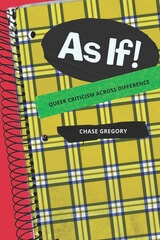
cover of As If!: Queer Criticism Across Difference

As If!

Queer Criticism Across Difference

Chase Gregory

Duke University Press, 2025

In As If!, Chase Gregory explores the stylistically strategic, often campy, and productively fraught cross-identifications of early queer criticism. Gregory calls this form of aids-era criticism as if!—a mode of writing in which authors struggle to read, write, and identify with and across categories of race, sexuality, and gender. Analyzing the work of Robert Reid-Pharr, Deborah E. McDowell, Barbara Johnson, and Eve Kosofsky Sedgwick, Gregory shows how their writing productively challenges fixed ideas of identity and knowledge production. Using these four writers as case studies of a larger trend within early queer criticism, Gregory demonstrates that even when critical attempts at relation are met by impasse, as if! criticism breaks down social relation, especially within those fields influenced by queer theory, deconstructionist feminist theory, and Black feminist theory. By advocating a return to as if! criticism as a politically useful blueprint for contemporary cultural inquiry, Gregory draws attention to the obstacles to forging identification across difference and insists on the impossible project of solidarity across such difference.
[more]
cover of Asegi Stories: Cherokee Queer and Two-Spirit Memory

Asegi Stories

Cherokee Queer and Two-Spirit Memory

Qwo-Li Driskill

University of Arizona Press, 2016

In Cherokee Asegi udanto refers to people who either fall outside of men’s and women’s roles or who mix men’s and women’s roles. Asegi, which translates as “strange,” is also used by some Cherokees as a term similar to “queer.” For author Qwo-Li Driskill, asegi provides a means by which to reread Cherokee history in order to listen for those stories rendered “strange” by colonial heteropatriarchy.

As the first full-length work of scholarship to develop a tribally specific Indigenous Queer or Two-Spirit critique, Asegi Stories examines gender and sexuality in Cherokee cultural memory, how they shape the present, and how they can influence the future.

The theoretical and methodological underpinnings of Asegi Stories derive from activist, artistic, and intellectual genealogies, referred to as “dissent lines” by Maori scholar Linda Tuhiwai Smith. Driskill intertwines Cherokee and other Indigenous traditions, women of color feminisms, grassroots activisms, queer and Trans studies and politics, rhetoric, Native studies, and decolonial politics. Drawing from oral histories and archival documents in order to articulate Cherokee-centered Two-Spirit critiques, Driskill contributes to the larger intertribal movements for social justice.

[more]
cover of At Risk: Rhetoric, Deviance, and the Politics of HIV Prevention

At Risk

Rhetoric, Deviance, and the Politics of HIV Prevention

McKinley Green

The Ohio State University Press, 2026

At Risk explores how young people living with HIV have developed risk-reduction practices that seem to contradict public health recommendations for HIV prevention. Putting forward a rhetoric of deviance to frame these instances, McKinley Green argues that they represent intentional healthcare decisions that help young people mitigate the health risks that are most pressing in their daily lives. While current HIV risk-reduction priorities in the US are framed around a finite spectrum of sexual behaviors and medical technologies, those living with HIV often encounter a broader spectrum of risks shaped by structural inequities like racism, housing insecurity, queer and transphobia, HIV stigma, trauma in medical settings, and addiction, all of which create conditions that increase the risk of HIV transmission and present other threats to safety and autonomy.

Drawing from more than sixty hours of interviews with young people living with HIV, frontline healthcare workers, and HIV activists, Green highlights how those living with HIV have developed agency and expertise in navigating, mitigating, and communicating about risk. In doing so, he offers alternative epistemologies of sexual health risk that point toward more patient-centered HIV prevention frameworks.

[more]
cover of Atmospheres of Violence: Structuring Antagonism and the Trans/Queer Ungovernable

Atmospheres of Violence

Structuring Antagonism and the Trans/Queer Ungovernable

Eric A. Stanley

Duke University Press, 2021
Advances in LGBTQ rights in the recent past—marriage equality, the repeal of Don't Ask, Don't Tell, and the expansion of hate crimes legislation—have been accompanied by a rise in attacks against trans, queer and/or gender-nonconforming people of color. In Atmospheres of Violence, theorist and organizer Eric A. Stanley shows how this seeming contradiction reveals the central role of racialized and gendered violence in the United States. Rather than suggesting that such violence is evidence of individual phobias, Stanley shows how it is a structuring antagonism in our social world. Drawing on an archive of suicide notes, AIDS activist histories, surveillance tapes, and prison interviews, they offer a theory of anti-trans/queer violence in which inclusion and recognition are forms of harm rather than remedies to it. In calling for trans/queer organizing and worldmaking beyond these forms, Stanley points to abolitionist ways of life that might offer livable futures.
[more]
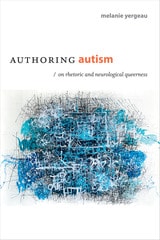
cover of Authoring Autism: On Rhetoric and Neurological Queerness

Authoring Autism

On Rhetoric and Neurological Queerness

M. Remi Yergeau

Duke University Press, 2018

In Authoring Autism M. Remi Yergeau defines neurodivergence as an identity—neuroqueerness—rather than an impairment. Using a queer theory framework, Yergeau notes the stereotypes that deny autistic people their humanity and the chance to define themselves while also challenging cognitive studies scholarship and its reification of the neurological passivity of autistics. They also critique early intensive behavioral interventions—which have much in common with gay conversion therapy—and questions the ableist privileging of intentionality and diplomacy in rhetorical traditions. Using storying as their method, they present an alternative view of autistic rhetoricity by foregrounding the cunning rhetorical abilities of autistics and by framing autism as a narrative condition wherein autistics are the best-equipped people to define their experience. Contending that autism represents a queer way of being that simultaneously embraces and rejects the rhetorical, Yergeau shows how autistic people queer the lines of rhetoric, humanity, and agency. In so doing, they demonstrate how an autistic rhetoric requires the reconceptualization of rhetoric’s very essence.
[more]
cover of Autobiography of My Hungers

Autobiography of My Hungers

Rigoberto González

University of Wisconsin Press, 2019

Rigoberto González, author of the critically acclaimed memoir Butterfly Boy: Memories of a Chicano Mariposa, takes a second piercing look at his past through a startling new lens: hunger.
            The need for sustenance originating in childhood poverty, the adolescent emotional need for solace and comfort, the adult desire for a larger world, another lover, a different body—all are explored by González in a series of heartbreaking and poetic vignettes.
            Each vignette is a defining moment of self-awareness, every moment an important step in a lifelong journey toward clarity, knowledge, and the nourishment that comes in various forms—even "the smallest biggest joys" help piece together a complex portrait of a gay man of color who at last defines himself by what he learns, not by what he yearns for.

Bill Whitehead Award for Lifetime Literary Achievement, Publishing Triangle

“Told in a series of revealing vignettes and poems, González’s Autobiography of my Hungers turns moments of need and want into revelations of truth and self-awareness, creating the portrait of an artist that is complex if not entirely complete.”—El Paso Times

“Through his provocative vignettes, González communicates a lifetime of struggle for affirmation and self-acceptance.”—Make/Shift 

[more]
cover of Autobiography of an Androgyne

Autobiography of an Androgyne

Ralph Werther and Edited by Scott Herring

Rutgers University Press, 2008

First printed in 1918, Ralph Werther's Autobiography of an Androgyne charts his emerging self-understanding as a member of the "third sex" and documents his explorations of queer underworlds in turn-of-the-century New York City. Werther presents a sensational life narrative that begins with a privileged upper-class birth and a youthful realization of his difference from other boys. He concludes with a decision to undergo castration. Along the way, he recounts intimate stories of adolescent sexual encounters with adult men and women, escapades as a reckless "fairie" who trolled Brooklyn and the Bowery in search of working-class Irish and Italian immigrants, and an immersion into the subculture of male "inverts." This new edition also includes a critical introduction by Scott Herring that situates the text within the scientific, historical, literary, and social contexts of urban American life in the late-nineteenth and early-twentieth centuries. Tracing how this pioneering autobiography engages with conversations on immigration, gender, economics, metropolitan working-class culture, and the invention of homosexuality across class lines, this edition is ideal for courses on topics ranging from Victorian literature to modern American sexuality.
[more]