Results by title
642 books match the query 'Linguistics' and 70 start with a

Annotated Bibliography of Southern American English
James B. McMillan
University of Alabama Press, 1989
The only book-length bibliography on the speech of the American South, this volume focuses on the pronunciation, vocabulary, grammar, naming practices, word play, and other aspects of language that have interested researchers and writers for two centuries. Compiled here are the works of linguists, historians, anthropologists, sociologists, and educators, as well as popular commentators.
With over 3,800 entries, this invaluable resource is a testament to the significance of Southern speech, long recognized as a distinguishing feature of the South, and the abiding interest of Southerners in their speech as a mark of their identity. The entries encompass Southern dialects in all their distinctive varieties—from Appalachian to African American, and sea islander to urbanite.
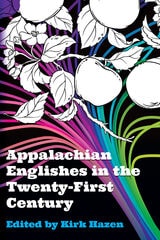
Appalachian Englishes in the Twenty-First Century
Kirk Hazen
West Virginia University Press, 2020
A portal to the language scholarship of the last thirty years, Appalachian Englishes in the Twenty-First Century translates state-of-the-art research for a nonspecialist audience, while setting the agenda for further study of language in one of America’s most recognized regions.
Approaching Second
Second Position Clitics and Related PhenomenaArnold Zwicky
CSLI, 1996
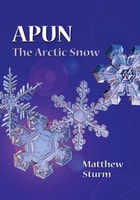
Apun
The Arctic SnowMatthew Sturm
University of Alaska Press, 2009
There are some twenty-five words for “snow” in the Inupiaq language. Each word denotes a different kind of snow—fresh powder snow, hard pack, soft snow, very wet snow, or just snow. Such fine distinction is reasonable, for over the centuries, Natives of the Arctic have had to rely on their knowledge of the snow to survive. Now Matthew Sturm has prepared an educational children’s book designed to teach a new generation of Arctic residents the importance of Arctic snow cover. Fully illustrated to demonstrate the cycle of the snow cover, Apun covers each phase of the “snow year.” Geared towards grades 3–4, this is a must read for elementary science classes.
Apun
The Arctic Snow (A Teacher's Guide)Matthew Sturm
University of Alaska Press, 2009
There are some twenty-five words for “snow” in the Inupiaq language. Each word denotes a different kind of snow—fresh powder snow, hard pack, soft snow, very wet snow, or just snow. Such fine distinction is reasonable, for over the centuries, Natives of the Arctic have had to rely on their knowledge of the snow to survive. Now Matthew Sturm has prepared an educational children’s book designed to teach a new generation of Arctic residents the importance of Arctic snow cover. Fully illustrated to demonstrate the cycle of the snow cover, Apun covers each phase of the “snow year.” Geared towards grades 3–4, this is a must read for elementary science classes.
Arabic Computational Linguistics
Edited by Ali Farghaly
CSLI, 2010
This comprehensive volume explores new Arabic machine translation systems, innovations in speech recognition and mention detection, tree banks, and linguistic corpora. Arabic Computational Linguistics will be an indispensable reference for language researchers and practitioners alike.
Architectures, Rules, and Preferences
Variations on Themes by Joan W. BresnanEdited by Annie Zaenen
CSLI, 2007
Arenas of Language Use
Herbert H. Clark
University of Chicago Press, 1993
According to Clark, in order for one person to understand another, there must be a "common ground" of knowledge between them. He shows how people infer this "common ground" from their past conversations, their immediate surroundings, and their shared cultural background. Clark also discusses the means by which speakers design their utterances for particular audiences and coordinate their use of language with other participants in a language arena. He argues that language use in conversation is a collaborative process, where speaker and listener work together to establish that the listener understands the speaker's meaning. Since people often use words to mean something quite different from the dictionary definitions of those words, Clark offers a realistic perspective on how speakers and listeners coordinate on the meanings of words.
This collection presents outstanding examples of Clark's pioneering work on the pragmatics of language use and it will interest psychologists, linguists, computer scientists, and philosophers.
Arguing with Tradition
The Language of Law in Hopi Tribal CourtJustin B. Richland
University of Chicago Press, 2008
Like many indigenous legal institutions across North America, the Hopi Tribal Court was created in the image of Anglo-American-style law. But Richland shows that in recent years, Hopi jurists and litigants have called for their courts to develop a jurisprudence that better reflects Hopi culture and traditions. Providing unprecedented insights into the Hopi and English courtroom interactions through which this conflict plays out, Richland argues that tensions between the language of Anglo-style law and Hopi tradition both drive Hopi jurisprudence and make it unique. Ultimately, Richland’s analyses of the language of Hopi law offer a fresh approach to the cultural politics that influence indigenous legal and governmental practices worldwide.
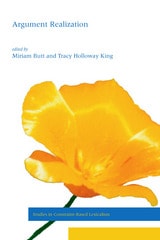
Argument Realization
Edited by Miriam Butt and Tracy Holloway King
CSLI, 2001
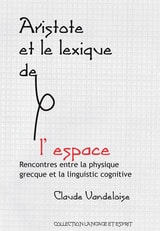
Aristote et le lexique de l'espace
Claude Vandeloise
CSLI, 2001
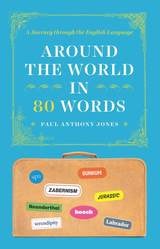
Around the World in 80 Words
A Journey through the English LanguagePaul Anthony Jones
University of Chicago Press, 2018
Surprising, entertaining, and illuminating, this is essential reading for armchair travelers and word nerds. Our dictionaries are full of hidden histories, tales, and adventures from all over the world—if you know where to look.
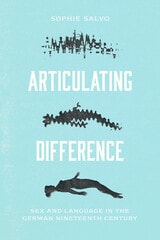
Articulating Difference
Sex and Language in the German Nineteenth CenturySophie Salvo
University of Chicago Press, 2024
Drawing on a wide range of texts, from understudied ethnographic and scientific works to canonical literature and philosophy, Sophie Salvo uncovers the prehistory of the inextricability of gender and language. Taking German discourses on language as her focus, she argues that we are not the inventors but, rather, the inheritors and adapters of the notion that gender and language are interrelated. Particularly during the long nineteenth century, ideas about sexual differences shaped how language was understood, classified, and analyzed. As Salvo explains, philosophers asserted the patriarchal origins of language, linguists investigated “women’s languages” and grammatical gender, and literary Modernists imagined “feminine” sign systems, and in doing so they not only deemed sex-based divisions to be necessary categories of language but also produced a plethora of gendered tropes and fictions, which they used both to support their claims and delimit their disciplines.
Articulating Difference charts new territory, revealing how gendered conceptions of language make possible the misogynistic logic of exclusion that underlies arguments claiming, for example, that women cannot be great orators or writers. While Salvo focuses on how male scholars aligned language study with masculinity, she also uncovers how women responded, highlighting the contributions of understudied nineteenth-century works on language that women wrote even as they were excluded from academic opportunities.
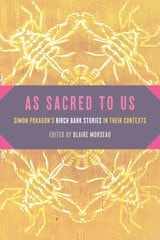
As Sacred to Us
Simon Pokagon’s Birch Bark Stories in Their ContextsBlaire Morseau
Michigan State University Press, 2023
Aspects of Article Introductions, Michigan Classics Ed.
John M. Swales
University of Michigan Press, 2011
Aspects of Article Introductions has bee reissued to make it more easily available than it has ever been, particularly for the use of university libraries and for younger and newer practitioners and researchers in the rapidly expanding and increasingly global field of EAP.
The original Aspects of Article Introductions appeared in fall 1981 as a ring-bound 90-page monograph. The “publisher” was the Language Studies Unit at the University of Aston in Birmingham. Although essentially an “underground” work, it has remained a relevant part of the short intellectual history of English for Academic Purposes, particularly as genre-based or genre-driven approaches to EAP research and pedagogical practice have become more popular. Its longevity is also a testament to the genre analysis work of John Swales, but in addition, the research article has become the most influential genre in most areas of scholarship, and introductions are at least supposed to be read first and to be designed in such a way as to attract as large readership as possible.
“If I were asked to list the most influential texts in applied linguistics over the last 30 years, John Swales' Aspects of Article Introductions would be in the top three or four. This was a seminal work which not only presented a novel way of analysing texts and a commentary on academic discourse, but one which helped to establish a foundation for the massive interest we see today in describing the structure and features of academic articles. This is not just a text which offers us a glimpse of an intellectual history, but it remains full of fascinating insights and observations about texts and the workings of academic discourse. While the ideas may have evolved and the genre it describes moved on, both the style of writing and the methodology it describes are as fresh and as revealing as anything written on the topic since.” ---Ken Hyland, Hong Kong University
Aspects of English Sentence Stress
By Susan F. Schmerling
University of Texas Press, 1976
Aspects of English Sentence Stress is written within the conceptual framework of generative-transformational grammar. However, it is atheoretical in the sense that the proposals made cannot be formulated in this theory and are a challenge to many other theories. The author's concern is not with the phonetic nature of stress; rather, using a working definition of stress as subjective impression of prominence, she attempts to formulate general principles that will predict the relative prominence of different words in particular utterances—what might be called the syntax of stress. She supports her arguments with a large amount of original data and provides the basis for new ways of thinking about this area of linguistic research.
Schmerling begins with a detailed review and critique of Noam Chomsky and Morris Halle's approach to sentence stress; she shows that their cyclic analysis cannot be considered valid, even for quite simple phrases and sentences. Next, she reviews discussions of sentence stress by Joan Bresnan, George Lakoff, and Dwight Bolinger, agreeing with Bolinger's contention that there is no intimate connection between sentence stress and syntactic structure but showing that his counterproposal to the standard approach is inadequate as well. She also examines the concept of "normal stress" and demonstrates that no linguistically significant distinction can be drawn between "normal" and "special" stress contours.
In generating her own proposals concerning sentence stress, Schmerling takes the view that certain items which are stressable are taken for granted by the speaker and are eliminated from consideration by the principles governing relative prominence of words in a sentence. Then she examines the pragmatic and phonological principles pertaining to items that are not eliminated from consideration. Finally, the author contends that the standard views, which she shows to be untenable, are a result of the assumption that linguistic entities should be studied apart from questions concerning their use, in that it was adoption of this methodological assumption that forced linguists to deny the essentially pragmatic nature of sentence stress.
Accessible to anyone who is familiar with the basic concepts of generative-transformational grammar, Aspects of English Sentence Stress presents provocative ideas in the field.
Aspects of the Tonal System of Kalabari-ljo
Otelemate G. Harry
CSLI, 2004
This study determines that right-to-left association is the best method of analysis for Kalabari-ljo and also proposes that both morphosyntactic and semantic input be included in the tone system rules. Harry's innovative work provides new evidence for the morphological and semantic input in phonology theory and launches a new platform for scholarship in African language studies.
Attitudes De Se
Linguistics, Epistemology, MetaphysicsEdited by Neil Feit and Alessandro Capone
CSLI, 2013
Attribute-Value Logic and the Theory of Grammar
Mark Johnson
CSLI, 1988
Automaton Theories of Human Sentence Comprehension
John T. Hale
CSLI, 2014