923 books match the query 'Urban' and 58 start with a
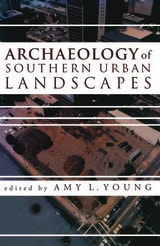
cover of Archaeology of Southern Urban Landscapes

Archaeology of Southern Urban Landscapes

Amy L Young

University of Alabama Press, 2000

Groundbreaking essays in urban archaeology highlight the impact of towns and cities on the southern landscape.

The rapid growth and development of urban areas in the South have resulted in an increase in the number of urban archaeology projects required by federal and state agencies. These projects provide opportunities not only to investigate marginal areas between the town and countryside but also to recover information long buried beneath the earliest urban structures. Such projects have also created a need for a one-volume update on archaeology as it is practiced in the urban areas of the southeastern United States.

Archaeology of Southern Urban Landscapes will assist practitioners and scholars in the burgeoning fields of urban and landscape archaeology by treating the South as a distinctive social, geographic, and material entity and by focusing on the urban South rather than the stereotypical South of rural plantations. The case studies in this volume span the entire southeastern United States, from Annapolis to New Orleans and from colonial times to the 19th century. The authors address questions involving the function of cities, interregional diversity, the evolution of the urban landscape, and the impact of the urban landscape on southern culture. By identifying the relationship between southern culture and the South's urban landscapes, this book will help us understand the built landscape of the past and predict future growth in the region.
 

[more]
cover of Architecture and the Urban in Spanish Film

Architecture and the Urban in Spanish Film

Edited by Susan Larson

Intellect Books, 2021

The first edited collection in English on urban space and architecture in Spanish film from 1896 to the present.

Building on existing film and urban histories, this collection examines Spanish film through contemporary interdisciplinary theories of urban space, the built environment, visuality, and mass culture from the industrial age to the digital present.

Architecture and the Urban in Spanish Film brings together innovative scholarship from an international and interdisciplinary group of film, architecture, and urban studies scholars as they explore the reciprocal relationship between the seventh art and the built environment. The contributors explore a wide range of topics, including the role of film in the shifting relationship between private and public; the ways cinema as a new technology reshaped how cities and buildings are built and inhabited; the question of the mobile gaze; film and everyday life; monumentality and the construction of historical memory for a variety of viewing publics; and the effects of the digital and the virtual on filmmaking and spectatorship.

This engaging collection will interest anyone researching, teaching, and studying Spanish film, international film studies, urban, and cultural studies.
[more]
cover of Are We There Yet?: The Myths and Realities of Autonomous Vehicles

Are We There Yet?

The Myths and Realities of Autonomous Vehicles

Edited by Michael A. Pagano

University of Illinois Press, 2020

Autonomous vehicle (AV) technology represents a possible paradigm shift in our way of life. But complex challenges and obstacles impose a reality at odds with the utopian visions propounded by AV enthusiasts in the private and public sectors.
 
The new volume in the Urban Agenda series examines the technological questions still surrounding autonomous vehicles and the uncertain societal and legislative impact of widespread AV adoption. Assessing both short- and long-term concerns, the authors probe how autonomous vehicles might change transportation but also land use, energy consumption, mass transit, commuter habits, traffic safety, job markets, the freight industry, and supply chains. At the same time, the essays discuss opportunities for industry, researchers, and policymakers to make the autonomous future safer, more efficient, and more mobile.
 
Contributors: Austin Brown, Stan Caldwell, Chris Hendrickson, Kazuya Kawamura, Taylor Long, and P. S. Srira.
[more]
cover of Atlanta Paradox

Atlanta Paradox

David L. Sjoquist

Russell Sage Foundation, 2000
Despite the rapid creation of jobs in the greater Atlanta region, poverty in the city itself remains surprisingly high, and Atlanta's economic boom has yet to play a significant role in narrowing the gap between the suburban rich and the city poor. This book investigates the key factors underlying this paradox. The authors show that the legacy of past residential segregation as well as the more recent phenomenon of urban sprawl both work against inner city blacks. Many remain concentrated near traditional black neighborhoods south of the city center and face prohibitive commuting distances now that jobs have migrated to outlying northern suburbs. The book also presents some promising signs. Few whites still hold overt negative stereotypes of blacks, and both whites and blacks would prefer to live in more integrated neighborhoods. The emergence of a dynamic, black middle class and the success of many black-owned businesses in the area also give the authors reason to hope that racial inequality will not remain entrenched in a city where so much else has changed. A Volume in the Multi-City Study of Urban Inequality
[more]
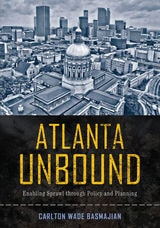
cover of Atlanta Unbound: Enabling Sprawl through Policy and Planning

Atlanta Unbound

Enabling Sprawl through Policy and Planning

Carlton Wade Basmajian

Temple University Press, 2015
Looking at Atlanta, Georgia, one might conclude that the city’s notorious sprawl, degraded air quality, and tenuous water supply is a result of a lack of planning—particularly an absence of coordination at the regional level. In Atlanta Unbound, Carlton Wade Basmajian shows that Atlanta’s low-density urban form and its associated problems have been both highly coordinated and regionally planned.
 
Basmajian’s shrewd analysis shows how regional policies spanned political boundaries and   framed local debates over several decades. He examines the role of the Atlanta Regional Commission’s planning deliberations that appear to have contributed to the urban sprawl that they were designed to control. Basmajian explores four cases—regional land development plans, water supply strategies, growth management policies, and transportation infrastructure programs—to provide a detailed account of the interactions between citizens, planners, regional commissions, state government, and federal agencies.
 
In the process, Atlanta Unbound answers the question: Toward what end and for whom is Atlanta’s regional planning process working?
 
In the series Urban Life, Landscape, and Policy, edited by Zane L. Miller, David Stradling, and Larry Bennett
[more]
cover of Atlanta: Race, Class And Urban Expansion

Atlanta

Race, Class And Urban Expansion

Larry Keating

Temple University Press, 2001

Atlanta, the epitome of the New South, is a city whose economic growth has transformed it from a provincial capital to a global city, one that could bid for and win the 1996 Summer Olympics. Yet the reality is that the exceptional growth of the region over the last twenty years has exacerbated inequality, particularly for African Americans. Atlanta, the city of Martin Luther King, Jr., remains one of the most segregated cities  in the United States.

Despite African American success in winning the mayor's office and control of the City Council, development plans have remained in the control of private business interests. Keating  tells  a number of  troubling stories. The development of the Underground Atlanta, the construction of the rapid rail system (MARTA), the building of a new stadium for the Braves, the redevelopment of public housing, and the arrangements for the Olympic Games all share a lack of democratic process. Business and political elites ignored protests from neighborhood groups, the interests of the poor, and the advice of planners.
[more]
cover of Atmospheric Noise: The Indefinite Urbanism of Los Angeles

Atmospheric Noise

The Indefinite Urbanism of Los Angeles

Marina Peterson

Duke University Press, 2021
In Atmospheric Noise, Marina Peterson traces entanglements of environmental noise, atmosphere, sense, and matter that cohere in and through encounters with airport noise since the 1960s. Exploring spaces shaped by noise around Los Angeles International Airport (LAX), she shows how noise is a way of attuning toward the atmospheric: through noise we learn to listen to the sky and imagine the permeability of bodies and matter, sensing and conceiving that which is diffuse, indefinite, vague, and unformed. In her account, the “atmospheric” encompasses the physicality of the ephemeral, dynamic assemblages of matter as well as a logic of indeterminacy. It is audible as well as visible, heard as much as breathed. Peterson develops a theory of “indefinite urbanism” to refer to marginalized spaces of the city where concrete meets sky, windows resonate with the whine of departing planes, and endangered butterflies live under flight paths. Offering a conceptualization of sound as immanent and non-objectified, she demonstrates ways in which noise is central to how we know, feel, and think atmospherically.
[more]
cover of addicted.pregnant.poor

addicted.pregnant.poor

Kelly Ray Knight

Duke University Press, 2015

For the addicted, pregnant, and poor women living in daily-rent hotels in San Francisco's Mission district, life is marked by battles against drug cravings, housing debt, and potential violence. In this stunning ethnography Kelly Ray Knight presents these women in all their complex humanity and asks what kinds of futures are possible for them given their seemingly hopeless situation. During her four years of fieldwork Knight documented women’s struggles as they traveled from the street to the clinic, jail, and family court, and back to the hotels. She approaches addicted pregnancy as an everyday phenomenon in these women's lives and describes how they must navigate the tension between pregnancy's demands to stay clean and the pull of addiction and poverty toward drug use and sex work. By creating the space for addicted women's own narratives and examining addicted pregnancy from medical, policy, and social science perspectives, Knight forces us to confront and reconsider the ways we think about addiction, trauma, health, criminality, and responsibility. 
 
[more]