Results by title
1048 books match the query 'African American & Black' and 105 start with a

As iZ
Tyrone Williams
Omnidawn, 2018
As iZ is a tripartite lyric (Pharmacy, To Market and Library), a multi-prong investigation into the relationship between the West and East, the entangled networks among Judaism, Christianity, and Islam, and the dynamics among Islamic practices and pre-Islamic cultures. It is, in this sense, a meditation on the vacillation between between-ness and among-ness, the two and the many, and the desire to escape both two-ness and many-ness into the singularity of one on the way to extinction, the bone at zero.
[more]
At Home in Diaspora
Black International WritingWendy Walters
University of Minnesota Press, 2005
Although he never lived in Harlem, Chester Himes commented that he experienced “a sort of pure homesickness” while creating the Harlem-set detective novels from his self-imposed exile in Paris. Through writing, Himes constructed an imaginary home informed both by nostalgia for a community he never knew and a critique of the racism he left behind in the United States. Half a century later, Michelle Cliff wrote about her native Jamaica from the United States, articulating a positive Caribbean feminism that at the same time acknowledged Jamaica’s homophobia and color prejudice.
In At Home in Diaspora, Wendy Walters investigates the work of Himes, Cliff, and three other twentieth-century black international writers—Caryl Phillips, Simon Njami, and Richard Wright—who have lived in and written from countries they do not call home. Unlike other authors in exile, those of the African diaspora are doubly displaced, first by the discrimination they faced at home and again by their life abroad. Throughout, Walters suggests that in the absence of a recoverable land of origin, the idea of diaspora comes to represent a home that is not singular or exclusionary. In this way, writing in exile is much more than a literary performance; it is a profound political act.
Wendy W. Walters is assistant professor of literature at Emerson College.
[more]
Audre Lorde’s Transnational Legacies
Stella Bolaki
University of Massachusetts Press, 2015
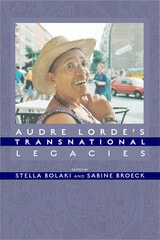
Among the most influential and insightful thinkers of her generation, Audre Lorde (1934–1992) inspired readers and activists through her poetry, autobiography, essays, and her political action. Most scholars have situated her work within the context of the women's, gay and lesbian, and black civil rights movements within the United States. However, Lorde forged coalitions with women in Europe, the Caribbean, Canada, Australia, New Zealand, and Africa, and twenty years after her passing, these alliances remain largely undocumented and unexplored.
Audre Lorde's Transnational Legacies is the first book to systematically document and thoroughly investigate Lorde's influence beyond the United States. Arranged in three thematically interrelated sections—Archives, Connections, and Work—the volume brings together scholarly essays, interviews, Lorde's unpublished speech about Europe, and personal reflections and testimonials from key figures throughout the world. Using a range of interdisciplinary approaches, contributors assess the reception, translation, and circulation of Lorde's writing and activism within different communities, audiences, and circles. They also shed new light on the work Lorde inspired across disciplinary borders.
In addition the volume editors, contributors include Sarah Cefai, Cassandra Ellerbe-Dueck, Paul M. Farber, Tiffany N. Florvil, Katharina Gerund, Alexis Pauline Gumbs, Gloria Joseph, Jackie Kay, Marion Kraft, Christiana Lambrinidis, Zeedah Meierhofer-Mangeli, Rina Nissim, Chantal Oakes, Lester C. Olson, Pratibha Parmar, Peggy Piesche, Dagmar Schultz, Tamara Lea Spira, and Gloria Wekker.
[more]
Authentic Blackness
The Folk in the New Negro RenaissanceJ. Martin Favor
Duke University Press, 1999
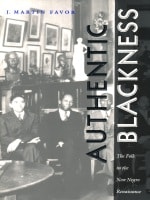
What constitutes “blackness” in American culture? And who gets to define whether or not someone is truly African American? Is a struggling hip-hop artist more “authentic” than a conservative Supreme Court justice? In Authentic Blackness J. Martin Favor looks to the New Negro Movement—also known as the Harlem Renaissance—to explore early challenges to the idea that race is a static category.
Authentic Blackness looks at the place of the “folk”—those African Americans “furthest down,” in the words of Alain Locke—and how the representation of the folk and the black middle class both spurred the New Negro Movement and became one of its most serious points of contention. Drawing on vernacular theories of African American literature from such figures as Henry Louis Gates Jr. and Houston Baker as well as theorists Judith Butler and Stuart Hall, Favor looks closely at the work of four Harlem Renaissance fiction writers: James Weldon Johnson, Nella Larsen, George Schuyler, and Jean Toomer. Arguing that each of these writers had, at best, an ambiguous relationship to African American folk culture, Favor demonstrates how they each sought to redress the notion of a fixed black identity. Authentic Blackness illustrates how “race” has functioned as a type of performative discourse, a subjectivity that simultaneously builds and conceals its connections with such factors as class, gender, sexuality, and geography.
Authentic Blackness looks at the place of the “folk”—those African Americans “furthest down,” in the words of Alain Locke—and how the representation of the folk and the black middle class both spurred the New Negro Movement and became one of its most serious points of contention. Drawing on vernacular theories of African American literature from such figures as Henry Louis Gates Jr. and Houston Baker as well as theorists Judith Butler and Stuart Hall, Favor looks closely at the work of four Harlem Renaissance fiction writers: James Weldon Johnson, Nella Larsen, George Schuyler, and Jean Toomer. Arguing that each of these writers had, at best, an ambiguous relationship to African American folk culture, Favor demonstrates how they each sought to redress the notion of a fixed black identity. Authentic Blackness illustrates how “race” has functioned as a type of performative discourse, a subjectivity that simultaneously builds and conceals its connections with such factors as class, gender, sexuality, and geography.
[more]

Autogeography
PoemsReginald Harris
Northwestern University Press, 2013
Winner of the Cave Canem Northwestern University Press Poetry Prize
In his second collection of poetry, Reginald Harris traverses real and imagined landscapes, searching for answers to the question “What are you?” From Baltimore to Havana, Atlantic City to Alabama—and from the broad memories of childhood to the very specific moment of Marvin Gaye singing at the 1983 NBA All-Star Game shortly before his death—this is a travel diary of internal and external journeys exploring issues of race and sexuality. The poet traveler falls into and out of love and lust, sometimes coupled, sometimes alone. Autogeography tracks how who you are changes depending on where you are; how where you are and where you’ve been determine who you are and where you might be headed.
In his second collection of poetry, Reginald Harris traverses real and imagined landscapes, searching for answers to the question “What are you?” From Baltimore to Havana, Atlantic City to Alabama—and from the broad memories of childhood to the very specific moment of Marvin Gaye singing at the 1983 NBA All-Star Game shortly before his death—this is a travel diary of internal and external journeys exploring issues of race and sexuality. The poet traveler falls into and out of love and lust, sometimes coupled, sometimes alone. Autogeography tracks how who you are changes depending on where you are; how where you are and where you’ve been determine who you are and where you might be headed.
[more]