Results by title
3071 books match the query 'Business & Economics' and 183 start with a
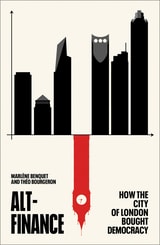
Alt-Finance
How the City of London Bought DemocracyMarlène Benquet
Pluto Press, 2022
Powerful financial forces have supported the neoliberal project since the 1980s to advance their interests, but there are now signs that these forces have a new face and a new strategy.
The majority of the British finance sector threw its support behind Britain leaving the European Union, a flagship institution of neoliberalism. Beyond this counterintuitive move, what was really happening and why? Alt-Finance examines a new authoritarian turn in financialised democracies, focusing on the City of London, revealing a dangerous alternative political project in the making.
In a clash with traditional finance, the new behemoths of financial capital - hedge funds, private equity firms, and real estate funds - have started to cohere around a set of political beliefs, promoting libertarian, authoritarian, climate-denying, and Eurosceptic views. Protecting investments, suppressing social dissent, and reducing state interference is at the core of their mission for a new world order.
By following the money, the authors provide indisputable evidence of these worrying developments. Through a clear analysis of the international dealings of this new authoritarian-libertarian regime, not just in Britain but in the US and Brazil, we can understand how our world is being shaped against our will by struggles between dominant groups.

Alternative Dispute Resolution in the Regulatory Process
Deirdre McCarthy Gallagher
Michigan State University Press, 2020
Altruism, Morality, and Economic Theory
Edmund S. Phelps
Russell Sage Foundation, 1975

Altruistically Inclined?
The Behavioral Sciences, Evolutionary Theory, and the Origins of ReciprocityAlexander J. Field
University of Michigan Press, 2004
Altruistically Inclined? examines the implications of recent research in the natural sciences for two important social scientific approaches to individual behavior: the economic/rational choice approach and the sociological/anthropological. It considers jointly two controversial and related ideas: the operation of group selection within early human evolutionary processes and the likelihood of modularity—domain-specific adaptations in our cognitive mechanisms and behavioral predispositions.
Experimental research shows that people will often cooperate in one-shot prisoner's dilemma (PD) games and reject positive offers in ultimatum games, contradicting commonly accepted notions of rationality. Upon first appearance, predispositions to behave in this fashion could not have been favored by natural selection operating only at the level of the individual organism.
Emphasizing universal and variable features of human culture, developing research on how the brain functions, and refinements of thinking about levels of selection in evolutionary processes, Alexander J. Field argues that humans are born with the rudiments of a PD solution module—and differentially prepared to learn norms supportive of it. His emphasis on failure to harm, as opposed to the provision of affirmative assistance, as the empirically dominant form of altruistic behavior is also novel.
The point of departure and principal point of reference is economics. But Altruistically Inclined? will interest a broad range of scholars in the social and behavioral sciences, natural scientists concerned with the implications of research and debates within their fields for the conduct of work elsewhere, and educated lay readers curious about essential features of human nature.

Amazonia at the Crossroads
The Challenge of Sustainable DevelopmentEdited by Anthony Hall
University of London Press, 2000
The challenge at this critical juncture is how to integrate such policies and practices into mainstream development within Amazonia. Contributors: David Cleary, Rene Dreifuss, Philip Fearnside, Jessica Groenendijk, Anthony Hall, Judith Kimerling, Tom Lovejoy, Dennis Mahar, David McGrath, Emilio Moran, Darrel Posey, Nigel Smith, and Wouter Veening.

Amber Waves
The Extraordinary Biography of Wheat, from Wild Grass to World MegacropCatherine Zabinski
University of Chicago Press, 2020
At breakfast tables and bakeries, we take for granted a grain that has made human civilization possible, a cereal whose humble origins belie its world-shaping power: wheat. Amber Waves tells the story of a group of grass species that first grew in scattered stands in the foothills of the Middle East until our ancestors discovered their value as a source of food. Over thousands of years, we moved their seeds to all but the polar regions of Earth, slowly cultivating what we now know as wheat, and in the process creating a world of cuisines that uses wheat seeds as a staple food. Wheat spread across the globe, but as ecologist Catherine Zabinski shows us, a biography of wheat is not only the story of how plants ensure their own success: from the earliest bread to the most mouthwatering pasta, it is also a story of human ingenuity in producing enough food for ourselves and our communities.
Since the first harvest of the ancient grain, we have perfected our farming systems to grow massive quantities of food, producing one of our species’ global mega crops—but at a great cost to ecological systems. And despite our vast capacity to grow food, we face problems with undernourishment both close to home and around the world. Weaving together history, evolution, and ecology, Zabinski’s tale explores much more than the wild roots and rise of a now-ubiquitous grain: it illuminates our complex relationship with our crops, both how we have transformed the plant species we use as food, and how our society—our culture—has changed in response to the need to secure food sources. From the origins of agriculture to gluten sensitivities, from our first selection of the largest seeds from wheat’s wild progenitors to the sequencing of the wheat genome and genetic engineering, Amber Waves sheds new light on how we grow the food that sustains so much human life.
Ambition and Adjustment
The Making and Unmaking of Postcolonial Development in AfricaPriya Lal
University of Chicago Press, 2026
How the best intentions of African socialism became the useful tools of capitalism.
In the mid-twentieth century, skilled labor was seen as the key to national development. For newly independent African countries, this posed a formidable challenge: to build thriving economies, they needed to rapidly educate workers. As it turns out, that wasn’t their only obstacle.
Ambition and Adjustment reveals how responses to this human capital problem from the political left and right converged in unlikely ways to block Africa’s postcolonial progress. Focusing on nation-building projects in Zambia and Tanzania, Priya Lal recounts how the first generations of Africa’s professional class faced pressures on all sides—from foreign planners prioritizing economic growth and from local socialists decrying higher education and professionalization as wasteful and elitist. When African development stalled, international institutions like the World Bank took up parts of both approaches, justifying structural adjustment programs that defunded African universities and hospitals in the name of social equity. Indeed, Lal shows that neoliberal austerity in the 1990s was packaged in Africa’s socialist narratives from the 1960s.
By unearthing this forgotten history, Ambition and Adjustment upends traditional accounts of postcolonial development, exposing how socialism and capitalism both conflicted and overlapped to shape Africa’s trajectory since independence.
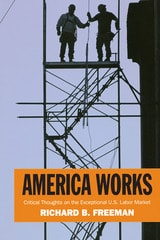
America Works
Thoughts on an Exceptional U.S. Labor MarketRichard B. Freeman
Russell Sage Foundation, 2007
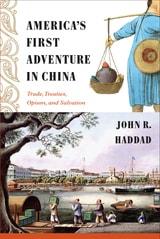
America's First Adventure in China
Trade, Treaties, Opium, and SalvationJohn R Haddad
Temple University Press, 2014
In America's First Adventure in China, John Haddad provides a colorful history of the evolving cultural exchange and interactions between these countries. He recounts how American expatriates adopted a pragmatic attitude-as well as an entrepreneurial spirit and improvisational approach-to their dealings with the Chinese. Haddad shows how opium played a potent role in the dreams of Americans who either smuggled it or opposed its importation, and he considers the missionary movement that compelled individuals to accept a hard life in an alien culture.
As a result of their efforts, Americans achieved a favorable outcome—they established a unique presence in China—and cultivated a relationship whose complexities continue to grow.

America's Healthcare Transformation
Strategies and InnovationsPhillips, Robert A.
Rutgers University Press, 2016
America's Spiritual Capital
Nicholas N. Capaldi
St. Augustine's Press, 2012

American Agriculture, Water Resources, and Climate Change
Edited by Gary D. Libecap and Ariel Dinar
University of Chicago Press, 2024
A collection of the most advanced and authoritative agricultural-economic research in the face of increasing water scarcity.
Agriculture has been critical in the development of the American economy. Except in parts of the western United States, water access has not been a critical constraint on agricultural productivity, but with climate change, this may no longer be the case. This volume highlights new research on the interconnections between American agriculture, water resources, and climate change. It examines climatic and geologic factors that affect the agricultural sector and highlights historical and contemporary farmer responses to varying conditions and water availability. It identifies the potential effects of climate change on water supplies, access, agricultural practices, and profitability, and analyzes technological, agronomic, management, and institutional adjustments. Adaptations such as new crops, production practices, irrigation technologies, water conveyance infrastructure, fertilizer application, and increased use of groundwater can generate both social benefits and social costs, which may be internalized with various institutional innovations. Drawing on both historical and present experiences, this volume provides valuable insights into the economics of water supply in American agriculture as climate change unfolds.

American Cinema of the 2010s
Themes and VariationsDennis Bingham
Rutgers University Press, 2022
The newest installment in the Screen Decades series, American Cinema in the 2010s takes a close look at the memorable movies, visionary filmmakers, and behind-the-scenes drama that made this decade such an exciting time to be a moviegoer. Each chapter offers an in-depth examination of a specific year, covering a wide variety of films, from blockbuster superhero movies like Black Panther and animated films like Frozen to smaller-budget biopics like I, Tonya and horror films like Hereditary. This volume introduces readers to a decade in which established auteurs like Quentin Tarantino were joined by an exceptionally diverse set of new talents, taking American cinema in new directions.
American Economic Growth and Standards of Living before the Civil War
Edited by Robert E. Gallman and John Joseph Wallis
University of Chicago Press, 1992
Despite the dramatic economic growth and rise in income levels, questions remain as to the general quality of life during this era. Was the improvement in income widely shared? How did economic growth affect the nature of work? Did higher levels of income lead to improved health and longevity? The authors address these questions by analyzing new estimates of labor force participation, real wages, and productivity, as well as of the distribution of income, height, and nutrition.
American Economic Policy in the 1980s
Edited by Martin Feldstein
University of Chicago Press, 1994
In his introduction, Martin Feldstein provides compelling analysis of policies with which he was closely involved as chairman of the Council of Economic Advisers during the Reagan administration: monetary and exchange rate policy, tax policy, and budget issues. Other leading economists and policymakers examine a variety of domestic and international issues, including monetary and exchange rate policy, regulation and antitrust, as well as trade, tax, and budget policies.
The contributors to this volume are Alberto Alesina, Phillip Areeda, Elizabeth Bailey, William F. Baxter, C. Fred Bergsten, James Burnley, Geoffrey Carliner, Christopher DeMuth, Douglas W. Elmendorf, Thomas O. Enders, Martin Feldstein, Jeffrey A. Frankel, Don Fullerton, William M. Isaac, Paul L Joskow, Paul Krugman, Robert E. Litan, Russell B. Long, Michael Mussa, William A. Niskanen, Roger G. Noll, Lionel H. Olmer, Rudolph Penner, William Poole, James M. Poterba, Harry M. Reasoner, William R. Rhodes, J. David Richardson, Charles Schultze, Paula Stern, David Stockman, William Taylor, James Tobin, W. Kip Viscusi, Paul A. Volcker, Charles E. Walker, David A. Wise, and Richard G. Woodbury.
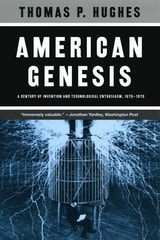
American Genesis
A Century of Invention and Technological Enthusiasm, 1870-1970Thomas P. Hughes
University of Chicago Press, 2004
A sweeping history of the inventors, inventions, and innovations that together created modern America.
A stunning, wide-ranging history from one of the foremost historians of technology of our age American Genesis tells the sweeping story of the technological revolution that made modern America. Unlike other histories of technology, which focus on particular inventions like the light bulb or the automobile, American Genesis makes these inventions characters in a broad chronicle, both shaped by and shaping a culture. By weaving scientific and technological advancement into other cultural trends, and bringing in fascinating characters like Edison, Ford, and Frederick Taylor, Hughes demonstrates here the myriad ways in which the two are inexorably linked, and in a new preface, he recounts his earlier missteps in predicting the future of technology and follows its move into the information age.
American Genesis
A Century of Invention and Technological Enthusiasm, 1870-1970Thomas P. Hughes
University of Chicago Press, 2004
*PULITZER PRIZE FINALIST*
A sweeping history of the inventors, inventions, and innovations that together created modern America.
A stunning, wide-ranging history from one of the foremost historians of technology of our age American Genesis tells the sweeping story of the technological revolution that made modern America. Unlike other histories of technology, which focus on particular inventions like the light bulb or the automobile, American Genesis makes these inventions characters in a broad chronicle, both shaped by and shaping a culture. By weaving scientific and technological advancement into other cultural trends, and bringing in fascinating characters like Edison, Ford, and Frederick Taylor, Hughes demonstrates here the myriad ways in which the two are inexorably linked, and in a new preface, he recounts his earlier missteps in predicting the future of technology and follows its move into the information age.
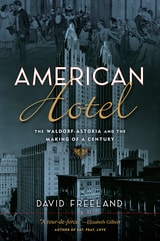
American Hotel
The Waldorf-Astoria and the Making of a CenturyDavid Freeland
Rutgers University Press, 2021
American Hotel takes us behind the glittering image to reveal the full extent of the Waldorf’s contribution toward shaping twentieth-century life and culture. Historian David Freeland examines the Waldorf from the opening of its first location in 1893 through its rise to a place of influence on the local, national, and international stage. Along the way, he explores how the hotel’s mission to provide hospitality to a diverse range of guests was put to the test by events such as Prohibition, the anticommunist Red Scare, and civil rights struggles.
Alongside famous guests like Frank Sinatra, Martin Luther King, Richard Nixon, and Eleanor Roosevelt, readers will meet the lesser-known men and women who made the Waldorf a leader in the hotel industry and a key setting for international events. American Hotel chronicles how institutions such as the Waldorf-Astoria played an essential role in New York’s growth as a world capital.

American Idle
Late-Career Job Loss in a Neoliberal EraAnnette Nierobisz
Rutgers University Press, 2025
American Journal of Health Economics, volume 10 number 1 (Winter 2024)
The University of Chicago Press
University of Chicago Press Journals, 2024
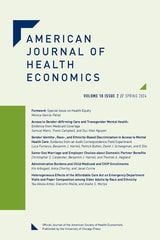
American Journal of Health Economics, volume 10 number 2 (Spring 2024)
The University of Chicago Press
University of Chicago Press Journals, 2024
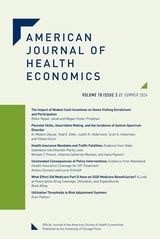
American Journal of Health Economics, volume 10 number 3 (Summer 2024)
The University of Chicago Press
University of Chicago Press Journals, 2024
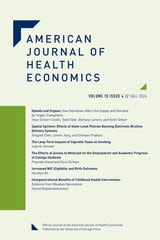
American Journal of Health Economics, volume 10 number 4 (Fall 2024)
The University of Chicago Press
University of Chicago Press Journals, 2024
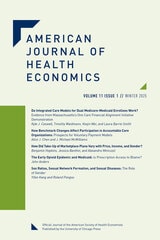
American Journal of Health Economics, volume 11 number 1 (Winter 2025)
The University of Chicago Press
University of Chicago Press Journals, 2025
American Journal of Health Economics, volume 11 number 2 (Spring 2025)
The University of Chicago Press
University of Chicago Press Journals, 2025
American Journal of Health Economics, volume 11 number 3 (Summer 2025)
The University of Chicago Press
University of Chicago Press Journals, 2025
American Journal of Health Economics, volume 11 number 4 (Fall 2025)
The University of Chicago Press
University of Chicago Press Journals, 2025
American Journal of Health Economics, volume 12 number 1 (Winter 2026)
The University of Chicago Press
University of Chicago Press Journals, 2026
American Journal of Health Economics, volume 12 number 2 (Spring 2026)
The University of Chicago Press
University of Chicago Press Journals, 2026
American Journal of Health Economics, volume 12 number 3 (Summer 2026)
The University of Chicago Press
University of Chicago Press Journals, 2026
American Journal of Health Economics, volume 12 number 4 (Fall 2026)
The University of Chicago Press
University of Chicago Press Journals, 2026

American Journal of Health Economics, volume 8 number 3 (Summer 2022)
The University of Chicago Press
University of Chicago Press Journals, 2022
American Journal of Health Economics, volume 8 number 4 (Fall 2022)
The University of Chicago Press
University of Chicago Press Journals, 2022
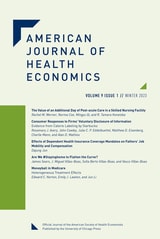
American Journal of Health Economics, volume 9 number 1 (Winter 2023)
The University of Chicago Press
University of Chicago Press Journals, 2023
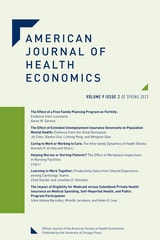
American Journal of Health Economics, volume 9 number 2 (Spring 2023)
The University of Chicago Press
University of Chicago Press Journals, 2023
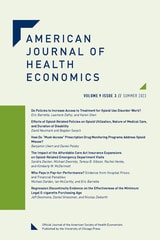
American Journal of Health Economics, volume 9 number 3 (Summer 2023)
The University of Chicago Press
University of Chicago Press Journals, 2023
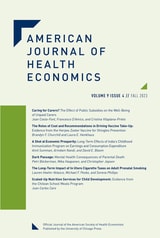
American Journal of Health Economics, volume 9 number 4 (Fall 2023)
The University of Chicago Press
University of Chicago Press Journals, 2023

American Taxation, American Slavery
Robin L. Einhorn
University of Chicago Press, 2006
For all the recent attention to the slaveholding of the founding fathers, we still know remarkably little about the influence of slavery on American politics. American Taxation, American Slavery tackles this problem in a new way. Rather than parsing the ideological pronouncements of charismatic slaveholders, it examines the concrete policy decisions that slaveholders and non-slaveholders made in the critical realm of taxation. The result is surprising—that the enduring power of antigovernment rhetoric in the United States stems from the nation’s history of slavery rather than its history of liberty.
We are all familiar with the states’ rights arguments of proslavery politicians who wanted to keep the federal government weak and decentralized. But here Robin Einhorn shows the deep, broad, and continuous influence of slavery on this idea in American politics. From the earliest colonial times right up to the Civil War, slaveholding elites feared strong democratic government as a threat to the institution of slavery. American Taxation, American Slavery shows how their heated battles over taxation, the power to tax, and the distribution of tax burdens were rooted not in debates over personal liberty but rather in the rights of slaveholders to hold human beings as property. Along the way, Einhorn exposes the antidemocratic origins of the popular Jeffersonian rhetoric about weak government by showing that governments were actually more democratic—and stronger—where most people were free.
A strikingly original look at the role of slavery in the making of the United States, American Taxation, American Slavery will prove essential to anyone interested in the history of American government and politics.
American Unemployment
Past, Present, and FutureFrank Stricker
University of Illinois Press, 2020
- Workers do not normally choose to be unemployed.
- In our current system, persistent unemployment is not an aberration. It is much more common than full employment, and the outcome of elite policy choices.
- Labor surpluses propped up by flawed unemployment numbers have helped to keep real wages stagnant for more than forty years.
- Prior to the New Deal and the era of big government, laissez-faire policies repeatedly led to depressions with heavy, even catastrophic, job losses.
- Undercounting the unemployed sabotages the creation of government job programs that can lead to more high-paying jobs and full employment.

American Universities in a Global Market
Edited by Charles T. Clotfelter
University of Chicago Press, 2010
America’s Romance with the English Garden
Thomas J. Mickey
Ohio University Press, 2013
Named one of “the year’s best gardening books” by The Spectator (UK, Nov. 2014)
The 1890s saw a revolution in advertising. Cheap paper, faster printing, rural mail delivery, railroad shipping, and chromolithography combined to pave the way for the first modern, mass-produced catalogs. The most prominent of these, reaching American households by the thousands, were seed and nursery catalogs with beautiful pictures of middle-class homes surrounded by sprawling lawns, exotic plants, and the latest garden accessories—in other words, the quintessential English-style garden.
America’s Romance with the English Garden is the story of tastemakers and homemakers, of savvy businessmen and a growing American middle class eager to buy their products. It’s also the story of the beginnings of the modern garden industry, which seduced the masses with its images and fixed the English garden in the mind of the American consumer. Seed and nursery catalogs delivered aspirational images to front doorsteps from California to Maine, and the English garden became the look of America.
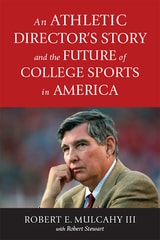
An Athletic Director’s Story and the Future of College Sports in America
Robert E. Mulcahy
Rutgers University Press, 2020
His words and actions were prominent during a nationally-reported incident involving student athletes. When the Rutgers Women’s Basketball team players were slandered by racist remarks from a popular radio talk show host, Mulcahy met it head on. With the coach and players, he set an inspiring example for defending character and values.
Though Mr. Mulcahy left Rutgers in 2009, his memoir reflects continued devotion to intercollegiate athletics and student athletes. His insights for addressing several leading issues confronting Division I sports today offer guidelines for present and future athletic directors to follow.
An Entrepreneur’s Manifesto
Steve Mariotti
Templeton Press, 2015
In an increasingly competitive world market, how does the United States rank? Many Americans are worried about the economic state of their nation, especially now that countries like China are becoming ever more economically powerful. What does America need to both stabilize and energize its economy?
Entrepreneurship, Steve Mariotti claims, is vital. An Entrepreneur’s Manifesto is Mariotti’s rallying cry for the world to recognize the potential that business creation holds for the individual and the economy. Mariotti explores how entrepreneurship affects schools and prisons, developed cities and isolated villages, brick-and-mortar stores, and internet-based businesses. He takes a hard look at the research on entrepreneurial education, entrepreneurship, government policy, and the social and cultural attributes most likely to foster successful business creation, incorporating his discussions with some of the best minds on the question of entrepreneurship. Mariotti also examines how the rise of the Internet and Web-based innovations like crowdfunding have both changed—and not changed—the fundamentals of promoting those who take the ultimate gamble of going into business for themselves.
As the author of several leading textbooks on the subject and founder of the Network for Teaching Entrepreneurship (NFTE), a global nonprofit organization that has educated more than 500,000 students and trained more than 5,000 teachers in 50 countries, Mariotti is both an experienced and reliable leader in what he calls the entrepreneurial revolution. Mariotti frequently writes for the Huffington Post and has been recruited by the State Department to discuss his ideas on youth entrepreneurship in Cambodia and other developing countries seeking to escape the shackles of centrally planned economic policies.
Neither a dry recitation of academic theory nor a scattered collection of feel-good stories, An Entrepreneur’s Manifesto builds on Mariotti’s unique perspective to offer a critique that is both inspiring and practical. Riveting stories complement enlightening real-world perspectives, making the work relatable and inspiring.
“There is no more revolutionary act,” Mariotti says, “than starting a business.”

An Historical Basis for Unemployment Insurance
Industrial Industrial Relations Counselors, Inc.
University of Minnesota Press, 1934
An Influencer's World
A Behind-the-Scenes Look at Social Media Influencers and CreatorsCaroline Baker
University of Iowa Press, 2023
INTERVIEWEES INCLUDE:
Isabella Avila (17.7m on TikTok)
Jacques Bastien (cofounder, SHADE)
Mark Cuban (8.6m on Twitter)
Mary Fitzgerald (1.8m on Instagram)
GloZell Green (4.6m on YouTube)
Tim Karsliyev (1.7m on Instagram)
Kevin Kreider (431k on Instagram)
Max Levine (cofounder, Amp Studios)
Cindy Pham (468k on YouTube)
Michael Schweiger (CEO, Central Entertainment Group)
LaToya Shambo (CEO/founder, Black Girl Digital)
Joshua Suarez (14.4m on TikTok)
An Inquiry into the Nature and Causes of the Wealth of Nations
Adam Smith
University of Chicago Press, 1977
Adam Smith's The Wealth of Nations was recognized as a landmark of immediately upon publication in 1776. As the first serious, data-driven argument for the principles of political economy, it is the point of departure for all subsequent economic thought. Smith's argument that human self-interest is the primary driver of economic activity, and that in aggregate that self-interest--acting through a market freed from government intervention-guides markets and economies toward the best outcomes for business and society, remains foundational for contemporary free-market economics.
This edition presents the definitive 1904 version of The Wealth of Nations, painstakingly edited by Edwin Cannan and featuring Cannan's illuminating introduction, and notes, as well as a a full index. An additional preface by distinguished economist George J. Stigler places Smith's book and thought in a contemporary context. The result is the best edition of this classic for students and general readers alike.

An Inquiry into the Nature and Causes of the Wealth of Nations
The Definitive EditionAdam Smith
University of Chicago Press, 0
The book that made the modern world, reissued in its definitive scholarly form and featuring a new foreword from Nobel Prize winner Amartya Sen.
First published in 1776, Adam Smith’s masterwork The Wealth of Nations formalized the first unified theory of modern economies—how human nature, public institutions, and private interests can coalesce in a society greater than the sum of its parts. More than 250 years later, it remains one of humanity’s most defining and lasting literary works.
This definitive edition includes Edwin Cannan’s famous annotations of the original text, accounting for both Smith’s early drafts and his lectures at the University of Glasgow, where he originated the book’s concepts. The result is the most complete edition of the work to date, maintaining unprecedented fidelity to Smith’s ideas and packaging them in fluent and elevating terms.
In a new foreword, Nobel laureate Amartya Sen offers context and contemporary incision for twenty-first-century readers, discussing the uses—and occasional misuses—of Smith’s ideas for the advancement of political agendas. The Wealth of Nations, Sen makes clear, is a book about societies, not just economies. “Smith’s economics accommodated his values,” he writes. As readers of The Wealth of Nations will discover and rediscover, those values prioritized the lives of everyday working people above all else.

An Outline of the Origins of Money
Heinrich Schurtz
HAU, 2024
“On this subject, I only knew the excellent little book by the late Schurtz”—Marcel Mauss, 1914, Les origines de la notion de monnaie.
Heinrich Schurtz’s 1898 book has been a touchstone for economic historians, anthropologists, and philosophers interested in the nature and origins of money in various societies, including Georg Simmel, Max Weber, Marcel Mauss, and Karl Polanyi. In his brief book, Schurtz experimented with concepts about money, going beyond traditional economic paradigms. Drawing on an extensive range of archaeological and ethnographic sources, he reframed a theory of money to include its materiality, symbolic nature, relationship to forms of property, and its dual origin in “outside money” and “inside money.” While it is not well known today, it was important to the theorization of money in the first half of the 20th century and its innovative synthesis offers galvanizing questions and insights into how value relations are formed and how currency systems are interrelated.
Analyses in the Economics of Aging
Edited by David A. Wise
University of Chicago Press, 2005
The volume begins with a discussion of the risks and merits of 401(k) plans. Subsequent chapters present recent analysis of the growth of Medicare costs; the different aspects of disability; and the evolution of health, wealth, and living arrangements over the life course. Keeping with the global tradition of previous volumes, Analyses in the Economics of Aging also includes comparative studies on savings behavior in Italy, the Netherlands, and the United States; an examination of household savings among different age groups in Germany; and a chapter devoted to population aging and the plight of widows in India.
Carefully compiled and containing some of the most cutting-edge research and analysis available, this volume should be of interest to any specialist or policymaker concerned with ongoing changes in savings and retirement behaviors.

Analytical Methods in Economics
Akira Takayama
University of Michigan Press, 1993