Results by title
3703 books match the query '19th Century' and 343 start with a

Ambient Life
Melville and the Ethereal EnlightenmentBranka Arsic
University of Minnesota Press, 2026
Rethinking the human through Melville’s encounters with oceans, ecologies, and non-Western cosmologies
Ambient Life offers a bold reimagining of Herman Melville’s writing through the lens of ecology. Renowned literary critic Branka Arsić reframes Melville not just as a novelist but as an environmental thinker—one who reoriented the terms of human identity, perception, and relation. Rather than treating Melville’s texts as separate literary objects, Arsić gathers them collectively to stage a philosophical meeting between Western Enlightenment epistemologies and the cosmologies of Polynesian and African traditions.
In Ambient Life, Melville’s thinking becomes a site where vegetal, animal, and elemental images dissolve the distinction between inner life and outer world, yielding a radically relational form of individuation. Showing how Melville envisioned the human body not as a bounded, rational mind-container but as a porous, sensing organ infused with its surroundings, Arsić presents the mind as ambient rather than internal—a “coral psyche” shaped by atmospheric, aesthetic, and affective entanglements. Drawing from rich historical archives and ethnographic narratives, Arsić’s archipelagic method mirrors this fluidity, traveling across oceans and epistemes to map a mode of thought.
Pushing the boundaries of scholarly form and content, Ambient Life is a resonant meditation on the unstable boundaries of the self that positions Melville as a witness to the ecological precarity of our time—and an unwitting ancestor of posthumanist thought.
Retail e-book files for this title are screen-reader friendly with images accompanied by short alt text and/or extended descriptions.
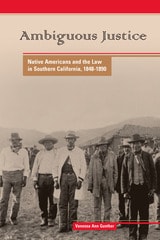
Ambiguous Justice
Native Americans and the Law in Southern California, 1848-1890Vanessa Ann Gunther
Michigan State University Press, 2006
In 1769, Spain took action to solidify control over its northern New World territories by establishing a series of missions and presidios in what is now modern California. To populate these remote establishments, the Spanish crown relied on Franciscan priests, whose role it was to convince the Native Californian population to abandon their traditional religious practices and adopt Catholicism. During their tutelage, the Indians of California would be indoctrinated into Spanish society, where they would learn obedience to the church and crown.
The legal system of Southern California has been used by Anglo populations as a social and demographic tool to control Native Americans. Following the Mexican-American War and the 1849 Gold Rush, as California property values increased and transportation corridors were established, Native Americans remained a sharply declining presence in many communities, and were likely to be charged with crimes. The sentences they received were lighter than those given to Anglo offenders, indicating that the legal system was used as a means of harassment. Additionally, courts chronicled the decline of the once flourishing native populations with each case of drunkenness, assault, or rape that appeared before the bench. Nineteenth-century American society had little sympathy for the plight of Indians or for the destruction of their culture. Many believed that the Indians of Southern California would fade from history because of their inability to adapt to a changing world. While many aspects of their traditional culture have been irreparably lost, the people of southern California are, nevertheless, attempting to recreate the cultures that were challenged by the influx of Europeans and later Americans to their lands.
Ambition, Competition, and Electoral Reform
The Politics of Congressional Elections Across TimeJamie L. Carson and Jason M. Roberts
University of Michigan Press, 2013
In Ambition, Competition, and Electoral Reform, Jamie L. Carson and Jason M. Roberts present an original study of U.S. congressional elections and electoral institutions for 1872-1944 from a contemporary political science perspective. Using data on late nineteenth and early twentieth century congressional elections, the authors test the applicability in a historical context of modern political science theories, assess the effects of institutional reforms, and identify the factors that shape the competitiveness of elections. They present several key findings: the strategic politicians theory is applicable in an era without candidate-centered campaigns; there was an incumbency advantage prior to the full development of candidate-centered campaigns; institutional reforms have had a significant effect on elections; and the degree of electoral competition frequently correlates with elected officials' responsiveness to citizens.

America in the Forties
The Letters of Ole Munch RæderGunnar Malmin
University of Minnesota Press, 1929
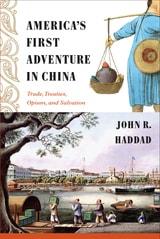
America's First Adventure in China
Trade, Treaties, Opium, and SalvationJohn R Haddad
Temple University Press, 2014
In America's First Adventure in China, John Haddad provides a colorful history of the evolving cultural exchange and interactions between these countries. He recounts how American expatriates adopted a pragmatic attitude-as well as an entrepreneurial spirit and improvisational approach-to their dealings with the Chinese. Haddad shows how opium played a potent role in the dreams of Americans who either smuggled it or opposed its importation, and he considers the missionary movement that compelled individuals to accept a hard life in an alien culture.
As a result of their efforts, Americans achieved a favorable outcome—they established a unique presence in China—and cultivated a relationship whose complexities continue to grow.
America's Religious Crossroads
Faith and Community in the Emerging MidwestStephen T. Kissel
University of Illinois Press, 2021
Perceptive and broad in scope, America’s Religious Crossroads illuminates the integral relationship between communal and spiritual growth in early Midwestern history.
American Architects and Their Books, 1840-1915
Kenneth Hafertepe
University of Massachusetts Press, 2007
In this well-illustrated volume, a chronological sequel to American Architects and Their Books to 1848, twelve distinguished historians of architecture discuss from various points of view the books that inspired architects both famous and not-so-famous, and the books the architects themselves produced. They examine the multifaceted relationship of nineteenth- and early twentieth-century architects to print culture—the literary works that architects collected, used, argued over, wrote, illustrated, designed, printed, were inspired by, cribbed from, educated clients with, advertised their services through, designed libraries for, or just plain enjoyed. The result is a volume that presents the intersection of the history of architecture, the history of ideas, and the history of the book. Changes in print culture during this period had a significant impact on the architectural profession, as revealed in these well-informed scholarly essays.
In addition to the editors, contributors include Jhennifer A. Amundson, Edward R. Bosley, Ted Cavanagh, Elspeth Cowell, Elaine Harrington, Michael J. Lewis, Anne E. Mallek, Daniel D. Reiff, Earle G. Shettleworth, Jr., and Chris Szczesny-Adams. Among the architects discussed are A. J. Downing, Charles Sumner Greene, James Sims, Samuel Sloan, John Calvin Stevens, Thomas U. Walter, and Frank Lloyd Wright.

American Astronomy
Community, Careers, and Power, 1859-1940John Lankford
University of Chicago Press, 1997
research, teaching, or practice in the United States between 1859 and 1940, John Lankford
paints a meticulously documented portrait of this community. He tallies the number with and
without doctorates, the number that taught in colleges or universities versus those involved in
industrial or government work, the number of women versus men, and so on. He also
addresses the crucial question of power within the community—what it meant, which
astronomers had it, and what they did with it.
Drawing on more than a decade of archival research, Lankford attends to the numbers in
concise tables and figures, and takes care to focus through biographical sketches on the
human beings his data represent. This dual approach convincingly illustrates how the changing
structure of a scientific community can alter both the career trajectories of its members and the
nature of the scientific research they choose to pursue.
American Boundaries
The Nation, the States, the Rectangular SurveyBill Hubbard Jr.
University of Chicago Press, 2009

American Community
Radical Experiments in Intentional LivingMark S. Ferrara
Rutgers University Press, 2020
American Community takes us inside forty of the most interesting intentional communities in the nation’s history, from the colonial era to the present day. You will learn about such little-known experiments in cooperative living as the Icarian communities, which took the utopian ideas expounded in a 1840 French novel and put them into practice, ultimately spreading to five states over fifty years. Plus, it covers more recent communities such as Arizona’s Arcosanti, designed by architect Paolo Soleri as a model for ecologically sustainable living.
In this provocative and engaging book, Mark Ferrara guides readers through an array of intentional communities that boldly challenged capitalist economic arrangements in order to attain ideals of harmony, equality, and social justice. By shining a light on these forgotten histories, it shows that far from being foreign concepts, communitarianism and socialism have always been vital parts of the American experience.
American Courage, American Carnage
The 7th Infantry Regiment's Combat Experience, 1812 through World War IIJohn C. McManus
University of Missouri Press, 2025
In the months leading up to the War of 1812, Congress authorized the creation of this regiment. It fought with distinction at the Battle of New Orleans, anchoring General Andrew Jackson's main defensive line, forever earning the nickname "Cottonbalers" because the soldiers of the 7th were said to have battled the British from behind large rows of cotton bales. From now on, whenever Americans went to war, the Cottonbalers would always find themselves in the center of the action, where the danger was greatest.
Between these covers is the whole story, told through the eyes of the soldiers—the realities of combat expressed in raw human terms. From the marshy grounds of the Chalmette plantation in New Orleans to the daunting heights of Chapultepec in Mexico City; from the bloody horror of the long, stone wall at Fredericksburg to the deadly crossfire of the Wheatfield at Gettysburg, from the shocking gore of Custer's massacre at Little Bighorn to the desperation of dusty frontier battles; from the foggy hills of Santiago in Cuba to the muddy, pockmarked no man's land of Belleau Wood in France; from the invasion of North Africa to Sicily, Anzio, southern France, the Vosges Mountains, the breaching of the Rhine, and the 7th's triumphant capture of Hitler's mountain home at Berchtesgaden in May, 1945, this remarkable book chronicles multiple generations of Cottonbalers who have fought and bled for their country.
American Courage, American Carnage is an inside look at the drama, tragedy, fatigue and pathos of war, from America's early nineteenth century struggles as a fledgling republic to its emergence as a superpower in the twentieth. Based on nearly a decade of archival research, battlefield visits, interviews, and intensive study, and illustrated with copious maps and photographs, this book is a moving, authoritative, tale of Americans in combat.
American Creed
Philanthropy and the Rise of Civil Society, 1700-1865Kathleen D. McCarthy
University of Chicago Press, 2003
The market revolution, participatory democracy, and voluntary associations have all been closely linked since the birth of the United States. American Creed explores the relationships among these three institutions, showing how charities and reform associations forged partnerships with government, provided important safety valves for popular discontent, and sparked much-needed economic development. McCarthy also demonstrates how the idea of philanthropy became crucially wedded to social activism during the Jacksonian era. She explores how acts of volunteerism and charity became involved with the abolitionist movement, educational patronage, the struggle against racism, and female social justice campaigns. What resulted, she contends, were heated political battles over the extent to which women and African Americans would occupy the public stage.
Tracing, then, the evolution of civil society and the pivotal role of philanthropy in the search for and exercise of political and economic power, this book will prove essential to anyone interested in American history and government.
American Culture, Canons, and the Case of Elizabeth Stoddard
Robert McClure Smith
University of Alabama Press, 2003
Elizabeth Stoddard was a gifted writer of fiction, poetry, and journalism; successfully published within her own lifetime; esteemed by such writers as William Dean Howells and Nathaniel Hawthorne; and situated at the epicenter of New York’s literary world. Nonetheless, she has been almost excluded from literary memory and importance. This book seeks to understand why. By reconsidering Stoddard’s life and work and her current marginal status in the evolving canon of American literary studies, it raises important questions about women’s writing in the 19th century and canon formation in the 20th century.
Essays in this study locate Stoddard in the context of her contemporaries, such as Dickinson and Hawthorne, while others situate her work in the context of major 19th-century cultural forces and issues, among them the Civil War and Reconstruction, race and ethnicity, anorexia and female invalidism, nationalism and localism, and incest. One essay examines the development of Stoddard’s work in the light of her biography, and others probe her stylistic and philosophic originality, the journalistic roots of her voice, and the elliptical themes of her short fiction. Stoddard’s lifelong project to articulate the nature and dynamics of woman’s subjectivity, her challenging treatment of female appetite and will, and her depiction of the complex and often ambivalent relationships that white middle-class women had to their domestic spaces are also thoughtfully considered.
The editors argue that the neglect of Elizabeth Stoddard’s contribution to American literature is a compelling example of the contingency of critical values and the instability of literary history. This study asks the question, “Will Stoddard endure?” Will she continue to drift into oblivion or will a new generation of readers and critics secure her tenuous legacy?
American Dreaming, Global Realities
Rethinking U.S. Immigration HistoryEdited by Donna R. Gabaccia and Vicki L. Ruiz
University of Illinois Press, 2006
An introduction to the best from the new directions in U.S. immigration history
Representing a selection of the finest new research on immigration, American Dreaming, Global Realities explores the ways in which immigrant lives and those of their children are shaped by transnational bonds, globalization, family ties, and personal choice, and the ways in which they engender a sense of belonging and a sense of themselves as “Americans.”
American Dreaming, Global Realities considers a plurality of very specific historical, economic, regional, familial, and cultural contexts. This history reveals resistance and accommodation, both persistent older traditions and Americanization, plus the creation of new cultural forms blending old and new. The twenty-two interdisciplinary essays included in this collection explore the intricate overlapping of race, class, and gender on ethnic identity and on American citizenship.
American Economic Growth and Standards of Living before the Civil War
Edited by Robert E. Gallman and John Joseph Wallis
University of Chicago Press, 1992
Despite the dramatic economic growth and rise in income levels, questions remain as to the general quality of life during this era. Was the improvement in income widely shared? How did economic growth affect the nature of work? Did higher levels of income lead to improved health and longevity? The authors address these questions by analyzing new estimates of labor force participation, real wages, and productivity, as well as of the distribution of income, height, and nutrition.
American Genesis
A Century of Invention and Technological Enthusiasm, 1870-1970Thomas P. Hughes
University of Chicago Press, 2004
A sweeping history of the inventors, inventions, and innovations that together created modern America.
A stunning, wide-ranging history from one of the foremost historians of technology of our age American Genesis tells the sweeping story of the technological revolution that made modern America. Unlike other histories of technology, which focus on particular inventions like the light bulb or the automobile, American Genesis makes these inventions characters in a broad chronicle, both shaped by and shaping a culture. By weaving scientific and technological advancement into other cultural trends, and bringing in fascinating characters like Edison, Ford, and Frederick Taylor, Hughes demonstrates here the myriad ways in which the two are inexorably linked, and in a new preface, he recounts his earlier missteps in predicting the future of technology and follows its move into the information age.
American Genesis
A Century of Invention and Technological Enthusiasm, 1870-1970Thomas P. Hughes
University of Chicago Press, 2004
*PULITZER PRIZE FINALIST*
A sweeping history of the inventors, inventions, and innovations that together created modern America.
A stunning, wide-ranging history from one of the foremost historians of technology of our age American Genesis tells the sweeping story of the technological revolution that made modern America. Unlike other histories of technology, which focus on particular inventions like the light bulb or the automobile, American Genesis makes these inventions characters in a broad chronicle, both shaped by and shaping a culture. By weaving scientific and technological advancement into other cultural trends, and bringing in fascinating characters like Edison, Ford, and Frederick Taylor, Hughes demonstrates here the myriad ways in which the two are inexorably linked, and in a new preface, he recounts his earlier missteps in predicting the future of technology and follows its move into the information age.
American Indians and the Market Economy, 1775-1850
Edited by Lance Greene and Mark R. Plane,with a foreword by Timothy K. Perttula
University of Alabama Press, 2011
The last quarter of the 18th century was a period of extensive political, economic, and social change in North America, as the continent-wide struggle between European superpowers waned. Native groups found themselves enmeshed in the market economy and new state forms of control, among other new threats to their cultural survival. Native populations throughout North America actively engaged the expanding marketplace in a variety of economic and social forms. These actions, often driven by and expressed through changes in material culture, were supported by a desire to maintain distinctive ethnic identities.
Illustrating the diversity of Native adaptations in an increasingly hostile and marginalized world, this volume is continental in scope—ranging from Connecticut to the Carolinas, and westward through Texas and Colorado. Calling on various theoretical perspectives, the authors provide nuanced perspectives on material culture use as a manipulation of the market economy. A thorough examination of artifacts used by Native Americans, whether of Euro-American or Native origin, this volume provides a clear view of the realities of the economic and social interactions between Native groups and the expanding Euro-American population and the engagement of these Native groups in determining their own fate.
American Literary Minimalism
Robert C. Clark
University of Alabama Press, 2015
Tracing the evolution of minimalist style from Hemingway to the twenty‑first century.
Although a handful of books and articles have been written about American literary Minimalism during the last forty years, the mode remains misunderstood. When in a 2011 interview in The Paris Review author Ann Beattie was asked how she felt about being “classed as a minimalist,” she began her answer: “none of us have ever known what that means.” Her response brings into focus the lack of agreement or clarity about the sources and definitions of literary Minimalism. Robert C. Clark’s American Literary Minimalism fills this significant gap.
Clark demonstrates that, despite assertions by many scholars to the contrary, the movement originated in the aesthetic programs of the Imagists and literary Impressionists active at the turn of the twentieth century. The genre reflects the philosophy that “form is thought,” and that style alone dictates whether a poem, story, or novel falls within the parameters of the tradition. The characteristics of Minimalist fiction are efficiency, frequent use of allusion, and implication through omission.
Organizing his analysis both chronologically and according to lines of influence, Clark offers a definition of the mode, describes its early stages, and then explores six works that reflect its core characteristics: Ernest Hemingway’s In Our Time; Raymond Carver’s Cathedral; Jay McInerney’s Bright Lights, Big City; Susan Minot’s Monkeys; Sandra Cisneros’s Caramelo; and Cormac McCarthy’s The Road. In his conclusion, Clark discusses the ongoing evolution of the category.
American Magnitude
Hemispheric Vision and Public Feeling in the United StatesChrista J. Olson
The Ohio State University Press, 2021
Winner, 2023 Rhetoric Society of America Book Award
Winner, 2022 Marie Hochmuth Nichols Award from the National Communication Association
At a moment in US politics when racially motivated nationalism, shifting relations with Latin America, and anxiety over national futures intertwine, understanding the long history of American preoccupation with magnitude and how it underpins national identity is vitally important. In American Magnitude, Christa J. Olson tracks the visual history of US appeals to grandeur, import, and consequence (megethos), focusing on images that use the wider Americas to establish US character. Her sources—including lithographs from the US-Mexican War, pre–Civil War paintings of the Andes, photo essays of Machu Picchu, and WWII-era films promoting hemispheric unity—span from 1845 to 1950 but resonate into the present.
Olson demonstrates how those crafting the appeals that feed the US national imaginary—artists, scientists, journalists, diplomats, and others—have invited US audiences to view Latin America as a foil for the greatness of their own nation and encouraged white US publics in particular to see themselves as especially American among Americans. She reveals how each instance of visual rhetoric relies upon the eyes of others to instantiate its magnitude—and falters as some viewers look askance instead. The result is the possibility of a post-magnitude United States: neither great nor failed, but modest, partial, and imperfect.
American Mediterraneans
A Study in Geography, History, and RaceSusan Gillman
University of Chicago Press, 2022
The naturalist Alexander von Humboldt, visiting the Gulf-Caribbean in the early nineteenth century, called it America’s Mediterranean. Almost a century later, Southern California was hailed as “Our Mediterranean, Our Italy!” Although “American Mediterranean” is not a household phrase in the United States today, it once circulated widely in French, Spanish, and English as a term of art and folk idiom. In this book, Susan Gillman asks what cultural work is done by this kind of unsystematic, open-ended comparative thinking.
American Mediterraneans tracks two centuries of this geohistorical concept, from Humboldt in the early 1800s, to writers of the 1890s reflecting on the Pacific world of the California coast, to writers of the 1930s and 40s speculating on the political past and future of the Caribbean. Following the term through its travels across disciplines and borders, American Mediterraneans reveals a little-known racialized history, one that paradoxically appealed to a range of race-neutral ideas and ideals.
American Missionaries and the Middle East
Foundational EncountersMehmet Ali Dogan
University of Utah Press, 2010
During the nineteenth and early twentieth centuries, American missionary encounters in the Middle East set foundations for later U.S.-Middle Eastern relations. Missionaries presented examples of American culture to Middle Eastern peoples, just as they interpreted the Middle East for Americans back home. These engagements prompt larger questions about the consequences of American Christian cultural projection into the wider world.
This volume focuses on regions that were once part of the Ottoman Empire in western Asia, the Balkans, and North Africa. Contributors explain the distinctly American dimensions of these missionary encounters, the cultural influences they exerted on the region, and their consequences for local nationalism, print culture, education, and more. This is an excellent resource for specialists in history, Middle Eastern studies, American studies, religious studies, missiology, and anyone interested more broadly in American engagement in the Middle East.

American Naturalism and the Jews
Garland, Norris, Dreiser, Wharton, and CatherDonald Pizer
University of Illinois Press, 2007
American Orchestras in the Nineteenth Century
Edited by John Spitzer
University of Chicago Press, 2012
Studies of concert life in nineteenth-century America have generally been limited to large orchestras and the programs we are familiar with today. But as this book reveals, audiences of that era enjoyed far more diverse musical experiences than this focus would suggest. To hear an orchestra, people were more likely to head to a beer garden, restaurant, or summer resort than to a concert hall. And what they heard weren’t just symphonic works—programs also included opera excerpts and arrangements, instrumental showpieces, comic numbers, and medleys of patriotic tunes.
American Public Philosophy and the Mystery of Lincolnism
Eric C. Sands
University of Missouri Press, 2009
American Romanticism and the Marketplace
Michael T. Gilmore
University of Chicago Press, 1985
"[Gilmore] demonstrates the profound, sustained, engagement with society embodied in the works of Emerson, Hawthorne, Thoreau and Melville. In effect, he relocates the American Renaissance where it properly belongs, at the centre of a broad social, economic, and ideological movement from the Jacksonian era to the Civil War. Basically, Gilmore's argument concerns the writers' participation in what Thoreau called 'the curse of trade.' He details their mixed resistance to and complicity in the burgeoning literary marketplace and, by extension, the entire ' economic revolution' which between 1830 and 1860 'transformed the United States into a market society'. . . .
"The result is a model of literary-historical revisionism. Gilmore's opening chapters on Emerson and Thoreau show that 'transcendental' thought and language can come fully alive when understood within the material processes and ideological constraints of their time. . . . The remaining five chapters, on Hawthorne and Melville, contain some of the most penetrating recent commentaries on the aesthetic strategies of American Romantic fiction, presented within and through some of the most astute, thoughtful considerations I know of commodification and the 'democratic public' in mid-nineteenth-century America. . . . Practically and methodologically, American Romanticism and the Marketplace has a significant place in the movement towards a new American literary history. It places Gilmore at the forefront of a new generation of critics who are not just reinterpreting familiar texts or discovering new texts to interpret, but reshaping our ways of thinking about literature and culture."—Sacvan Bercovitch, Times Literary Supplement
"Gilmore writes with energy, clarity, and wit. The reader is enriched by this book." William H. Shurr, American Literature
American Sage
The Spiritual Teachings of Ralph Waldo EmersonBarry M. Andrews
University of Massachusetts Press, 2021
Unitarian minister Barry M. Andrews has spent years studying Emerson, finding wisdom and guidance in his teachings and practices, and witnessing how the spiritual lives of others are enriched when they grasp the many meanings in his work. In American Sage, Andrews explores Emerson's writings, including his journals and letters, and makes them accessible to today's spiritual seekers. Written in everyday language and based on scholarship grounded in historical detail, this enlightening book considers the nineteenth-century religious and intellectual crosscurrents that shaped Emerson's worldview to reveal how his spiritual teachings remain timeless and modern, universal and uniquely American.

American Science in the Age of Jackson
George H. Daniels
University of Alabama Press, 1968
A foundational history of science, ideas, and professional identity in nineteenth-century America.
American Science in the Age of Jackson is a landmark study that traces the emergence of a distinctly American scientific community during one of the most transformative periods in the nation's history. Focusing on the years between 1815 and 1845, George H. Daniels examines how a loosely connected network of amateur naturalists, physicians, educators, and scientific enthusiasts evolved into a more organized and professional body of researchers united by shared goals, methods, institutions, and intellectual commitments. Through an innovative analysis of leading scientists and the scientific journals that connected them, Daniels reconstructs the foundations of American science at the moment it began to establish an independent identity.
Originally recognized as the first major effort to define an American scientific community, this influential work explores the individuals, publications, and philosophical traditions that shaped scientific inquiry in the early republic and Jacksonian era. Daniels examines the careers and writings of the most prominent American scientists of the period, demonstrating how they built professional networks, established standards of evidence and inquiry, and promoted science as an essential component of national progress. In doing so, he illuminates the institutional development of scientific societies, colleges, journals, and research programs that would lay the groundwork for the nation's later scientific achievements.
Featuring biographical sketches of leading scientists, analyses of early scientific journals, and a detailed examination of the ideas that united the nation's scientific elite, American Science in the Age of Jackson remains a foundational text for understanding the origins of scientific culture in the United States. More than a history of science, it is a history of intellectual ambition, institutional growth, and the pursuit of knowledge in a rapidly changing society. Scholars and students of American history, history of science, intellectual history, philosophy, and nineteenth-century studies will find this volume an indispensable resource for understanding how American science established the foundations of its modern identity.
American Socialist Triptych
The Literary-Political Work of Charlotte Perkins Gilman, Upton Sinclair, and W. E. B. Du BoisMark W. Van Wienen
University of Michigan Press, 2014
"A meticulously researched, highly informed, carefully argued, and very accessible account of American socialism, socialists, and socialistic thinking, from the late nineteenth century through the 1960s . . . challenges the intellectual and political legacy of Werner Sombart's Why Is There No Socialism in the United States?, whose spirit still hovers over animated discussions about the 'failures' of socialism in the United States."
---James A. Miller, George Washington University
"A valuable rethinking and reframing of the traditions of leftist literary scholarship in the U.S."
---Sylvia Cook, University of Missouri, St. Louis
American Socialist Triptych: The Literary-Political Work of Charlotte Perkins Gilman, Upton Sinclair, and W. E. B. Du Bois explores the contributions of three writers to the development of American socialism over a fifty--year period and asserts the vitality of socialism in modern American literature and culture.
Drawing upon a wide range of texts including archival sources, Mark W. Van Wienen demonstrates the influence of reform-oriented, democratic socialism both in the careers of these writers and in U.S. politics between 1890 and 1940. While offering unprecedented in-depth analysis of modern American socialist literature, this book charts the path by which the supposedly impossible, dangerous ideals of a cooperative commonwealth were realized, in part, by the New Deal.
American Socialist Triptych provides in-depth, innovative readings of the featured writers and their engagement with socialist thought and action. Upton Sinclair represents the movement's most visible manifestation, the Socialist Party of America, founded in 1901; Charlotte Perkins Gilman reflects the socialist elements in both feminism and 1890s reform movements, and W. E. B. Du Bois illuminates social democratic aspirations within the NAACP. Van Wienen's book seeks to re-energize studies of Sinclair by treating him as a serious cultural figure whose career peaked not in the early success of The Jungle but in his nearly successful 1934 run for the California governorship. It also demonstrates as never before the centrality of socialism throughout Gilman's and Du Bois's literary and political careers.
More broadly, American Socialist Triptych challenges previous scholarship on American radical literature, which has focused almost exclusively on the 1930s and Communist writers. Van Wienen argues that radical democracy was not the phenomenon of a decade or of a single group but a sustained tradition dispersed within the culture, providing a useful genealogical explanation for how socialist ideas were actually implemented through the New Deal.
American Socialist Triptych also revises modern American literary history, arguing for the endurance of realist and utopian literary modes at the height of modernist literary experimentation and showing the importance of socialism not only to the three featured writers but also to their peers, including Edward Bellamy, Hamlin Garland, Jack London, Edna St. Vincent Millay, and Claude McKay. Further, by demonstrating the importance of social democratic thought to feminist and African American campaigns for equality, the book dialogues with recent theories of radical egalitarianism. Readers interested in American literature, U.S. history, political theory, and race, gender, and class studies will all find in American Socialist Triptych a valuable and provocative resource.
American Sunshine
Diseases of Darkness and the Quest for Natural LightDaniel Freund
University of Chicago Press, 2012
In the second half of the nineteenth century, American cities began to go dark. Hulking new buildings overspread blocks, pollution obscured the skies, and glass and smog screened out the health-giving rays of the sun. Doctors fed anxities about these new conditions with claims about a rising tide of the "diseases of darkness," especially rickets and tuberculosis.
In American Sunshine, Daniel Freund tracks the obsession with sunlight from those bleak days into the twentieth century. Before long, social reformers, medical professionals, scientists, and a growing nudist movement proffered remedies for America’s new dark age. Architects, city planners, and politicians made access to sunlight central to public housing and public health. and entrepreneurs, dairymen, and tourism boosters transformed the pursuit of sunlight and its effects into a commodity. Within this historical context, Freund sheds light on important questions about the commodification of health and nature and makes an original contribution to the histories of cities, consumerism, the environment, and medicine.
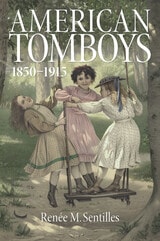
American Tomboys, 1850-1915
Renée M. Sentilles
University of Massachusetts Press, 2018
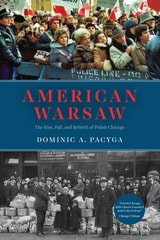
American Warsaw
The Rise, Fall, and Rebirth of Polish ChicagoDominic A. Pacyga
University of Chicago Press, 2019
Every May, a sea of 250,000 people decked out in red and white head to Chicago’s Loop to celebrate the Polish Constitution Day Parade. In the city, you can tune in to not one but four different Polish-language radio stations or jam out to the Polkaholics. You can have lunch at pierogi food trucks or pick up pączkis at the grocery store. And if you’re lucky, you get to take off work for Casimir Pulaski Day. For more than a century, Chicago has been home to one of the largest Polish populations outside of Poland, and the group has had an enormous influence on the city’s culture and politics. Yet, until now, there has not been a comprehensive history of the Chicago Polonia.
With American Warsaw, award-winning historian and Polish American Dominic A. Pacyga chronicles more than a century of immigration, and later emigration back to Poland, showing how the community has continually redefined what it means to be Polish in Chicago. He takes us from the Civil War era until today, focusing on how three major waves of immigrants, refugees, and fortune seekers shaped and then redefined the Polonia. Pacyga also traces the movement of Polish immigrants from the peasantry to the middle class and from urban working-class districts dominated by major industries to suburbia. He documents Polish Chicago’s alignments and divisions: with other Chicago ethnic groups; with the Catholic Church; with unions, politicians, and city hall; and even among its own members. And he explores the ever-shifting sense of Polskość, or “Polishness.”
Today Chicago is slowly being eclipsed by other Polish immigrant centers, but it remains a vibrant—and sometimes contentious—heart of the Polish American experience. American Warsaw is a sweeping story that expertly depicts a people who are deeply connected to their historical home and, at the same time, fiercely proud of their adopted city. As Pacyga writes, “While we were Americans, we also considered ourselves to be Poles. In that strange Chicago ethnic way, there was no real difference between the two.”
American Women Poets of the Nineteenth Century
Edited by Cheryl Walker
Rutgers University Press, 1992
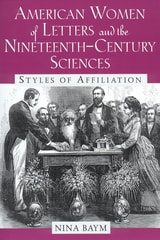
American Women of Letters and the Nineteenth-Century Sciences
Styles of AffiliationBaym, Nina
Rutgers University Press, 2001
Choice Outstanding Academic Title
During the nineteenth century, the content and institutional organization of the sciences evolved dramatically, altering the public's understanding of knowledge. As science grew in importance, many women of letters tried to incorporate it into a female worldview. Nina Baym explores the responses to science displayed in a range of writings by American women. Conceding that they could not become scientists, women insisted, however, that they were capable of understanding science and participating in its discourse. They used their access to publishing to advocate the study and transmission of scientific information to the general public.
Bayms book includes biographies and a full exploration of these women's works. Among those considered are:
• Almira Phelps, author of Familiar Lectures on Botany (it sold 350,000 copies)
• Sarah Hale, who filled Godey's Lady's Book with science articles
• Catharine Esther Beecher, who based her domestic advice on scientific information
• Elizabeth Cary Agassiz, the actual ghostwriter of her husband's popular science essays
• Emily Dickinson, whose poetry is replete with scientific images.
Baym also investigates science in women's novels, writing by and about women doctors, and the scientific claims advanced by women's spiritualist movements. This book truly breaks new ground, outlining a field of inquiry that few have noted exists.
Americans and Their Land
The House Built on AbundanceAnne Mackin
University of Michigan Press, 2006
—James Carroll, author of House of War and An American Requiem, winner of the National Book Award
“Anne Mackin has taken a fresh and provocative look at that most fascinating of relationships: the one between the American people and the American land.”
—Michael Pollan, Knight Professor of Journalism and Director of the Knight Program in Science and Environmental Journalism at University of California Berkeley, contributing writer to the New York Times Magazine, and author of The Omnivore's Dilemma and The Botany of Desire
“Anne Mackin has given us a valuable and less-used lens to view the development of our neighborhoods, towns and cities: the land itself. Our relationship to the earth beneath our feet—how we dig it, buy it, sell it, zone it, pave it, spoil it or pamper it—helps explain what is produced on top of the land in our nation, from farms to homes to skyscrapers. All in all, Mackin takes us on a novel and erudite journey, from one coast to the other, and from Colonial times to the present. This valuable book marks a significant and lasting contribution to the way we see and understand our landscape and ourselves.”
—Alex Marshall, author of How Cities Work: Suburbs, Sprawl, and the Roads Not Taken
“To really understand the origins of the range war now raging between smart growth and property rights advocates over the future of the American land, you need to read this exceptional book.”
—Robert D. Yaro, President Regional Plan Association and Professor in Practice, University of Pennsylvania
Thomas Malthus once said, “The happiness of the Americans depended much less upon their peculiar degree of civilization than . . . upon their having a great plenty of fertile uncultivated land.”
Malthus knew. Lord MacCaulay knew. Albert Gallatin knew. America and its people would change as a growing population whittled away the supply of land.
Nothing has shaped the American character like the abundance of land that met the colonist, the pioneer, and the early suburbanite. With today’s political and economic institutions shaped by the largesse of yesteryear, how will Americans fare in the new landscape of water wars, expensive housing, rising fuel prices, environmental and property rights battles, and powerful industrial lobbies?
Why is land the key to American democracy? How can we protect our democracy as more people and industries compete more intensively for our remaining resources? Americans and Their Land begins an important, overdue discussion of these questions. Anne Mackin takes the reader story by story from frontier history to the present and shows how land shaped the American political landscape. She shows how our evolving traditions of apportioning resources have allowed diminished supplies to create our present, increasingly unequal society, and she asks how 300 million Americans living in the new American landscape of growing competition can better share those resources.
Americans in the Treasure House
Travel to Porfirian Mexico and the Cultural Politics of EmpireBy Jason Ruiz
University of Texas Press, 2014
When railroads connected the United States and Mexico in 1884 and overland travel between the two countries became easier and cheaper, Americans developed an intense curiosity about Mexico, its people, and its opportunities for business and pleasure. Indeed, so many Americans visited Mexico during the Porfiriato (the long dictatorship of Porfirio Díaz, 1876–1911) that observers on both sides of the border called the hordes of tourists and business speculators a “foreign invasion,” an apt phrase for a historical moment when the United States was expanding its territory and influence.
Americans in the Treasure House examines travel to Mexico during the Porfiriato, concentrating on the role of travelers in shaping ideas of Mexico as a logical place for Americans to extend their economic and cultural influence in the hemisphere. Analyzing a wealth of evidence ranging from travelogues and literary representations to picture postcards and snapshots, Jason Ruiz demonstrates that American travelers constructed Mexico as a nation at the cusp of modernity, but one requiring foreign intervention to reach its full potential. He shows how they rationalized this supposed need for intervention in a variety of ways, including by representing Mexico as a nation that deviated too dramatically from American ideals of progress, whiteness, and sexual self-control to become a modern “sister republic” on its own. Most importantly, Ruiz relates the rapid rise in travel and travel discourse to complex questions about national identity, state power, and economic relations across the U.S.–Mexico border.
America’s Hardscrabble General
Ulysses S. Grant, from Farm Boy to ShilohJack Hurst
Southern Illinois University Press, 2022
Renowned for his skill, courage, and indomitability during the Civil War, Ulysses S. Grant is considered a model for outstanding American generalship. However, unlike most of his fellow officers, Grant came from humble Midwestern beginnings and experienced a number of professional failures before rising to military prominence.
Grant grew up on a farm on the Ohio frontier and reluctantly attended West Point, where he finished in the middle of his class. In his early army career, he was often underestimated by his peers despite valiant service. After the Mexican War Grant’s “Hardscrabble” farm outside St. Louis failed, and when he decided to rejoin the U.S. army, he was given the unenviable command of a rowdy volunteer regiment, the 21st Illinois.
How did Grant—an average student, failed farmer, and common man—turn the 21st Illinois into a showcase regiment and become a successful general? In this engaging analysis, Jack Hurst argues that Grant’s military brilliance stemmed not from his West Point education but rather from his roots in America’s lower middle class and its commonsense values. His upbringing in the antebellum rural Midwest undergirded his military skill and helped him develop an innate humility, sense of justice, and ability to focus, leading him to form close relationships with his men.
Through a detailed account of Grant’s early years, from boyhood through the Battle of Shiloh, Hurst explores how Grant’s modest start and experiences in the Mexican War prefigured his greatest military triumphs. Ultimately Grant abandoned the traditional military practice of his time, which relied upon maneuver, and instead focused on fighting. His strategy to always move forward, win or lose, turned even his losses into essential elements of victory and characterized the aggressive, relentless approach that would ultimately win the Civil War and save the Union.
Amy Levy
Critical EssaysLinda Hunt Beckman
Ohio University Press, 2000
Amy Levy
Critical EssaysNaomi Hetherington
Ohio University Press, 2010
Amy Levy has risen to prominence in recent years as one of the most innovative and perplexing writers of her generation. Embraced by feminist scholars for her radical experimentation with queer poetic voice and her witty journalistic pieces on female independence, she remains controversial for her representations of London Jewry that draw unmistakably on contemporary antisemitic discourse.
Amy Levy: Critical Essays brings together scholars working in the fields of Victorian cultural history, women’s poetry and fiction, and the history of Anglo-Jewry. The essays trace the social, intellectual, and political contexts of Levy’s writing and its contemporary reception. Working from close analyses of Levy’s texts, the collection aims to rethink her engagement with Jewish identity, to consider her literary and political identifications, to assess her representations of modern consumer society and popular culture, and to place her life and work within late-Victorian cultural debate.
This book is essential reading for undergraduate and postgraduate students offering both a comprehensive literature review of scholarship-to-date and a range of new critical perspectives.
Contributors:
Susan David Bernstein,University of Wisconsin-Madison
Gail Cunningham,Kingston University
Elizabeth F. Evans,Pennslyvania State University–DuBois
Emma Francis,Warwick University
Alex Goody,Oxford Brookes University
T. D. Olverson,University of Newcastle upon Tyne
Lyssa Randolph,University of Wales, Newport
Meri-Jane Rochelson,Florida International University
An Abolitionist Abroad
Sarah Parker Remond in Cosmopolitan EuropeSirpa Salenius
University of Massachusetts Press, 2016
Remond's extensive travels and diverse acquaintances demonstrate that the nineteenth-century grand tour of Europe was not exclusively the privilege of white intellectuals but included African American travelers, among them women. This biography, based on international archival research, tells the fascinating story of how Remond forged a radical path, establishing relationships with fellow activists, artists, and intellectuals across Europe.
An Actor's Tale
Theater, Culture, and Everyday Life in the Nineteenth-Century United StatesAmy Hughes
University of Michigan Press, 2025
Ultimately, Hughes reveals how this actor’s tale illuminates the widespread tendency to ignore, deny, and forgive White male mediocrity in US culture, and how a deeper understanding of people like Watkins can transform our understanding of the past—and our understanding of ourselves.
An American Girl, and Her Four Years in a Boys' College
Olive San Louie Anderson
University of Michigan Press, 2006
In 1870, the University of Michigan-one of the oldest, largest, and most prestigious public universities in the United States-admitted its first woman student. An American Girl, and Her Four Years in a Boys' College, written by one of the first woman graduates from the University of Michigan and published pseudonymously in 1878, describes what it was like to be a member of this tiny group of brave coeds. The story is told through the eyes of Wilhelmine Elliot, an untraditional girl who enrolls at the fictional University of Ortonville, a thinly disguised stand-in for the University of Michigan.
Will's challenges mirror those of other women college students of the era, including the reactions of male faculty and students, relationships with other women students and with family and friends back home, and social attitudes toward the women's movement and liberal religious values. The editors' engaging introduction places the novel in its relevant historical and literary contexts, as do helpful annotations throughout the text.
"The 1870s were an important moment of debate over women's roles and responsibilities. What's here is very interesting not only about higher education, and 'strong-minded women,' but about religion, domesticity, independence, marriage, and homosocial bonding."
--Carol Lasser, Oberlin College
Olive San Louie Anderson (ca. 1852-86) graduated from the University of Michigan in 1875 and published An American Girl in 1878 under the name SOLA. Elisabeth Israels Perry is John Francis Bannon Professor of History, Saint Louis University. Jennifer Ann Price is a Ph.D. candidate in American Studies at Saint Louis University.
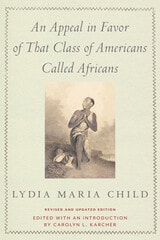
An Appeal in Favor of That Class of Americans Called Africans
Revised and Updated EditionLydia Maria Child, Edited with an introduction by Carolyn L. Karcher
University of Massachusetts Press, 2023
Published in Boston in 1833, Lydia Maria Child’s An Appeal in Favor of That Class of Americans Called Africans provided the abolitionist movement with its first full-scale analysis of race and enslavement. Controversial in its own time, the Appeal surveyed the institution of slavery from historical, political, economic, legal, racial, and moral perspectives and advocated for the immediate emancipation of the enslaved without compensation to their enslavers. By placing American slavery in historical context and demonstrating how slavery impacted—and implicated—Americans of all regions and races, the Appeal became a central text for the abolitionist movement that continues to resonate in the present day.
This revised and updated edition is enhanced by Carolyn L. Karcher’s illuminating introduction, a chronology of Child’s life, and a list of books for further reading.

An Arizona Chronology
The Territorial Years, 1846–1912Douglas D. Martin
University of Arizona Press, 1963
Who better to choose news items giving a key to the times than Douglas D. Martin, who first set newspaper type when he was 15, filled news and magazine columns and book pages galore, and today at 75 is still writing for print? He knows newspapers from the composing room to the editor's desk—Detroit Free Press—not excepting reportorial beats, having received the Pulitzer Prize for reporting on his own.
An Artist's Journey
Lettres d'un bachelier es musique, 1835-1841Franz Liszt
University of Chicago Press, 1989

An Early Encounter with Tomorrow
Europeans, Chicago's Loop, and the World's Columbian ExpositionArnold Lewis
University of Illinois Press, 1997
Extravagantly illustrated with over seventy photographs, drawings, paintings, and contemporary cartoons, An Early Encounter with Tomorrow documents the mixture of amazement and alarm with which European visitors greeted 1890s Chicago: as a futuristic city animated by a crass, frenetic mercantile class. This volume also contains an extensive bibliography, arranged by country, and profiles of the foreign observers who sought the implications for European culture in what Asa Briggs called the "shock city" of the western world.
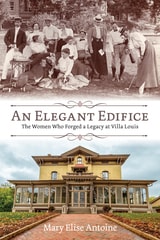
An Elegant Edifice
The Women Who Forged a Legacy at Villa LouisMary Elise Antoine
Wisconsin Historical Society Press, 2026
On the banks of the upper Mississippi River at Prairie du Chien, Wisconsin, stands Villa Louis, the majestic Italianate-style mansion and estate built by the prosperous Dousman family in 1871. An Elegant Edifice tells the stories of the women of the Dousman residence. Jane, who outlived her husband by fourteen years, oversaw the estate and maintained the family’s presence in Prairie du Chien. Jane’s daughter-in-law, Nina, managed the property and assumed the role of head of the family following her husband’s death, ensuring stability for her children during times of tragedy. Finally, Nina’s daughters Violet and Virginia helped to restore the family home in the 1930s, secure its future as a historic site, and record the Dousmans’ history for posterity.
An Elegant Edifice illustrates the broad strokes of American expansionism through the backgrounds and activities of these influential women, complete with marriages and separations, births and deaths, business disputes, lawsuits, and reconciliations. With stories of St. Louis and St. Paul society, the stylish shops of New York City, and the prominence of Prairie du Chien in the nineteenth century, this book reveals the leisure activities and extravagant lifestyle afforded to the family by their wealth—Tiffany jewelry and housewares, William Morris wallpaper and fabrics, Jaccard silver, and a fine art collection to rival the public museums of the era.
Thanks to the women’s fortitude and shared conviction in the importance of family, Villa Louis has been preserved and restored to its 1890s splendor and is today considered one of the most authentically restored Italianate villas in the United States. While previous histories have focused on the Dousman patriarchs, public historian Mary Elise Antoine offers a new perspective on the Dousman family history by bringing into focus Jane, Nina, Violet, and Virginia. These women’s lives—historically less well-documented than the lives of their husbands, fathers, and sons—contributed greatly to the preservation of Villa Louis and to our understanding of an important chapter in American history.
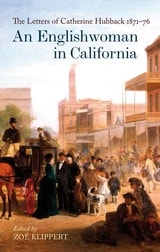
An Englishwoman in California
The Letters of Catherine Hubback, 1871-76Edited by Zoë Klippert
Bodleian Library Publishing, 2010
A niece of Jane Austen and a novelist herself, Catherine Hubback was fifty-two years old when she left England for America. She travelled to California on the Transcontinental Railroad and settled in Oakland, on the eastern shore of San Francisco Bay. Her son Edward shared her household and commuted by ferryboat to a wheat brokerage in the City.
In letters to her eldest son John and his wife Mary in Liverpool, Catherine conveys her delight – and her exasperation – at her new environment. She portrays her neighbours with a novelist's wry wit and brings her English sensibility to bear on gardening with unfamiliar plants and maintaining a proper wardrobe in a dry climate. She writes vividly of her adventures as she moves about a landscape recognizable to present-day residents, at a time when boats rather than bridges spanned the bay, and hot springs were the main attraction in the Napa Valley. In an atmosphere of financial unrest, she writes freely of her anxieties, while supplementing Edward's declining income by making lace and teaching the craft to other women. She recalls her 'prosperous days' in England, but finds pleasure in small things and assuredly takes her place in a society marked by great disparities in wealth.
In addition to transcriptions of the letters, this highly readable edition offers pertinent information on many of the people and places mentioned, explanatory notes, and striking illustrations. The introduction places the letters in context and tells the story of Catherine Hubback, whose life evolved in ways unprecedented in the Austen family.

An Environmental History of Knowledge and Politics
Forestry in Nineteenth- and Twentieth-Century HungaryRobert Balogh
Central European University Press, 2026
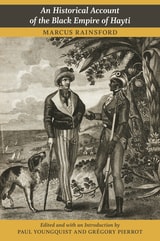
An Historical Account of the Black Empire of Hayti
Marcus Rainsford
Duke University Press, 2013