Results by title
3258 books match the query 'Art' and 405 start with a
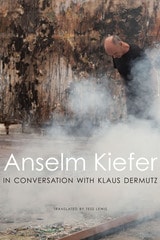
Anselm Kiefer in Conversation with Klaus Dermutz
Anselm Kiefer and Klaus Dermutz
Seagull Books, 2018
The only visual artist to have won the Peace Prize of the German Book Trade, Anselm Kiefer is a profoundly literary painter. In these conversations, Kiefer describes how the central materials of his art—lead, sand, water, fire, ashes, plants, clothing, oil paint, watercolor, and ink—influence the act of creation. No less decisive are his intellectual and artistic touchstones: the sixteenth-century Jewish mystic Isaac Luria, the German Romantic poet Novalis, Ingeborg Bachmann, Paul Celan, Martin Heidegger, Marcel Proust, Adalbert Stifter, the operas of Richard Wagner, the Catholic liturgy, and the innovative theater director and artist Tadeusz Kantor. Kiefer and Dermutz discuss all of these influential thinkers, as well as Kiefer’s own status as a controversial figure. His relentless examination of German history, the themes of guilt, suffering, communal memory, and the seductions of destruction have earned him equal amounts of criticism and praise. The conversations in this book offer a rare insight into the mind of a gifted creator, appealing to artists, critics, art historians, cultural journalists, and anyone interested in the visual arts and the literature and history of the twentieth century.
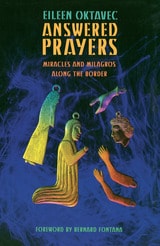
Answered Prayers
Miracles and Milagros along the BorderEileen Oktavec
University of Arizona Press, 1995
In Answered Prayers, the Mexicans, Mexican Americans, Tohono O'odham, and Yaquis who practice this tradition share their stories of unwavering faith and divine intervention. Anthropologist and photographer Eileen Oktavec has spent more than two decades documenting this fascinating tradition in the Arizona-Mexico borderlands. Quoting extensive interviews, she explains the beliefs of the people who perform this ancient folk ritual and the many rules guiding this practice. She also describes the many places where milagros are offered—from the elaborate Mexican baroque Mission San Xavier near Tucson, Arizona, to tiny household shrines and hospitals on both sides of the border. Oktavec also explains how milagros are made, where they are bought, and how they are used in jewelry, sculpture, and art.
Anti-Book
On the Art and Politics of Radical PublishingNicholas Thoburn
University of Minnesota Press, 2016
No, Anti-Book is not a book about books. Not exactly. And yet it is a must for anyone interested in the future of the book. Presenting what he terms “a communism of textual matter,” Nicholas Thoburn explores the encounter between political thought and experimental writing and publishing, shifting the politics of text from an exclusive concern with content and meaning to the media forms and social relations by which text is produced and consumed. Taking a “post-digital” approach in considering a wide array of textual media forms, Thoburn invites us to challenge the commodity form of books—to stop imagining books as transcendent intellectual, moral, and aesthetic goods unsullied by commerce. His critique is, instead, one immersed in the many materialities of text.
Anti-Book engages with an array of writing and publishing projects, including Antonin Artaud’s paper gris-gris, Valerie Solanas’s SCUM Manifesto, Guy Debord’s sandpaper-bound Mémoires, the collective novelist Wu Ming, and the digital/print hybrid of Mute magazine. Empirically grounded, it is also a major achievement in expressing a political philosophy of writing and publishing, where the materiality of text is interlaced with conceptual production. Each chapter investigates a different form of textual media in concert with a particular concept: the small-press pamphlet as “communist object,” the magazine as “diagrammatic publishing,” political books in the modes of “root” and “rhizome,” the “multiple single” of anonymous authorship, and myth as “unidentified narrative object.”
An absorbingly written contribution to contemporary media theory in all its manifestations, Anti-Book will enrich current debates about radical publishing, artists’ books and other new genre and media forms in alternative media, art publishing, media studies, cultural studies, critical theory, and social and political theory.

Antidiets of the Avant-Garde
From Futurist Cooking to Eat ArtCecilia Novero
University of Minnesota Press, 2009
Discussing an aspect of the European avant-garde that has often been neglected-its relationship to the embodied experience of food, its sensation, and its consumption-Cecilia Novero exposes the surprisingly key roles that food plays in the theoretical foundations and material aesthetics of a broad stratum of works ranging from the Italian Futurist Cookbook to the magazine Dada, Walter Benjamin's writings on eating and cooking, Daniel Spoerri's Eat Art, and the French New Realists.
Starting from the premise that avant-garde art involves the questioning of bourgeois aesthetics, Novero demonstrates that avant-garde artists, writers, and performers have produced an oppositional aesthetics of indigestible art. Through the rhetoric of incorporation and consumption and the use of material ingredients in their work, she shows, avant-garde artists active in the 1920s and 1930s as well as the neo-avant-garde movements engaged critically with consumer culture, memory, and history.
Attention to food in avant-garde aesthetics, Novero asserts, reveals how these works are rooted in a complex temporality that associates memory and consumption with dynamics of change.
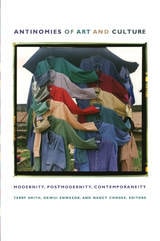
Antinomies of Art and Culture
Modernity, Postmodernity, ContemporaneityTerry Smith, Okwui Enwezor, and Nancy Condee, eds.
Duke University Press, 2008
In the volume’s introduction the theorist Terry Smith argues that predictions that postmodernity would emerge as a global successor to modernity have not materialized as anticipated. Smith suggests that the various situations of decolonized Africa, post-Soviet Europe, contemporary China, the conflicted Middle East, and an uncertain United States might be better characterized in terms of their “contemporaneity,” a concept which captures the frictions of the present while denying the inevitability of all currently competing universalisms. Essays range from Antonio Negri’s analysis of contemporaneity in light of the concept of multitude to Okwui Enwezor’s argument that the entire world is now in a postcolonial constellation, and from Rosalind Krauss’s defense of artistic modernism to Jonathan Hay’s characterization of contemporary developments in terms of doubled and even para-modernities. The volume’s centerpiece is a sequence of photographs from Zoe Leonard’s Analogue project. Depicting used clothing, both as it is bundled for shipment in Brooklyn and as it is displayed for sale on the streets of Uganda, the sequence is part of a striking visual record of new cultural forms and economies emerging as others are left behind.
Contributors: Monica Amor, Nancy Condee, Okwui Enwezor, Boris Groys, Jonathan Hay, Wu Hung, Geeta Kapur, Rosalind Krauss, Bruno Latour, Zoe Leonard, Lev Manovich, James Meyer, Gao Minglu, Helen Molesworth, Antonio Negri, Sylvester Okwunodu Ogbechie, Nikos Papastergiadis, Colin Richards, Suely Rolnik, Terry Smith, McKenzie Wark
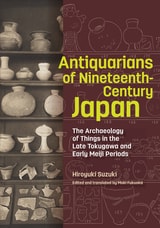
Antiquarians of Nineteenth-Century Japan
The Archaeology of Things in the Late Tokugawa and Early Meiji PeriodsHiroyuki Suzuki
J. Paul Getty Trust, The, 2022
Originally published in Japanese, Antiquarians of Nineteenth-Century Japan looks at the approach toward object-based research across the late Tokugawa and early Meiji periods, which were typically kept separate, and elucidates the intellectual continuities between these eras. Focusing on the top-down effects of the professionalizing of academia in the political landscape of Meiji Japan, which had advanced by attacking earlier modes of scholarship by antiquarians, Suzuki shows how those outside the government responded, retracted, or challenged new public rules and values. He explores the changing process of evaluating objects from the past in tandem with the attitudes and practices of antiquarians during the period of Japan’s rapid modernization. He shows their roots in the intellectual sphere of the late Tokugawa period while also detailing how they adapted to the new era. Suzuki also demonstrates that Japan’s antiquarians had much in common with those from Europe and the United States.
Art historian Maki Fukuoka provides an introduction to the English translation that highlights the significance of Suzuki’s methodological and intellectual analyses and shows how his ideas will appeal to specialists and nonspecialists alike.
Antony Gormley on Sculpture
Antony Gormley
University of Chicago Press, 2015
Combining commentary on his own works with discussions of other artists and the Eastern religious traditions that have inspired him, Gormley offers wisdom on topics such as the body in space, how to approach an environment when conceiving an installation, bringing mindfulness and internal balance to sculpture, and much more. Lavishly illustrated, this book will be of interest to not only art lovers, curators, and critics, but also artists and art students. Dynamic and thought-provoking, Antony Gormley on Sculpture is essential reading for anyone fascinated by sculpture and its long and complex history as a medium.

Anxious Objects
Willie Cole's Favorite BrandsPatterson Sims
Rutgers University Press, 2006
An object maker, musician, poet, and performer, Willie Cole is an artist with remarkably diverse art-making skills and a formidable imagination. Best known for his assemblage, mixed media sculptural works, and prints, Cole liberates and aggrandizes everyday artifacts, including irons, ironing boards, hairdryers, high-heeled shoes, lawn jockeys, bicycle parts, and other discarded domestic appliances and hardware and transforms them into powerful and iconic art works.
The time-textured objects that he works with are seen by most as banal and expendable, but in Cole's hands they are given new vitality and metaphorical meaning. Frequently, he takes his found American consumer objects and Africanizes or ritualizes them, creating potent global artistic hybrids. His works also track his distinctive, Newark, New Jersey-based heritage, movingly melding the social, political, and cultural perspectives of urban African American experience.
Although wit and humor are often evident in his methods, Cole's readaptions of African tribal art motifs and forms are based more in respectful appreciation than appropriation and careful study rather than simple imitation. His works address a range of serious topics including race relations, capitalist materialism, religious belief systems, and human pathos.
Surveying the wide range of Cole's methods, media, and themes from the late 1980s to the present, this catalog includes thirty stunning color illustrations of his most significant sculptures, paintings, works on paper, and prints. An extensive interview with Cole by Dr. Leslie King-Hammond, Dean of the Maryland Institute of Art, as well as a commentary by Dr. Lowery Stokes Sims, President of the Studio Museum in Harlem, about Cole's pivotal residency there place this unique artist's work in the context of African American and contemporary art. The catalogue also includes biographical information in the form of two chronologies, one of which is a personal resum by the artist, as well as exhibition histories, bibliographies, and a listing of public collections of his work.
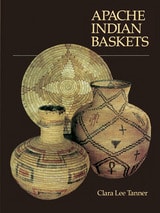
Apache Indian Baskets
Clara Lee Tanner
University of Arizona Press, 1982
Apocalypse Cinema
Stephen Prince
Rutgers University Press, 2021
This book provides a lively overview of apocalypse cinema, including alien invasions, nuclear annihilation, asteroid collisions, climate change, and terrifying plagues. Covering pivotal films from the silent era to the present day, including Metropolis, Invasion of the Body Snatchers, Dr. Strangelove, Contagion, and Avengers: Endgame, Stephen Prince explores how these dark visions are rooted in religious and prophetic traditions, and he considers how our love for apocalypse cinema is tied to fundamental existential questions and anxieties that never go out of fashion.
Apollo and Vulcan
The Art Markets in Italy, 1400-1700Guido Guerzoni
Michigan State University Press, 2011
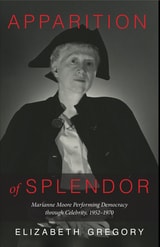
Apparition of Splendor
Marianne Moore Performing Democracy through Celebrity, 1952–1970Elizabeth Gregory
University of Delaware Press, 2021
While the later work of the great Modernist poet Marianne Moore was hugely popular during her final two decades, since her death critics have condemned it as trivial. This book challenges that assessment: with fresh readings of many of the late poems and of the iconic, cross-dressing public persona Moore developed to deliver them, Apparition of Splendor demonstrates that Moore used her late-life celebrity in daring and innovative ways to activate egalitarian principles that had long animated her poetry. Dressed as George Washington in cape and tricorn and writing about accessible topics like sports, TV shows, holidays, love, activism, mortality and celebrity itself, she reached a wide cross-section of Americans, encouraging them to consider what democracy means in their daily lives, particularly around issues of gender, sexuality, racial integration, class, age, and immigration. Moore actively sought out publication in popular venues (like Vogue, The New Yorker, and the Saturday Evening Post, etc.) and wrote on material chosen to directly appeal to the audiences there, influencing younger contemporaries, including poets like Ashbery, O’Hara, and Bishop, and artists like Warhol, Yoko Ono, and Ray Johnson.
Published by the University of Delaware Press. Distributed worldwide by Rutgers University Press.
Applied Arts and Health
Building Bridges across Art, Therapy, Health, Education, and CommunityEdited by Ross W. Prior, Mitchell Kossak, and Teresa A. Fisher
Intellect Books, 2022
This forward-thinking collection documents diverse approaches to creative arts engagement, building metaphoric bridges across the field with an emphasis on creativity and well-being in education and community development. The book advances integrative and multimodal art-based processes by focusing on applied arts and health practice, research, scholarship, expressive arts therapy, community, and education. It aims to give prominence to art-based research and provides useful support to those working and researching across the field.
Bringing together a collection of world-leading authors in the field and spanning a range of cultures, the projects documented in the volume are a significant new addition to cohesive research in this area. In continuing to advance applied arts and health, while furthering a commitment to art-based research, Applied Arts and Health places emphasis upon the artistic research methodology, underscoring that art (performing art and visual art) is the evidence. It offers the field an integral vision for the arts both theoretically and practically. Further, the book breaks down the silos that have been unhelpful in the development of practice.
Après la Crise
États contemporains de la photographieEdited by Donatien Grau and Christoph Wiesner
Diaphanes, 2019

Aqueduct Hunting in the Seventeenth Century
Raffaele Fabretti's De aquis et aquaeductibus veteris RomaeHarry B. Evans
University of Michigan Press, 2002
Fabretti's treatise, De aquis et aquaeductibus veteris Romae dissertationes tres, is cited as a matter of course by all later scholars working in the area of Roman topography. Its findings--while updated and supplemented by more recent archaeological efforts--have never been fully superseded. Yet despite its enormous importance and impact on scholarly efforts, the De aquis has never yet been translated from the original Latin. Aqueduct Hunting in the Seventeenth Century provides a full translation of and commentary on Fabretti's writings, making them accessible to a broad audience and carefully assessing their scholarly contributions.
Harry B. Evans offers his reader an introduction to Fabretti and his scholarly world. A complete translation and a commentary that focuses primarily on the topographical problems and Fabretti's contribution to our understanding of them are also provided. Evans also assesses the contributions and corrections of later archaeologists and topographers and places the De aquis in the history of aqueduct studies.
Evans demonstrates that Fabretti's conclusions, while far from definitive, are indeed significant and merit wider attention than they have received to date. This book will appeal to classicists and classical archaeologists, ancient historians, and readers interested in the history of technology, archaeology, and Rome and Italy in the seventeenth century.
Harry B. Evans is Professor of Classics, Fordham University.
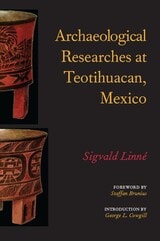
Archaeological Researches at Teotihuacan, Mexico
Sigvald Linne, with a foreword by Staffan Brunius and introduction by George L.
University of Alabama Press, 2003
In 1932, the Ethnographical Museum of Sweden sent an archaeological expedition to Mexico under the direction of Sigvald Linné to determine the full extent of this ancient Teotihuacan occupation and to collect exhibit-quality artifacts. Of an estimated 2,000-plus residential compounds at Teotihuacan, only 20 apartment-like structures were excavated at the time. Yet Linné’s work revealed residential patterns that have been confirmed later in other locations.
Some of the curated objects from the Valley of Mexico and the adjacent state of Puebla are among the most rare and unique artifacts yet found. Another important aspect of this research was that, with the aid of the Museum of Natural History in Washington, Linné’s team conducted ethnographic interviews with remnant native Mexican peoples whose culture had not been entirely destroyed by the Conquest, thereby collecting and preserving valuable information for later research.
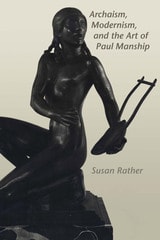
Archaism, Modernism, and the Art of Paul Manship
By Susan Rather
University of Texas Press, 1993
Archaism, an international artistic phenomenon from early in the twentieth century through the 1930s, receives its first sustained analysis in this book. The distinctive formal and technical conventions of archaic art, especially Greek art, particularly affected sculptors—some frankly modernist, others staunchly conservative, and a few who, like American Paul Manship, negotiated the distance between tradition and modernity. Susan Rather considers the theory, practice, and criticism of early twentieth-century sculpture in order to reveal the changing meaning and significance of the archaic in the modern world. To this end—and against the background of Manship’s career—she explores such topics as the archaeological resources for archaism, the classification of the non-Western art of India as archaic, the interest of sculptors in modem dance (Isadora Duncan and Ruth St. Denis), and the changing critical perception of archaism.
Rather rejects the prevailing conception of archaism as a sterile and superficial academic style to argue its initial importance as a modernist mode of expression. The early practitioners of archaism—including Aristide Maillol, André Derain, and Constantin Brancusi—renounced the rhetorical excess, overrefined naturalism, and indirect techniques of late nineteenth-century sculpture in favor of nonnarrative, stylized and directly carved works, for which archaic Greek art offered an important example. Their position found implicit support in the contemporaneous theoretical writings of Emmanuel Löwy, Wilhelm Worringer, and Adolf von Hildebrand.
The perceived relationship between archaic art and tradition ultimately compromised the modernist authority of archaism and made possible its absorption by academic and reactionary forces during the 1910s. By the 1920s, Paul Manship was identified with archaism, which had become an important element in the aesthetic of public sculpture of both democratic and totalitarian societies. Sculptors often employed archaizing stylizations as ends in themselves and with the intent of evoking the foundations of a classical art diminished in potency by its ubiquity and obsolescence. Such stylistic archaism was not an empty formal exercise but an urgent affirmation of traditional values under siege. Concurrently, archaism entered the mainstream of fashionable modernity as an ingredient in the popular and commercial style known as Art Deco. Both developments fueled the condemnation of archaism—and of Manship, its most visible exemplar—by the avant-garde. Rather’s exploration of the critical debate over archaism, finally, illuminates the uncertain relationship to modernism on the part of many critics and highlights the problematic positions of sculpture in the modernist discourse.
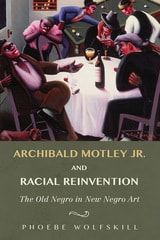
Archibald Motley Jr. and Racial Reinvention
The Old Negro in New Negro ArtPhoebe Wolfskill
University of Illinois Press, 2017
Phoebe Wolfskill demonstrates how Motley's art embodied the tenuous nature of the Black Renaissance and the wide range of ideas that structured it. Focusing on key works in Motley's oeuvre, Wolfskill reveals the artist's complexity and the variety of influences that informed his work. Motley’s paintings suggest that the racist, problematic image of the Old Negro was not a relic of the past but an influence that pervaded the Black Renaissance. Exploring Motley in relation to works by notable black and non-black contemporaries, Wolfskill reinterprets Motley's oeuvre as part of a broad effort to define American cultural identity through race, class, gender, religion, and regional affiliation.
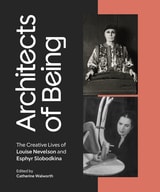
Architects of Being
The Creative Lives of Louise Nevelson and Esphyr SlobodkinaCatherine Walworth
University of Arkansas Press, 2025
Born just nine years apart in Ukraine and Siberia, respectively, Louise Nevelson and Esphyr Slobodkina were both children of Jewish families who fled Russian governmental repression and conflict. Both made early marriages of convenience or convention that were short-lived. Both went to New York in the 1920s, struggling to become artists amid the Great Depression. Both overcame the accepted modes of making, moving between art forms in expansive, category-defying ways. The parallels are poignant, including their similarly fearless devotion to abstract art in an era that had yet to fully embrace it. Architects of Being pays homage to these two women who were direct and dauntless.
Fittingly, this book draws its title from Nevelson’s insight that “there’s something very important about character: character is structure. Character is the architecture of the being.” The connection between inner self and outward manifestation—both one’s art and one’s self-fashioning—is at the heart of Architects of Being. This richly illustrated and expertly researched exhibition catalog celebrates Nevelson’s and Slobodkina’s artistic journeys and architectural affinities, expanding our understanding of how these pioneering figures dissolved boundaries between art forms in ways that prefigured what we see throughout the art world today.
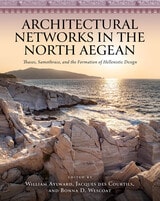
Architectural Networks in the North Aegean
Thasos, Samothrace, and the Formation of Hellenistic DesignEdited by William Aylward, Jacques des Courtils, and Bonna D. Wescoat
University of Wisconsin Press, 2025
Employing the idea of networks to effectively describe the interconnectedness of design, materials, technology, religion, and politics, the contributors to this volume establish the need to understand this important region holistically and on its own terms. Taking a close look at major buildings and monuments—while considering technique, design, and decoration as elements of a vigorous web—this volume offers important insights about the area’s significance in the history of Hellenistic architecture, including lasting innovations in architectural illusion, Ionic entablature, and groundbreaking uses of marble and plaster. From the North Aegean, such principles and tactics were transmitted to the rest of the Hellenistic world, influencing Roman architecture and, from there, Western architectural history.
Architecture Filmmaking
Edited by Igea Troiani and Hugh Campbell
Intellect Books, 2019
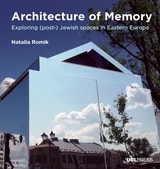
Architecture of Memory
Exploring (Post-) Jewish Spaces in Eastern EuropeNatalia Romik
University College London, 2025
Using archival, architectural, and artistic methods, Architecture of Memory investigates the spectral architecture of former shtetls, predominantly Jewish towns in Central and Eastern Europe before World War II. Through architectural designs, art, and theoretical discussions mapping the historical legacy and present condition of shtetls, author Natalia Romik explores themes of architectural disappearance, urban remembrance, and functional change amid social upheaval. Romik’s unique design research of synagogue ruins, burial grounds, former ritual baths, and other “difficult heritage” contributes to discussions about the protection of Jewish heritage in places where there is no longer any Jewish population.
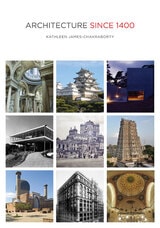
Architecture since 1400
Kathleen James-Chakraborty
University of Minnesota Press, 2014
The first global history of architecture to give equal attention to Western and non-Western structures and built landscapes, Architecture since 1400 is unprecedented in its range, approach, and insight. From Tenochtitlan’s Great Pyramid in Mexico City and the Duomo in Florence to Levittown’s suburban tract housing and the Bird’s Nest Stadium in Beijing, its coverage includes the world’s most celebrated structures and spaces along with many examples of more humble vernacular buildings. Lavishly illustrated with more than 300 photographs, plans, and interiors, this book presents key moments and innovations in architectural modernity around the globe.
Deftly integrating architectural and social history, Kathleen James-Chakraborty pays particular attention to the motivations of client and architect in the design and construction of environments both sacred and secular: palaces and places of worship as well as such characteristically modern structures as the skyscraper, the department store, and the cinema. She also focuses on the role of patrons and addresses to an unparalleled degree the impact of women in commissioning, creating, and inhabiting the built environment, with Gertrude Jekyll, Lina Bo Bardi, and Zaha Hadid taking their place beside Brunelleschi, Sinan, and Le Corbusier.
Making clear that visionary architecture has never been the exclusive domain of the West and recognizing the diversity of those responsible for commissioning, designing, and constructing buildings, Architecture since 1400 provides a sweeping, cross-cultural history of the built environment over six centuries.
Archiveology
Walter Benjamin and Archival Film PracticesCatherine Russell
Duke University Press, 2018
Archives of American Art Journal, volume 60 number 1 (Spring 2021)
The University of Chicago Press
University of Chicago Press Journals, 2021
Archives of American Art Journal, volume 60 number 2 (Fall 2021)
The University of Chicago Press
University of Chicago Press Journals, 2021
Archives of American Art Journal, volume 61 number 1 (Spring 2022)
The University of Chicago Press
University of Chicago Press Journals, 2022
Archives of American Art Journal, volume 61 number 2 (Fall 2022)
The University of Chicago Press
University of Chicago Press Journals, 2022
Archives of American Art Journal, volume 62 number 1 (Spring 2023)
The University of Chicago Press
University of Chicago Press Journals, 2023
Archives of American Art Journal, volume 62 number 2 (Fall 2023)
The University of Chicago Press
University of Chicago Press Journals, 2023
Archives of American Art Journal, volume 63 number 1 (Spring 2024)
The University of Chicago Press
University of Chicago Press Journals, 2024
Archives of American Art Journal, volume 63 number 2 (Fall 2024)
The University of Chicago Press
University of Chicago Press Journals, 2024
Archives of American Art Journal, volume 64 number 1 (Spring 2025)
The University of Chicago Press
University of Chicago Press Journals, 2025
Archives of American Art Journal, volume 64 number 2 (Fall 2025)
The University of Chicago Press
University of Chicago Press Journals, 2025
Archives of American Art Journal, volume 65 number 1 (Spring 2026)
The University of Chicago Press
University of Chicago Press Journals, 2026
Archives of the Insensible
Of War, Photopolitics, and Dead MemoryAllen Feldman
University of Chicago Press, 2015
Excavating a scenography of trials—formal or covert, orchestrated or improvised, criminalizing or criminal—Feldman shows how the will to truth disappears into the very violence it interrogates. He maps the sensory inscriptions and erasures of war, highlighting war as a media that severs factuality from actuality to render violence just. He proposes that war promotes an anesthesiology that interdicts the witness of a sensory and affective commons that has the capacity to speak truth to war. Feldman uses layered deconstructive description to decelerate the ballistical tempo of war to salvage the embodied actualities and material histories that war reduces to the ashes of collateral damage, the automatism of drones, and the opacities of black sites. The result is a penetrating work that marries critical visual theory, political philosophy, anthropology, and media archeology into a trenchant dissection of emerging forms of sovereignty and state power that war now makes possible.
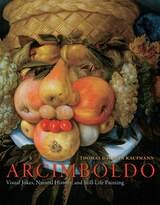
Arcimboldo
Visual Jokes, Natural History, and Still-Life PaintingThomas DaCosta Kaufmann
University of Chicago Press, 2010
In Giuseppe Arcimboldo’s most famous paintings, grapes, fish, and even the beaks of birds form human hair. A pear stands in for a man’s chin. Citrus fruits sprout from a tree trunk that doubles as a neck. All sorts of natural phenomena come together on canvas and panel to assemble the strange heads and faces that constitute one of Renaissance art’s most striking oeuvres. The first major study in a generation of the artist behind these remarkable paintings, Arcimboldo tells the singular story of their creation.
Drawing on his thirty-five-year engagement with the artist, Thomas DaCosta Kaufmann begins with an overview of Arcimboldo’s life and work, exploring the artist’s early years in sixteenth-century Lombardy, his grounding in Leonardesque traditions, and his tenure as a Habsburg court portraitist in Vienna and Prague. Arcimboldo then trains its focus on the celebrated composite heads, approaching them as visual jokes with serious underpinnings—images that poetically display pictorial wit while conveying an allegorical message. In addition to probing the humanistic, literary, and philosophical dimensions of these pieces, Kaufmann explains that they embody their creator’s continuous engagement with nature painting and natural history. He reveals, in fact, that Arcimboldo painted many more nature studies than scholars have realized—a finding that significantly deepens current interpretations of the composite heads.
Demonstrating the previously overlooked importance of these works to natural history and still-life painting, Arcimboldo finally restores the artist’s fantastic visual jokes to their rightful place in the history of both science and art.
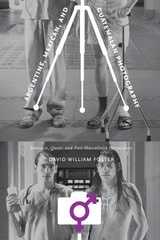
Argentine, Mexican, and Guatemalan Photography
Feminist, Queer, and Post-Masculinist PerspectivesBy David William Foster
University of Texas Press, 2014
One of the important cultural responses to political and sociohistorical events in Latin America is a resurgence of urban photography, which typically blends high art and social documentary. But unlike other forms of cultural production in Latin America, photography has received relatively little sustained critical analysis. This pioneering book offers one of the first in-depth investigations of the complex and extensive history of gendered perspectives in Latin American photography through studies of works from Argentina, Mexico, and Guatemala.
David William Foster examines the work of photographers ranging from the internationally acclaimed artists Graciela Iturbide, Pedro Meyer, and Marcos López to significant photographers whose work is largely unknown to English-speaking audiences. He grounds his essays in four interlocking areas of research: the experience of human life in urban environments, the feminist matrix and gendered cultural production, Jewish cultural production, and the ideological principles of cultural works and the connections between the works and the sociopolitical and historical contexts in which they were created. Foster reveals how gender-marked photography has contributed to the discourse surrounding the project of redemocratization in Argentina and Guatemala, as well as how it has illuminated human rights abuses in both countries. He also traces photography’s contributions to the evolution away from the masculinist-dominated post–1910 Revolution ideology in Mexico. This research convincingly demonstrates that Latin American photography merits the high level of respect that is routinely accorded to more canonical forms of cultural production.
Arijana Lekic-Fridrih
All Art Is a Political Statement / Svaka Umjetnost Je Politicka IzavaRebekah Modrak
Disobedience Press, 2024
Arijana Lekić-Fridrih: All Art is a Political Statement introduces audiences to the work of Croatian artist Arijana Lekić-Fridrih and, in particular, to her Silent Mass, a performance resisting the “Be Manly” movement, a series of mass prayer events held in Croatian public squares by a battalion of men who pray for the abolition of women’s rights, for women’s “chastity,” and for men’s “masculine authority.” All Art is a Political Statement links the erosion of women’s rights across intercontinental boundaries and offers Lekić-Fridrih’s multimedia art as a guide for activism against retrograde restrictions on the freedom of women.
Arijana Lekić-Fridrih: Svaka umjetnost je politička izjava upoznaje publiku s radom hrvatske umjetnice Arijane Lekić-Fridrih, a posebno s njezinom Tihom misom, performansom otpora pokretu “Budi muško”, nizu masovnih molitvenih događanja koje na hrvatskim javnim trgovima održava bataljun muškaraca moleći za ukidanje ženskih prava, za žensku “čednost”, a za muškarce “muški autoritet”. Svaka umjetnost je politička izjava spaja eroziju ženskih prava preko interkontinentalnih granica i nudi multimedijsku umjetnost Lekić-Fridrih kao vodič za aktivizam protiv nazadnih ograničenja slobode žena.
Aristotle's Rhetoric
An Art of CharacterEugene Garver
University of Chicago Press, 1995
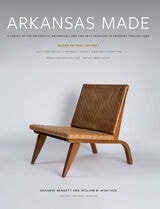
Arkansas Made, Volume 1
A Survey of the Decorative, Mechanical, and Fine Arts Produced in Arkansas through 1950Swannee Bennett
University of Arkansas Press, 2020
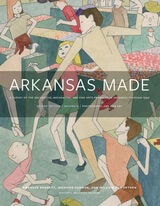
Arkansas Made is the culmination of Historic Arkansas Museum’s exhaustive investigations into the history of the state’s material culture. Decades of meticulous research have resulted in this exciting two-volume survey of cabinetmakers, silversmiths, potters, fine artists, quilters, and other artisans working in communities all over the state.
The work of the artisans documented here has been the driving force of Historic Arkansas Museum’s mission to collect and preserve Arkansas’s creative legacy and rich artistic traditions. Artisans from across Arkansas’s rich cultural landscape come to life among the colorful quilts, playful temperance jugs, and inventive effigies included in Volume I. Readers will delight not only in the striking full-color images but also in the stories that weave them together across time and region to create a lively picture of art and artisanship in a state too little celebrated for its creative output.
Quilts and Textiles • Ceramics • Silver •Weaponry • Furniture • Vernacular Architecture • Native American Art
Arkansas Made, Volume 2
A Survey of the Decorative, Mechanical, and Fine Arts Produced in Arkansas through 1950Swannee Bennett
University of Arkansas Press, 2020
Arkansas Made is the culmination of Historic Arkansas Museum’s exhaustive investigations into the history of the state’s material culture. Decades of meticulous research have resulted in this exciting two-volume survey of cabinetmakers, silversmiths, potters, fine artists, quilters, and other artisans working in communities all over the state.
The work of the artisans documented here has been the driving force of Historic Arkansas Museum’s mission to collect and preserve Arkansas’s creative legacy and rich artistic traditions. The photographs and fine artworks that enliven the pages of Volume II represent not only a delightfully broad scope of talent in genres ranging from landscapes to cubist portraits to political cartoons, but also a longstanding tradition of advocacy and support for the arts in Arkansas.
Volume 2Photography • Fine Art
Armenia
Masterpieces from an Enduring CultureTheo Maarten van Lint and Robin Meyer
Bodleian Library Publishing, 2015
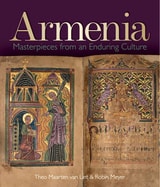
Published to accompany an exhibition at the Bodleian Library, Armenia: Masterpieces from an Enduring Culture draws on the Libraries’ magnificent collection of Armenian manuscripts and early printed books, as well as works of art and religious artifacts to tell the story of the region. The book contains nearly two hundred color illustrations of some of the most treasured masterpieces, from philosophical treatises to splendidly illuminated gospel manuscripts. Also including four essays by experts in the field, the book affords ample insight into the perseverance of the Armenian people in the face of tremendous adversity.
Arrows Tipped with Flowers
Threshold Theory for Transformative LearningJulie Geredien
University of Illinois Press, 2026
Threshold theory challenges unexamined mental habits and exposes absolutisms that hold social order by impeding the comprehension process. As those learning at the threshold approach transition and the unknown, they participate in transformations that illuminate hidden developmental patterns and ecological relationships. Geredien’s threshold theorizing brings together realities at the heart of creativity, relational worldview, and anti-oppression work to forge the philosophical and psychological foundations necessary to reshape policies and practices.
Innovative and expansive, Arrows Tipped with Flowers reveals the psychology of integrity that underpins truly global learning and explains the need to develop more inclusive and reflective approaches to knowledge formation.

Art & Money
Marc Shell
University of Chicago Press, 1995
Unlike traditional approaches to the topic, Art & Money is not a study of money and exchange as an artistic "theme." It is also not a study of economics as a context for the history of art. Rather, it is a path-breaking exploration of the internal logic—the set of meanings and values—common to both money and art.
Art & Money provides striking insight into current matters of art collection, counterfeiting, and problems of attribution, into the general relation between word and image, and into controversies over taxation and crises or scandals in the financial world. Shell's historical range is immense, and he fills this study with amusing anecdotes and insights ranging from the relic of the Holy Foreskin to the state's arrest of J. S. G. Boggs, a conceptual artist who draws money. Illustrated with over one hundred halftones and eight color plates, this stunning volume will force a rethinking of our old presumptions about where money ends and art begins.

Art & Outrage
Provocation, Controversy and the Visual ArtsJohn A. Walker
Pluto Press, 1998
When art hits the headlines, it is usually because it has caused offence or is perceived by the media to have shock-value. Over the last fifty years many artists have been censored, vilified, accused of blasphemy and obscenity, threatened with violence, prosecuted and even imprisoned. Their work has been trashed by the media and physically attacked by the public.
In Art & Outrage, John A. Walker covers the period from the late 1940s to the 1990s to provide the first detailed survey of the most prominent cases of art that has scandalised. The work of some of Britain’s leading, and less well known, painters and sculptors of the postwar period is considered, such as Richard Hamilton, Bryan Organ, Rachel Whiteread, Reg Butler, Damien Hirst, Jamie Wagg, Barry Flanagan and Antony Gormley. Included are works made famous by the media, such as Carl Andre’s Tate Gallery installation of 120 bricks, Rick Gibson’s foetus earrings, Anthony-Noel Kelly’s cast body-parts sculptures and Marcus Harvey’s portrait of Myra Hindley. Walker describes how each incident emerged, considers the arguments for and against, and examines how each was concluded. While broadly sympathetic to radical contemporary art, Walker has some residual sympathy for the layperson’s bafflement and antagonism. This is a scholarly yet accessible study of the interface between art, society and mass media which offers an alternative history of postwar British art and attitudes.
Art & Language International
Conceptual Art between Art WorldsRobert Bailey
Duke University Press, 2016
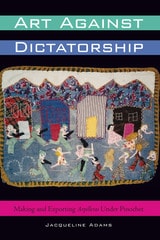
Art Against Dictatorship
Making and Exporting Arpilleras Under PinochetBy Jacqueline Adams
University of Texas Press, 2013
Art can be a powerful avenue of resistance to oppressive governments. During the dictatorship of Augusto Pinochet in Chile, some of the country’s least powerful citizens—impoverished women living in Santiago’s shantytowns—spotlighted the government’s failings and use of violence by creating and selling arpilleras, appliquéd pictures in cloth that portrayed the unemployment, poverty, and repression that they endured, their work to make ends meet, and their varied forms of protest. Smuggled out of Chile by human rights organizations, the arpilleras raised international awareness of the Pinochet regime’s abuses while providing income for the arpillera makers and creating a network of solidarity between the people of Chile and sympathizers throughout the world.
Using the Chilean arpilleras as a case study, this book explores how dissident art can be produced under dictatorship, when freedom of expression is absent and repression rife, and the consequences of its production for the resistance and for the artists. Taking a sociological approach based on interviews, participant observation, archival research, and analysis of a visual database, Jacqueline Adams examines the emergence of the arpilleras and then traces their journey from the workshops and homes in which they were made, to the human rights organizations that exported them, and on to sellers and buyers abroad, as well as in Chile. She then presents the perspectives of the arpillera makers and human rights organization staff, who discuss how the arpilleras strengthened the resistance and empowered the women who made them.
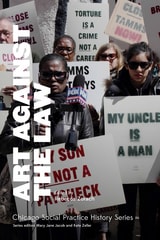
Art Against the Law
Edited by Rebecca Zorach
School of the Art Institute of Chicago, 2014
Despite the city's sometimes notorious political and social history, art practices that challenge authority have thrived in Chicago. Art Against the Law examines the creative tactics of the city’s activist artists and their ways of addressing the broad definitions of the law—from responses to excessive policing to inequities in public policy. These include creative forms of protest, rebellion against the law through illegal art practices, and using the political system itself as an art medium to alter existing laws. The essays and conversations in this volume also address the boundaries between art and creative activism and question whether lines should be drawn at all. Through these texts and interviews, Art Against the Law proves that creative imagination can be formidable in challenging the status quo.
Art Against the Law is part of the new Chicago Social Practice History series, edited by Mary Jane Jacob and Kate Zeller in the Department of Exhibitions and Exhibition Studies at the School of the Art Institute of Chicago (SAIC).
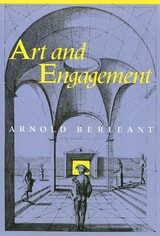
Art And Engagement
Arnold Berleant
Temple University Press, 1993
In this book Arnold Berleant develops a bold alternative to the eighteenth-century aesthetic of disinterestedness. Centering on the notion of participatory engagement in the appreciation of art, he explores its appearance in art and in aesthetic perception, especially during the past century. Aesthetic engagement becomes a key, both on historical and theoretical grounds, to making intelligible our experiences with both contemporary and classical arts. In place of the traditional aesthetic that enjoins the appreciator to adopt a contemplative attitude, distancing the art object in order to ensure its removal from practical uses, Art and Engagement examines the ways in which art entices us into intimate participation in its workings.
Beginning with the historical and theoretical underpinnings of the idea of engagement, Berleant focuses on how engagement works as a force in different arts. Successive chapters pursue its influence in landscape painting, architecture and environmental design, literature, music, dance, and film.
Art and Engagement argues forcefully for the originality and power of aesthetic perception. Demolishing the conceptual barriers erected by the Western world’s limiting tradition, the book discloses the condition of engagement that has always been present when our aesthetic encounters have been most effective and suggests a new direction for aesthetic inquiry.