Results by title
28246 books match the query 'History' and 2543 start with a
At the President's Side
The Vice Presidency in the Twentieth CenturyEdited by Timothy Walch
University of Missouri Press, 1997
The nation's first vice president, John Adams, called his job "the most insignificant office ever the invention of man contrived or his imagination conceived." And many of the forty-four men who succeeded him in the office have said much worse. Perhaps the biggest problem is that the job has a fancy title, but few responsibilities. Other than presiding over the Senate, the vice president of the United States has no constitutional duties. In fact, it is not even clear that the founders of the republic ever intended that the vice president would succeed to the presidency upon the death of an incumbent.
Yet, despite the relative obscurity of the position, few politicians turn down the opportunity to serve as vice president of the United States. Being elected vice president is often a stepping-stone to the presidency. Since World War II, five vice presidents—Harry Truman, Richard Nixon, Lyndon Johnson, Gerald Ford, and George Bush—have gone on to become president. While it may not be glamorous, the vice presidency is an important training ground for national leadership.
The essays in this book trace the evolution of the vice presidency in the twentieth century from Theodore Roosevelt to Dan Quayle. The first five chapters tell the stories of a colorful collection of the men chosen because of their native states or their political acumen, but not their leadership abilities. The next four chapters form a mosaic of tragedy. Richard Nixon rose from the vice presidency to the presidency only to be forced from office. Lyndon Johnson's tenure ended unhappily because of the prolonged fighting in Vietnam. Hubert Humphrey was humiliated as vice president by a man who should have known better. And Spiro Agnew was rousted from the office by petty greed.
The following four chapters tell the story of a new vice presidency. Nelson Rockefeller, Walter Mondale, George Bush, and Dan Quayle redefined the job that not many people wanted but that few could refuse. In a particularly valuable essay, Quayle reflects on the checkered past of his predecessors, gives credit to Walter Mondale for rehabilitating the vice presidency, and tells of his working relationship with George Bushþoffering a unique glimpse of an office that is quickly becoming the second most powerful in the nation.
Addressing the future of the office, Richard E. Neustadt provides a detailed analysis of the nucleus of vice presidential powerþproximity to the president. To whit, we have Neustadt's maxim: "The power and influence of a vice president is inversely proportional to the political distance between that vice president and his president. The greater the distance the less the power."
At the President's Side includes anecdotal and informative essays by presidential scholars John Milton Cooper Jr., Robert H. Ferrell, Elliot A. Rosen, Richard S. Kirkendall, Richard Norton Smith, Robert Dallek, Joel K. Goldstein, John Robert Greene, and Steven M. Gillon. Also included are incisive commentaries by such Washington insiders as Hugh Sidey, R. W. Apple Jr., James Cannon, and Chase Untermeyer. This book will inform and entertain general readers and also challenge scholars interested in the presidency and the vice presidency.

At the Vanguard of Vinyl
A Cultural History of the Long-Playing Record in JazzDarren Mueller
Duke University Press, 2024
Atavistic Tendencies
The Culture of Science in American ModernityDana Seitler
University of Minnesota Press, 2008
A provocative exploration of the impact of the human sciences on literature, politics, and culture
The post-Darwinian theory of atavism forecasted obstacles to human progress in the reappearance of throwback physical or cultural traits after several generations of absence. In this original and stimulating work, Dana Seitler explores the ways in which modernity itself is an atavism, shaping a historical and theoretical account of its dramatic rise and impact on Western culture and imagination.
Examining late nineteenth- and early twentieth-century science, fiction, and photography, Seitler discovers how modern thought oriented itself around this paradigm of obsolescence and return—one that served to sustain ideologies of gender, sexuality, and race. She argues that atavism was not only a discourse of violence—mapping racial and sexual divisions onto the boundary between human and animal—but was also an illustration of how modern science understood human being as a temporal category. On one hand, atavism positioned some humans as more advanced than others on an evolutionary scale. On the other, it undermined such progressivism by suggesting that because all humans had evolved from animals they were therefore not purely human. Atavism thus reveals how scientific theories of a recurrent past were a significant feature of modernity.At the beginning of the twentieth century, atavistic theory had widespread social and economic effects on the taxonomies of medicine, the logic of the welfare state, conceptions of the modern family, and images of the abnormal. Investigating the cultural logic of science in conjunction with naturalist, feminist, and popular narratives, Seitler exposes the influence of atavism: a fundamental shift in ways of knowing—and telling stories about—the modern human.
Athene Palace
Hitler's "New Order" Comes to RumaniaR. G. Waldeck
University of Chicago Press, 2013
Athenian Tragedy in Performance
A Guide to Contemporary Studies and Historical DebatesMelinda Powers
University of Iowa Press, 2014
A case study of Euripides’s Bacchae, which provides more information about performance than any other extant tragedy, demonstrates possible methods for reconstructing the play’s historical performance and also the inevitable challenges inherent in that task, from the limited sources and the difficulty of interpreting visual material, to the risks of conflating actor with character and extrapolating backward from contemporary theatrical experience.
As an inquiry into the study of theatre and performance, an introduction to historical writing, a reference for further reading, and a clarification of several general misconceptions about Athenian tragedy and its performance, this historiographical analysis will be useful to specialists, practitioners, and students alike.
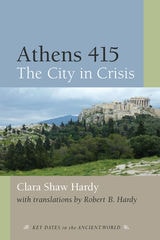
Athens 415
The City in CrisisClara Shaw Hardy, with translations by Robert B. Hardy
University of Michigan Press, 2020
On a summer night in 415 BCE, unknown persons systematically mutilated most of the domestic “herms”—guardian statues of the god Hermes—in Athens. The reaction was immediate and extreme: the Athenians feared a terrifying conspiracy was underway against the city and its large fleet—and possibly against democracy itself. The city established a board of investigators, which led to informants, accusations, and flight by many of the accused. Ultimately, dozens were exiled or executed, their property confiscated.
This dramatic period offers the opportunity to observe the city in crisis. Sequential events allow us to see the workings of the major institutions of the city (assembly, council, law courts, and theater, as well as public and private religion). Remarkably, the primary sources for these tumultuous months name conspirators and informants from a very wide range of status-groups: citizens, women, slaves, and free residents. Thus the incident provides a particularly effective entry-point into a full multifaceted view of the way Athens worked in the late fifth century.
Designed for classroom use, Athens 415 is no potted history, but rather a source-based presentation of ancient urban life ideal for the study of a people and their institutions and beliefs. Original texts—all translated by poet Robert B. Hardy—are presented along with thoughtful discussion and analyses by Clara Shaw Hardy in an engaging narrative that draws students into Athens’ crisis.
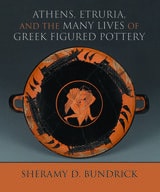
Athens, Etruria, and the Many Lives of Greek Figured Pottery
Sheramy D. Bundrick
University of Wisconsin Press, 2021
Thousands of Greek painted vases have emerged from excavations of tombs, sanctuaries, and settlements throughout Etruria, from southern coastal centers to northern communities in the Po Valley. Using documented archaeological assemblages, especially from tombs in southern Etruria, Bundrick challenges the widely held assumption that Etruscans were hellenized through Greek imports. She marshals evidence to show that Etruscan consumers purposefully selected figured pottery that harmonized with their own local needs and customs, so much so that the vases are better described as etruscanized. Athenian ceramic workers, she contends, learned from traders which shapes and imagery sold best to the Etruscans and employed a variety of strategies to maximize artistry, output, and profit.

Athens, Ohio
The Village YearsRobert L. Daniel
Ohio University Press, 1997
Two hundred years ago, Rufus Putnam, leader of the Ohio Company, sent eleven men west into the Ohio Country to found what is now the City of Athens. As one of the oldest communities in Ohio, Athens has a heritage rich in history and lore. Now, as Athens looks ahead to its third century, historian and raconteur Robert L. Daniel provides a timely assessment of the community’s past.
Drawing on reminiscences by Athens residents over the past two centuries, and on newspaper accounts, institutional archives, census records, and a host of historic photographs and drawings, Daniel illustrates how the Athens community grew, how it changed over the years, and what it was like to have lived in Athens in the past, from the times before white settlement to 1920. He identifies the problems the community faced and how it went about resolving them—its efforts to provide local government, the changing ways its people earned a living, the ways they worshipped, their efforts to establish Ohio University, how they coped during times of war, and what they did to amuse themselves.
In a lively style peppered with firsthand accounts by the people who made Athens, Daniel narrates his tale with wry humor and a sharp eye for detail. Always focusing on the people who lived there, he brings Athens to life during its village years.
Atlanta Life Insurance
Guardian of Black Economic DignityAlexa Benson Henderson
University of Alabama Press, 1990
Efforts to develop an economic base within the Black community began even before the Civil War. These efforts gained new meaning in the post-Reconstruction period as Blacks strove to adapt to radically changing economic circumstances and the emergence of the Jim Crow South. In Atlanta, shortly after the turn of the century, Alonzo Franklin Herndon, a former slave, joined a long line of Black entrepreneurs by creating Atlanta Life Insurance Company. More than three-quarters of a century later, it remains an important enterprise that is the nation’s largest Black-controlled shareholder insurance company. The firm is today a significant example of the efforts of Black Americans to achieve economic independence and dignity in America.
Atlantic Celts
Ancient People Of Modern InventionSimon James
University of Wisconsin Press, 1999
The Celtic peoples hold a fundamental place in the British national conscious-ness. In this book Simon James surveys ancient and modern ideas of the Celts and challenges them in the light of revolutionary new thinking on the Iron Age peoples of Britain. Examining how ethnic and national identities are constructed, he presents an alternative history of the British Isles, proposing that the idea of insular Celtic identity is really a product of the rise of nationalism in the eighteenth century. He considers whether the “Celticness” of the British Isles is a romantic, even politically dangerous, falsification of history, with implications for the debate on self-government for the Celtic regions of the United Kingdom.

Atlantic Isles
Travel and Identity in the British and Irish West, 1880–1940Gareth Roddy
University of London Press, 2025
The west has long gripped the imagination. In Atlantic Isles, Gareth Roddy examines the cultural and political prominence of the "westward gaze," which flourished in late-nineteenth century Britain and Ireland. From Cornish cliffs and Welsh mountains to Hebridean islands and the Connemara highlands, the west was an imagined geography that transcended the national territories of these isles. In the west, geologists uncovered ancient layers of rock, ethnologists described older racial "types," philologists looked for the survival of Celtic languages, and antiquarians and archaeologists marveled at megalithic monuments at the Atlantic coastline.
This book draws on wide-ranging contemporary sources, including works of geology, philology, ethnology, history, geography, archaeology, folklore, literature, sociology, and an extensive collection of travel writing that popularized western landscapes among readers and tourists who explored the increasingly accessible west by road, rail, and steamer. Atlantic Isles reveals that western landscapes were especially powerful spaces of modern enchantment, where stories of sunken lands and mythical islands produced a sense of mystery and wonder in a supposedly disenchanted world. The significance of western landscapes for national identities is well known, but this book demonstrates that the west was also central to debates about Britishness and to the bold attempt to construct a narrative of multinational union that claimed deep historical roots at a time when the subject of Home Rule periodically dominated political debate.
Atlas of Iowa
Robert C. Shepard
University of Iowa Press, 2024
Atlas of Nevada Conifers
A Phytogeographic ReferenceDavid Alan Charlet
University of Nevada Press, 1996
Atlas of Nevada Conifers is a major scientific contribution to our understanding of the ecology of Nevada. It documents in great detail the distribution of all native conifer species in the state—critical information because of the primary ecological importance of conifers for all organisms and because of the lack of documentation of these distributions in the scientific literature before now. Charlet maps and documents the exact location of herbarium records for 1,600 individual trees. The data found in 23 tables and 22 range maps will serve as a primary reference for botanists, land managers, and conservation biologists for years to come.
Atmospheric Things
On the Allure of Elemental EnvelopmentDerek P. McCormack
Duke University Press, 2018

Atomic Bombshells
How Plastics Shaped Postwar BodiesIsabelle Held
Duke University Press, 2026

Atomic Comics
Cartoonists Confront the Nuclear WorldFerenc Morton Szasz
University of Nevada Press, 2013
The advent of the Atomic Age challenged purveyors of popular culture to explain to the general public the complex scientific and social issues of atomic power. Atomic Comics examines how comic books, comic strips, and other cartoon media represented the Atomic Age from the early 1920s to the present. Through the exploits of superhero figures such as Atomic Man and Spiderman, as well as an array of nuclear adversaries and atomic-themed adventures, the public acquired a new scientific vocabulary and discovered the major controversies surrounding nuclear science. Ferenc Morton Szasz’s thoughtful analysis of the themes, content, and imagery of scores of comics that appeared largely in the United States and Japan offers a fascinating perspective on the way popular culture shaped American comprehension of the fissioned atom for more than three generations.
Atomic Culture
How We Learned to Stop Worrying and Love the BombMichael A. Amundson
University Press of Colorado, 2004
Despite the growing interest in atomic culture and history, the body of relevant scholarship is relatively sparse. Atomic Culture opens new doors into the field by providing a substantive, engaging, and historically based consideration of the topic that will appeal to students and scholars of the Atomic Age as well as general readers.
Contributors include Michael A. Amundson, Mick Broderick, Peter Goin, John Hunner, Ferenc M. Szasz, A. Costandina Titus, Peter C. van Wyck, and Scott C. Zeman.
Atomic Environments
Nuclear Technologies, the Natural World, and Policymaking, 1945–1960Neil S. Oatsvall
University of Alabama Press, 2023
Demonstrates how policymakers influenced environmental science during the early nuclear age
In Atomic Environments: Nuclear Technologies, the Natural World, and Policymaking, 1945–1960, Neil S. Oatsvall examines how top officials in the Truman and Eisenhower administrations used environmental science to develop nuclear strategy at the beginning of the Cold War. While many people were involved in research and analysis during the period in question, it was at highest levels of executive decision-making where environmental science and nuclear science most clearly combined to shape the nation’s policies.
Oatsvall clearly demonstrates how the natural world and the scientific disciplines that study it became integral parts of nuclear science rather than adversarial fields of knowledge. But while nuclear technologies heavily depended on environmental science to develop, those same technologies frequently caused great harm to the natural world. Moreover, while some individuals expressed real anxieties about the damage wrought by nuclear technologies, policymakers as a class consistently made choices that privileged nuclear boosterism and secrecy, prioritizing institutional values over the lives and living systems that they were ostensibly charged to protect.
By scrutinizing institutional policymaking practices and agendas at the birth of the nuclear age, a constant set of values becomes clear. Oatsvall reveals an emerging technocratic class that routinely valued knowledge about the environment to help create and maintain a nuclear arsenal, despite its existential threat to life on earth and the negative effects many nuclear technologies had on ecosystems and the American people alike. Although policymakers took their charge to protect and advance the welfare of the United States and its people seriously, Atomic Environments demonstrates how they often failed to do so because their allegiance to the US nuclear hierarchy blinded them to the real risks and dangers of the nuclear age.

Atoms and Alchemy
Chymistry and the Experimental Origins of the Scientific RevolutionWilliam R. Newman
University of Chicago Press, 2006
Tracing the alchemical roots of Robert Boyle’s famous mechanical philosophy, Newman shows that alchemy contributed to the mechanization of nature, a movement that lay at the very heart of scientific discovery. Boyle and his predecessors—figures like the mysterious medieval Geber or the Lutheran professor Daniel Sennert—provided convincing experimental proof that matter is made up of enduring particles at the microlevel. At the same time, Newman argues that alchemists created the operational criterion of an “atomic” element as the last point of analysis, thereby contributing a key feature to the development of later chemistry. Atomsand Alchemy thus provokes a refreshing debate about the origins of modern science and will be welcomed—and deliberated—by all who are interested in the development of scientific theory and practice.
Atrocities of the Mind
Essays on Violence and Politics in the American CenturyDwight Macdonald
University of Chicago Press, 2026
An essential collection of Dwight Macdonald’s prophetic essays on politics, art, and violence in twentieth-century America.
What does extreme violence do to human values? Does the concept of collective guilt make sense in assessing responsibility for genocide? Has modern mechanized society forever destroyed the possibility of peaceful resistance through art and civil disobedience? Atrocities of the Mind presents anew Dwight Macdonald, one of America’s foremost literary journalists and political activists, grappling with the hard questions of his time—and ours.
In this collection, Macdonald writes about major events—the Holocaust, the atomic bombing of Hiroshima, Gandhi’s assassination, the Vietnam War, and social phenomena such as mass shootings, campus protests, and police brutality—with clear-sighted and buoyant prose. He writes incisively about the cinema of Alfred Hitchcock and Roman Polanski, praises Dorothy Day’s pacifism, and reports circulating an antiwar petition in the White House Rose Garden. And not without effect: his essay “Our Invisible Poor” is said to have spurred the Johnson administration’s War on Poverty.
Norman Mailer memorably called Macdonald “a man with whom one might seldom agree but could never disrespect because he always told the truth as he saw the truth—a man therefore of the most incorruptible integrity.” In our America, reeling from political violence, Macdonald’s truth-telling reminds us how we got here and who we might still become.
Atrocity, Deviance, and Submarine Warfare
Norms and Practices during the World WarsNachman Ben-Yehuda
University of Michigan Press, 2013
In the early 20th century, the diesel-electric submarine made possible a new type of unrestricted naval warfare. Such brutal practices as targeting passenger, cargo, and hospital ships not only violated previous international agreements; they were targeted explicitly at civilians. A deviant form of warfare quickly became the norm.
In Atrocity, Deviance, and Submarine Warfare, Nachman Ben-Yehuda recounts the evolution of submarine warfare, explains the nature of its deviance, documents its atrocities, and places these developments in the context of changing national identities and definitions of the ethical, at both social and individual levels. Introducing the concept of cultural cores, he traces the changes in cultural myths, collective memory, and the understanding of unconventionality and deviance prior to the outbreak of World War I. Significant changes in cultural cores, Ben-Yehuda concludes, permitted the rise of wartime atrocities at sea.

Attachments to War
Biomedical Logics and Violence in Twenty-First-Century AmericaJennifer Terry
Duke University Press, 2017
Attack and Counterattack
The Texas-Mexican Frontier, 1842By Joseph Milton Nance
University of Texas Press, 1964
It is 1842—a dramatic year in the history of Texas-Mexican relations. After five years of uneasy peace, of futile negotiations, of border raids and temporary, unofficial truces, a series of military actions upsets the precarious balance between the two countries. Once more the Mexican Army marches on Texas soil; once more the frontier settlers strengthen their strongholds for defense or gather their belongings for flight. Twice San Antonio falls to Mexican generals; twice the Texans assemble armies for the invasion of Mexico. It is 1842—a year of attack and counterattack.
This is the story that Joseph Milton Nance relates, with a definitiveness and immediacy which come from many years of meticulous research. The exciting story of 1842 is a story of emotions which had simmered through the long, insecure years and which now boil out in blustery threats and demands for vengeance. The Texans threaten to march beyond the Sierra Madres and raise their flag at Monterrey; the Mexicans promise to subdue this upstart Texas and to teach its treacherous inhabitants their place. With communications poor and imaginations fertile, rumors magnify chance banditry into military raids, military raids into full-scale invasions. Newspapers incite their readers with superdramatic, intoxicating accounts of the events. Texans and Mexicans alike respond with a kind of madness that has little or no method. Texas solicits volunteers, calls out troops, plans invasions, and assembles her armies, completely disregarding the fact that her treasury is practically empty—there is little money to buy guns. Meanwhile, in Mexico, where gold and silver are needed for other purposes, “invasions” of Texas are launched—but they are only brief forays more suitable for impressive publicity than for permanent gains.
Still, the conflicts of threat and retaliation, so often futile, are frequently dignified by idealism, friendship, courage, and determination. Both Mexicans and Texans are fighting and dying for liberty, defending their homes against foreign invaders, establishing and maintaining friendships that cross racial and national boundaries, struggling with conflicting loyalties, and—all the while—striving to wrest a living for themselves and their families from the grudging frontier.
Attack and Counterattack, continuing the account which was begun in After San Jacinto, tells from original sources the full story of Texas-Mexican relations from the time of the Santa Fe Expedition through the return of the Somervell Expedition from the Rio Grande. These books examine in great detail and with careful accuracy a period of Texas history that had not heretofore been thoroughly studied and that had seldom been given unbiased treatment. The source materials compiled in the notes and bibliography—particularly the military reports, letters, diaries, contemporary newspapers, and broadsides—will be a valuable tool for any scholar who wishes to study this or related periods.
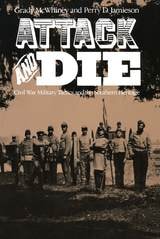
Attack and Die
Civil War Military Tactics and the Southern HeritageGrady McWhiney
University of Alabama Press, 1984
Why did the Confederacy lose so many men? The authors contend that the Confederates bled themselves nearly to death in the first three years of the war by making costly attacks more often than the Federals. Offensive tactics, which had been used successfully by Americans in the Mexican War, were much less effective in the 1860s because an improved weapon—the rifle—had given increased strength to defenders. This book describes tactical theory in the 1850s and suggests how each related to Civil War tactics. It also considers the development of tactics in all three arms of the service during the Civil War.
In examining the Civil War the book separates Southern from Northern tactical practice and discusses Confederate military history in the context of Southern social history. Although the Southerners could have offset their numerical disadvantage by remaining on the defensive and forcing the Federals to attack, they failed to do so. The authors argue that the Southerners’ consistent favoring of offensive warfare was attributable, in large measure, to their Celtic heritage: they fought with the same courageous dash and reckless abandon that had characterized their Celtic forebears since ancient times. The Southerners of the Civil War generation were prisoners of their social and cultural history: they attacked courageously and were killed—on battlefields so totally defended by the Federals that “not even a chicken could get through.”
Attic Greek Prose Syntax
Revised and Expanded in English, Volume 1K. W. Kruger
University of Michigan Press, 1998
The language of classical Greek literature has been extensively studied since the Renaissance, and the most generally admired approach to Greek grammar and syntax has long been K. W. Krüger's Griechische Sprachlehre. In this translation Guy L. Cooper III accepts Krüger's simple and transparent organization, but greatly expands the substance of the earlier work by increasing the total number of citations from the original texts. Research since 1875, especially the contributions of Basil Lanneau Gildersleeve, is incorporated so as to create a reference work, in English, which covers the full range of this complex subject.
Krüger's original paragraph numbering has been maintained so that references in previously published works can be followed directly in the new work. However, every paragraph and chapter has been revised and expanded, opening up new subheadings within Krüger's format. The English has moved away from Krüger's laconic style to a more flowing, readable presentation, without jargon and unexplained technical language. A complete index of passages cited and the impressive number of citations make the work a running syntactic commentary on the whole range of Attic prose literature. The net result is a new comprehensive reference work, an essential reference for libraries and personal collections alike.
Guy L. Cooper III is Professor Emeritus of Classics, University of North Carolina at Asheville.
Volume 2
cloth ISBN 0-472-10844-1
Set of Volumes 1 & 2
cloth ISBN 0-472-10844-1
Attic Greek Prose Syntax
Revised and Expanded in English, Volume 2K. W. Kruger
University of Michigan Press, 1998
The language of classical Greek literature has been extensively studied since the Renaissance, and the most generally admired approach to Greek grammar and syntax has long been K. W. Krüger's Griechische Sprachlehre. In this translation Guy L. Cooper III accepts Krüger's simple and transparent organization, but greatly expands the substance of the earlier work by increasing the total number of citations from the original texts. Research since 1875, especially the contributions of Basil Lanneau Gildersleeve, is incorporated so as to create a reference work, in English, which covers the full range of this complex subject.
Krüger's original paragraph numbering has been maintained so that references in previously published works can be followed directly in the new work. However, every paragraph and chapter has been revised and expanded, opening up new subheadings within Krüger's format. The English has moved away from Krüger's laconic style to a more flowing, readable presentation, without jargon and unexplained technical language. A complete index of passages cited and the impressive number of citations make the work a running syntactic commentary on the whole range of Attic prose literature. The net result is a new comprehensive reference work, an essential reference for libraries and personal collections alike.
Guy L. Cooper III is Professor Emeritus of Classics, University of North Carolina at Asheville.
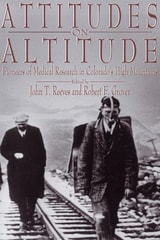
Attitudes on Altitude
Pioneers of Medical Research in Colorado's High MountainsJohn T. Reeves
University Press of Colorado, 2001

Attorney for the Damned
Clarence Darrow in the CourtroomClarence Darrow
University of Chicago Press, 2012
Published for the first time in 1957, Attorney for the Damned collects Darrow’s most influential summations and supplements them with scene-setting explanations and comprehensive notes by Arthur Weinberg. Darrow confronts issues that remain relevant over half a century after his death: First Amendment rights, capital punishment, and the separation of church and state. With an insightful forward by Justice William O. Douglas, this volume serves as a powerful reminder of Darrow’s relevance today.

Attorney for the Frontier
Enos StutsmonDale Gibson
University of Manitoba Press, 1983
Attu Boy
A Young Alaskan's WWII MemoirNick Golodoff
University of Alaska Press, 2015
One of those survivors, Nick Golodoff, became a prisoner of war at just six years old. He was among the dozens of Unangan Attu residents swept away to Hokkaido, and one of only twenty-five to survive. Attu Boy tells Golodoff’s story of these harrowing years as he found both friendship and cruelty at the hands of the Japanese. It offers a rare look at the lives of civilian prisoners and their captors in WWII-era Japan. It also tells of Golodoff’s bittersweet return to a homeland torn apart by occupation and forced internments. Interwoven with other voices from Attu, this richly illustrated memoir is a testament to the struggles, triumphs, and heartbreak of lives disrupted by war.
Au Te Waate / We Remember It
Hiaki Survival Through a Bitter WarMaria Fernanda Leyva; Edited by Heidi Harley
University of Arizona Press, 2025
This compelling work delves into the personal narratives of Hiaki (Yaqui) individuals who endured the tumultuous period from 1900 to 1930, when they faced systematic attacks, conscription, deportation, and enslavement under Mexican government policies. Presented in both the original Hiaki language and English translation, these accounts offer an unparalleled glimpse into the lives of those who resisted and survived the era’s harsh realities. The narratives describe military engagements, the struggles of refugee life, forced labor, and the resilience of families under extreme duress. This work provides a unique and unvarnished account of the impacts of Mexican colonialism and aggression on individuals and families, completely from the Hiaki perspective.
Au Te Waate / We Remember It is not just a historical account but a linguistic treasure, preserving the naturally produced speech of five Hiaki speakers from a previous era. Transcriptions of interviews recorded by author Maria Fernanda Leyva with family members and friends provide invaluable insights into the Hiaki language. The interviews document and preserve the narrative styles, vocabulary, and grammatical constructions of the time.
This work also serves as a crucial resource for scholars of linguistics and history alike, capturing dialect variation and illustrating the linguistic evolution of the Hiaki community. Additionally, for Hiaki people studying their own language, this book stands as a rich repository of cultural and linguistic heritage, meticulously maintained through side-by-side translations and contextual historical introductions.
The narratives in this book are anchored by the experiences of five Hiaki speakers, whose stories of displacement, survival, and resistance provide a deeply personal perspective on the broader historical events of the Porfirio Díaz dictatorship and the early years of the Mexican Revolution. Au Te Waate / We Remember It stands as an important record, preserving these critical voices for future generations and offering profound insights into the resilience of the Hiaki people.
Audible Empire
Music, Global Politics, CritiqueRonald Radano and Tejumola Olaniyan, editors
Duke University Press, 2016
Contributors: Kofi Agawu, Philip V. Bohlman. Michael Denning, Brent Hayes Edwards, Nan Enstad, Andrew Jones, Josh Kun, Morgan Luker, Jairo Moreno, Tejumola Olaniyan, Marc Perry, Ronald Radano, Nitasha Sharma, Micol Seigel, Gavin Steingo, Penny Von Eschen, Amanda Weidman.
Audubon at Sea
The Coastal and Transatlantic Adventures of John James AudubonEdited by Christoph Irmscher and Richard J. King
University of Chicago Press, 2022
The American naturalist John James Audubon (1785–1851) is widely remembered for his iconic paintings of American birdlife. But as this anthology makes clear, Audubon was also a brilliant writer—and his keen gaze took in far more than creatures of the sky. Culled from his published and unpublished writings, Audubon at Sea explores Audubon’s diverse observations of the ocean, the coast, and their human and animal inhabitants. With Audubon expert Christoph Irmscher and scholar of the sea Richard J. King as our guides, we set sail from the humid expanses of the American South to the shores of England and the chilly landscapes of the Canadian North. We learn not only about the diversity of sea life Audubon documented—birds, sharks, fish, and whales—but also about life aboard ship, travel in early America, Audubon’s work habits, and the origins of beloved paintings. As we face an unfathomable loss of seabirds today, Audubon’s warnings about the fragility of birdlife in his time are prescient and newly relevant.
Charting the course of Audubon’s life and work, from his birth in Haiti to his death in New York City, Irmscher and King’s sweeping introduction and carefully drawn commentary confront the challenges Audubon’s legacy poses for us today, including his participation in American slavery and the thousands of birds he killed for his art. Rounded out by hundreds of historical and ornithological notes and beautiful illustrations, and with a foreword by distinguished photographer and conservationist Subhankar Banerjee, Audubon at Sea is the most comprehensively annotated collection of Audubon’s work ever published.
August Reckoning
Jack Turner and Racism in Post–Civil War AlabamaWilliam Warren Rogers Sr.
University of Alabama Press, 2004
During the decades of Bourbon ascendancy after 1874, Alabama institutions like those in other southern states were dominated by whites. Former slave and sharecropper Jack Turner refused to accept a society so structured. Highly intelligent, physically imposing, and an orator of persuasive talents, Turner was fearless before whites and emerged as a leader of his race. He helped to forge a political alliance between blacks and whites that defeated and humiliated the Bourbons in Choctaw County, the heart of the Black Belt, in the election of 1882. That summer, after a series of bogus charges and arrests, Turner was accused of planning to lead his private army of blacks in a general slaughter of the county whites. Justice was forgotten in the resultant fear and hysteria.

Augusta Evans Wilson, 1835-1909
William Perry Fidler
University of Alabama Press, 1951
A comprehensive biography of Augusta Jane Evans Wilson, one of the nineteenth-century America’s best-selling authors
A fascinating biography about Augusta Jane Evans, a nearly forgotten writer who was nevertheless one of the most popular writers of her era. She wrote nine novels about southern women, including St. Elmo, which sold a staggering one million copies within four months of its release in 1866. William Fidler traces the life of Augusta Jane Evans from her birth in 1835 in Columbus, Georgia till her death in Alabama in 1909.
Auguste Bébian
Paving the Way for Deaf EmancipationFabrice Bertin
Gallaudet University Press, 2024
To some, he is a mythical figure; to others, he is unknown. Auguste Bébian (1789-1839) reflects society’s ambivalence toward Deaf history: sometimes recognized, often ignored. In the wake of Abbé de l’Épée, whose name is remembered in posterity and who demonstrated that the large-scale education of Deaf people was possible, Auguste Bébian was nonetheless a key player in an unprecedented upheaval, which in many ways went beyond the educational sphere. The goal of this research on Auguste Bébian, combining biographical elements and analysis of his thinking in unprecedented ways, is not to deconstruct the myth, but rather to decipher the messages it conveys, and to understand what it tells us, indirectly, about the Deaf experience.
Born in 1789 in Guadeloupe, part of the French West Indies, it was on the other side of the Atlantic Ocean, in France, that Auguste Bébian fulfilled most of his destiny. While living at the National Institution for the Deaf in Paris at the beginning of the 19th century, his daily contact with the young students made him the first known hearing person in France to achieve true mastery of sign language, the natural language of Deaf people, and a deep understanding of its inherent culture. On becoming a teacher, he constantly defended the use of sign language as a linguistic system in its own right in order to awaken the intelligence of Deaf children, to whom “we pay no more attention than to the sunlight that shines on us every day.” His numerous publications display a level of modernity rarely seen before or since. This biographical and historical study shows how the passion evinced by Auguste Bébian was a crucial link in the chain of events that led to the emancipation of Deaf people.
Augustine in the Pelagian Controversy
Defending Church UnityAndrew Chronister
Catholic University of America Press, 2024
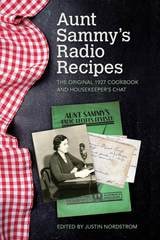
Aunt Sammy's Radio Recipes
The Original 1927 Cookbook and Housekeeper's ChatJustin Nordstrom
University of Arkansas Press, 2018
From the 1920s through the 1940s, American kitchens had a welcome guest in “Aunt Sammy,” a creation of the US Department of Agriculture and its Bureau of Home Economics. Through the radio program Housekeeper’s Chat, Aunt Sammy gave lively advice on food preparation, household chores, parenting and children, and gender dynamics as she encouraged women to embrace the radio and a host of modern consumer household products. The recipes she shared were gathered, in 1927, into a cookbook that became a valuable household manual for tens of thousands of Americans.
Aunt Sammy’s Radio Recipes revives the famous cookbook and joins it with extensive excerpts from the accompanying radio broadcasts, providing a fascinating study of how a witty and charming fictionalized personae became one of the early celebrity chefs of the radio age.
Aurality
Listening and Knowledge in Nineteenth-Century ColombiaAna María Ochoa Gautier
Duke University Press, 2014
Auschwitz, Poland, and the Politics of Commemoration, 1945–1979
Jonathan Huener
Ohio University Press, 2003
Few places in the world carry as heavy a burden of history as Auschwitz. Recognized and remembered as the most prominent site of Nazi crimes, Auschwitz has had tremendous symbolic weight in the postwar world.
Auschwitz, Poland, and the Politics of Commemoration is a history of the Auschwitz memorial site in the years of the Polish People’s Republic. Since 1945, Auschwitz has functioned as a memorial and museum. Its monuments, exhibitions, and public spaces have attracted politicians, pilgrims, and countless participants in public demonstrations and commemorative events.
Jonathan Huener’s study begins with the liberation of the camp and traces the history of the State Museum at Auschwitz from its origins immediately after the war until the 1980s, analyzing the landscape, exhibitions, and public events at the site.
Based on extensive research and illustrated with archival photographs, Auschwitz, Poland, and the Politics of Commemoration accounts for the development and durability of a Polish commemorative idiom at Auschwitz. Emphasis on Polish national “martyrdom” at Auschwitz, neglect of the Shoah as the most prominent element of the camp’s history, political instrumentalization of the grounds and exhibitions—these were some of the more controversial aspects of the camp’s postwar landscape.
Professor Huener locates these and other public manifestations of memory at Auschwitz in the broad scope of Polish history, in the specific context of postwar Polish politics and culture, and against the background of Polish-Jewish relations. Auschwitz, Poland, and the Politics of Commemoration will be of interest to scholars, students, and general readers of the history of modern Poland and the Holocaust.
Austerities and Aspirations
A Comparative History of Growth, Consumption, and Quality of Life in East Central Europe since 1945Béla Tomka
Central European University Press, 2020
This monograph provides an analysis of the economic performance and living standard in Czechoslovakia and its successor states, Hungary, and Poland since 1945. The novelty of the book lies in its broad comparative perspective: it places East Central Europe in a wider European framework that underlines the themes of regional disparities and European commonalities. Going beyond the traditional growth paradigm, the author systematically studies the historical patterns of consumption, leisure, and quality of life—aspects that Tomka argues can best be considered in relation to one other. By adopting this “triple approach,” he undertakes a truly interdisciplinary research drawing from history, economics, sociology, and demography.
As a result of Tomka’s three-pillar comparative analysis, the book makes a major contribution to the debates on the dynamics of economic growth in communist and postcommunist East Central Europe, on the socialist consumer culture along with its transformation after 1990, and on how the accounts on East Central Europe can be integrated into the emerging field of historical quality of life research.
Austin and Mabel
The Amherst Affair and Love Letters of Austin Dickinson and Mabel Loomis ToddPolly Longsworth
University of Massachusetts Press, 1999
Austin, Cleared for Takeoff
Aviators, Businessmen, and the Growth of an American CityBy Kenneth B. Ragsdale
University of Texas Press, 2004
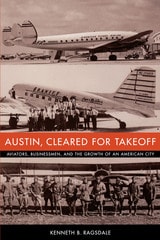
Austin, Texas, entered the aviation age on October 29, 1911, when Calbraith Perry Rodgers landed his Wright EX Flyer in a vacant field near the present-day intersection of Duval and 45th Streets. Some 3,000 excited people rushed out to see the pilot and his plane, much like the hundreds of thousands who mobbed Charles A. Lindbergh and The Spirit of St. Louis in Paris sixteen years later. Though no one that day in Austin could foresee all the changes that would result from manned flight, people here—as in cities and towns across the United States—realized that a new era was opening, and they greeted it with all-out enthusiasm.
This popularly written history tells the story of aviation in Austin from 1911 to the opening of Austin-Bergstrom International Airport in 1999. Kenneth Ragsdale covers all the significant developments, beginning with military aviation activities during World War I and continuing through the barnstorming era of the 1920s, the inauguration of airmail service in 1928 and airline service in 1929, and the dedication of the first municipal airport in 1930. He also looks at the University of Texas's role in training pilots during World War II, the growth of commercial and military aviation in the postwar period, and the struggle over airport expansion that occupied the last decades of the twentieth century. Throughout, he shows how aviation and the city grew together and supported each other, which makes the Austin aviation experience a case study of the impact of aviation on urban communities nationwide.
Australia, New Zealand, and the Pacific Islands since the First World War
Edited by William S. Livingston and Wm. Roger Louis
University of Texas Press, 1979
Three forces—dwindling British power, rising American influence, and nationalism in a variety of forms—have transformed Australia, New Zealand, and the adjacent islands since 1919. In this volume, some of the most distinguished scholars of the Pacific region assess these significant historical changes.
These essays deal with international relations, politics, changing social structures, and literature since World War I. The themes of the volume as a whole are social and humanistic; they concern the evolution of both a regional identity and separate national identities in the Southwest Pacific. The unique areal and thematic concentration of this book makes it essential reading for all those interested in the history, politics, and culture of the Pacific.
Australian Adventure
Letters from an Ambassador's WifeBy Anne Clark
University of Texas Press, 1969
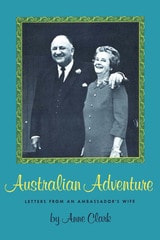
From August 1965 to February 1968, during his period of service in Australia, Ambassador Edward Clark traveled in that country as no other American and probably few Australians ever have. His wife, Anne Clark, traveled with him, then wrote her observations and impressions to friends and family in the United States.
Her letters, published for the first time in this volume, reveal the isolations and involvements as well as the opportunities and the pleasures of embassy life. The etiquette of official functions at times posed problems, as in the Clarks' first black-tie dinner with the Acting Governor General, where Mrs. Clark was supposed to curtsy. "Some Ambassadors feel strongly that the representative of the President of the United States should never bend his knee (or rather his wife's) to any man. Mrs. Battle, wife of our predecessor ... put the question directly to President Kennedy. His answer to her was, 'Curtsy you must, but keep a stiff upper knee.'"
Soon, Anne Clark realized that the routine of appearances and entertainments was constant: "I do not know when I will make peace with the schedule. I am a slave to the little black book that is my calendar."
In addition to the intricacies of embassy life, the Clarks encountered much that was unfamiliar—new people, almost a new language, new flowers, new animals—even a sky with its new moon upside down. But their warm hospitality and genuine interest in things Australian attracted friends throughout the continent. Figures from the government, the church, the diplomatic circle, and everyday life, plus well-known guests from home, all become known to the reader in this perceptive account of official life from the inside.

Australian Film Theory and Criticism
Volume 1: Critical PositionsNoel King, Constantine Verevis, and Deane Williams
Intellect Books, 2013
Australian Film Theory and Criticism
Volume 2: InterviewsEdited by Noel King and Deane Williams
Intellect Books, 2014
Authentic Indians
Episodes of Encounter from the Late-Nineteenth-Century Northwest CoastPaige Raibmon
Duke University Press, 2005
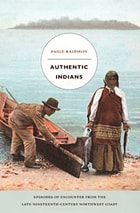
Drawing on research in newspapers, magazines, agency and missionary records, memoirs, and diaries, Raibmon combines cultural and labor history. She looks at three historical episodes: the participation of a group of Kwakwaka’wakw from Vancouver in the 1893 World’s Columbian Exposition in Chicago; the work of migrant Aboriginal laborers in the hop fields of Puget Sound; and the legal efforts of Tlingit artist Rudolph Walton to have his mixed-race step-children admitted to the white public school in Sitka, Alaska. Together these episodes reveal the consequences of outsiders’ attempts to define authentic Aboriginal culture. Raibmon argues that Aboriginal culture is much more than the reproduction of rituals; it also lies in the means by which Aboriginal people generate new and meaningful ways of identifying their place in a changing modern environment.
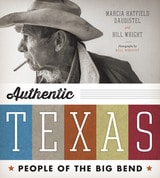
Authentic Texas
People of the Big BendBy Marcia Hatfield Daudistel and Bill Wright
University of Texas Press, 2013
Winner, Southwest Book Award, Border Regional Library Association, 2015
The Texas of vast open spaces inhabited by independent, self-reliant men and women may be more of a dream than a reality for the state’s largely urban population, but it still exists in the Big Bend. One of the most sparsely settled areas of the United States, the Big Bend attracts people who are willing to forego many modern conveniences for a lifestyle that proclaims “don’t fence me in.” Marcia Hatfield Daudistel and Bill Wright believe that the character traits exemplified by folks in the Big Bend—including self-sufficiency, friendliness, and neighborliness—go back to the founding of the state. In this book, they introduce us to several dozen Big Bend residents—old and young, long-settled and recently arrived, racially diverse—who show us what it means to be an authentic Texan.
Interviewing people in Marathon, Big Bend National Park, Terlingua, Redford, Presidio, Alpine, Marfa, Valentine, Balmorhea, Limpia Crossing, and Fort Davis, Daudistel and Wright discover the reasons why residents of the Big Bend make this remote area of Texas their permanent home. In talking to ranchers and writers, entrepreneurs and artists, people living off the grid and urban refugees, they find a common willingness to overcome difficulties through individual skill and initiative. As one interviewee remarks, you have to have a lot of “try” in you to make a life in the Big Bend. Bill Wright’s photographs of the people and landscapes are a perfect complement to the stories of these authentic Texans. Together, these voices and images offer the most complete, contemporary portrait of the Texas Big Bend.