Results by title
3703 books match the query '19th century' and 343 start with a
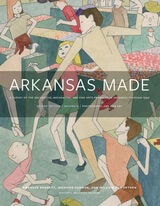
Arkansas Made, Volume 2
A Survey of the Decorative, Mechanical, and Fine Arts Produced in Arkansas through 1950Swannee Bennett
University of Arkansas Press, 2020
Arkansas Made is the culmination of Historic Arkansas Museum’s exhaustive investigations into the history of the state’s material culture. Decades of meticulous research have resulted in this exciting two-volume survey of cabinetmakers, silversmiths, potters, fine artists, quilters, and other artisans working in communities all over the state.
The work of the artisans documented here has been the driving force of Historic Arkansas Museum’s mission to collect and preserve Arkansas’s creative legacy and rich artistic traditions. The photographs and fine artworks that enliven the pages of Volume II represent not only a delightfully broad scope of talent in genres ranging from landscapes to cubist portraits to political cartoons, but also a longstanding tradition of advocacy and support for the arts in Arkansas.
Volume 2Photography • Fine Art
Arkansas Travelers
Geographies of Exploration and Perception, 1804-1834Andrew J. Milson
University of Arkansas Press, 2023
“I reckon stranger you have not been used much to traveling in the woods,” a hunter remarked to Henry Rowe Schoolcraft as he trekked through the Ozark backcountry in late 1818. The ensuing exchange is one of many compelling encounters between Arkansas travelers and settlers depicted in Arkansas Travelers: Geographies of Exploration and Perception, 1804–1834. This book is the first to integrate the stories of four travelers who explored Arkansas during the transformative period between the Louisiana Purchase of 1803 and statehood in 1836: William Dunbar, Thomas Nuttall, Henry Rowe Schoolcraft, and George William Featherstonhaugh.
In addition to gathering their tales of treacherous rivers, drunken scoundrels, and repulsive food, historian and geographer Andrew J. Milson explores the impact such travel narratives have had on geographical understandings of Arkansas places. Using the language in each traveler’s narrative, Milson suggests, and the book includes, new maps that trace these perceptions, illustrating not just the lands traversed, but the way travelers experienced and perceived place. By taking a geographical approach to the history of these spaces, Arkansas Travelers offers a deeper understanding—a deeper map—of Arkansas.
Arkansas, 1800-1860
Remote and RestlessS. Charles Bolton
University of Arkansas Press, 1998
Often thought of as a primitive backwoods peopled by rough hunters and unsavory characters, early Arkansas was actually productive and dynamic in the same manner as other American territories and states. In this, the second volume in the Histories of Arkansas, S. Charles Bolton describes the emigration, mostly from other southern states, that carried Americans into Arkansas; the growth of an agricultural economy based on cotton, corn, and pork; the dominance of evangelical religion; and the way in which women coped with the frontier and made their own contributions toward its improvement. He closely compares the actual lifestyles of the settlers with the popularly held, uncomplimentary image.
Separate chapters deal with slavery and the lives of the slaves and with Indian affairs, particularly the dispossession of the native Quapaws and the later-arriving Cherokees. Political chapters explore opportunism in Arkansas Territory, the rise of the Democratic Party under the control of the Sevier-Johnson group known as the Dynasty, and the forces that led Arkansas to secede from the Union. In addition, Arkansas’s role in the Mexican War and the California gold rush is treated in detail.
In truth, geographic isolation and a rugged terrain did keep Arkansas underpopulated, and political violence and a disastrous experience in state banking tarnished its reputation, but the state still developed rapidly and successfully in this period, playing an important role on the southwestern frontier.
Winner of the 1999 Booker Worthen Literary Prize
Arkansas’s Gilded Age
The Rise, Decline, and Legacy of Populism and Working-Class ProtestMatthew Hild
University of Missouri Press, 2018
The story of farmer and labor protest in Arkansas during the late nineteenth century offers lessons relevant to contemporary
working-class Americans in what some observers have called the “new Gilded Age.”
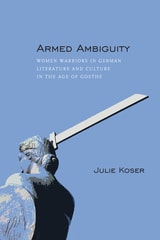
Armed Ambiguity
Women Warriors in German Literature and Culture in the Age of GoetheJulie Koser
Northwestern University Press, 2016
Armed Ambiguity is a fascinating examination of the tropes of the woman warrior constructed by print culture—including press reports, novels, dramatic works, and lyrical texts—during the decades-long conflict in Europe around 1800.
In it, Julie Koser sheds new light on how women’s bodies became a battleground for competing social, cultural, and political agendas in one of the most pivotal periods of modern history. She traces the women warriors in this work as reflections of the social and political climate in German-speaking lands, and she reveals how literary texts and cultural artifacts that highlight women’s armed insurrection perpetuated the false dichotomy of "public" versus "private" spheres along a gendered fault line. Koser illuminates how reactionary visions of "ideal femininity" competed with subversive fantasies of new femininities in the ideological battle being waged over the restructuring of German society.
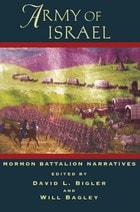
Army Of Israel
David Bigler
Utah State University Press, 2000
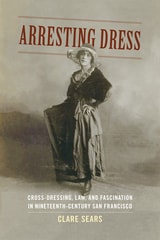
Arresting Dress
Cross-Dressing, Law, and Fascination in Nineteenth-Century San FranciscoClare Sears
Duke University Press, 2015

Arretium (Arezzo)
Edited by Ingrid Edlund-Berry and Cristiana Zaccagnino
University of Texas Press, 2024
A comprehensive examination of the history and excavation of the Etruscan city of Arretium.
Beneath the Italian city of Arezzo lie the remains of Etruscan Arretium. This volume, the first comprehensive treatment of excavations at Arretium, gathers the most up-to-date scholarship on the city and delves into key archaeological discoveries and the stories they tell about life in the Etruscan world.
Chapters explore local history—including the city’s complex political exchanges with Rome—Etruscan religion, Arretium’s role as a center of the arts, and the challenges of excavation amid the bustle of European urban modernity. Editors Ingrid Edlund-Berry and Cristiana Zaccagnino have gathered chapters by expert contributors that detail Arretium’s material culture, including the city’s famed pottery, Arretine ware, which was known across the Mediterranean; terracotta pieces depicting gods and other supernatural beings; and exquisite bronze-work, most notably the piece now known as the Chimaera of Arezzo. One of the few Etruscan cities that continued flourishing after the Roman takeover, Arretium proves to be a trove of archaeological riches and of the historical insights they reveal.

Art and the Academy in the Nineteenth Century
Rafael Cardoso Denis
Rutgers University Press, 2000
"Intellectually broad and carefully grounded in fundamental issues affecting the time, role, and place of the academy in society, this collection explores the ways in which art and tradition are either maintained or rearticulated late in the Victorian Era. Art and the Academy forges a distinctive new way to look at the broad range of academic creativity against a complex network of changing social patterns." -Gabriel P. Weisberg, department of art history, University of Minnesota
Throughout the nineteenth century, academies functioned as the main venues for the teaching, promotion, and display of art. Contemporary scholars have, for the most part, denigrated academic art, calling it formulaic, unoriginal, and repetitious. The contributors to Art and the Academy in the Nineteenth Century challenge this entrenched notion and consider how academies worldwide have represented an important system of artistic preservation and transmission. Their essays eschew easy binaries that have reigned in academia for over half a century and that simply oppose the avant-garde to academism.
The essayists uncover the institutional structures and artistic practices of academies in England, France, Germany, and Brazil. Investigating artistic protocols across national and cultural boundaries, the scholars examine the relationship between artistic training and cultural identity. Their essays provide new insights into the ways in which institutions of art helped shape the nineteenth century's view of itself as an age of civilization amidst the turmoil of rapid social and cultural change. With an engaging mix of works by leading scholars, Art and the Academy will be essential reading for anyone interested in the artistic, cultural, and social history of the nineteenth century.
Rafael Cardoso Denis is adjunct professor (visiting) at the Escola Superior de Desenho Industrial (Universidade do Estado do Rio de Janeiro). Colin Trodd is senior lecturer in art history at the University of Sunderland.
.
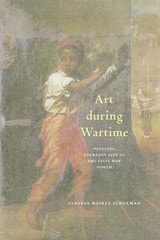
Art during Wartime
Painting Everyday Life in the Civil War NorthVanessa Meikle Schulman
University of Massachusetts Press, 2024
While the Civil War raged on, many northern artists depicted everyday life rather than grand battles or landscapes of noble sacrifice. Amidst a conflict that was upending antebellum social norms, these artists created realistic scenes of mundane events, known as genre paintings. While many of the paintings seem merely to show everyday incidents, Vanessa Meikle Schulman argues that artists connected the visuals to larger concerns.
With attention to how the war shaped new definitions of gender, race, and disability, Art during Wartime uncovers the complexity of these genre paintings. Schulman uses seven case studies of prominent and lesser-known artists who explored how the war instigated social change and shaped northern opinions about current events, including George Cochran Lambdin, Vincent Colyer, and Eastman Johnson. Utilizing detailed visual analysis and extensive historical research, Art during Wartime reframes our narrative of Civil War visual culture, placing genre painting in a central ideological role.
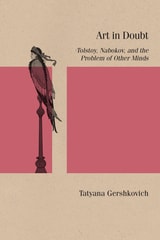
Art in Doubt
Tolstoy, Nabokov, and the Problem of Other MindsTatyana Gershkovich
Northwestern University Press, 2021
Leo Tolstoy’s and Vladimir Nabokov’s radically opposed aesthetic worldviews emanate from a shared intuition—that approaching a text skeptically is easy, but trusting it is hard
Two figures central to the Russian literary tradition—Tolstoy, the moralist, and Nabokov, the aesthete—seem to have sharply conflicting ideas about the purpose of literature. Tatyana Gershkovich undermines this familiar opposition by identifying a shared fear at the root of their seemingly antithetical aesthetics: that one’s experience of the world might be entirely one’s own, private and impossible to share through art.
Art in Doubt: Tolstoy, Nabokov, and the Problem of Other Minds reconceives the pair’s celebrated fiction and contentious theorizing as coherent, lifelong efforts to reckon with the problem of other people’s minds. Gershkovich demonstrates how the authors’ shared yearning for an impossibly intimate knowledge of others formed and deformed their fiction and brought them through parallel logic to their rival late styles: Tolstoy’s rustic simplicity and Nabokov’s baroque complexity. Unlike those authors for whom the skeptical predicament ends in absurdity or despair, Tolstoy and Nabokov both hold out hope that skepticism can be overcome, not by force of will but with the right kind of text, one designed to withstand our impulse to doubt it. Through close readings of key canonical works—Anna Karenina, The Kreutzer Sonata, Hadji Murat, The Gift, Pale Fire—this book brings the twin titans of Russian fiction to bear on contemporary debates about how we read now, and how we ought to.
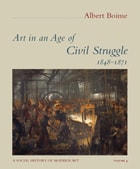
Art in an Age of Civil Struggle, 1848-1871
Albert Boime
University of Chicago Press, 2008
Tracing the various movements of realism through the major metropolitan centers of Europe and America, Boime strikingly evokes the milieus that shaped the lives and works of Gustave Courbet, Edouard Manet, Émile Zola, Honoré Daumier, Walt Whitman, Abraham Lincoln, and the earliest photographers, among countless others. In doing so, he spearheads a powerful new way of reassessing how art emerges from the welter of cultural and political events and the artist’s struggle to interpret his surroundings. Boime supports this multifaceted approach with a wealth of illustrations and written sources that demonstrate the intimate links between visual culture and social change. Culminating at the transition to impressionism, Art in an Age of Civil Struggle makes historical sense of a movement that paved the way for avant-garde aesthetics and, more broadly, of how a particular style emerges at a particular moment.
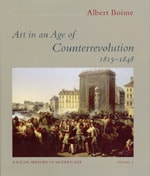
Art in an Age of Counterrevolution, 1815-1848
Albert Boime
University of Chicago Press, 2004
This volume focuses on the astonishing range of art forms currently understood to fall within the broad category of Romanticism. Drawing on visual media and popular imagery of the time, this generously illustrated work examines the art of Romanticism as a reaction to the social and political events surrounding it. Boime reinterprets canonical works by such politicized artists as Goya, Delacroix, Géricault, Friedrich, and Turner, framing their work not by personality but by its sociohistorical context. Boime's capacious approach and scope allows him to incorporate a wide range of perspectives into his analysis of Romantic art, including Marxism, social history, gender identity, ecology, structuralism, and psychoanalytic theory, a reach that parallels the work of contemporary cultural historians and theorists such as Edward Said, Pierre Bourdieu, Eric Hobsbawm, Frederic Jameson, and T. J. Clark.
Boime ultimately establishes that art serves the interests and aspirations of the cultural bourgeoisie. In grounding his arguments on their work and its scope and influence, he elucidates how all artists are inextricably linked to history. This book will be used widely in art history courses and exert enormous influence on cultural studies as well.
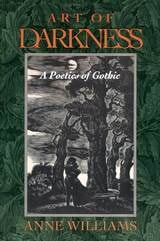
Art of Darkness
A Poetics of GothicAnne Williams
University of Chicago Press, 1995
Building on the psychoanalytic and feminist theory of Julia Kristeva, Williams argues that Gothic conventions such as the haunted castle and the family curse signify the fall of the patriarchal family; Gothic is therefore "poetic" in Kristeva's sense because it reveals those "others" most often identified with the female. Williams identifies distinct Male and Female Gothic traditions: In the Male plot, the protagonist faces a cruel, violent, and supernatural world, without hope of salvation. The Female plot, by contrast, asserts the power of the mind to comprehend a world which, though mysterious, is ultimately sensible. By showing how Coleridge and Keats used both Male and Female Gothic, Williams challenges accepted notions about gender and authorship among the Romantics. Lucidly and gracefully written, Art of Darkness alters our understanding of the Gothic tradition, of Romanticism, and of the relations between gender and genre in literary history.
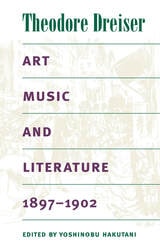
Art, Music, and Literature, 1897-1902
Theodore Dreiser. Edited by Yoshinobu Hakutani
University of Illinois Press, 2007
In this volume, liberally seasoned with period illustrations, Yoshinobu Hakutani has collected and annotated a rich selection of Theodore Dreiser's pre-fame writings on the cultural milieu of his day.
In these brief essays, Dreiser sallies into the vibrant world of creative work in turn-of-the-century America. He inspects the eccentric and revealing paraphernalia of artists' studios, probes the work habits of writers, and goes behind the scenes in the popular song-writing business, where this week's celebrity is next week's has-been. He profiles famous figures and introduces numerous women artists, novelists, and musicians, including the prolific and tireless Amelia Barr (mother of fourteen children and author of thirty-two novels), the illustrator Alice B. Stephens, and the opera singer Lillian Nordica. Hakutani's notes provide biographical detail on dozens of now-obscure individuals mentioned by Dreiser.

Artful Lives
The Francis Watts Lee Family and Their TimesPatricia J. Fanning
University of Massachusetts Press, 2016
Francis Watts Lee and his family hold a special place in the history of American photography. F. Holland Day completed a series of remarkable photographs of Lee's daughter Peggy, and the striking portrait of the child and her mother titled Blessed Art Thou among Women is one of Gertrude Käsebier's most iconic compositions. In Artful Lives, Patricia J. Fanning uses these and other significant images as guideposts to explore the Lee family and the art and culture of their age.
A social reform advocate, Francis Watts Lee was an artistic photographer and a talented printer, part of the circle of avant-garde artists and intellectuals who formed Boston's bohemia. He married twice, first Agnes Rand, an award-winning poet and children's book author, and later, after their divorce, Marion Lewis Chamberlain, a librarian and MIT-trained architect. Francis and Agnes's eldest daughter, Peggy, who was so integral to the work of pioneer Pictorialists, died at age seven of juvenile diabetes. Her sister, Alice, who lost her hearing in infancy, became a wood carver and sculptor.
Utilizing previously unknown family archives and institutional sources, Fanning traces the Lee family's story in the context of major artistic, political, social, and religious trends, including the Arts and Crafts movement, Christian Socialism, and Aestheticism, while also showing how their experiences reflected the national culture's evolving conceptions of family, gender, childhood, medicine, deaf education, and mourning. This richly drawn and gracefully written account of one family informs our understanding of this vibrant era, in Boston and well beyond.
Articulating Difference
Sex and Language in the German Nineteenth CenturySophie Salvo
University of Chicago Press, 2024
Drawing on a wide range of texts, from understudied ethnographic and scientific works to canonical literature and philosophy, Sophie Salvo uncovers the prehistory of the inextricability of gender and language. Taking German discourses on language as her focus, she argues that we are not the inventors but, rather, the inheritors and adapters of the notion that gender and language are interrelated. Particularly during the long nineteenth century, ideas about sexual differences shaped how language was understood, classified, and analyzed. As Salvo explains, philosophers asserted the patriarchal origins of language, linguists investigated “women’s languages” and grammatical gender, and literary Modernists imagined “feminine” sign systems, and in doing so they not only deemed sex-based divisions to be necessary categories of language but also produced a plethora of gendered tropes and fictions, which they used both to support their claims and delimit their disciplines.
Articulating Difference charts new territory, revealing how gendered conceptions of language make possible the misogynistic logic of exclusion that underlies arguments claiming, for example, that women cannot be great orators or writers. While Salvo focuses on how male scholars aligned language study with masculinity, she also uncovers how women responded, highlighting the contributions of understudied nineteenth-century works on language that women wrote even as they were excluded from academic opportunities.
Artificial Generation
Photogenic French Literature and the Prehistory of Cinematic ModernityChristina Parker-Flynn
Rutgers University Press, 2022

Artisans into Workers
LABOR IN NINETEENTH-CENTURY AMERICABruce Laurie
University of Illinois Press, 1989
history, Bruce Laurie examines the character of working-class factionalism, plebian expectations of government, and relations between the organized few and the unorganized many. Laurie also examines the republican tradition and the movements that drew on it, from the General Trades Unions in the age of Jackson to the Knights of Labor later in the century.
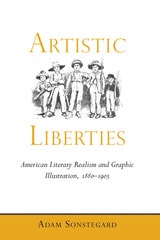
Artistic Liberties
American Literary Realism and Graphic Illustration, 1880-1905Adam Sonstegard
University of Alabama Press, 2013
Though today we commonly read major works of nineteenth-century American literature in unillustrated paperbacks or anthologies, many of them first appeared as magazine serials, accompanied by ample illustrations that sometimes made their way into the serials’ first printings as books. The graphic artists creating these illustrations often visually addressed questions that the authors had left for the reader to interpret, such as the complexions of racially ambiguous characters in Uncle Tom’s Cabin. The artists created illustrations that depicted what outsiders saw in Huck and Jim in Adventures of Huckleberry Finn, rather than what Huck and Jim learned to see in one another. These artists even worked against the texts on occasion—for instance, when the illustrators reinforced the same racial stereotypes that writers such as Paul Laurence Dunbar had intended to subvert in their works.
Authors of American realism commonly submitted their writing to editors who allowed them little control over the aesthetic appearance of their work. In his groundbreaking Artistic Liberties, Adam Sonstegard studies the illustrations from these works in detail and finds that the editors employed illustrators who were often unfamiliar with the authors’ intentions and who themselves selected the literary material they wished to illustrate, thereby taking artistic liberties through the tableaux they created.
Sonstegard examines the key role that the appointed artists played in visually shaping narratives—among them Mark Twain’s Pudd’nhead Wilson, Stephen Crane’s The Monster, and Edith Wharton’s The House of Mirth—as audiences tended to accept their illustrations as guidelines for understanding the texts. In viewing these works as originally published, received, and interpreted, Sonstegard offers a deeper knowledge not only of the works, but also of the realities surrounding publication during this formative period in American literature.
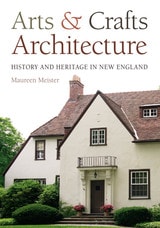
Arts and Crafts Architecture
History and Heritage in New EnglandMaureen Meister
University Press of New England, 2014
Ashes of the Mind
War and Memory in Northern Literature, 1865-1900Martin Griffin
University of Massachusetts Press, 2009
The memory of the American Civil War took many forms over the decades after the conflict ended: personal, social, religious, and political. It was also remembered and commemorated by poets and fiction writers who understood that the war had bequeathed both historical and symbolic meanings to American culture. Although the defeated Confederacy became best known for producing a literature of nostalgia and an ideological defensiveness intended to protect the South's own version of history, authors loyal to the Union also confronted the question of what the memory of the war signified, and how to shape the literary response to that individual and collective experience.
In Ashes of the Mind, Martin Griffin examines the work of five Northerners—three poets and two fiction writers—who over a period of four decades tried to understand and articulate the landscape of memory in postwar America, and in particular in that part of the nation that could, with most justification, claim the victory of its beliefs and values. The book begins with an examination of the rhetorical grandeur of James Russell Lowell's Harvard Commemoration Ode, ranges across Herman Melville's ironic war poetry, Henry James's novel of North-South reconciliation, The Bostonians, and Ambrose Bierce's short stories, and ends with the bitter meditation on race and nation presented by Paul Laurence Dunbar's elegy “Robert Gould Shaw.” Together these texts reveal how a group of representative Northern writers were haunted in different ways by the memory of the
conflict and its fraught legacy.
Griffin traces a concern with individual and community loss, ambivalence toward victory, and a changing politics of commemoration in the writings of Lowell, Melville, James, Bierce, and Dunbar. What links these very different authors is a Northern memory of the war that became more complex and more compromised as the century went on, often replacing a sense of justification and achievement with a perception of irony and failed promise.
Asian American History
Huping Ling
Rutgers University Press, 2023
Asian American History provides a comprehensive historical dive into Asian immigration to the United States, exploring it in international and domestic contexts and alongside the significant elements that define Asian America: imperialism and global capitalist expansion; labor and capital; race and ethnicity; immigration and exclusion; family and work; community and gender roles; assimilation and multiculturalism; panethnicity and identity; transnationalism and globalization; and new challenges and opportunities. Huping Ling traces the roots of Asian immigration from the late 1700s through intervening centuries of racial prejudice, wartime experiences, legal restrictions, and social mobility into the 2010s. It is an up-to-date and easily accessible resource for high school and college students as well as anyone who is interested in Asian American history.

Aspen
The History of a Silver Mining Town, 1879 - 1893Malcolm J. Rohrbough
University Press of Colorado, 2000
Assassination of a Michigan King
The Life of James Jesse StrangRoger Van Noord
University of Michigan Press, 1997
As a young man, Strang was a dreamer of grandiose dreams--dreams of power, of royalty, and of fame. For him, the dreams came true. But in his pursuit of those dreams, Strang walked a tightrope to avoid ever-impending doom. Strang's kingdom flourished despite perennial conflicts with non-Mormons, including a gun battle with mainlanders, and despite a major prosecution by the federal government. His kingdom was designed to be totally independent of the state and nation. And yet, he was a shrewd political tactician who took advantage of Michigan law to be twice elected to the state legislature and become what one Detroit newspaper called the most powerful politician in the state.
Here is Strang the man of contrasts and contradictions, the strident opponent of polygamy and the husband of five wives, the astute editor and the incendiary propagandist, the prophet and the scoundrel, the man who through the sheer force of his personality made his followers a group to be feared in his region.
Vast amount of fresh information, including contemporary journals, documents, and letters never before used by biographers help draw a portrait of one of the most complex and resourceful leaders in American history.
Assassins against the Old Order
Italian Anarchist Violence in Fin de Siecle EuropeNunzio Pernicone, Fraser Ottanelli
University of Illinois Press, 2018
Nunzio Pernicone and Fraser M. Ottanelli dig into the transnational experiences and the historical, social, cultural, and political conditions behind the phenomenon of anarchist violence in Italy. Looking at political assassinations in the 1890s, they illuminate the public effort to equate anarchy's goals with violent overthrow. Throughout, Pernicone and Ottanelli combine a cutting-edge synthesis of the intellectual origins, milieu, and nature of Italian anarchist violence with vivid portraits of its major players and their still-misunderstood movement.
A bold challenge to conventional thinking, Assassins against the Old Order demolishes a century of myths surrounding anarchist violence and its practitioners.
Association and Enlightenment
Scottish Clubs and Societies, 1700-1830Mark C. Wallace
Bucknell University Press, 2021
Asylum, Prison, and Poorhouse
The Writings and Reform Work of Dorothea Dix in IllinoisDavid L. Lightner
Southern Illinois University Press, 1999
This illustrated collection of annotated newspaper articles and memorials by Dorothea Dix provides a forum for the great mid-nineteenth-century humanitarian and reformer to speak for herself.
Dorothea Lynde Dix (1802–87) was perhaps the most famous and admired woman in America for much of the nineteenth century. Beginning in the early 1840s, she launched a personal crusade to persuade the various states to provide humane care and effective treatment for the mentally ill by funding specialized hospitals for that purpose. The appalling conditions endured by most mentally ill inmates in prisons, jails, and poorhouses led her to take an active interest also in prison reform and in efforts to ameliorate poverty.
In 1846–47 Dix brought her crusade to Illinois. She presented two lengthy memorials to the legislature, the first describing conditions at the state penitentiary at Alton and the second discussing the sufferings of the insane and urging the establishment of a state hospital for their care. She also wrote a series of newspaper articles detailing conditions in the jails and poorhouses of many Illinois communities.
These long-forgotten documents, which appear in unabridged form in this book, contain a wealth of information on the living conditions of some of the most unfortunate inhabitants of Illinois. In his preface, David L. Lightner describes some of the vivid images that emerge from Dorothea Dix's descriptions of social conditions in Illinois a century and a half ago: "A helpless maniac confined throughout the bitter cold of winter to a dark and filthy pit. Prison inmates chained in hallways and cellars because no more men can be squeezed into the dank and airless cells. Aged paupers auctioned off by county officers to whoever will maintain them at the lowest cost."
Lightner provides an introduction to every document, placing each memorial and newspaper article in its proper social and historical context. He also furnishes detailed notes, making these documents readily accessible to readers a century and a half later. In his final chapter, Lightner assesses both the immediate and the continuing impact of Dix's work.
At the Hearth of the Crossed Races
A French-Indian Community in Nineteenth-Century Oregon, 1812-1859Melinda Marie Jetté
Oregon State University Press, 2015
Jetté’s study focuses on the “hearth” of this contact: French Prairie, so named for the French-Indian families who resettled the homeland of the Ahantchuyuk Kalapuyans. Although these families sought a middle course in their relations with their various neighbors, their presence ultimately contributed to the Anglo-American colonization of the region. By establishing farming and husbandry operations in the valley, the French-Indian settlers enhanced the Willamette Valley’s appeal as a destination of choice for the Anglo-Americans who later emigrated to the Pacific Northwest via the Oregon Trail.
Upon these emigrants’ arrival, the social space for the people of the “crossed races” diminished considerably, as the Anglo-Americans instituted a system of settler colonialism based on racial exclusion. Like their Native kin, the French-Indian families pursued various strategies to navigate the changing times and Jetté’s study of French Prairie takes on the relationships among all three: the French-Indian families, the indigenous peoples, and the Anglo-American settlers.
With At the Hearth of the Crossed Races, Jetté delivers a social history that deepens our understanding of the Oregon Country in the nineteenth century. This history of French Prairie provides a window into the multi-racial history of the Pacific Northwest and offers an alternative vision of early Oregon in the lives of the biracial French-Indian families whose community challenged notions of white supremacy, racial separation, and social exclusion.
At the Limit of the Obscene
German Realism and the Disgrace of MatterErica Weitzman
Northwestern University Press, 2021
As German-language literature turned in the mid-nineteenth century to the depiction of the profane, sensual world, a corresponding anxiety emerged about the terms of that depiction—with consequences not only for realist poetics but also for the conception of the material world itself. At the Limit of the Obscene examines the roots and repercussions of this anxiety in German realist and postrealist literature. Through analyses of works by Adalbert Stifter, Gustav Freytag, Theodor Fontane, Arno Holz, Gottfried Benn, and Franz Kafka, Erica Weitzman shows how German realism’s conflicted representations of the material world lead to an idea of the obscene as an excess of sensual appearance beyond human meaning: the obverse of the anthropocentric worldview that German realism both propagates and pushes to its crisis. At the Limit of the Obscene thus brings to light the troubled and troubling ontology underlying German realism, at the same time demonstrating how its works continue to shape our ideas about representability, alterity, and the relationship of human beings to the non-human well into the present day.
Atavistic Tendencies
The Culture of Science in American ModernityDana Seitler
University of Minnesota Press, 2008
A provocative exploration of the impact of the human sciences on literature, politics, and culture
The post-Darwinian theory of atavism forecasted obstacles to human progress in the reappearance of throwback physical or cultural traits after several generations of absence. In this original and stimulating work, Dana Seitler explores the ways in which modernity itself is an atavism, shaping a historical and theoretical account of its dramatic rise and impact on Western culture and imagination.
Examining late nineteenth- and early twentieth-century science, fiction, and photography, Seitler discovers how modern thought oriented itself around this paradigm of obsolescence and return—one that served to sustain ideologies of gender, sexuality, and race. She argues that atavism was not only a discourse of violence—mapping racial and sexual divisions onto the boundary between human and animal—but was also an illustration of how modern science understood human being as a temporal category. On one hand, atavism positioned some humans as more advanced than others on an evolutionary scale. On the other, it undermined such progressivism by suggesting that because all humans had evolved from animals they were therefore not purely human. Atavism thus reveals how scientific theories of a recurrent past were a significant feature of modernity.At the beginning of the twentieth century, atavistic theory had widespread social and economic effects on the taxonomies of medicine, the logic of the welfare state, conceptions of the modern family, and images of the abnormal. Investigating the cultural logic of science in conjunction with naturalist, feminist, and popular narratives, Seitler exposes the influence of atavism: a fundamental shift in ways of knowing—and telling stories about—the modern human.
Atlantic Double-Cross
American Literature and British Influence in the Age of EmersonRobert Weisbuch
University of Chicago Press, 1987
Describing the transatlantic "double-cross" of literary influence, Weisbuch documents both the American desire to create a literature distinctly different from English models and the English insistence that any such attempt could only fail. The American response, as he demonstrates, was to make strengths out of national disadvantages by rethinking history, time, and traditional concepts of the self, and by reinterpreting and ridiculing major British texts in mocking allusions and scornful parodies.
Weisbuch approaches a precise characterization of this "double-cross" by focusing on paired sets of English and American texts. Investigations of the causes, motives, and literary results of the struggle alternate with detailed analyses of several test cases. Weisbuch considers Melville's challenge to Dickens, Thoreau's response to Coleridge and Wordsworth, Hawthorne's adaptation of Keats and influence on Eliot, Whitman's competition with Arnold, and Poe's reshaping of Shelley. Adding a new dimension to the exploration of an emerging aesthetic consciousness, Atlantic Double-Cross provides important insights into the creation of the American literary canon.
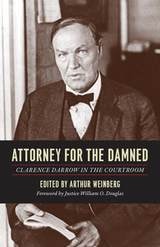
Attorney for the Damned
Clarence Darrow in the CourtroomClarence Darrow
University of Chicago Press, 2012
Published for the first time in 1957, Attorney for the Damned collects Darrow’s most influential summations and supplements them with scene-setting explanations and comprehensive notes by Arthur Weinberg. Darrow confronts issues that remain relevant over half a century after his death: First Amendment rights, capital punishment, and the separation of church and state. With an insightful forward by Justice William O. Douglas, this volume serves as a powerful reminder of Darrow’s relevance today.
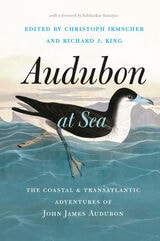
Audubon at Sea
The Coastal and Transatlantic Adventures of John James AudubonEdited by Christoph Irmscher and Richard J. King
University of Chicago Press, 2022
The American naturalist John James Audubon (1785–1851) is widely remembered for his iconic paintings of American birdlife. But as this anthology makes clear, Audubon was also a brilliant writer—and his keen gaze took in far more than creatures of the sky. Culled from his published and unpublished writings, Audubon at Sea explores Audubon’s diverse observations of the ocean, the coast, and their human and animal inhabitants. With Audubon expert Christoph Irmscher and scholar of the sea Richard J. King as our guides, we set sail from the humid expanses of the American South to the shores of England and the chilly landscapes of the Canadian North. We learn not only about the diversity of sea life Audubon documented—birds, sharks, fish, and whales—but also about life aboard ship, travel in early America, Audubon’s work habits, and the origins of beloved paintings. As we face an unfathomable loss of seabirds today, Audubon’s warnings about the fragility of birdlife in his time are prescient and newly relevant.
Charting the course of Audubon’s life and work, from his birth in Haiti to his death in New York City, Irmscher and King’s sweeping introduction and carefully drawn commentary confront the challenges Audubon’s legacy poses for us today, including his participation in American slavery and the thousands of birds he killed for his art. Rounded out by hundreds of historical and ornithological notes and beautiful illustrations, and with a foreword by distinguished photographer and conservationist Subhankar Banerjee, Audubon at Sea is the most comprehensively annotated collection of Audubon’s work ever published.
August Reckoning
Jack Turner and Racism in Post–Civil War AlabamaWilliam Warren Rogers Sr.
University of Alabama Press, 2004
During the decades of Bourbon ascendancy after 1874, Alabama institutions like those in other southern states were dominated by whites. Former slave and sharecropper Jack Turner refused to accept a society so structured. Highly intelligent, physically imposing, and an orator of persuasive talents, Turner was fearless before whites and emerged as a leader of his race. He helped to forge a political alliance between blacks and whites that defeated and humiliated the Bourbons in Choctaw County, the heart of the Black Belt, in the election of 1882. That summer, after a series of bogus charges and arrests, Turner was accused of planning to lead his private army of blacks in a general slaughter of the county whites. Justice was forgotten in the resultant fear and hysteria.
Aurality
Listening and Knowledge in Nineteenth-Century ColombiaAna María Ochoa Gautier
Duke University Press, 2014
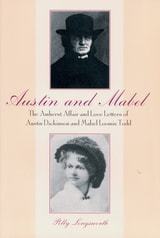
Austin and Mabel
The Amherst Affair and Love Letters of Austin Dickinson and Mabel Loomis ToddPolly Longsworth
University of Massachusetts Press, 1999
Authentic Indians
Episodes of Encounter from the Late-Nineteenth-Century Northwest CoastPaige Raibmon
Duke University Press, 2005
Drawing on research in newspapers, magazines, agency and missionary records, memoirs, and diaries, Raibmon combines cultural and labor history. She looks at three historical episodes: the participation of a group of Kwakwaka’wakw from Vancouver in the 1893 World’s Columbian Exposition in Chicago; the work of migrant Aboriginal laborers in the hop fields of Puget Sound; and the legal efforts of Tlingit artist Rudolph Walton to have his mixed-race step-children admitted to the white public school in Sitka, Alaska. Together these episodes reveal the consequences of outsiders’ attempts to define authentic Aboriginal culture. Raibmon argues that Aboriginal culture is much more than the reproduction of rituals; it also lies in the means by which Aboriginal people generate new and meaningful ways of identifying their place in a changing modern environment.
Autobiography of Samuel S. Hildebrand
The Renowned Missouri BushwhackerKirby Ross
University of Arkansas Press, 2016
Autobiography
Narrative of TransformationCarolyn A. Barros
University of Michigan Press, 1997
Automatic Religion
Nearhuman Agents of Brazil and FrancePaul Christopher Johnson
University of Chicago Press, 2021
Automatic Religion explores an unlikely series of episodes from the end of the nineteenth century, when crucial ideas related to automatism and, in a different realm, the study of religion were both being born. Paul Christopher Johnson draws on years of archival and ethnographic research in Brazil and France to explore the crucial boundaries being drawn at the time between humans, “nearhumans,” and automata. As agency came to take on a more central place in the philosophical, moral, and legal traditions of the West, certain classes of people were excluded as less-than-human. Tracking the circulation of ideas across the Atlantic, Johnson tests those boundaries, revealing how they were constructed on largely gendered and racial foundations. In the process, he reanimates one of the most mysterious and yet foundational questions in trans-Atlantic thought: what is agency?
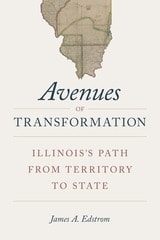
Avenues of Transformation
Illinois's Path from Territory to StateJames A. Edstrom
Southern Illinois University Press, 2022
A territory split by slavery, a state forged for union
Avenues of Transformation traces the surprising path, marked by shame, ambition, and will that led to Illinois’s admission to the Union in 1818. Historian James A. Edstrom guides the reader through this story by associating each stage of the narrative—the original statehood campaign, the passage of Illinois’s statehood-enabling act by Congress, and Illinois’s first constitutional convention—with the primary leaders in each of those episodes. The lives of these men—Daniel Pope Cook, Nathaniel Pope, and Elias Kent Kane—reflect the momentous tangle of politics, slavery, and geography. This history maps the drive for statehood in the conflict between nation and state, in the perpetuation of slavery, and in the sweep of water and commerce. It underscores the ways in which the Prairie State is uniquely intertwined—economically, socially, and politically—with every region of the Union: North, South, East, and West—and captures the compelling moment when Illinois statehood stood ready to more perfectly unify the nation.
This volume is the first full-length book in over a century to describe and analyze Illinois’s admission to the Union. It marks the first time that a historian has analyzed in detail the roll-call votes of the first state constitutional convention, seated evenly by pro- and antislavery delegates. Edstrom’s wit and prose weave a lively narrative of political ambition and human failure. Patiently crafted, Avenues of Transformation will be the first source for readers to turn to for gaining a better understanding of Illinois statehood.
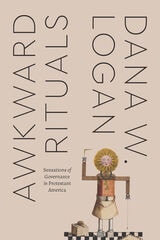
Awkward Rituals
Sensations of Governance in Protestant AmericaDana W. Logan
University of Chicago Press, 2022
In the years between the American Revolution and the Civil War, there was an awkward persistence of sovereign rituals, vestiges of a monarchical past that were not easy to shed. In Awkward Rituals, Dana Logan focuses our attention on these performances, revealing the ways in which governance in the early republic was characterized by white Protestants reenacting the hierarchical authority of a seemingly rejected king. With her unique focus on embodied action, rather than the more common focus on discourse or law, Logan makes an original contribution to debates about the relative completeness of America’s Revolution.
Awkward Rituals theorizes an under-examined form of action: rituals that do not feel natural even if they sometimes feel good. This account challenges common notions of ritual as a force that binds society and synthesizes the self. Ranging from Freemason initiations to evangelical societies to missionaries posing as sailors, Logan shows how white Protestants promoted a class-based society while simultaneously trumpeting egalitarianism. She thus redescribes ritual as a box to check, a chore to complete, an embarrassing display of theatrical verve. In Awkward Rituals, Logan emphasizes how ritual distinctively captures what does not change through revolution.