Results by title
8642 books match the query '20th Century' and 836 start with a
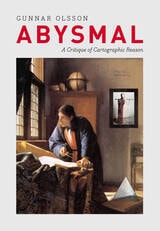
Abysmal
A Critique of Cartographic ReasonGunnar Olsson
University of Chicago Press, 2007
People rely on reason to think about and navigate the abstract world of human relations in much the same way they rely on maps to study and traverse the physical world. Starting from that simple observation, renowned geographer Gunnar Olsson offers in Abysmal an astonishingly erudite critique of the way human thought and action have become deeply immersed in the rhetoric of cartography and how this cartographic reasoning allows the powerful to map out other people’s lives.
A spectacular reading of Western philosophy, religion, and mythology that draws on early maps and atlases, Plato, Kant, and Wittgenstein, Thomas Pynchon, Gilgamesh, and Marcel Duchamp, Abysmal is itself a minimalist guide to the terrain of Western culture. Olsson roams widely but always returns to the problems inherent in reason, to question the outdated assumptions and fixed ideas that thinking cartographically entails. A work of ambition, scope, and sharp wit, Abysmal will appeal to an eclectic audience—to geographers and cartographers, but also to anyone interested in the history of ideas, culture, and art.
Academic Freedom Imperiled
The Mccarthy Era At The University Of NevadaJ. Dee Kille
University of Nevada Press, 2004
Academic Science, Higher Education, and the Federal Government, 1950-1983
John T. Wilson
University of Chicago Press, 1983
Accidental Occidental
Economics and Culture of Transition in Mitteleuropa, the Baltic and the Balkan AreaLajos Bokros
Central European University Press, 2013

Accidental Shepherd
How a California Girl Rescued an Ancient Mountain Farm in NorwayLiese Greensfelder
University of Minnesota Press, 2024
A summer job turns serious when a young woman takes the reins on a remote farm—and learns far more than how to herd sheep
In May 1972, Liese Greensfelder arrived in the small Norwegian town of Øystese to startling news: Johannes, the farmer who hired her for the summer, had just been hospitalized after a stroke. Could she please watch over his place for a month or so, until he got back on his feet? Twenty years old and with no farming experience, Liese was dropped off the next day at a centuries-old mountain farm at the end of a dirt road high above the magnificent Hardanger Fjord—with 115 sheep, two cows, one calf, a draft horse, and a Norwegian herding dog to care for.
Armed with a command of Danish that enabled rudimentary communication, Liese began learning from neighbors who spoke an ancient Norwegian dialect—how to feed the animals, milk by hand, and supervise her first lambing. The farm was run in the old way: horses and wagons instead of tractors, haymaking in the rain, and hikes into the mountains to check on the sheep that ranged free over those wild peaks all summer. And, she was quick to discover, the farm was on the brink of ruin, for Johannes was a heartless man who had abused his animals and neglected his buildings and equipment for decades.
Although her employer had alienated his neighbors, they immediately welcomed the American newcomer and offered her help. As “a month or so” stretched to a year and Liese struggled for the survival of the farm, she joined this tight-knit enclave of farmers, learning their stories and history, adopting their dialect, and growing intimately familiar with the grass-based farming practices that had sustained them for generations.
From moments of levity, such as sampling a neighbor’s fruit wines, Christmas parties, and skiing; to soul-battering challenges, including the directive to kill a fox, sending sheep to slaughter, rotten silage, and vicious weather; to the yearnings of a young woman awash in a sea of masculinity, Accidental Shepherd is a candid account of Liese’s year in a remote farmhouse. Confronted with dangers and obstacles for which she was utterly unprepared, she tells a story of remarkable resilience and records the fascinating but rapidly vanishing traditions of the community that took her in.

Accidental Shepherd
How a California Girl Rescued an Ancient Mountain Farm in NorwayLiese Greensfelder
University of Minnesota Press, 2024
A summer job turns serious when a young woman takes the reins on a remote farm—and learns far more than how to herd sheep
In May 1972, Liese Greensfelder arrived in the small Norwegian town of Øystese to startling news: Johannes, the farmer who hired her for the summer, had just been hospitalized after a stroke. Could she please watch over his place for a month or so, until he got back on his feet? Twenty years old and with no farming experience, Liese was dropped off the next day at a centuries-old mountain farm at the end of a dirt road high above the magnificent Hardanger Fjord—with 115 sheep, two cows, one calf, a draft horse, and a Norwegian herding dog to care for.
Armed with a command of Danish that enabled rudimentary communication, Liese began learning from neighbors who spoke an ancient Norwegian dialect—how to feed the animals, milk by hand, and supervise her first lambing. The farm was run in the old way: horses and wagons instead of tractors, haymaking in the rain, and hikes into the mountains to check on the sheep that ranged free over those wild peaks all summer. And, she was quick to discover, the farm was on the brink of ruin, for Johannes was a heartless man who had abused his animals and neglected his buildings and equipment for decades.
Although her employer had alienated his neighbors, they immediately welcomed the American newcomer and offered her help. As “a month or so” stretched to a year and Liese struggled for the survival of the farm, she joined this tight-knit enclave of farmers, learning their stories and history, adopting their dialect, and growing intimately familiar with the grass-based farming practices that had sustained them for generations.
From moments of levity, such as sampling a neighbor’s fruit wines, Christmas parties, and skiing; to soul-battering challenges, including the directive to kill a fox, sending sheep to slaughter, rotten silage, and vicious weather; to the yearnings of a young woman awash in a sea of masculinity, Accidental Shepherd is a candid account of Liese’s year in a remote farmhouse. Confronted with dangers and obstacles for which she was utterly unprepared, she tells a story of remarkable resilience and records the fascinating but rapidly vanishing traditions of the community that took her in.
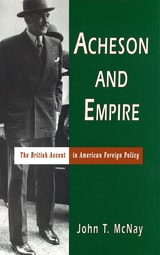
Acheson and Empire
The British Accent in American Foreign PolicyJohn T. McNay
University of Missouri Press, 2001
Acheson and Empire offers a compelling reassessment of Dean Acheson's policies toward the former colonial world during his period as secretary of state from 1949 to 1953. John T. McNay argues that Acheson inherited through his own personal history a way of understanding the world that encouraged imperial-style international relationships. This worldview represented a well-developed belief system rooted in his Ulster Protestant heritage that remained consistent throughout his life.
By exploring relationships of the United States with Britain and countries formerly or then controlled by Britain, such as India, Ireland, Iran, and Egypt, McNay shows the significance of Acheson's beliefs. McNay argues that Acheson's support of existing imperial relationships was so steadfast that it often led other nations to perceive that the United States was nothing more than a front for British interests. He believes this approach to foreign policy damaged American relations with emerging countries and misled the British regarding possibilities of an Anglo-American partnership.
Acheson and Empire contends that the widely accepted view of Acheson as a foreign policy realist is misleading and that historians should acknowledge that his affinity for the British Empire went beyond his clothing and mannerisms. McNay maintains that the widely accepted view of Acheson as one of a group of "wise men" who shaped the Cold War world by basing their decisions on cold calculation of American interests should be reconsidered.
Drawing from extensive research in archival sources, including the Truman Library, the National Archives, the Public Record Office in London, and Acheson's personal papers at Yale, Acheson and Empire offers a fresh look at Dean Acheson that runs counter to previous biographies and many histories of the Cold War.

Achille Lauro
Arne Zuidhoek
Amsterdam University Press, 2024
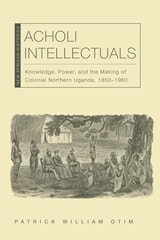
Acholi Intellectuals
Knowledge, Power, and the Making of Colonial Northern Uganda, 1850–1960Patrick William Otim
Ohio University Press, 2024
Acid Hype
American News Media and the Psychedelic ExperienceSteven Siff
University of Illinois Press, 2015
Acid Hype offers the untold tale of LSD's wild journey from Brylcreem and Ivory soap to incense and peppermints. As Stephen Siff shows, the early attention lavished on the drug by the news media glorified its use in treatments for mental illness but also its status as a mystical--yet legitimate--gateway to exploring the unconscious mind. Siff's history takes readers to the center of how popular media hyped psychedelic drugs in a constantly shifting legal and social environment, producing an intricate relationship between drugs and media experience that came to define contemporary pop culture. It also traces how the breathless coverage of LSD gave way to a textbook moral panic, transforming yesterday's refined seeker of truths into an acid casualty splayed out beyond the fringe of polite society.

Acid Revival
The Psychedelic Renaissance and the Quest for Medical LegitimacyDanielle Giffort
University of Minnesota Press, 2020
A vivid analysis of the history and revival of clinical psychedelic science
Psychedelic drugs are making a comeback. In the mid-twentieth century, scientists actively studied the potential of drugs like LSD and psilocybin for treating mental health problems. After a decades-long hiatus, researchers are once again testing how effective these drugs are in relieving symptoms for a wide variety of psychiatric conditions, from depression and obsessive–compulsive disorder to posttraumatic stress disorder and substance addiction. In Acid Revival, Danielle Giffort examines how this new generation of researchers and their allies are working to rehabilitate psychedelic drugs and to usher in a new era of psychedelic medicine.
As this team of researchers and mental health professionals revive the field of psychedelic science, they are haunted by the past and by one person in particular: psychedelic evangelist Timothy Leary. Drawing on extensive archival research and interviews with people working on scientific psychedelia, Giffort shows how today’s researchers tell stories about Leary as an “impure” scientist and perform his antithesis to address a series of lingering dilemmas that threaten to rupture their budding legitimacy. Acid Revival presents new information about the so-called psychedelic renaissance and highlights the cultural work involved with the reassembly of dormant areas of medical science.
This colorful and accessible history of the rise, fall, and reemergence of psychedelic medicine is infused with intriguing narratives and personalities—a story for popular science aficionados as well as for scholars of the history of science and medicine.

Acoustic Properties
Radio, Narrative, and the New Neighborhood of the AmericasTom McEnaney
Northwestern University Press, 2017
Based on original archival research in Buenos Aires, Havana, Paris, and the United States, the book develops a literary media theory that understands sound as a transmedial phenomenon and radio as a transnational medium. Analyzing the construction of new social and political relations in the wake of the United States’ 1930s Good Neighbor Policy, Acoustic Properties challenges standard narratives of hemispheric influence through new readings of Richard Wright’s cinematic work in Argentina, Severo Sarduy’s radio plays in France, and novels by John Dos Passos, Manuel Puig, Raymond Chandler, and Carson McCullers. Alongside these writers, the book also explores Che Guevara and Fidel Castro’s Radio Rebelde, FDR’s fireside chats, Félix Caignet’s invention of the radionovela in Cuba, Evita Perón’s populist melodramas in Argentina, Orson Welles’s experimental New Deal radio, Cuban and U.S. “radio wars,” and the 1960s African American activist Robert F. Williams’s proto–black power Radio Free Dixie.
From the doldrums of the Great Depression to the tumult of the Cuban Revolution, Acoustic Properties illuminates how novelists in the radio age converted writing into a practice of listening, transforming realism as they struggled to channel and shape popular power.
Across Continents
Writing Goans, Making WorldsR. Benedito Ferrão
University of Michigan Press, 2026
Across Continents employs Goan literary subjectivity as epistemology to critique a specific limitation of postcolonial thought, one that does not account for the situations or afterlife of Portuguese colonialism. Employing various novels, R. Benedito Ferrão considers the relationship between Portuguese and British colonialisms through the displacement of Goan characters betwixt Asia, Africa, Europe, and North America. The experiences of these figures in dealing with the processes of nation, statecraft, and political intrigue at various historical junctures offer a comparative understanding of the tumultuous conditions of postcoloniality in the making of marginalized subjectivity across continents.
In examining the mobility and diversity of Goan experiences as represented in works by Salman Rushdie, M. G. Vassanji, Roger King, and Margaret Mascarenhas, this book calls into question limits of citizenship, nationality, and notions of belonging. Ferrão centers seemingly minor figures to exemplify the effects of colonial and postcolonial changes that connect diverse geopolities.
Across Oceans of Law
The Komagata Maru and Jurisdiction in the Time of EmpireRenisa Mawani
Duke University Press, 2018
Across Spoon River
Edgar Lee Masters; Introduction by Ronald Primeau
University of Illinois Press, 1991
The autobiography of the influential American poet
This intimate and provocative autobiography, first published in 1936, reveals the innermost thoughts of a great American poet. Edgar Lee Masters was a transitional figure in American literature with one foot planted in the nineteenth century and the other firmly placed on the path of what we now think of as the modern period.
Masters expounds on his own development as a poet and as a human being; he shares his views on American culture, politics, and the literary criticism of the times. Masters's friends and acquaintances discussed here include some of the most prominent writers and politicians of his age. And he reflects on his life events that shaped, haunted, and inspired his writings of the classic Spoon River Anthology.
Across The Pacific
Asian Americans and GlobalizationEvelyn Hu-Dehart, E
Temple University Press, 2000
Members of the Asian American community have always been trans-Pacific, but are now more than ever, since the 1965 change in U.S. immigration law. Entering the U.S. at the culmination of the Civil Rights movement, Asians becoming Asian Americans have joined a self-consciously multicultural society. Asian economies roared onto the world stage, creating new markets while circulating capital and labor at an unprecedented scale and intensity, thereby helping drive the forces of modern globalization. These essays by well-known scholars in the field of Asian American studies consider such topics as the impact of new migrations on Asian American subjectivity and politics, Asian American activism and U.S. foreign policy, and the role of Asian Americans in Pacific Rim economies.
Considering issues of diaspora, transmigrancy, assimilation, institutionalized racism, and community, Across the Pacific covers such cutting-edge subjects as the cultural expressions of dislocation among contemporary Asian American writers, as well as the impact of the new migrations on Asian American subjectivity and politics.
Across the Waves
How the United States and France Shaped the International Age of RadioDerek Vaillant
University of Illinois Press, 2017
Drawing on a broad range of American and French archives, Derek Vaillant joins textual and aural materials with original data analytics and maps to illuminate U.S.-French broadcasting's political and cultural development. Vaillant focuses on the period from 1931 until France dismantled its state media system in 1974. His analysis examines mobile actors, circulating programs, and shifting institutions that shaped international radio's use in times of war and peace. He explores the extraordinary achievements, the miscommunications and failures, and the limits of cooperation between America and France as they shaped a new media environment. Throughout, Vaillant explains how radio's power as an instantaneous mass communications tool produced, legitimized, and circulated various notions of states, cultures, ideologies, and peoples as superior or inferior.
A first comparative history of its subject, Across the Waves provocatively examines how different strategic agendas, aesthetic aims and technical systems shaped U.S.-French broadcasting and the cultural politics linking the United States and France.
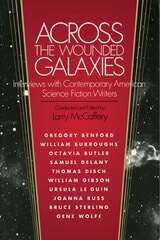
Across the Wounded Galaxies
Interviews with Contemporary American Science Fiction WritersConducted and edited by Larry McCaffery
University of Illinois Press, 1990
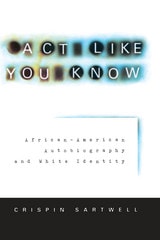
Act Like You Know
African-American Autobiography and White IdentityCrispin Sartwell
University of Chicago Press, 1998
There is, Sartwell contends, a fundamental elusiveness to that identity. Whiteness defines itself as normative, as a neutral form of the human condition, marking all other forms of identity as "racial" or "ethnic" deviations. Invisible to itself, white identity seeks to define its essence over and against those other identities, in effect defining itself through opposition and oppression. By maintaining fictions of black licentiousness, violence, and corruption, white identity is able to cast itself as humane, benevolent, and pure; the stereotype fabricates not only the oppressed but the oppressor as well. Sartwell argues that African-American autobiography perceives white identity from a particular and unique vantage point; one that is knowledgeable and intimate, yet fundamentally removed from the white world and thus unencumbered by its obfuscating claims to normativity.
Throughout this provocative work, Sartwell steadfastly recognizes the many ways in which he too is implicated in the formulation and perpetuation of racial attitudes and discourse. In Act Like You Know, he challenges both himself and others to take a long, hard look in the mirror of African-American autobiography, and to find there, in the light of those narratives, the visible features of white identity.
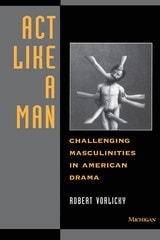
Act Like a Man
Challenging Masculinities in American DramaRobert Vorlicky
University of Michigan Press, 1995
In the first comprehensive study of plays written for male characters only, Robert Vorlicky offers a new theory that links cultural codes governing gender and the conventions determining dramatic form. Act Like a Manlooks at a range of plays, including those by O'Neill, Albee, Mamet, Baraka, and Rabe as well as new works by Philip Kan Gotanda, Alonzo Lamont, and Robin Swados, to examine how dialogue within these works reflects the social codes of male behavior and inhibits individualization among men.
Plays in which women are absent are often characterized by the location of a male "other"—a female presence who distances himself from the dominant, impersonal masculine ethos and thereby becomes a facilitator of personal communication. The potential authority of this figure is so powerful that its presence becomes the primary determinant of the quality of men's interaction and of the range of male subjectivities possible. This formulation becomes the basis of an alternative theory of American dramatic construction, one that challenges traditional dramaturgical notions of realism.
The book will appeal to scholars and students interested in drama, gender, race, sexuality, and American culture, as well as playwrights, teachers of playwrights, and artistic directors. It includes an extensive bibliography of more than four hundred male-cast plays and monodramas, the first such compilation and one that points to further research into a previously unexplored area.
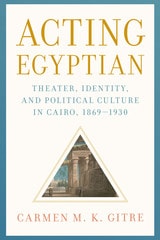
Acting Egyptian
Theater, Identity, and Political Culture in Cairo, 1869–1930By Carmen M. K. Gitre
University of Texas Press, 2019
In the late nineteenth and early twentieth centuries, during the “protectorate” period of British occupation in Egypt—theaters and other performance sites were vital for imagining, mirroring, debating, and shaping competing conceptions of modern Egyptian identity. Central figures in this diverse spectrum were the effendis, an emerging class of urban, male, anticolonial professionals whose role would ultimately become dominant. Acting Egyptian argues that performance themes, spaces, actors, and audiences allowed pluralism to take center stage while simultaneously consolidating effendi voices.
From the world premiere of Verdi’s Aida at Cairo’s Khedivial Opera House in 1871 to the theatrical rhetoric surrounding the revolution of 1919, which gave women an opportunity to link their visibility to the well-being of the nation, Acting Egyptian examines the ways in which elites and effendis, men and women, used newly built performance spaces to debate morality, politics, and the implications of modernity. Drawing on scripts, playbills, ads, and numerous other sources, the book brings to life provocative debates that fostered a new image of national culture and performances that echoed the events of urban life in the struggle for independence.
Acting Jewish
Negotiating Ethnicity on the American Stage and ScreenHenry Bial
University of Michigan Press, 2005
Acting Jewish documents this history, looking at the work of Jewish writers, directors, and actors in the American entertainment industry with particular attention to the ways in which these artists offer behavioral models for Jewish-American audiences. The book spans the period from 1947 to the present and takes a close look at some of America's favorite plays (Death of a Salesman, Fiddler on the Roof, Angels in America), films (Gentleman's Agreement, AnnieHall), and television shows (The Goldbergs, Seinfeld), identifying a double-coding by which performers enact, and spectators read, Jewishness in contemporary performance-and, by extension, enact and read other minority identities. The book thus explores and illuminates the ever-changing relationship between Jews and mainstream American culture.
"Fascinating and original . . . Bial's command of sources is impressive, and his concept of 'double-coding' is convincing . . . the book should have no trouble finding a large audience."
-Barbara Grossman, author of Funny Woman: The Life and Times of Fanny Brice
Acting Up and Getting Down
Plays by African American TexansBy Sandra M. Mayo and Elvin Holt
University of Texas Press, 2014
One of the few books of its kind, Acting Up and Getting Down brings together seven African American literary voices that all have a connection to the Lone Star state. Covering Texas themes and universal ones, this collection showcases often-overlooked literary talents to bring to life inspiring facets of black theatre history.
Capturing the intensity of racial violence in Texas, from the Battle of San Jacinto to a World War I–era riot at a Houston training ground, Celeste Bedford Walker’s Camp Logan and Ted Shine’s Ancestors provide fascinating narratives through the lens of history. Thomas Meloncon’s Johnny B. Goode and George Hawkins’s Br’er Rabbit explore the cultural legacies of blues music and folktales. Three unflinching dramas (Sterling Houston’s Driving Wheel, Eugene Lee’s Killingsworth, and Elizabeth Brown-Guillory’s When the Ancestors Call) examine homosexuality, a death in the family, and child abuse, bringing to light the private tensions of intersections between the individual and the community.
Supplemented by a chronology of black literary milestones as well as a playwrights’ canon, Acting Up and Getting Down puts the spotlight on creative achievements that have for too long been excluded from Texas letters. The resulting anthology not only provides new insight into a regional experience but also completes the American story as told onstage.
Action Writing
Jack Kerouac's Wild FormMichael Hrebeniak
Southern Illinois University Press, 2008
Action Writing: Jack Kerouac's Wild Form connects the personal and creative development of the Beat generation's famous icon with cultural changes in postwar America. Michael Hrebeniak asserts that Jack Kerouac's "wild form"—self-organizing narratives free of literary, grammatical, and syntactical conventions—moves within an experimental continuum across the arts to generate a Dionysian sense of writing as raw process. Action Writing highlights how Kerouac made concrete his 1952 intimation of "something beyond the novel" by assembling ideas from Beat America, modernist poetics, action painting, bebop, and subterranean oral traditions.
Geared to scholars and students of American literature, Beat studies, and creative writing, Action Writing places Kerouac's writing within the context of the American art scene at midcentury. Reframing the work of Kerouac and the Beat generation within the experimental modernist and postmodernist literary tradition, this probing inquiry offers a direct engagement with the social and cultural history at the foreground of Kerouac's career from the 1940s to the late 1960s.
Activist Biology
The National Museum, Politics, and Nation Building in BrazilRegina Horta Duarte
University of Arizona Press, 2016
For the first time in English, Brazil’s leading environmental historian, Regina Horta Duarte, brings us a nuanced analysis of the National Museum of Brazil’s contribution to that country’s formation and history. In Activist Biology, Duarte explores the careers of three of these scientists as they leveraged biology as a strategy for change. Devoted to educational initiatives, they organized exhibits, promoted educational film and radio, wrote books, published science communication magazines, fostered school museums, and authored textbooks for young people. Their approach was transdisciplinary, and their reliance on multimedia formats was pioneering.
Capturing a crucial period in Brazil’s history, this portrait of science as a creative and potentially transformative pathway will intrigue anyone fascinated by environmental history, museums, and the history of science. Duarte skillfully shows how Brazilian science furthered global scientific knowledge in ways that are relevant now more than ever.
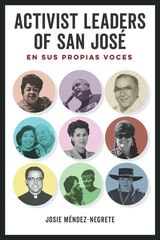
Activist Leaders of San José
En sus propias vocesJosie Méndez-Negrete
University of Arizona Press, 2020
Sociologist and activist Josie Méndez-Negrete has returned to her hometown to document and record the stories of those who made contributions to the cultural and civic life of San José. Through interview excerpts, biographical and historical information, and analysis, Méndez-Negrete shows the contributions of this singular community throughout the twentieth century and the diversity of motivations across the generations.
Activists share with Méndez-Negrete how they became conscious about their communities and how they became involved in grassroots organizing, protest, and social action. Spanning generations, we hear about the motivations of activists in the 1930s to the end of the twentieth century. We hear firsthand stories of victories and struggles, successes and failures from those who participated.
Activist Leaders of San José narrates how parents—both mothers and fathers—were inspired to work for the rights of their people. Workers’ and education rights were at the core, but they also took on the elimination of at-large elections to open city politics, labor rights, domestic abuse, and health care. This book is an important record of the contributions of San José in improving conditions for the Mexican American community.
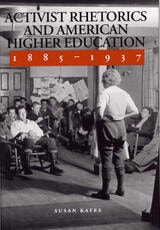
Activist Rhetorics and American Higher Education, 1885-1937
Susan Kates
Southern Illinois University Press, 2000
In this study of the history of rhetoric education, Susan Kates focuses on the writing and speaking instruction developed at three academic institutions founded to serve three groups of students most often excluded from traditional institutions of higher education in late-nineteenth-and early-twentieth-century America: white middle-class women, African Americans, and members of the working class.
Kates provides a detailed look at the work of those students and teachers ostracized from rhetorical study at traditional colleges and universities. She explores the pedagogies of educators Mary Augusta Jordan of Smith College in Northhampton, Massachusetts; Hallie Quinn Brown of Wilberforce University in Wilberforce, Ohio; and Josephine Colby, Helen Norton, and Louise Budenz of Brookwood Labor College in Katonah, New York.
These teachers sought to enact forms of writing and speaking instruction incorporating social and political concerns in the very essence of their pedagogies. They designed rhetoric courses characterized by three important pedagogical features: a profound respect for and awareness of the relationship between language and identity and a desire to integrate this awareness into the curriculum; politicized writing and speaking assignments designed to help students interrogate their marginalized standing within the larger culture in terms of their gender, race, or social class; and an emphasis on service and social responsibility.
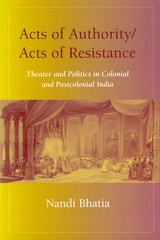
Acts of Authority/Acts of Resistance
Theater and Politics in Colonial and Postcolonial IndiaNandi Bhatia
University of Michigan Press, 2004
Nandi Bhatia argues that Indian theater was a significant force in the struggle against oppressive colonial and postcolonial structures, as it sought to undo various schemes of political and cultural power through its engagement with subjects derived from mythology, history, and available colonial models such as Shakespeare. Bhatia's attention to local histories within a postcolonial framework places performance in a global and transcultural context. Drawing connections between art and politics, between performance and everyday experience, Bhatia shows how performance often intervened in political debates and even changed the course of politics.
One of the first Western studies of Indian theater to link the aesthetics and the politics of that theater, Acts of Authority/Acts of Resistance combines in-depth archival research with close readings of dramatic texts performed at critical moments in history. Each chapter amplifies its themes against the backdrop of specific social conditions as it examines particular dramatic productions, from The Indigo Mirror to adaptations of Shakespeare plays by Indian theater companies, illustrating the role of theater in bringing nationalist, anticolonial, and gendered struggles into the public sphere.
Nandi Bhatia is Associate Professor of English at the University of Western Ontario.
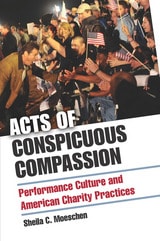
Acts of Conspicuous Compassion
Performance Culture and American Charity PracticesSheila C. Moeschen
University of Michigan Press, 2016
Sheila C. Moeschen sheds new light on the legacy and involvement of disabled people within charity—specifically, the articulation of performance culture as a vital theoretical framework for discussing issues of embodiment and identity, a framework that dislodges previously held notions of the disabled existing as passive “objects” of pity. This work gives rise to a more complicated and nuanced discussion of the participation of the disabled community in the charity industry, of the opportunities afforded by performance culture for disabled people to act as critical agents of charity, and of the new ethical and political issues that arise from employing performance methodology in a culture with increased appetites for voyeurism, display, and complex spectacle.
Acts of Faith and Imagination
Theological Patterns in Catholic FictionBrent Little
Catholic University of America Press, 2023
Acts of Mind
Conversations with Contemporary PoetsRichard Jackson
University of Alabama Press, 1984
Acts of Mind grew out of interviews conducted by the author for Poetry Miscellany. The aim of which was to help develop a method for talking about the work of contemporary poets.
The poets whose views appear in this volume represent a fair cross-section of the more important tendencies and impulses to be found in contemporary poetry and poetics.
Acts of Poetry
American Poets' Theater and the Politics of PerformanceHeidi R. Bean
University of Michigan Press, 2019
American poets’ theater emerged in the postwar period alongside the rich, performance-oriented poetry and theater scenes that proliferated on the makeshift stages of urban coffee houses, shared apartments, and underground theaters, yet its significance has been largely overlooked by critics. Acts of Poetry shines a spotlight on poets’ theater’s key groups, practitioners, influencers, and inheritors, such as the Poets’ Theatre, the Living Theatre, Gertrude Stein, Bunny Lang, Frank O’Hara, Amiri Baraka, Carla Harryman, and Suzan-Lori Parks. Heidi R. Bean demonstrates the importance of poets’ theater in the development of twentieth-century theater and performance poetry, and especially evolving notions of the audience’s role in performance, and in narratives of the relationship between performance and everyday life. Drawing on an extensive archive of scripts, production materials, personal correspondence, theater records, interviews, manifestoes, editorials, and reviews, the book captures critical assessments and behind-the-scenes discussions that enrich our understanding of the intertwined histories of American theater and American poetry in the twentieth century.
Acts of Theft
Arthur A. Cohen
University of Chicago Press, 1987
This unforgettable novel tells the story of an Austrian nobleman who as a young man at the end of World War I, finds himself irresistibly drawn to thievery. Forty years later, living in Mexico, he has made stealing his trade, pillaging Mayan tombs to illicitly secure pre-Columbian art, which he sells on the black market. At the same time, he creates his own sculptures, which the market refuses to reward. Eventually, his activities catch the eye of a dedicated, solitary Mexican police detective, and a reckoning--one that has its roots in the long history of European plunder of the riches of the New World--is set in violent motion.
Praised on publication by Cynthia Ozick, the Washington Post, and more, this unforgettable novel harks back to the great nineteenth-century social novels while still being fully of its late-twentieth-century time.
Addiction, Inc.
Medication-Assisted Treatment and America's Forgotten War on DrugsEmily Dufton
University of Chicago Press, 2026
Despite epidemic levels of overdoses in the United States, by 2020, only twenty percent of Americans suffering from opioid use disorder (OUD) received medication-assisted treatment (MAT), the gold standard of addiction treatment, which uses methadone, buprenorphine, or naltrexone to reduce illicit drug use and curb the symptoms of withdrawal. While MAT is the most effective treatment available for OUD, it’s also the most controversial, the most expensive, and the most difficult to access. And yet, the medications at the center of this treatment—and the private industries that distribute them—generate roughly sixteen billion dollars each year, on par with national sales of coffee and pet food.
In Addiction, Inc., historian Emily Dufton explains how this promising avenue of treatment emerged during President Richard Nixon’s war on drugs in 1971 as a radical experiment in public health, when hundreds of federally-funded treatment clinics opened nationwide. Dufton then explores how these nationalized clinics gave way to an immensely profitable private industry that offers poor care at high costs to an insufficient number of people. Drawing on original research and over a hundred interviews with policymakers, medical experts, pharmaceutical lobbyists, and patients and their families, she tells a gripping story of squandered potential and missed opportunities, as MAT transformed from a revolutionary political project launched from the White House itself into a commercial success—and a public health disaster.
Urgent, eye-opening, and deeply human, Addiction, Inc. reveals how, over the past fifty years, the United States built an addiction treatment system that made recovery harder instead of easier, and what it will take to change its course.
Addiction, Inc.
Medication-Assisted Treatment and America’s Forgotten War on DrugsEmily Dufton
University of Chicago Press, 2026
Despite epidemic levels of overdoses in the United States, by 2020, only twenty percent of Americans suffering from opioid use disorder (OUD) received medication-assisted treatment (MAT), the gold standard of addiction treatment, which uses methadone, buprenorphine, or naltrexone to reduce illicit drug use and curb the symptoms of withdrawal. While MAT is the most effective treatment available for OUD, it’s also the most controversial, the most expensive, and the most difficult to access. And yet, the medications at the center of this treatment—and the private industries that distribute them—generate roughly sixteen billion dollars each year, on par with national sales of coffee and pet food.
In Addiction, Inc., historian Emily Dufton explains how this promising avenue of treatment emerged during President Richard Nixon’s war on drugs in 1971 as a radical experiment in public health, when hundreds of federally-funded treatment clinics opened nationwide. Dufton then explores how these nationalized clinics gave way to an immensely profitable private industry that offers poor care at high costs to an insufficient number of people. Drawing on original research and over a hundred interviews with policymakers, medical experts, pharmaceutical lobbyists, and patients and their families, she tells a gripping story of squandered potential and missed opportunities, as MAT transformed from a revolutionary political project launched from the White House itself into a commercial success—and a public health disaster.
Urgent, eye-opening, and deeply human, Addiction, Inc. reveals how, over the past fifty years, the United States built an addiction treatment system that made recovery harder instead of easier, and what it will take to change its course.
Addressing Postmodernity
Kenneth Burke, Rhetoric, and a Theory of Social ChangeBarbara Biesecker
University of Alabama Press, 2000
In Addressing Postmodernity, Barbara Biesecker examines the relationship between rhetoric and social change and the ways human beings transform social relations through the purposeful use of symbols. In discerning the conditions of possibility for social transformation and the role of human beings and rhetoric in it, Biesecker turns to the seminal work of Kenneth Burke.
Through a close reading of Burke's major works, A Grammar of Motives, A Rhetoric of Motives, and The Rhetoric of Religion: Studies in Logology, the author addresses the critical topic of the
fragmentation of the contemporary lifeworld revealing postmodernity will have a major impact on Burkeian scholarship and on the rhetorical critique of social relations in general.
Directly confronting the challenges posed by postmodernity to social theorists and critics alike and juxtaposing the work of Burke and Jurgen Habermas, Biesecker argues that a radicalized rereading of Burke's theory of the negative opens the way toward a resolutely rhetorical theory of social change and human agency.

Adiós Niño
The Gangs of Guatemala City and the Politics of DeathDeborah T. Levenson
Duke University Press, 2013

Administrative Implementation of Civil Rights
By Joseph Parker Witherspoon
University of Texas Press, 1968
The civil rights problem of the mid-twentieth century was one of the greatest challenges to the American social fabric since the Civil War. Riots in scores of cities, and serious intergroup tensions and conflicts in thousands more, underlined the seriousness of the problem.
Administrative Implementation of Civil Rights examines the role, operation, and contribution of the device most often relied on by local and state governments for dealing with intergroup problems—the human- relations commission. First used in the early 1940s to deal with discrimination against blacks, this commission was later often charged with implementing the civil rights of other minority groups and of women, the elderly, the handicapped, and the poor. It is Joseph Parker Witherspoon’s thesis that the human-relations commission was not used effectively, that an agency of this type has great strengths that most local and state governments did not utilize, and that its weaknesses are susceptible of remedy and must be eliminated. He explains these weaknesses and develops proposals for correcting them.
Witherspoon examines the roles of the local, state, and federal governments in solving this country’s complicated and serious civil rights problem and demonstrates that a program that carefully coordinates action by the federal government with action by local and state governments could be made to work effectively. As a part of this demonstration he proposes the enactment of a new form of comprehensive civil rights legislation at local, state, and national levels, and presents a series of four model statutes—the Alpha Model Acts—for effectuating his proposals. The approach emphasized in these statutes greatly strengthens the role of the human-relations commission as a law-enforcement agency and, in particular, focuses the operation of federal and state action upon life in the individual community.
The book concludes with a group of appendices listing all state and many local commissions and agencies handling human-relations problems at that time, and summarizing the type of authority, the jurisdiction, the operating budget, and the legislative basis for each. This list will be of interest to those studying the history of civil rights and public policy in the United States.
Adoption, Memory, and Cold War Greece
Kid pro quo?Gonda Van Steen
University of Michigan Press, 2019
This book presents a committed quest to unravel and document the postwar adoption networks that placed more than 3,000 Greek children in the United States, in a movement accelerated by the aftermath of the Greek Civil War and by the new conditions of the global Cold War. Greek-to-American adoptions and, regrettably, also their transactions and transgressions, provided the blueprint for the first large-scale international adoptions, well before these became a mass phenomenon typically associated with Asian children. The story of these Greek postwar and Cold War adoptions, whose procedures ranged from legal to highly irregular, has never been told or analyzed before. Adoption, Memory, and Cold War Greece answers the important questions: How did these adoptions from Greece happen? Was there any money involved? Humanitarian rescue or kid pro quo? Or both? With sympathy and perseverance, Gonda Van Steen has filled a decades-long gap in our understanding, and provided essential information to the hundreds of adoptees and their descendants whose lives are still affected today.
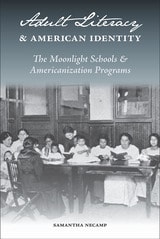
Adult Literacy and American Identity
The Moonlight Schools and Americanization ProgramsSamantha NeCamp
Southern Illinois University Press, 2014
The release of U.S. census data in 1910 sparked rhetoric declaring the nation had a literacy crisis and proclaiming illiterate citizens a threat to democratic life. While newspaper editors, industrialists, and officials in the federal government frequently placed the blame on newly arrived immigrants, a smaller but no less vocal group of rural educators and clubwomen highlighted the significant number of native-born illiterate adults in the Appalachian region. Author Samantha NeCamp looks at the educational response to these two distinct literacy narratives—the founding of the Moonlight Schools in eastern Kentucky, focused on native-born nonliterate adults, and the establishment of the Americanization movement, dedicated to the education of recent immigrants.
Drawing on personal correspondence, conference proceedings, textbooks, and speeches, NeCamp demonstrates how the Moonlight Schools and the Americanization movement competed for public attention, the interest of educators, and private and governmental funding, fueling a vibrant public debate about the definition of literacy. The very different pedagogical practices of the two movements—and how these practices were represented to the public—helped shape literacy education in the United States. Reading the Moonlight Schools and the Americanization movement in relation to one another, Adult Literacy and American Identity expands the history and theory of literacy and literacy education in the United States. This book will be of interest to scholars in literacy, Appalachian studies, and rhetoric and composition.
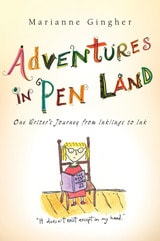
Adventures in Pen Land
One Writer's Journey from Inklings to InkMarianne Gingher
University of Missouri Press, 2008
Featuring guest appearances by other writers such as Fred Chappell, Max Steele, and Annie Dillard plus cameos by the likes of Patty Hearst, Richard Nixon, and Bon Jovi, Adventures in Pen Land celebrates writing as a form of play that Gingher has never outgrown. The lighthearted illustrations by novelist Daniel Wallace (author of Big Fish) serve to reinforce this refreshing message as they depict one writer and her imagination growing up together.
Adventures in the Archaic
Primitivism, Degrowth, and the French Social Sciences, 1945–1975Ryan L. Allen
University of Chicago Press, 2026
We tend to associate primitivism with the nostalgic idealization of origins, often aimed at parts of the world that are viewed as closer to that idealized past than modern post-industrial society. Primitivist impulses still exist in popular culture, whether in paleo diets or returns to foraging, and they can also be seen in intellectual and political circles in debates around the possibility of degrowth. In this book, historian Ryan L. Allen examines primitivism anew through four fascinating figures: Georges Bataille, Henri Lefebvre, Georges Devereux, and Mircea Eliade.
In the postwar period, Allen shows, the French social sciences reappraised the primitive and archaic from anthropological, sociological, psychiatric, and religious angles. These four thinkers sought past alternatives to midcentury hypermodernization and capitalist excess. They put forth trenchant critiques of contemporary society and sought in the archaic past a way to imagine a more sustainable future. Adventures in the Archaic rehabilitates these thinkers, showing how their critique of growth and consumerism was nourished by an engagement with primitive cultures as potential sources of cultural and ecological wisdom. As we confront planetary crisis, Allen suggests, there is still much we can learn from these iconoclastic approaches.
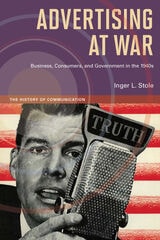
Advertising at War
Business, Consumers, and Government in the 1940sInger L. Stole
University of Illinois Press, 2012
Using archival sources, newspapers accounts, and trade publications, Stole demonstrates that the war elevated and magnified the seeming contradictions of advertising and allowed critics of these practices one final opportunity to corral and regulate the institution of advertising. Exploring how New Dealers and consumer advocates such as the Consumers Union battled the advertising industry, Advertising at War traces the debate over two basic policy questions: whether advertising should continue to be a tax-deductible business expense during the war, and whether the government should require effective standards and labeling for consumer products, which would render most advertising irrelevant. Ultimately the postwar climate of political intolerance and reverence for free enterprise quashed critical investigations into the advertising industry. While advertising could be criticized or lampooned, the institution itself became inviolable.
Advice and Consent
The Development of the Policy SciencesPeter DeLeon
Russell Sage Foundation, 1988
Aesthetic Revolutions and Twentieth-Century Avant-Garde Movements
Aleš Erjavec, editor
Duke University Press, 2015
Contributors. John E. Bowlt, Sascha Bru, David Craven, Aleš Erjavec, Tyrus Miller, Raymond Spiteri, Miško Šuvakovic
Aesthetics and Marxism
Chinese Aesthetic Marxists and Their Western ContemporariesKang Liu
Duke University Press, 2000
Far from being secondary considerations in Chinese Marxism, aesthetics and culture are in fact principal concerns. In this respect, such Marxists are similar to their Western counterparts, although Europeans have had little understanding of the Chinese experience. Liu traces the genealogy of aesthetic discourse in both modern China and the West since the era of classical German thought, showing where conceptual modifications and divergences have occurred in the two traditions. He examines the work of Mao Zedong, Lu Xun, Li Zehou, Qu Qiubai, and others in China, and from the West he discusses Kant, Schiller, Schopenhauer, and Marxist theorists including Horkheimer, Adorno, Benjamin, and Marcuse. While stressing the diversity of Marxist positions within China as well as in the West, Liu explains how ideas of culture and aesthetics have offered a constructive vision for a postrevolutionary society and have affected a wide field of issues involving the problems of modernity.
Forcefully argued and theoretically sophisticated, this book will appeal to students and scholars of contemporary Marxism, cultural studies, aesthetics, and modern Chinese culture, politics, and ideology.
Aesthetics and Revolution
Nicaraguan Poetry 1979-1990Greg Dawes
University of Minnesota Press, 1993
In Aesthetics and Revolution, Dawes demonstrates that there is an objective grounding for cultural studies found in the aesthetic means of production. By analyzing the relations and forces of production in this realm we inevitably cross over into the economic means of production as well as the struggle for political representation. Ultimately, aesthetics is at the intersection of class and gender interests and their struggle for hegemony.
In Aesthetics and Revolution, Dawes has chosen a group of writers of different theoretical sympathies, class, gender, and social positions to reveal the conflictual interests of the social classes and genders as a whole. Through close readings of their work, Dawes examines the thematic nodes that are expressed in positions as diverse as Ernesto Cardenal’s liberation theology, Pablo Antonio Cuadra’s populism, the campesino’s oral tradition, and Gioconda Belli’s erotic verses in relation to the changes taking place in revolutionary Nicaragua.
Aesthetics of Alienation
Reassessment of Early Soviet Cultural TheoriesEvgeny Dobrenko
Northwestern University Press, 2005
In chapters on Proletkult, RAPP, LEF, and Pereval, Dobrenko reexamines the theories generated by these major Marxist literary groupings of the early Soviet Union. He shows how each approached the problems of literature's response to the presumed social mandate of the young communist society, and how Socialist Realism emerged as a conglomerate of these earlier, revolutionary theories. With extensive and detailed reference to supporting testimony and documents, Dobrenko clearly demonstrates how Socialist Realism was created from within the revolutionary culture, and how this culture and its disciples fully participated in this creative process. His work represents a major breakthrough in our current understanding of the complex sources that contributed to early Soviet culture.
Aesthetics of Disturbance
Anti-Art in Avant-Garde DramaDavid Graver
University of Michigan Press, 1995
Aesthetics of Self-Invention
Oscar Wilde To David BowieShelton Waldrep
University of Minnesota Press, 2004
Traces the influence of Oscar Wilde as the precursor of twentieth-century artists of self-performance
By printing the title “Professor of Aesthetics” on his visiting cards, Oscar Wilde announced yet another transformation—and perhaps the most significant of his career, proclaiming his belief that he could redesign not just his image but his very self. Shelton Waldrep explores the cultural influences at play in Wilde’s life and work and his influence on the writing and performance of the twentieth century, particularly on the lives and careers of some of its most aestheticized performers: Truman Capote, Andy Warhol, David Hockney, and David Bowie. As Waldrep reveals, Wilde’s fusing of art with commerce foresaw the coming century’s cultural producers who would blend works of both “high art” and mass-market appeal.
Whether as a gay man or as a postmodern performance artist ahead of his time, Wilde ultimately emerges here as the embodiment of the twentieth-century media-savvy artist who is both subject and object of the aesthetic and economic systems in which he is enmeshed.