Results by title
4924 books match the query 'Philosophy' and 409 start with a
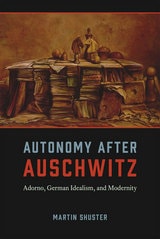
Autonomy After Auschwitz
Adorno, German Idealism, and ModernityMartin Shuster
University of Chicago Press, 2014
Shuster uncovers dangers in the notion of autonomy as it was originally conceived by Kant. Putting Adorno into dialogue with a range of European philosophers, notably Kant, Hegel, Horkheimer, and Habermas—as well as with a variety of contemporary Anglo-American thinkers such as Richard Rorty, Stanley Cavell, John McDowell, and Robert Pippin—he illuminates Adorno’s important revisions to this fraught concept and how his different understanding of autonomous agency, fully articulated, might open up new and positive social and political possibilities. Altogether, Autonomy after Auschwitz is a meditation on modern evil and human agency, one that demonstrates the tremendous ethical stakes at the heart of philosophy.

Autonomy
The Social Ontology of Art under CapitalismNicholas Brown
Duke University Press, 2019
Avatar Bodies
A Tantra For PosthumanismAnn Weinstone
University of Minnesota Press, 2004
An ethically-based approach to human relations for the media age
Otherness, alterity, the alien—over the course of the past fifty years many of us have based our hopes for more ethical relationships on concepts of difference. Combining philosophy, literary criticism, fiction, autobiography, and real and imagined correspondence, Ann Weinstone proposes that only when we stop ordering the other to be other—whether technological, animal, or simply inanimate—will we truly become posthuman.
Posthumanism has thus far focused nearly exclusively on human–technology relations. Avatar Bodies develops a posthumanist vocabulary for human-to-human relationships that turns our capacities for devotion, personality, and pleasure. Drawing on both the philosophies and practices of Indian Tantra, Weinstone argues for the impossibility of absolute otherness; we are all avatar bodies, consisting of undecidably shared gestures, skills, memories, sensations, beliefs, and affects.
Weinstone calls her book a “tantra”—by which she means a set of instructions for practices aimed at sensitizing the reader to the inherent permeability of self to other, self to world. This tantra for posthumanism elaborates devotional gestures that will expose us to more unfettered contacts and the transformative touch.
Averroes' Middle Commentaries on Aristotles Categories and De Interpretatione
St. Augustine's Press, 1998
Averroes' Middle Commentary on Aristotle's Poetics
St. Augustine's Press, 1999

Awakening to Race
Individualism and Social Consciousness in AmericaJack Turner
University of Chicago Press, 2012
Axiomatics
Mathematical Thought and High ModernismAlma Steingart
University of Chicago Press, 2023
Why did abstraction dominate American art, social science, and natural science in the mid-twentieth century? Why, despite opposition, did abstraction and theoretical knowledge flourish across a diverse set of intellectual pursuits during the Cold War? In recovering the centrality of abstraction across a range of modernist projects in the United States, Alma Steingart brings mathematics back into the conversation about midcentury American intellectual thought. The expansion of mathematics in the aftermath of World War II, she demonstrates, was characterized by two opposing tendencies: research in pure mathematics became increasingly abstract and rarified, while research in applied mathematics and mathematical applications grew in prominence as new fields like operations research and game theory brought mathematical knowledge to bear on more domains of knowledge. Both were predicated on the same abstractionist conception of mathematics and were rooted in the same approach: modern axiomatics.
For American mathematicians, the humanities and the sciences did not compete with one another, but instead were two complementary sides of the same epistemological commitment. Steingart further reveals how this mathematical epistemology influenced the sciences and humanities, particularly the postwar social sciences. As mathematics changed, so did the meaning of mathematization.
Axiomatics focuses on American mathematicians during a transformative time, following a series of controversies among mathematicians about the nature of mathematics as a field of study and as a body of knowledge. The ensuing debates offer a window onto the postwar development of mathematics band Cold War epistemology writ large. As Steingart’s history ably demonstrates, mathematics is the social activity in which styles of truth—here, abstraction—become synonymous with ways of knowing.
Aztec Philosophy
Understanding a World in MotionJames Maffie
University Press of Colorado, 2014
Aztec Philosophy focuses on the ways Aztec metaphysics—the Aztecs’ understanding of the nature, structure and constitution of reality—underpinned Aztec thinking about wisdom, ethics, politics,\ and aesthetics, and served as a backdrop for Aztec religious practices as well as everyday activities such as weaving, farming, and warfare. Aztec metaphysicians conceived reality and cosmos as a grand, ongoing process of weaving—theirs was a world in motion. Drawing upon linguistic, ethnohistorical, archaeological, historical, and contemporary ethnographic evidence, Maffie argues that Aztec metaphysics maintained a processive, transformational, and non-hierarchical view of reality, time, and existence along with a pantheistic theology.
Aztec Philosophy will be of great interest to Mesoamericanists, philosophers, religionists, folklorists, and Latin Americanists as well as students of indigenous philosophy, religion, and art of the Americas.

an other
a black feminist consideration of animal lifeSharon Patricia Holland
Duke University Press, 2023