Results by title
805 books match the query '18th Century' and 37 start with b
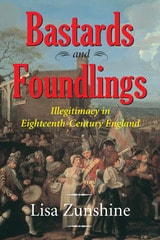
BASTARDS AND FOUNDLINGS
ILLEGITIMACY IN EIGHTEENTH-CENTURY ENGLANDLisa Zunshine
The Ohio State University Press, 2005

Bach Perspectives, Volume 10
Bach and the OrganMatthew Dirst
University of Illinois Press, 2016
Bach Perspectives, Volume 12
Bach and the Counterpoint of ReligionEdited by Robin A. Leaver
University of Illinois Press, 2018
Bach Perspectives, Volume 13
Bach ReworkedEdited by Laura Buch
University of Illinois Press, 2020
An insightful look at how composers build on each other's work, Bach Reworked reveals how nuanced understandings of parody procedures can fuel both musical innovation and historically informed performance.
Contributors: Stephen A. Crist, Ellen Exner, Moira Leanne Hill, Erinn E. Knyt, and Markus Zepf
Bach Perspectives, Volume 14
Bach and Mozart: Connections, Patterns, and PathwaysEdited by Paul Corneilson
University of Illinois Press, 2022
An official publication of the American Bach Society, Bach Perspectives, Volume 14 draws on a variety of approaches and a broad range of subject matter in presenting a new wave of innovative classical musical scholarship.
Contributors: Eleanor Selfridge-Field, Yoel Greenberg, Noelle M. Heber, Michael Maul, Stephen Roe, and David Schulenberg

Bach Perspectives, Volume 9
J.S. Bach and His Contemporaries in GermanyEdited by Andrew Talle
University of Illinois Press, 2013
In this volume, Wolfgang Hirschmann proposes an ethnographic approach that contextualizes Bach's works, addressing the aesthetic paths he took as well as those he did not pursue. Steven Zohn's essay considers Telemann's contribution to the orchestral Ouverture genre, observering how Telemann's approach to integrating the national styles of his time was quite different from, but no less rich than, Bach's. Andrew Talle compares settings and strategies of Vergnügte Ruh, beliebte Seelenlust by Bach and Graupner. Alison Dunlop presents valuable primary research on Muffat, the most commonly cited keyboard music composer in Vienna during Bach's lifetime. Finally, Michael Maul sheds new light on the Scheibe-Birnbaum controversy, contextualizing the most famous critique of J. S. Bach's compositional style by discussing the other composers that Scheibe critiqued.
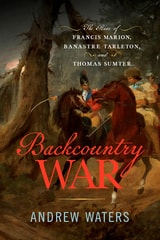
Backcountry War
The Rise of Francis Marion, Banastre Tarleton, and Thomas SumterAndrew Waters
Westholme Publishing, 2026
Over the past several decades, the history of the American Revolution in the South has undergone a transformation to better incorporate regional events into the greater narrative of the war. Among these events was the vicious “backcountry” war from the Georgia border, across the South Carolina wilderness, to the North Carolina Piedmont between rebel Americans and loyalist and British forces. Centered in South Carolina, this running battle saw some of the most intense and continuous fighting of the war, and from its skirmishes, feints, and sieges, three key leaders emerged: American partisans Francis “Swamp Fox” Marion and Thomas “Gamecock” Sumter, and British Legion commander Banastre “Bloody Ban” Tarleton.
For the first time, Backcountry War: The Rise of Francis Marion, Banastre Tarleton, and Thomas Sumter by Andrew Waters frames the history of these three men into in a single narrative, focusing on the events of 1780 in South Carolina that witnessed their collective ascendance from common soldiers to American legends. It was a time when British victories at Charleston and Camden left the Continental Army in tatters and the entire American South vulnerable to British conquest. Yet in those dark hours, Sumter, Marion, and others like them rose in the swamps and hills of the South Carolina wilderness. Fighting a wildly successful partisan war against better trained and better equipped British forces, including Tarleton’s British Legion, with victories at lesser-known places like Hanging Rock and Nelson’s Ferry, they gained precious months for the reorganizing Continental Army. Their collective efforts led to the stunning American victory at Cowpens and a stalemate at Guilford’s Courthouse the following year that finally convinced British general Charles Cornwallis to abandon the Carolinas for Virginia.
With background biographies of its three main protagonists, a thorough sketch of Great Britain’s Southern Strategy, and a sociocultural examination of the South Carolina frontier in the years leading up to the American Revolution, Backcountry War offers a fresh perspective on an extraordinary chapter of American history and a compelling account of the deadly contest between three of the war’s most charismatic leaders.
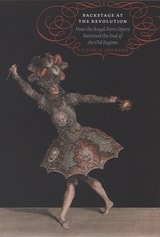
Backstage at the Revolution
How the Royal Paris Opera Survived the End of the Old RegimeVictoria Johnson
University of Chicago Press, 2008
Sifting through royal edicts, private letters, and Revolutionary records of all kinds, Johnson uncovers the roots of the Opera’s survival in its identity as a uniquely privileged icon of French culture—an identity established by the conditions of its founding one hundred years earlier under Louis XIV. Johnson’s rich cultural history moves between both epochs, taking readers backstage to see how a motley crew of singers, dancers, royal ministers, poet entrepreneurs, shady managers, and the king of France all played a part in the creation and preservation of one of the world’s most fabled cultural institutions.

Bad Books
Rétif de la Bretonne, Sexuality, and PornographyAmy S. Wyngaard
University of Delaware Press, 2013
Published by University of Delaware Press. Distributed worldwide by Rutgers University Press.
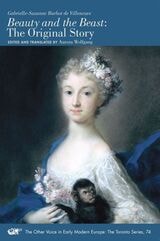
Beauty and the Beast
The Original StoryGabrielle-Suzanne Barbot de Villeneuve
Iter Press, 2020
The Other Voice in Early Modern Europe: The Toronto Series volume 74
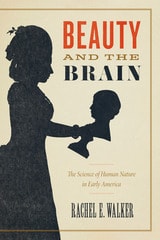
Beauty and the Brain
The Science of Human Nature in Early AmericaRachel E. Walker
University of Chicago Press, 2023
Between the 1770s and the 1860s, people all across the globe relied on physiognomy and phrenology to evaluate human worth. These once-popular but now-discredited disciplines were based on a deceptively simple premise: that facial features or skull shape could reveal a person’s intelligence, character, and personality. In the United States, these were culturally ubiquitous sciences that both elite thinkers and ordinary people used to understand human nature.
While the modern world dismisses phrenology and physiognomy as silly and debunked disciplines, Beauty and the Brain shows why they must be taken seriously: they were the intellectual tools that a diverse group of Americans used to debate questions of race, gender, and social justice. While prominent intellectuals and political thinkers invoked these sciences to justify hierarchy, marginalized people and progressive activists deployed them for their own political aims, creatively interpreting human minds and bodies as they fought for racial justice and gender equality. Ultimately, though, physiognomy and phrenology were as dangerous as they were popular. In addition to validating the idea that external beauty was a sign of internal worth, these disciplines often appealed to the very people who were damaged by their prejudicial doctrines. In taking physiognomy and phrenology seriously, Beauty and the Brain recovers a vibrant—if largely forgotten—cultural and intellectual universe, showing how popular sciences shaped some of the greatest political debates of the American past.
Before Voltaire
The French Origins of “Newtonian” Mechanics, 1680-1715J.B. Shank
University of Chicago Press, 2017
Before Voltaire explores how Newton’s ideas made their way not just through the realm of French science, but into the larger world of society and culture of which Principia was an intertwined part. Shank also details a history of the beginnings of calculus-based mathematical physics that integrates it into the larger intellectual currents in France at the time, including the Battle of the Ancients and the Moderns, the emergence of wider audiences for science, and the role of the newly reorganized Royal Academy of Sciences. The resulting book offers an unprecedented cultural history of one the most important and influential elements of Enlightenment science.
Benjamin Franklin's Printing Network
Disseminating Virtue in Early AmericaRalph Frasca
University of Missouri Press, 2005
Beside the Bard
Scottish Lowland Poetry in the Age of BurnsGeorge S. Christian
Bucknell University Press, 2020
Published by Bucknell University Press. Distributed worldwide by Rutgers University Press.
Between Design and Making
Architecture and Craftsmanship, 1630–1760Edited by Andrew Tierney and Melanie Hayes
University College London, 2024
The seventeenth and eighteenth centuries represent a high point in design and workmanship intersectionality. Skilled artisans worked across a spectrum of practices in design, supervision, and execution, and architects relied on this experience when building sites. However, this relationship has been under-studied in the architectural achievement of the early modern era.
Combining analysis of buildings, archival material, and eighteenth-century writings, editors Andrew Tierney and Melanie Hayes re-evaluate the social and professional fabric binding design to the act of making and reflect on the asymmetry between architecture and craft. They argue for a process-oriented understanding of architectural production that explores the scribbled and annotated beginnings of design; the debates and revisions in forging details; and the grappling with building materials that pushed projects from conception to completion.
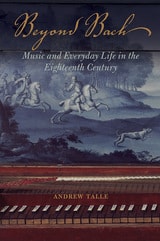
Beyond Bach
Music and Everyday Life in the Eighteenth CenturyAndrew Talle
University of Illinois Press, 2018
Eschewing the great composer style of music history, Andrew Talle takes us on a journey that looks at how ordinary people made music in Bach's Germany. Talle focuses in particular on the culture of keyboard playing as lived in public and private. As he ranges through a wealth of documents, instruments, diaries, account ledgers, and works of art, Talle brings a fascinating cast of characters to life. These individuals--amateur and professional performers, patrons, instrument builders, and listeners--inhabited a lost world, and Talle's deft expertise teases out the diverse roles music played in their lives and in their relationships with one another. At the same time, his nuanced re-creation of keyboard playing's social milieu illuminates the era's reception of Bach's immortal works.
Beyond Pontiac's Shadow
Michilimackinac and the Anglo-Indian War of 1763Keith R. Widder
Michigan State University Press, 2013
On June 2, 1763, the Ojibwe captured Michigan’s Fort Michilimackinac from the British. Ojibwe warriors from villages on Mackinac Island and along the Cheboygan River had surprised the unsuspecting garrison while playing a game of baggatiway. On the heels of the capture, Odawa from nearby L’Arbre Croche arrived to rescue British prisoners, setting into motion a complicated series of negotiations among Ojibwe, Odawa, and Menominee and other Indians from Wisconsin. Because nearly all Native people in the Michilimackinac borderland had allied themselves with the British before the attack, they refused to join the Michilimackinac Ojibwe in their effort to oust the British from the upper country; the turmoil effectively halted the fur trade. Beyond Pontiac’s Shadow examines the circumstances leading up to the attack and the course of events in the aftermath that resulted in the regarrisoning of the fort and the restoration of the fur trade. At the heart of this discussion is an analysis of French-Canadian and Indian communities at the Straits of Mackinac and throughout the pays d’en haut. An accessible guide to this important period in Michigan, American, and Canadian history, Beyond Pontiac’s Shadow sheds invaluable light on a political and cultural crisis.
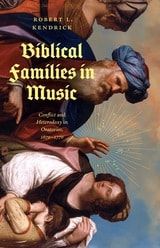
Biblical Families in Music
Conflict and Heterodoxy in Oratorios, 1670–1770Robert L. Kendrick
University of Chicago Press, 2025
Based to a great extent on the Old Testament, the largely Catholic musical-dramatic genre was popular in Italy, Austria, and southern Germany in the seventeenth and eighteenth centuries. Biblical Families in Music reveals how difficult stories of fratricide, child sacrifice, death, and forbidden love performed a didactic function in oratorios, teaching early modern audiences about piety and the rules of proper family life.
In the century after 1670, the heavily adapted tales of Abraham and Isaac, Cain and Abel, and the Egyptian slave Hagar and her son Ishmael were set to music by figures such as Alessandro Scarlatti and Antonio Sacchini and performed during Lent in churches and other sacred spaces for an audience of court nobility, clergy, and the urban patriciate. By examining the resonance of Catholic oratorios within predominantly upper-class social realities, the book broadens our cultural understanding of the early modern European family and underscores the centrality of family and familial relation to social position, devotional taste, and identity.
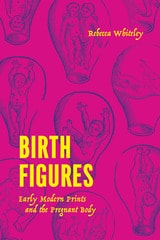
Birth Figures
Early Modern Prints and the Pregnant BodyRebecca Whiteley
University of Chicago Press, 2023
Birth figures are printed images of the pregnant womb, always shown in series, that depict the variety of ways in which a fetus can present for birth. Historian Rebecca Whiteley coined the term and here offers the first systematic analysis of the images’ creation, use, and impact. Whiteley reveals their origins in ancient medicine and explores their inclusion in many medieval gynecological manuscripts, focusing on their explosion in printed midwifery and surgical books in Western Europe from the mid-sixteenth to the mid-eighteenth century. During this period, birth figures formed a key part of the visual culture of medicine and midwifery and were widely produced. They reflected and shaped how the pregnant body was known and treated. And by providing crucial bodily knowledge to midwives and surgeons, birth figures were also deeply entangled with wider cultural preoccupations with generation and creativity, female power and agency, knowledge and its dissemination, and even the condition of the human in the universe.
Birth Figures studies how different kinds of people understood childbirth and engaged with midwifery manuals, from learned physicians to midwives to illiterate listeners. Rich and detailed, this vital history reveals the importance of birth figures in how midwifery was practiced and in how people, both medical professionals and lay readers, envisioned and understood the mysterious state of pregnancy.
Black Enlightenment
Surya Parekh
Duke University Press, 2023
Black Patriots and Loyalists
Fighting for Emancipation in the War for IndependenceAlan Gilbert
University of Chicago Press, 2012
Black Yankees
The Development of an Afro-American Subculture in Eighteenth-Century New EnglandWilliam D. Piersen
University of Massachusetts Press, 1988
On the face of it, the master class called the tunes and slaves danced the beat. Blacks who were taken into New England's bondage were clearly engulfed in a pervasive, narrow-minded Euro-American society that had no interest in fostering Afro-American autonomy. The New England experience was often cruel, and the numbers alone suggest it was among the most unequal of black/white cultural contacts in the New World. Nonetheless, despite the strictures of bondage, the black Yankees of eighteenth-century New England created a sustaining folk culture of their own.
Blake, Nationalism, and the Politics of Alienation
Julia M. Wright
Ohio University Press, 2027
William Blake’s reputation as a staunch individualist is based in large measure on his repeated attacks on institutions and belief systems that constrain the individual’s imagination. Blake, however, rarely represents isolation positively, suggesting that the individual’s absolute freedom from communal pressures is not the ideal. Instead, as Julia Wright argues in her award-winning study Blake, Nationalism, and the Politics of Alienation, Blake’s concern lies with the kind of community that is being established. Moreover, writing at the moment of the emergence of modern nationalism, Blake reveals a concern with the national community in particular.
Beginning with a discussion of the priority of national narrative in late-eighteenth-century art theory and antiquarianism, Blake, Nationalism, and the Politics of Alienation traces its relevance in Blake’s printed works, from The Poetical Sketches and the Lambeth Prophecies to The Laocoön. Professor Wright then turns to Europe, America, and Visions of the Daughters of Albion, focusing on Blake’s portrayals of particular characters’ alienation from the groups and ideologies represented in the texts. The book closes by arguing that Blake’s major printed works, Milton and Jerusalem, are explicit and extensive engagements with the question of nation—and empire.
Although nationalism existed in various forms during the Romantic period, Blake’s contemporaries generally assumed that nations should progress continuously, producing a clear narrative line from an auspicious origin to the perfect fulfillment of that promise. Wright argues that these mutually determining constructs of national character and national narrative inform Blake’s handling of the problem of the individual-within-a-community.
Bluestocking Feminism and British-German Cultural Transfer, 1750-1837
Alessa Johns
University of Michigan Press, 2014
Body Language
Medicine and the Eighteenth-Century Comic NovelKathleen Tamayo Alves
Bucknell University Press, 2026
Body Language examines the complex intersections of British eighteenth-century comic fiction and medical discourse. By engaging medical writings of renowned and widely-read physicians of the Enlightenment such as John Freind, Thomas Sydenham, Albrecht von Haller, John Whytt, and William Cullen, with novels of humor by Henry Fielding, Tobias Smollett, Laurence Sterne, and Charlotte Lennox, Alves explains how medicine shaped comic language by dramatizing female-specific phenomena like menstruation, hysteria, nervous disorders, and pregnancy. In these novels, the medical belief that women are incapable of bodily self-regulation becomes an imperative for policing women’s bodies and highlights the enduring shortcomings of patriarchal systems. Ultimately, these comic representations offer a counternarrative of women’s bodies, agency, and selfhood, exposing masculine anxieties about the effectiveness of marriage to regulate women’s sexuality.
Published by Bucknell University Press. Distributed worldwide by Rutgers University Press.
Bondmen and Rebels
A Study of Master-Slave Relations in AntiguaDavid Barry Gaspar
Duke University Press, 1985
Boswell and the Press
Essays on the Ephemeral Writing of James BoswellDonald J. Newman
Bucknell University Press, 2021
Bounded Lives, Bounded Places
Free Black Society in Colonial New Orleans, 1769–1803Kimberly S. Hanger
Duke University Press, 1997
Drawing on rare archives in Louisiana and Spain, Hanger reconstructs the world of late-eighteenth-century New Orleans from the perspective of its free black residents, and documents the common experiences and enterprises that helped solidify libres’ sense of group identity. Over the course of three and a half decades of Spanish rule, free people of African descent in New Orleans made their greatest advances in terms of legal rights and privileges, demographic expansion, vocational responsibilities, and social standing. Although not all blacks in Spanish New Orleans yearned for expanded opportunity, Hanger shows that those who did were more likely to succeed under Spain’s dominion than under the governance of France, Great Britain, or the United States.
The advent of U.S. rule brought restrictions to both manumission and free black activities in New Orleans. Nonetheless, the colonial libre population became the foundation for the city’s prosperous and much acclaimed Creoles of Color during the antebellum era.
Braddock's March
How the Man Sent to Seize a Continent Changed American HistoryThomas E. Crocker
Westholme Publishing, 2009
Winner of the 2011 New York Society of Colonial Wars Distinguished Book Award
“The strength of this book lies in Crocker’s presentation of the battle and the complicated logistics involved.”—Times Literary Supplement “Braddock’s March is arguably the first truly comprehensive history devoted exclusively to the calamitous march that remade North America. . . . Braddock’s story is superb history.”—Weekly Standard “Drawing on original sources, Crocker grittily reconstructs the advance of Edward Braddock’s army on Fort Duquesne. . . . Attentive to detail, Crocker will engage colonial-history readers in this well illustrated book.”—Booklist
“Both Braddock’s epic march and subsequent destruction are brought to life by Thomas E. Crocker in Braddock’s March, his impeccably researched account of an important but largely forgotten chapter in American history. . . . It all adds up to a stirring tale.”—Washington Times
“Before we parted, the General told me he should never see me more; for he was going with a handful of men to conquer whole nations; and to do this they must cut their way through unknown woods. He produced a map of the country, saying at the same time, ‘Dear Pop, we are sent like sacrifices to the altar.’” - George Anne Bellamy on General Edward Braddock’s departure
In January 1755, Major General Edward Braddock was sent by Great Britain on a mission to drive France once and for all from the New World. Accompanied by the largest armed expeditionary force ever sent to North America, Braddock’s primary target was the Forks of the Ohio, where he planned to seize Fort Duquesne (at present-day Pittsburgh, Pennsylvania), and then march north into Canada. After landing in Alexandria, Virginia, and organizing his troops and supply chain, Braddock and his expedition began its nearly 250-mile trek, heroically cutting through uncharted wilderness, fording rivers, and scaling the Appalachian mountains, all while hauling baggage and heavy artillery. Braddock was joined on this epic mission by a young Virginia colonel, George Washington, and others who would later play major roles in the American Revolution, including Horatio Gates, Thomas Gage, and Charles Lee; among those driving the expedition’s wagons were Daniel Boone and Daniel Morgan. Having withstood the harsh frontier and finally marching upon Fort Duquesne on a hot July morning, Braddock’s exhausted column was ambushed by a combined French and Indian force. Over two-thirds of Braddock’s British and colonial troops were killed or wounded, including Braddock himself, struck by a bullet in the chest while attempting to rally his disoriented troops. George Washington miraculously escaped harm despite four bullet holes through his clothing. With this battle, North America became the greatest stake in the global war between France and Great Britain.
In Braddock’s March: How the Man Sent to Seize a Continent Changed American History, Thomas E. Crocker tells the riveting story of one of the most important events in colonial America. Not only did Braddock’s expedition have a profound impact on American political and military developments, this fateful march laid the foundation for the “National Pike,” the major road for westward expansion, launched the career of George Washington, and sowed the seeds of dissent between England and its colonies that would ultimately lead to the American Revolution.
Brazil at the Dawn of the Eighteenth Century
André João Antonil
Tagus Press, 2012
British Literature and Technology, 1600-1830
Kristin M. Girten
Bucknell University Press, 2023
Enlightenment-era writers had not yet come to take technology for granted, but nonetheless were—as we are today—both attracted to and repelled by its potential. This volume registers the deep history of such ambivalence, examining technology’s influence on Enlightenment British literature, as well as the impact of literature on conceptions of, attitudes toward, and implementations of technology. Offering a counterbalance to the abundance of studies on literature and science in seventeenth- and eighteenth-century Britain, this volume’s focus encompasses approaches to literary history that help us understand technologies like the steam engine and the telegraph along with representations of technology in literature such as the “political machine.” Contributors ultimately show how literature across genres provided important sites for Enlightenment readers to recognize themselves as “chimeras”—“hybrids of machine and organism”—and to explore the modern self as “a creature of social reality as well as a creature of fiction.”
British Romanticism and Prison Reform
Jonas Cope
Bucknell University Press, 2025
In eighteenth-century Britain, criminals were routinely whipped, branded, hanged, or transported to America. Only in the last quarter of the century—with the War of American Independence and legal and sociopolitical challenges to capital punishment—did the criminal justice system change, resulting in the reformed prison, or penitentiary, meant to educate, rehabilitate, and spiritualize even hardened felons. This volume is the first to explore the relationship between historical penal reform and Romantic-era literary texts by luminaries such as Godwin, Keats, Byron, and Austen. The works examined here treat incarceration as ambiguous: prison walls oppress and reinforce the arbitrary power of legal structures but can also heighten meditation, intensify the imagination, and awaken the conscience. Jonas Cope skillfully traces the important ideological work these texts attempt: to reconcile a culture devoted to freedom with the birth of the modern prison system that presents punishment as a form of rehabilitation.
Published by Bucknell University Press. Distributed worldwide by Rutgers University Press.
British Soldiers, American War
Voices of the American RevolutionDonald N. Hagist
Westholme Publishing, 2012
Nine Rare and Fascinating First-Person Profiles of Soldiers Who Fought for the British Crown
Much has been written about the colonists who took up arms during the American Revolution and the army they created. Far less literature, however, has been devoted to their adversaries. The professional soldiers that composed the British army are seldom considered on a personal level, instead being either overlooked or inaccurately characterized as conscripts and criminals. Most of the British Redcoats sent to America in defense of their government’s policies were career soldiers who enlisted voluntarily in their late teens or early twenties. They came from all walks of British life, including those with nowhere else to turn, those aspiring to improve their social standing, and all others in between. Statistics show that most were simply hardworking men with various amounts of education who had chosen
the military in preference to other occupations. Very few of these soldiers left writings from which we can learn their private motives and experiences.
British Soldiers, American War: Voices of the American Revolution is the first collection of personal narratives by British common soldiers ever assembled and published. Author Don N. Hagist has located first-hand accounts of nine soldiers who served in America in the 1770s and 1780s. In their own words we learn of the diverse population—among them a former weaver, a boy who quarelled with his family, and a man with wanderlust—who joined the army and served tirelessly and dutifully, sometimes faithfully and sometimes irresolutely, in the uniform of their nation. To accompany each narrative, the author provides a contextualizing essay based on archival research giving background on the soldier and his military service. Taken as a whole these true stories reveal much about the individuals who composed what was, at the time, the most formidable fighting force in the world.
Building the Devil's Empire
French Colonial New OrleansShannon Lee Dawdy
University of Chicago Press, 2008
Building the Devil’s Empire is the first comprehensive history of New Orleans’s early years, tracing the town’s development from its origins in 1718 to its revolt against Spanish rule in 1768. Shannon Lee Dawdy’s picaresque account of New Orleans’s wild youth features a cast of strong-willed captives, thin-skinned nobles, sharp-tongued women, and carousing travelers. But she also widens her lens to reveal the port city’s global significance, examining its role in the French Empire and the Caribbean, and she concludes that by exemplifying a kind of rogue colonialism—where governments, outlaws, and capitalism become entwined—New Orleans should prompt us to reconsider our notions of how colonialism works.
"[A] penetrating study of the colony's founding."—Nation
“A brilliant and spirited reinterpretation of the emergence of French New Orleans. Dawdy leads us deep into the daily life of the city, and along the many paths that connected it to France, the North American interior, and the Greater Caribbean. A major contribution to our understanding of the history of the Americas and of the French Atlantic, the work is also a model of interdisciplinary research and analysis, skillfully bringing together archival research, archaeology, and literary analysis.”—Laurent Dubois, Duke University
Building the King’s Highway
Labor, Society, and Family on Mexico’s Caminos Reales, 1757-1804Bruce A. Castleman
University of Arizona Press, 2005
Focusing on the camino real linking Mexico City and the port of Veracruz, Bruce Castleman has written a social history of road construction laborers in late Bourbon Mexico. He has drawn on employment and census records to study a major shift in methods used by the Spanish colonial regime to mobilize the supply of unskilled labor—and concomitant changes in the identities those laborers asserted for themselves.
Through a close analysis of wages actually paid to named individuals from one week to the next, Castleman opens a new window on Mexican history. In the 1760s, a free-wage labor regime replaced a draft-labor system, and by examining records of road construction he traces both this transformation and its implications. During this time, free-wage artisans saw their earnings reduced, and they were pushed into the labor pool, and Castleman reveals how a shift occurred in the way that laborers identified themselves as the Spanish casta system of racial classification became increasingly fluid.
In his study, Castleman introduces some of the principle players of eighteenth-century Mexico, from viceroys to tobacco planters to military engineers. He then fleshes out the lives of working persons, drawing on a complete set of construction records from the construction of the Puente de Escamela at Orizaba to forge a collective biography that considers their existences apart from the workplace. By linking census and employment records, he uncovers a host of social indicators such as marriage preference, family structure, and differences over time in how the caste system was used to classify people according to ancestry.
As Castleman shows, roads did not so much link Mexico to the global economy as forge regional markets within New Spain, and his work provides an astute analysis of struggles between the Bourbon colonial state, the important consulados of Mexico City and Veracruz, and more localized interests over road policy. More important, Building the King’s Highway provides a valuable new perspective on people’s lives as it advances our understanding of labor in late colonial Latin America.
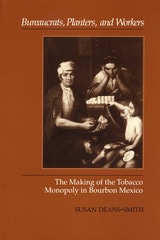
Bureaucrats, Planters, and Workers
The Making of the Tobacco Monopoly in Bourbon MexicoBy Susan Deans-Smith
University of Texas Press, 1992
Honorable Mention, Bolton Memorial Prize, Conference on Latin American History
A government monopoly provides an excellent case study of state-society relationships. This is especially true of the tobacco monopoly in colonial Mexico, whose revenues in the later half of the eighteenth century were second only to the silver tithe as the most valuable source of government income. This comprehensive study of the tobacco monopoly illuminates many of the most important themes of eighteenth-century Mexican social and economic history, from issues of economic growth and the supply of agricultural credit to rural relations, labor markets, urban protest and urban workers, class formation, work discipline, and late colonial political culture.
Drawing on exhaustive research of previously unused archival sources, Susan Deans-Smith examines a wide range of new questions. Who were the bureaucrats who managed this colonial state enterprise and what policies did they adopt to develop it? How profitable were the tobacco manufactories, and how rational was their organization? What impact did the reorganization of the tobacco trade have upon those people it affected most—the tobacco planters and tobacco workers?
This research uncovers much that was not previously known about the Bourbon government's management of the tobacco monopoly and the problems and limitations it faced. Deans-Smith finds that there was as much continuity as change after the monopoly's establishment, and that the popular response was characterized by accommodation, as well as defiance and resistance. She argues that the problems experienced by the monopoly at the beginning of the nineteenth century did not originate from any simmering, entrenched opposition. Rather, an emphasis upon political stability and short-term profits prevented any innovative reforms that might have improved the monopoly's long-term performance and productivity.
With detailed quantitative data and rare material on the urban working poor of colonial Mexico, Bureaucrats, Planters, and Workers will be important reading for all students of social, economic, and labor history, especially of Mexico and Latin America.
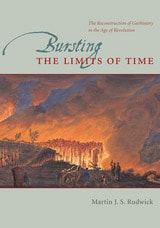
Bursting the Limits of Time
The Reconstruction of Geohistory in the Age of RevolutionMartin J. S. Rudwick
University of Chicago Press, 2005
In 1650, Archbishop James Ussher of Armagh joined the long-running theological debate on the age of the earth by famously announcing that creation had occurred on October 23, 4004 B.C. Although widely challenged during the Enlightenment, this belief in a six-thousand-year-old planet was only laid to rest during a revolution of discovery in the late eighteenth and early nineteenth centuries. In this relatively brief period, geologists reconstructed the immensely long history of the earth-and the relatively recent arrival of human life. Highlighting a discovery that radically altered existing perceptions of a human's place in the universe as much as the theories of Copernicus, Darwin, and Freud did, Bursting the Limits of Time is a herculean effort by one of the world's foremost experts on the history of geology and paleontology to sketch this historicization of the natural world in the age of revolution.
Addressing this intellectual revolution for the first time, Rudwick examines the ideas and practices of earth scientists throughout the Western world to show how the story of what we now call "deep time" was pieced together. He explores who was responsible for the discovery of the earth's history, refutes the concept of a rift between science and religion in dating the earth, and details how the study of the history of the earth helped define a new branch of science called geology. Rooting his analysis in a detailed study of primary sources, Rudwick emphasizes the lasting importance of field- and museum-based research of the eighteenth and nineteenth centuries.
Bursting the Limits of Time, the culmination of more than three decades of research, is the first detailed account of this monumental phase in the history of science.