Results by title
101 books match the query '1933-1945' and 3 start with b

Barricade
Utpal Dutt
Seagull Books, 2022
Although Utpal Dutt is acknowledged as a trailblazer of post-Independence Indian theater, English readers have not had access to the range and wealth of his drama. Barricade is a political play that stages the Nazi takeover of Germany in 1933 with an eye on India. Today, the surge to power of far-right parties and fundamentalist fanaticism across the world means that the co-option of democracy and civil society that led to Nazi fascism can happen again—or indeed has already happened—granting Barricade its immediate urgency. Equipped with an introduction analyzing its historical context, this translation of Barricade is also a very rare product in dramatic literature, collating both the printed original as well as a documented performance of the production directed by Dutt.
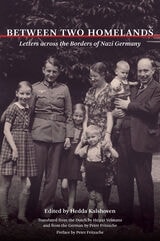
Between Two Homelands
Letters across the Borders of Nazi GermanyEdited by Hedda Kalshoven
University of Illinois Press, 2014
In 1920, at the age of thirteen, Irmgard Gebensleben first traveled from Germany to The Netherlands on a "war-children transport." She would later marry a Dutch man and live and raise her family there while keeping close to her German family and friends through the frequent exchange of letters. Yet during this period geography was not all that separated them. Increasing divergence in political opinions and eventual war between their countries meant letters contained not only family news but personal perspectives on the individual, local, and national choices that would result in the most destructive war in history.
This important collection, first assembled by Irmgard Gebensleben's daughter Hedda Kalshoven, gives voice to ordinary Germans in the Weimar Republic and the Third Reich and in the occupied Netherlands. The correspondence between Irmgard, her friends, and four generations of her family delve into their most intimate and candid thoughts and feelings about the rise of National Socialism. The responses to the German invasion and occupation of the Netherlands expose the deeply divided loyalties of the family and reveal their attempts to bridge them. Of particular value to historians, the letters evoke the writers' beliefs and their understanding of the events happening around them.
This first English translation of Ik denk zoveel aan jullie: Een briefwisseling tussen Nederland en Duitsland 1920-1949, has been edited, abridged, and annotated by Peter Fritzsche with the assent and collaboration of Hedda Kalshoven. After the book's original publication the diary of Irmgard's brother and loyal Wehrmacht soldier, Eberhard, was discovered and edited by Hedda Kalshoven. Fritzsche has drawn on this important additional source in his preface.
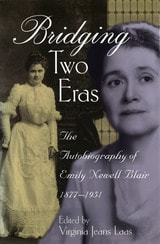
Bridging Two Eras
The Autobiography of Emily Newell Blair, 1877-1951Emily Newell Blair, Edited & Intro by Virginia Jeans Laas
University of Missouri Press, 1999
First written in 1937 and never before published, Bridging Two Eras is the fascinating autobiography of Emily Newell Blair, a remarkable woman who successfully reconciled a productive public life with the traditional values of a housewife and mother.
Because Blair's life essentially spanned two eras, from the end of the nineteenth century through the middle of the twentieth, she thought of herself as a bridge builder. A dedicated feminist, she wanted her autobiography to help women understand what life was like during that transition time. She had moved from being a conventional, middle-class, midwestern wife and mother to becoming an acclaimed author, a nationally known feminist, and vice chairman of the Democratic National Committee only two years after women gained the right to vote. She felt that her story could encourage women to take their rightful places in public life.
Bridging Two Eras is divided into two parts. Book I is a charming evocation of life in southwest Missouri in the closing decades of the nineteenth century. It offers great insight into family relationships, class structure, and social attitudes typical of much of small-town America. Book II addresses Blair's public career and follows her progress as professional writer, suffrage activist, and partisan politician. Included are acute judgments of leading political figures, fascinating vignettes of the suffrage movement, an insider's view of the workings of the national Democratic Party in the 1920s and 1930s, and a valuable outlook on Missouri politics during the first third of the twentieth century.
Perceptive and introspective, Blair captivates her readers as she traces her own evolution. With candor, she explains her conflicts between family and career, acknowledging the difficulties and tensions she faced in pursuing a public life. Delightfully written, Bridging Two Eras provides valuable insight into all the possibilities, as well as the limitations, life then held for an American woman.