Results by title
193 books match the query '1945-' and 8 start with b
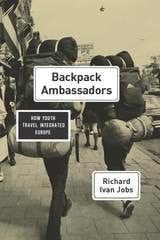
Backpack Ambassadors
How Youth Travel Integrated EuropeRichard Ivan Jobs
University of Chicago Press, 2017
From the Berlin Wall to the beaches of Spain, the Spanish Steps in Rome to the Pudding Shop in Istanbul, Jobs tells the stories of backpackers whose personal desire for freedom of movement brought the people and places of Europe into ever-closer contact. As greater and greater numbers of young people trekked around the continent, and a truly international youth culture began to emerge, the result was a Europe that, even in the midst of Cold War tensions, found its people more and more connected, their lives more and more integrated. Drawing on archival work in eight countries and five languages, and featuring trenchant commentary on the relevance of this period for contemporary concerns about borders and migration, Backpack Ambassadors brilliantly recreates a movement that was far more influential and important than its footsore travelers could ever have realized.

Be Not Afraid
A Southern Journey Through Law, Liberty, and Civil RightsJack Drake
University of Alabama Press, 2026
A civil rights attorney’s unflinching memoir about the fight against segregation and systemic racism through landmark legal battles in Alabama
Be Not Afraid: A Southern Journey Through Law, Liberty, and Civil Rights is a timely and unflinching memoir from civil rights attorney Jack Drake, who has spent decades on the front lines of Alabama’s legal battles for racial justice. Raised in a segregated community in Gardendale, Alabama, Drake came of age during the civil rights movement and became a pivotal figure in cases that reshaped the state’s legal and moral landscape.
Drake helped reform Alabama’s grossly inadequate mental health system and supported voting rights efforts throughout Alabama. His career underscores the crucial role private attorneys and grassroots advocates played in enforcing civil rights laws long after their passage.
Through vivid recollections of courtroom battles, civil rights alliances, and personal transformation, Be Not Afraid offers an intimate view into the persistence and courage required to challenge systemic injustice. At a time when debates over equity and democracy remain pressing, Drake’s story is both a powerful reflection on the past and a call to action for the present. It speaks to the enduring importance of legal advocacy and community solidarity in the fight for a more just society, making it essential reading for those engaged in civil rights history, law, or social change.

Birth Quake
The Baby Boom and Its AftershocksDiane J. Macunovich
University of Chicago Press, 2002
Macunovich focuses on the pervasive effects of changes in "relative cohort size," the ratio of young to middle-aged adults, as masses of young people tried to achieve the standard of living to which they had become accustomed in their parents' homes despite dramatic reductions in their earning potential relative to that of their parents. Macunovich presents the results of detailed empirical analyses that illustrate how varied and important cohort effects can be on a wide range of economic indicators, social factors, and even on more tumultuous events including the stock market crash of 1929, the "oil shock" of 1973, and the "Asian flu" of the 1990s. Birth Quake demonstrates that no discussion of business or economic trends can afford to ignore the effects of population.

Birth and Fortune
The Impact of Numbers on Personal WelfareRichard A. Easterlin
University of Chicago Press, 1987
"[Easterlin] has made clear, I think unambiguously, that the baby-boom generation is economically underprivileged merely because of its size. And in showing this, he demonstrates that population size can be as restrictive as a factor as sex, race, or class on equality of opportunity in the U.S."—Jeffrey Madrick, Business Week
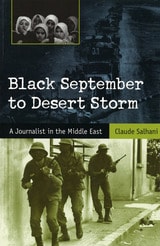
Black September to Desert Storm
A Journalist in the Middle EastClaude Salhani
University of Missouri Press, 1998
For more than twenty years, Claude Salhani traveled throughout the volatile Middle East as a photojournalist and reporter in search of the region's biggest stories. Wars, terrorist acts, demonstrations by religious extremists, and the flight of refugees were among the events he witnessed. "I have seen much through my lens . . . the most terrible cruelties, the most horrible suffering—and the most improbable and moving acts of love and generosity. I have been warmly received by kings, prime ministers, and secretaries of state. I have been shot at, kidnapped, and rifle-butted," writes Salhani in the prologue of this fascinating account.
From exclusive travels with former U.S. Secretary of State Henry Kissinger to intimate moments with combatants in the battle for Beirut to the forbidden world of drug smugglers in Lebanon, to the Iranian Revolution, and finally to the rise of Desert Storm, Salhani transports readers behind the scenes of many groundbreaking news stories. He proves that behind the front-page story we see, an equally intriguing tale is often hidden—that of the difficult, bizarre, even comical circumstances in which news is obtained.
Offering insight into the potent mixture of journalism and warfare, Black September to Desert Storm shares with readers an extraordinary journey into the headline-grabbing sagas that have plagued the Middle East in the last three decades. Salhani's "behind-the-lens" perspective will appeal to students of journalism and the Middle East, as well as anyone simply fascinated by the trials that many journalists undergo to capture "The Story."
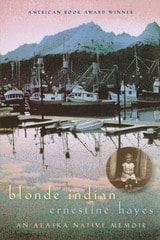
Blonde Indian
An Alaska Native MemoirErnestine Hayes
University of Arizona Press, 2006
Told in eloquent layers that blend Native stories and metaphor with social and spiritual journeys, this enchanting memoir traces the author’s life from her difficult childhood growing up in the Tlingit community, through her adulthood, during which she lived for some time in Seattle and San Francisco, and eventually to her return home. Neither fully Native American nor Euro-American, Hayes encounters a unique sense of alienation from both her Native community and the dominant culture. We witness her struggles alongside other Tlingit men and women—many of whom never left their Native community but wrestle with their own challenges, including unemployment, prejudice, alcoholism, and poverty.
The author’s personal journey, the symbolic stories of contemporary Natives, and the tales and legends that have circulated among the Tlingit people for centuries are all woven together, making Blonde Indian much more than the story of one woman’s life. Filled with anecdotes, descriptions, and histories that are unique to the Tlingit community, this book is a document of cultural heritage, a tribute to the Alaskan landscape, and a moving testament to how going back—in nature and in life—allows movement forward.

Brazilian Art under Dictatorship
Antonio Manuel, Artur Barrio, and Cildo MeirelesClaudia Calirman
Duke University Press, 2012
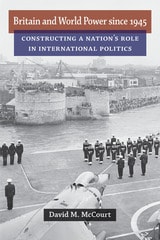
Britain and World Power since 1945
Constructing a Nation's Role in International PoliticsDavid M. McCourt
University of Michigan Press, 2014