Results by title
163 books match the query '1945-1989' and 8 start with b
Barbara F. Vucanovich
From Nevada to Congress, and Back AgainBarbara F. Vucanovich
University of Nevada Press, 2014
Barbara Vucanovich was sixty-two when she ran in her first election, becoming the first woman ever elected to a federal office from Nevada. In this engaging memoir, written with her daughter, she reflects on the road that led her to Washington--her years as mother, businesswoman, and volunteer.
[more]
Barney Frank
The Story of America's Only Left-Handed, Gay, Jewish CongressmanStuart Weisberg
University of Massachusetts Press, 2009
In a survey conducted by Washingtonian magazine, Barney Frank was rated the smartest, funniest, and most eloquent member of Congress. A mainstay in the House of Representatives since 1981, he has come to be known for his talent as a legislator, his zeal for verbal combat, his imposing intellect, and a quick wit that both disarms and entertains other lawmakers. Most recently, as chair of the Financial Services Committee, he was instrumental in crafting a compromise bill to stem the tide of home mortgage foreclosures, as well as the subsequent $700 billion "rescue plan."
Based on interviews with over 150 people, including more than thirty hours with Frank himself, this biography reconstructs for the first time his life and career, from his working-class childhood in Bayonne, New Jersey, to his years at Harvard and in Boston politics, through his rise to national prominence. Stuart Weisberg captures Frank in all his quirkiness, irreverence, and complexity. He also examines his less appealing side—his gruff exterior, his legendary impatience, his aversion to wasting time. Weisberg reveals the pressure Frank has felt as the most prominent openly gay politician in the United States, one whose career was nearly derailed by a highly publicized sex scandal involving a male prostitute.
Above all, this book shows Frank to be a superb legislator—a pragmatic politician who has dedicated his career to pursuing an unabashedly liberal agenda and whose depth of intellect and sense of humor have made him one of the most influential and colorful figures in Washington.
[more]
Barry Goldwater and the Remaking of the American Political Landscape
Edited by Elizabeth Tandy Shermer
University of Arizona Press, 2013
Nearly four million Americans worked on Barry Goldwater’s behalf in the presidential election of 1964. These citizens were as dedicated to their cause as those who fought for civil rights and against the Vietnam War. Arguably, the conservative agenda that began with Goldwater has had effects on American politics and society as profound and far reaching as the liberalism of the 1960s. According to the essays in this volume, it’s high time for a reconsideration of Barry Goldwater’s legacy.
Since Goldwater’s death in 1998, politicians, pundits, and academics have been assessing his achievements and his shortcomings. The twelve essays in this volume thoroughly examine the life, times, and impact of “Mr. Conservative.” Scrutinizing the transformation of a Phoenix department store owner into a politician, de facto political philosopher, and five-time US senator, contributors highlight the importance of power, showcasing the relationship between the nascent conservative movement’s cadre of elite businessmen, newsmen, and intellectuals and their followers at the grassroots—or sagebrush—level.
Goldwater, who was born in the Arizona Territory in 1909, was deeply influenced by his Western upbringing. With his appearance on the national stage in 1964, he not only articulated a new brand of conservatism but gave a voice to many Americans who were not enamored with the social and political changes of the era. He may have lost the battle for the presidency, but he energized a coalition of journalists, publishers, women’s groups, and Southerners to band together in a movement that reshaped the nation.
[more]
Berlin and the Cold War
Seth Givens; Ingo Trauschweizer
Ohio University Press, 2024
The Cold War is back in the news. So is history, in the sense of past geopolitical confrontations that for a span of a few decades were thought to be largely decoupled from present-day political developments. Of course, such reflexive reactions lack nuance and, until the Russian invasion of Ukraine in February 2022, tended to refer more to tensions between the United States and China. We should neither see Russia’s aggressive war in Ukraine immediately as part of a new cold war—though it could certainly become one of its foundation pieces—nor define history simply in terms of warfare and conflict. Yet such history has great appeal in efforts to understand the dizzying and depressing events of recent years. For example, correspondents and commentators have likened the delivery of weapons systems, protective gear, and humanitarian aid to a beleaguered Ukraine to the Berlin Airlift of 1948–49. But relying on history as a guide may mislead as much as enlighten. No city symbolizes the Cold War quite as Berlin does. When we think of the Cold War and of Berlin, we tend to emphasize the crises—the 1948–49 blockade and airlift, perhaps the 1953 East German workers’ uprising, surely the 1958–61 crisis, during which the Berlin Wall was built—and the climactic ending of the Cold War in Europe when the wall came down. Berlin may conjure up iconic moments and tropes, from a statement attributed to Nikita Khrushchev in 1963 that Berlin was “the testicles of the West,” to John F. Kennedy’s insistence that all free men had to be invested in the defense of Berlin, to Ronald Reagan’s exhortation to Mikhail Gorbachev to “tear down this wall.” For American presidents (or presidential hopefuls), Berlin and the Brandenburg Gate have remained powerful images, even in the twenty-first century. A presence in Berlin signals strong leadership in the West, even though the proximate reasons why the West, as a political construct, emerged in the first place may be gone. In that sense, Berlin also stands for overcoming the past: first, West Berlin as the counterpoint not only to eastern communism but also to defeated fascism, and second, the new Berlin as the capital of a unified Germany and as a symbol that the West has won.
[more]
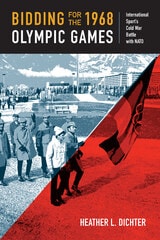
Bidding for the 1968 Olympic Games
International Sport's Cold War Battle with NATOHeather L. Dichter
University of Massachusetts Press, 2021
Winner of the 2022 Lord Aberdare Literary Prize from the British Society of Sports History
During the Cold War, political tensions associated with the division of Germany came to influence the world of competitive sport. In the 1950s, West Germany and its NATO allies refused to recognize the communist East German state and barred its national teams from sporting competitions. The construction of the Berlin Wall in 1961 further exacerbated these pressures, with East German teams denied travel to several world championships. These tensions would only intensify in the run-up to the 1968 Olympics.
In Bidding for the 1968 Olympic Games, Heather L. Dichter considers how NATO and its member states used sport as a diplomatic arena during the height of the Cold War, and how international sport responded to political interference. Drawing on archival materials from NATO, foreign ministries, domestic and international sport functionaries, and newspapers, Dichter examines controversies surrounding the 1968 Summer and Winter Olympic Games, particularly the bidding process between countries to host the events. As she demonstrates, during the Cold War sport and politics became so intertwined that they had the power to fundamentally transform each other.
[more]
Black Elected Officials
Study of Black Americans Holding Government OfficeJames Conyers
Russell Sage Foundation, 1976
Presents the first nationwide profile of black Americans (over 3,500) who now hold elective governmental office. The book is based upon a questionnaire survey of black elected officials together with a comparison survey of white men and women elected to similar types of offices in the same geographical region. The inclusion of extensive quotations from interviews with thirty-four black elected officials adds realism, depth, and insight to the quantitative analysis. The authors interrelate fresh and meaningful information on the political ideologies and motivations of black officials, their perceived political impacts, and expectations for the future. Presents the first nationwide profile of black Americans (over 3,500) who now hold elective governmental office. The book is based upon a questionnaire survey of black elected officials together with a comparison survey of white men and women elected to similar types of offices in the same geographical region. The inclusion of extensive quotations from interviews with thirty-four black elected officials adds realism, depth, and insight to the quantitative analysis. The authors interrelate fresh and meaningful information on the political ideologies and motivations of black officials, their perceived political impacts, and expectations for the future.
[more]
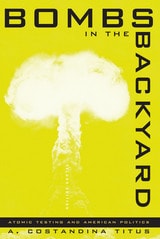
Bombs in the Backyard
Atomic Testing and American PoliticsA. Constandina Titus
University of Nevada Press, 2001
On January 27, 1951, the first atomic weapon was detonated over a section of desert known as Frenchman Flat in southern Nevada, providing dramatic evidence of the Nevada Test Site's beginnings. Fifty years later, author A. Costandina Titus reviews contemporary nuclear policy issues concerning the continued viability of that site for weapons testing. Titus has updated her now-classic study of atomic testing with fifteen years of political and cultural history, from the mid-1980s Reagan-Gorbachev nuclear standoff to the authorization of the Nevada Test Site Research Center, a Desert Research Institute facility scheduled to open in 2001. In this second edition of Bombs in the Backyard, Titus deftly covers the post-Cold War transformation of American atomic policy as well as our overarching cultural interest in all matters atomic, making this a must-read for anyone interested in atomic policy and politics.
[more]
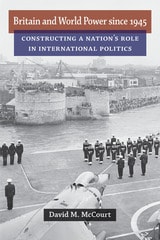
Britain and World Power since 1945
Constructing a Nation's Role in International PoliticsDavid M. McCourt
University of Michigan Press, 2014
?Though Britain’s descent from global imperial power began in World War II and continued over the subsequent decades with decolonization, military withdrawal, and integration into the European Union, its foreign policy has remained that of a Great Power. David M. McCourt maintains that the lack of a fundamental reorientation of Britain’s foreign policy cannot be explained only by material or economic factors, or even by an essential British international “identity.” Rather, he argues, the persistence of Britain’s place in world affairs can best be explained by the prominent international role that Britain assumed and into which it was thrust by other nations, notably France and the United States, over these years.
Using a role-based theory of state action in international politics based on symbolic interactionism and the work of George Herbert Mead, Britain and World Power since 1945 puts forward a novel interpretation of Britain’s engagement in four key international episodes: the Suez Crisis of 1956, the Skybolt Crisis of 1962, Britain’s second application to the European Economic Council in 1966–67, and Britain’s reinvasion of the Falklands in 1982. McCourt concludes with a discussion of international affairs since the end of the Cold War and the implications for the future of British foreign policy.
[more]