Results by title
53 books match the query '1948-' and 3 start with b
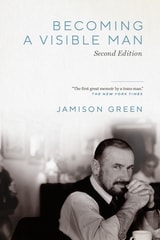
Becoming a Visible Man
Second EditionJamison Green
Vanderbilt University Press, 2020
At least two generations of transgender, nonbinary, and gender-nonconforming people have emerged since Becoming a Visible Man was first published in 2004, but the book remains a beloved resource for trans people and their allies.
Since the first edition's publication, author Jamison Green's writings and advocacy among business and governmental organizations around the world have led to major changes in the fields of law, medicine, and social policy, and his (mostly invisible) work has had significant effects on trans people globally. This new edition captures the changes of the last two decades, while also imparting a message of self-acceptance and health.
With profoundly personal and eminently practical threads, Green clarifies transgender experience for transgender people and their families, friends, and coworkers. Medical and mental health care providers, educators, business leaders, and advocates seeking information about transgender concerns can all gain from Green's integrative approach to the topic. This book candidly addresses emotional relationships that are affected by a transition, and brings refined integrity to the struggle to self-define, whether one undergoes a transition or chooses not to.
Emphasizing the lives of transgender men—who are often overlooked—he elucidates the experience of masculinity in a way that is self-assured and inclusive of feminist values. Green's inspirational wisdom has informed and empowered thousands of readers. There is still no other book like Becoming a Visible Man in the transgender canon.
[more]
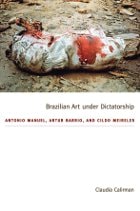
Brazilian Art under Dictatorship
Antonio Manuel, Artur Barrio, and Cildo MeirelesClaudia Calirman
Duke University Press, 2012
Brazilian Art under Dictatorship is a sophisticated analysis of the intersection of politics and the visual arts during the most repressive years of Brazil's military regime, from 1968 until 1975. Raised in Rio de Janeiro during the dictatorship, the curator and art historian Claudia Calirman describes how Brazilian visual artists addressed the political situation and opened up the local art scene to new international trends. Focusing on innovative art forms infused with a political undertone, Calirman emphasizes the desire among Brazilian artists to reconcile new modes of art making with a concern for local politics. Ephemeral works, such as performance art, media-based art, and conceptualism, were well suited to the evasion of censorship and persecution. Calirman examines the work and careers of three major artists of the period, Antonio Manuel, Artur Barrio, and Cildo Meireles. She explores the ways that they negotiated the competing demands of Brazilian politics and the international art scene, the efficacy of their political critiques, and their impact on Brazilian art and culture. Calirman suggests that the art of the late 1960s and early 1970s represented not just the artists' concerns with politics, but also their anxieties about overstepping the boundaries of artistic expression.
[more]

Burma
The Curse of IndependenceShelby Tucker
Pluto Press, 2001
Burma offers the first up-to-date overview and understanding of Burma’s tragic armed conflict in the twentieth century. Examining the ‘causes’ of the war, Shelby Tucker traces the political development of the country from the occupations by the British and Japanese and eventual independence in 1942, through the army coup of 1962 led by Ne Win, which established an authoritarian state, to the pro-democracy movement of the late 1980s. Tucker examines Burma’s drug trade; scrutinises Burma’s civil rights record; examines the role of the Nationalist leader Aung Seng, who attempted to unite the various sections of the population; the impact of Seng’s assassination and subsequent power struggles; and considers the future for a government faced with armed opposition from separatist movements among the ethnic minorities of Burma’s regions.
[more]