Results by title
1713 books match the query '21St Century' and 86 start with b
Banded Together
Economic Democratization in the Brass ValleyJeremy Brecher
University of Illinois Press, 2011
Bangtan Remixed
A Critical BTS ReaderPatty Ahn, Michelle Cho, Vernadette Vicuña Gonzalez, Rani Neutill, Mimi Thi Nguyen, and Yutian Wong, editors
Duke University Press, 2024
Contributors. Andrea Acosta, Patty Ahn, Carolina Alves, Inez Amihan Anderson, Allison Anne Gray Atis, Kaina “Kai” Bernal, Mutlu Binark, Jheanelle Brown, Sophia Cai, Michelle Cho, Mariam Elba, Ameena Fareeda, Vernadette Vicuña Gonzalez, Rosanna Hall, Dal Yong Jin, JIN Youngsun, Despina Kakoudaki, Yuni Kartika, Alptekin Keskin, Rachel Kuo, Marci Kwon, Courtney Lazore, Regina Yung Lee, S. Heijin Lee, Wonseok Lee, Amanda Lovely, Melody Lynch-Kimery, Maria Mison, Noel Sajid I. Murad, Sara Murphy, UyenThi Tran Myhre, Rani Neutill, Johnny Huy Nguyễn, Mimi Thi Nguyen, Karlina Octaviany, Nykeah Parham, Stefania Piccialli, Raymond San Diego, Hannah Ruth L. Sison, Prerna Subramanian, Havannah Tran, Andrew Ty, Gracelynne West, Yutian Wong, Jaclyn Zhou

Barrier of a Common Language
An American Looks at Contemporary British PoetryDana Gioia
University of Michigan Press, 2003
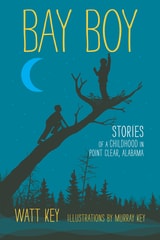
Bay Boy
Stories of a Childhood in Point Clear, AlabamaWatt Key, Illustrations by Murray Key
University of Alabama Press, 2019
Bay Boy is a collection of essays by award-winning young adult author Watt Key, chronicling his boyhood in Point Clear, Alabama. During his childhood, Point Clear was not the tony enclave of today with its spas, art galleries, and multimillion dollar waterfront properties. Rather, it was a sleepy resort community, practically deserted in the winter, with a considerable population of working-class residents.
As Key notes in his introduction, “Life in Point Clear is really about being outside. . . . I have never found a place so perfectly suited to exercise a young boy’s imagination.” Key and his brother filled their days collecting driftwood to make forts, scooting around the bay in a sturdy Stauter boat, and making art and writing stories when it rained.
In a tone that is simple and direct, punctuated by truly hilarious moments. Key writes about Gulf Coast traditions including Mardi Gras, shrimping, fishing, dove hunting, jubilees, camping out, and bracing for hurricanes. These stories are full of colorful characters— Nasty Bill Dickson, a curmudgeonly tow-truck driver; I’llNeeda, a middle-aged homeless woman encamped in a shack across the road; and the Ghost of Zundel’s Wharf, “the restless soul of a long-dead construction worker.” The stories are illustrated by charming and evocative artwork by the author’s brother Murray Key.
Be Water
Collective Improvisation in Hong Kong's Anti-Extradition ProtestsMing-sho Ho
Temple University Press, 2025
In Be Water, Ming-sho Ho examines the dynamics of the city-wide uprising from the perspective of agency power. He seeks to understand how numerous and anonymous Hongkongers contributed to this epoch-making campaign as well as how they responded to the full-scale state repression that enveloped them. Ho praises and questions the durability of the inventive Be Water Revolution and how the activists encouraged protests spontaneously, through interpersonal networks and by voluntarily collaborating with strangers at great personal risk.
Ho posits a new concept of “collective improvisation” to make sense of such a decentralized yet creative way of protesting. Be Water seeks to understand the rise and long afterlife of this movement and illustrate its efficacy. As Ho shows, these dynamics of collective improvisation have implications for contemporary protest movements around the world.
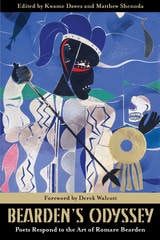
Bearden's Odyssey
Poets Respond to the Art of Romare BeardenEdited by Kwame Dawes and Matthew Shenoda, Foreword by Derek Walcott
Northwestern University Press, 2017
Borrowing from Romare Bearden’s aesthetic palette and inspired by his Odysseus series, Bearden’s Odyssey gathers, for the first time, poems from thirty-five of the most revered African diaspora poets in the United States. Poetic echoes come forth in themes of inspiration with historical intersections of one of the greatest visual artists of the twentieth century.
The award-winning editors, Kwame Dawes and Matthew Shenoda, assemble an esteemed literary congregation, with original poems by Chris Abani, Rita Dove, Lyrae Van Clief-Stefanon, Ed Roberson, Aracelis Girmay, Yusef Komunyakaa, and more. With a powerful foreword by Nobel laureate Derek Walcott and stunning visual reproductions of select Bearden masterpieces, this anthology fuses art and literature, standing as a testament to Romare Bearden’s power and influence in the contemporary artistic world.
Beautiful Flesh
A Body of EssaysStephanie G'Schwind
University Press of Colorado, 2017
Selected from the country’s leading literary journals and publications—Colorado Review, Creative Nonfiction, Georgia Review, Prairie Schooner, Crazyhorse, The Normal School, and others—Beautiful Flesh gathers eighteen essays on the body, essentially building a multi-gender, multi-ethnic body out of essays, each concerning a different part of the body: belly, brain, bones, blood, ears, eyes, hair, hands, heart, lungs, nose, ovaries, pancreas, sinuses, skin, spine, teeth, and vas deferens. The title is drawn from Wendy Call’s essay “Beautiful Flesh,” a meditation on the pancreas: “gorgeously ugly, hideously beautiful: crimson globes embedded in a pinkish-tan oval, all nestled on a bed of cabbage-olive green, spun through with gossamer gold.”
Other essays include Dinty W. Moore’s “The Aquatic Ape,” in which the author explores the curious design and necessity of sinuses; Katherine E. Standefer’s “Shock to the Heart, Or: A Primer on the Practical Applications of Electricity,” a modular essay about the author’s internal cardiac defibrillator and the nature of electricity; Matt Roberts’s “Vasectomy Instruction 7,” in which the author considers the various reasons for and implications of surgically severing and sealing the vas deferens; and Peggy Shinner’s “Elective,” which examines the author’s own experience with rhinoplasty and cultural considerations of the “Jewish nose.” Echoing the myriad shapes, sizes, abilities, and types of the human body, these essays showcase the many forms of the genre: personal, memoir, lyric, braided, and so on.
Contributors: Amy Butcher, Wendy Call, Steven Church, Sarah Rose Etter, Matthew Ferrence, Hester Kaplan, Sarah K. Lenz, Lupe Linares, Jody Mace, Dinty W. Moore, Angela Pelster, Matt Roberts, Peggy Shinner, Samantha Simpson, Floyd Skloot, Danielle R. Spencer, Katherine E. Standefer, Kaitlyn Teer, Sarah Viren, Vicki Weiqi Yang
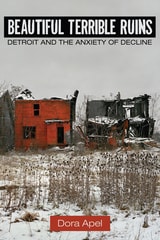
Beautiful Terrible Ruins
Detroit and the Anxiety of DeclineApel, Dora
Rutgers University Press, 2015
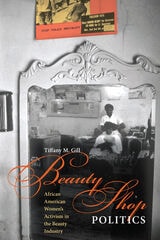
Beauty Shop Politics
African American Women's Activism in the Beauty IndustryTiffany M. Gill
University of Illinois Press, 2010
Looking through the lens of black business history, Beauty Shop Politics shows how black beauticians in the Jim Crow era parlayed their economic independence and access to a public community space into platforms for activism. Tiffany M. Gill argues that the beauty industry played a crucial role in the creation of the modern black female identity and that the seemingly frivolous space of a beauty salon actually has stimulated social, political, and economic change.
From the founding of the National Negro Business League in 1900 and onward, African Americans have embraced the entrepreneurial spirit by starting their own businesses, but black women's forays into the business world were overshadowed by those of black men. With a broad scope that encompasses the role of gossip in salons, ethnic beauty products, and the social meanings of African American hair textures, Gill shows how African American beauty entrepreneurs built and sustained a vibrant culture of activism in beauty salons and schools. Enhanced by lucid portrayals of black beauticians and drawing on archival research and oral histories, Beauty Shop Politics conveys the everyday operations and rich culture of black beauty salons as well as their role in building community.
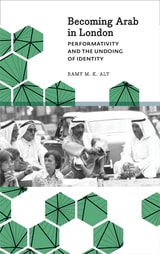
Becoming Arab in London
Performativity and the Undoing of IdentityRamy M. K. Aly
Pluto Press, 2015
Drawing on the work of Judith Butler, Aly emphasizes the need to move away from the concept of identity and toward the idea of race, gender, and class as performance. Based on seven years of fieldwork, during which time the author immersed himself in London’s Arab community, Becoming Arab in London is an innovative and necessary contribution to the study of diaspora and difference in contemporary Britain.

Becoming Hybrid
J. Mae Barizo
University of Michigan Press, 2027
Becoming Hybrid offers an intimate exploration of creative process and hybrid poetics. Weaving together essays, interviews, personal narrative, and pedagogical reflections, this book explores what it means to be “hybrid” in the twenty-first century, as artists increasingly produce work that challenges traditional formal boundaries. The book examines the transdisciplinary practice of artists like Cecilia Vicuña, Don Mee Choi, and Claudia Rankine, many of whom write from diasporic experience or from identities historically pushed to the margins. Emerging from Barizo’s lifelong engagements with music, philosophy, art, and literature, the book illuminates the idiosyncratic pathways she has taken to unsettle disciplinary boundaries as an author, artist, and performer. Becoming Hybrid traces how disciplinary and genre-bound conventions have shifted and dissolved across time, offering tools for decolonial pedagogy and collaborative writing workshops that honor multiple voices, lived experiences, and cultural traditions. Accessible yet intellectually rigorous, the book opens up a conversation about hybridity and creativity, making it an essential guide for anyone interested in how contemporary art and literature are reshaping the ways we think, write, and create today.
Becoming Philadelphia
How an Old American City Made Itself New AgainInga Saffron
Rutgers University Press, 2020
Becoming Philadelphia collects the best of Saffron’s work, plus a new introduction reflecting on the stunning changes the city has undergone. A fearless crusader who is also a seasoned reporter, Saffron ranges beyond the usual boundaries of architectural criticism to explore how big money and politics intersect with design, profoundly shaping our everyday experience of city life. Even as she celebrates Philadelphia’s resurgence, she considers how it finds itself grappling with the problems of success: gentrification, poverty, privatization, and the unequal distribution of public services.
What emerges in these 80 pieces is a remarkable narrative of a remarkable time. The proverbial first draft of history, these columns tell the story of how a great city shape-shifted before our very eyes.
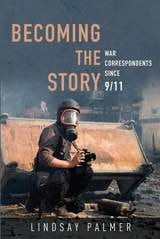
Becoming the Story
War Correspondents since 9/11Lindsay Palmer
University of Illinois Press, 2018
Becoming the Story examines the transformation of war reporting in the decade after 9/11. Lindsay Palmer delves into times when print or television correspondents themselves received intense public scrutiny because of an incident associated with the work of war reporting. Such instances include Daniel Pearl’s kidnapping and murder; Bob Woodruff’s near-fatal injury in Iraq; the expulsions of Maziar Bahari and Nazila Fathi from Iran in 2009; the sexual assault of Lara Logan; and Marie Colvin’s 2012 death in Syria. Merging analysis with in-depth interviews of Woodruff and others, Palmer shows what these events say about how post-9/11 conflicts transformed the day-to-day labor of reporting. But they also illuminate how journalists’ work became entangled with issues ranging from digitization processes to unprecedented hostility from all sides to the political logic of the War on Terror.
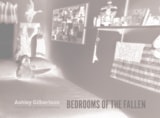
Bedrooms of the Fallen
Ashley Gilbertson
University of Chicago Press, 2014
The book’s wide-format black-and-white images depict the bedrooms of forty fallen soldiers—the equivalent of a single platoon—from the United States, Canada, and several European nations. Left intact by families of the deceased, the bedrooms are a heartbreaking reminder of lives cut short: we see high school diplomas and pictures from prom, sports medals and souvenirs, and markers of the idealism that carried them to war, like images of the Twin Towers and Osama Bin Laden. A moving essay by Gilbertson describes his encounters with the families who preserve these private memorials to their loved ones, and shares what he has learned from them about war and loss.
Bedrooms of the Fallen is a masterpiece of documentary photography, and an unforgettable reckoning with the human cost of war.

Before Grenfell
Fire, Safety and Deregulation in Twentieth-Century BritainShane Ewen
University of London Press, 2023
The 2017 Grenfell tower fire in London was a “slow disaster,” the product of a long accumulation of faults and errors that resulted from erroneous assumptions and organizational and governmental decision-making. This book offers a critical perspective on the systematic failures that lead to one of the greatest tragedies in Britain in our time.
Before Grenfell is a poignant and timely analysis of risk, fire, and safety in postwar Britain. Tracing the evolution of state housing policy in relation to multistory housing since the mid-1950s, the book adds to a burgeoning history of the British experience of fire and safety in high-rises and investigates a latent housing crisis in contemporary Britain against a backdrop of increasingly deregulated urban building development. Drawing on public inquiries, newspaper accounts, and oral histories, Shane Ewen details other avoidable disasters, including the Ronan Point tower block explosion in 1968, the Summerland leisure center fire in 1972, and the Bradford City Football Club fire in 1985. The book closes with a powerful chapter on fire safety campaigners, including survivor groups, who are seeking justice for the victims of fire disasters. Before Grenfell aims to exert pressure on policy-makers to act on the lessons of fatal disasters in order to both prevent future casualties and establish a legacy for those who lost their lives.
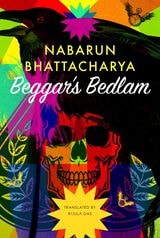
Beggar’s Bedlam
Nabarun Bhattacharya
Seagull Books, 2024
Beggar’s Bedlam is a surreal novel that unleashes the chaos of the carnival on the familiar. Part literary descendent of Bulgakov’s The Master and Margarita and part a reconstruction of lost Bengali history, Nabarun Bhattacharya’s masterpiece is a jubilant, fizzing wire of subaltern anarchy and insurrection.
Marshall Bhodi Sarkar and his lieutenant Sarkhel surreptitiously dig on the banks of the Ganges River looking for crude oil reserves. Instead, they unearth curved daggers, rusty broadswords, and a Portuguese cannon. Bhodi is an occasional military man and the lead sorcerer of the secret black-magic sect named Choktar. He joins forces with the flying Flaperoos—men with a predilection for alcohol and petty vandalism—to declare outright war against the Marxist–Leninist West Bengal government. In a bloodless revolution that is fascinating in its utter implausibility, a motley crew of yet more implausible characters come together in a magic-realist fictional remapping of Calcutta.
Begging for It
Alex Dimitrov
Four Way Books, 2013
Begin Where You Are
The Colorado Poets Laureate AnthologyTurner Wyatt
University Press of Colorado, 2025
This book contains celebrated works from Thomas Hornsby Ferril and others, alongside never-before-published pieces from Bobby LeFebre, Joseph Hutchison, David Mason, and Mary Crow. Contemporary poets offer perspectives on how serving as Colorado poet laureate shaped their writing and worlds.
Spearheaded by award-winning social entrepreneur Turner Wyatt, this book is a movement with a mission: A portion of the proceeds will fund poetry programming in underserved Colorado schools, libraries, and rural areas, making each purchase an investment in expanding access to this essential art form.
Featured poets: Andrea Gibson, Bobby LeFebre, Joseph Hutchison, David Mason, Mary Crow, Thomas Hornsby Ferril, Milford E. Shields, Margaret Clyde Robertson, Nellie Burget Miller, Alice Polk Hill
Behind the Lines
War Resistance Poetry on the American Home Front since 1941Philip Metres
University of Iowa Press, 2007
Behind the Lines investigates American war resistance poetry from the Second World War through the Iraq wars. Rather than simply chronicling the genre, Philip Metres argues that this poetry gets to the heart of who is authorized to speak about war and how it can be represented. As such, he explores a largely neglected area of scholarship: the poet’s relationship to dissenting political movements and the nation.
In his elegant study, Metres examines the ways in which war resistance is registered not only in terms of its content but also at the level of the lyric. He proposes that protest poetry constitutes a subgenre that—by virtue of its preoccupation with politics, history, and trauma—probes the limits of American lyric poetry. Thus, war resistance poetry—and the role of what Shelley calls unacknowledged legislators—is a crucial, though largely unexamined, body of writing that stands at the center of dissident political movements.
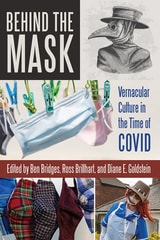
Behind the Mask
Vernacular Culture in the Time of COVIDBen Bridges
Utah State University Press, 2023
Despite vernacular’s potential nod to dominant or external culture, it is the strong connection to the local that grounds the vernacular within the experiential context that it occupies. Exploring the nature and shape of vernacular responses to the ongoing public health crisis, Behind the Mask documents processes that are otherwise likely to be forgotten. Including different ethnographic presents, contributors capture moments during the pandemic rather than upon reflection, making the work important to students and scholars of folklore and ethnology, as well as general readers interested in the COVID pandemic.
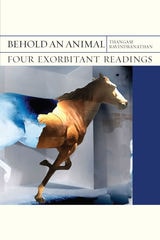
Behold an Animal
Four Exorbitant ReadingsThangam Ravindranathan
Northwestern University Press, 2019
As animals recede from our world, what tale is being told by literature’s creatures? Behold an Animal: Four Exorbitant Readings examines incongruous animals in the works of four major contemporary French writers: an airborne horse in a novel by Jean-Philippe Toussaint, extinct orangutans in Éric Chevillard, stray dogs in Marie NDiaye, vanishing (bits of) hedgehogs in Marie Darrieussecq. Resisting naturalist assumptions that an animal in a story is simply—literally or metaphorically—an animal, Thangam Ravindranathan understands it rather as the location of something missing. The animal is a lure: an unfinished figure fleeing the frame, crossing bounds of period, genre, even medium and language. Its flight traces an exorbitant (self-)portrait in which thinking admits to its commerce with life and flesh. It is in its animals, at the same time unbearably real and exquisitely unreal, that literature may today be closest to philosophy.
This book’s primary focus is the contemporary French novel and continental philosophy. In addition to Toussaint, Chevillard, NDiaye, and Darrieussecq, it engages the work of Jean de La Fontaine, Eadweard Muybridge, Edgar Allan Poe, Lewis Carroll, Samuel Beckett, and Francis Ponge.
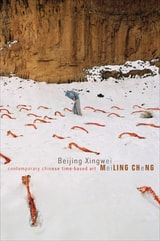
Beijing Xingwei
Contemporary Chinese Time-based ArtMeiling Cheng
Seagull Books, 2013
From cannibalism to light-calligraphy, from self-harming to animal sacrifice, from meat entwined with sex toys to a commodity-embedded ice wall, the idiosyncratic output of Chinese time-based art over the past twenty-five years has invigorated contemporary global art movements and conversation. In Beijing Xingwei, Meiling Cheng engages with such artworks created to mark China's rapid social, economical, cultural, intellectual, and environmental transformations in its post-Deng era.
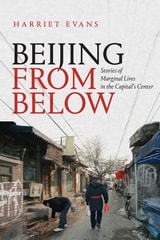
Beijing from Below
Stories of Marginal Lives in the Capital's CenterHarriet Evans
Duke University Press, 2020
Being Dead Otherwise
Anne Allison
Duke University Press, 2023

Belfast
Segregation, Violence and the CityPeter Shirlow and Brendan Murtagh
Pluto Press, 2006
The book offers a vivid portrait of the human drama and brutality of the conflict in Belfast. The authors argue that the control of place remains the most important weapon in the politicization of communities and the reproduction of political violence. Segregation provides the laboratory within which sectarianism continues to grow. Examining the implications of these social divisions, the authors draw upon a wide international literature and provide insights that will be useful to students of geography, planning, politics, sociology and peace studies.
Believing in Cleveland
Managing Decline in “The Best Location in the Nation”J. Mark Souther
Temple University Press, 2017
Detractors have called it "The Mistake on the Lake." It was once America’s "Comeback City." According to author J. Mark Souther, Cleveland has long sought to defeat its perceived civic malaise. Believing in Cleveland chronicles how city leaders used imagery and rhetoric to combat and, at times, accommodate urban and economic decline.
Souther explores Cleveland's downtown revitalization efforts, its neighborhood renewal and restoration projects, and its fight against deindustrialization. He shows how the city reshaped its image when it was bolstered by sports team victories. But Cleveland was not always on the upswing. Souther places the city's history in the postwar context when the city and metropolitan area were divided by uneven growth. In the 1970s, the city-suburb division was wider than ever.
Believing in Cleveland recounts the long, difficult history of a city that entered the postwar period as America's sixth largest, then lost ground during a period of robust national growth. But rather than tell a tale of decline, Souther provides a fascinating story of resilience for what some folks called "The Best Location in the Nation."
Belonging and Identity in STEM Higher Education
Edited by Camille Kandiko Howson and Martyn Kingsbury
University College London, 2024
In Belonging and Identity in STEM Higher Education, Camille Kandiko Howson and Martyn Kingsbury examine the role of science, technology, engineering, and mathematics (STEM) pedagogies in facilitating belonging, variable impacts across student characteristics, and the experiences of STEM students in higher education. Through case study contributions, the book analyzes the unique educational environments for STEM staff and students throughout Europe and Asia, challenging the assumptions that STEM fields are inherently unemotional and impersonal disciplines.
Better Bankers, Better Banks
Promoting Good Business through Contractual CommitmentClaire A. Hill and Richard W. Painter
University of Chicago Press, 2015
In Better Bankers, Better Banks, Claire A. Hill and Richard W. Painter look back at the history of banking and show how the current culture of bad behavior—dramatized by the corrupt, cocaine-snorting bankers of The Wolf of Wall Street—came to be. In the early 1980s, banks went from partnerships whose partners had personal liability to corporations whose managers had no such liability and could take risks with other people’s money. A major reason bankers remain resistant to change, Hill and Painter argue, is that while banks have been faced with large fines, penalties, and legal fees—which have exceeded one hundred billion dollars since the onset of the crisis—the banks (which really means the banks’shareholders) have paid them, not the bankers themselves. The problem also extends well beyond the pursuit of profit to the issue of how success is defined within the banking industry, where highly paid bankers clamor for status and clients may regard as inevitable bankers who prioritize their own self-interest. While many solutions have been proposed, Hill and Painter show that a successful transformation of banker behavior must begin with the bankers themselves. Bankers must be personally liable from their own assets for some portion of the bank’s losses from excessive risk-taking and illegal behavior. This would instill a culture that discourages such behavior and in turn influence the sorts of behavior society celebrates or condemns.
Despite many sensible proposals seeking to reign in excessive risk-taking, the continuing trajectory of scandals suggests that we’re far from ready to avert the next crisis. Better Bankers, Better Banks is a refreshing call for bankers to return to the idea that theirs is a noble profession.
Between Brown and Black
Anti-Racist Activism in BrazilAntonio José Bacelar da Silva
Rutgers University Press, 2022
Between Market and Myth
The Spanish Artist Novel in the Post-Transition, 1992-2014Katie J. Vater
Bucknell University Press, 2020
Published by Bucknell University Press. Distributed worldwide by Rutgers University Press.
Beyond Disaster
Building Collective Futures in Puerto RicoMelissa L. Rosario
Northwestern University Press, 2025
An alternative view of Puerto Rico’s past, present, and future
How do we map the pathways to liberation where we have been taught to see only trauma, suffering, and lack? Melissa L. Rosario offers an alternative view of Puerto Rico, America’s oldest colony, removing readers from the framework of crisis to consider the deeper legacies of its current impasse. Beyond Disaster: Building Collective Futures in Puerto Rico is an intimate portrait, weaving insights from the author’s own life, research, and organizing work as a scholar in the diaspora who rematriated. Rosario bridges the genres of social history and memoir to unsettle the meaning of resistance and freedom, underscoring the deep wounds of colonialism while still uplifting the profound possibilities of embodied alternatives.
Beyond Disaster critiques the framework of debt and crisis by examining the psychological, emotional, and spiritual effects of colonialism. Rosario highlights key examples of organizing efforts to defend land and education against total enclosure, protecting life amid loss. This book offers a series of microhistories, vignettes, and prose poetry to foreground the daily practices necessary to anchor the ecological and political landscapes of our collective future.
Beyond Discrimination
Racial Inequality in a Post-Racist EraFredrick C. Harris
Russell Sage Foundation, 2013
Beyond Ideology
Politics, Principles, and Partisanship in the U. S. SenateFrances E. Lee
University of Chicago Press, 2009
The congressional agenda, Frances Lee contends, includes many issues about which liberals and conservatives generally agree. Even over these matters, though, Democratic and Republican senators tend to fight with each other. What explains this discord? Beyond Ideology argues that many partisan battles are rooted in competition for power rather than disagreement over the rightful role of government.
The first book to systematically distinguish Senate disputes centering on ideological questions from the large proportion of them that do not, this volume foregrounds the role of power struggle in partisan conflict. Presidential leadership, for example, inherently polarizes legislators who can influence public opinion of the president and his party by how they handle his agenda. Senators also exploit good government measures and floor debate to embarrass opponents and burnish their own party’s image—even when the issues involved are broadly supported or low-stakes. Moreover, Lee contends, the congressional agenda itself amplifies conflict by increasingly focusing on issues that reliably differentiate the parties. With the new president pledging to stem the tide of partisan polarization, Beyond Ideology provides a timely taxonomy of exactly what stands in his way.
Beyond Representation in Contemporary Caribbean Art
Space, Politics, and the Public SphereCarlos Garrido Castellano
Rutgers University Press, 2019
Beyond Text
Theater and Performance in Print After 1900Jennifer Buckley
University of Michigan Press, 2019
Winner of the 2020 Outstanding Book Award from the Association for Theatre in Higher Education
Taking up the work of prominent theater and performance artists, Beyond Text reveals the audacity and beauty of avant-garde performance in print. With extended analyses of the works of Edward Gordon Craig, German expressionist Lothar Schreyer, the Living Theatre, Carolee Schneemann, and Guillermo Gómez-Peña, the book shows how live performance and print aesthetically revived one another during a period in which both were supposed to be in a state of terminal cultural decline. While the European and American avant-gardes did indeed dismiss the dramatic author, they also adopted print as a theatrical medium, altering the status, form, and function of text and image in ways that continue to impact both the performing arts and the book arts.
Beyond Text participates in the ongoing critical effort to unsettle conventional historical and theoretical accounts of text-performance relations, which have too often been figured in binary, chronological (“from page to stage”), or hierarchical terms. Across five case studies spanning twelve decades, Beyond Text demonstrates that print—as noun and verb—has been integral to the practices of modern and contemporary theater and performance artists.
Beyond the Death of God
Religion in 21st Century International PoliticsSimone Raudino and Patricia Sohn, Editors
University of Michigan Press, 2022
This volume offers a nuanced picture with specific instances of religion and politics in Muslim, Jewish, Christian, Buddhist, and Hindu contexts, broadly presenting the phenomenon of religion and politics via country and thematic case studies. Qualitative, quantitative, material, philosophical, and theological analyses draw upon social theory to show how (and why) religion matters deeply in each time and place.
The authors and contributors demonstrate that religion is a significant force that drives societies and polities around the world, and that a radical change in the Western understanding of value-driven global politics is needed. Beyond the Death of God offers new, local voices to Western audiences—through essays that suggest the need for an appreciation of Divinity as a quintessence holding a significant place in the hearts, minds, social orders, and political organization of polities around the world.
Beyond the Wall
Writing a Path through PalestineBidisha
Seagull Books, 2012
Bible Trouble
Queer Reading at the Boundaries of Biblical ScholarshipTeresa J. Hornsby
SBL Press, 2011
The essays in Bible Trouble all engage queer theories for purposes of biblical interpretation, a rare effort to date within biblical scholarship. The title phrase “Bible Trouble” plays on Judith Butler's Gender Trouble, gesturing toward a primary text for contemporary queer theory. The essays consider, among others, the Lazarus story, the Ethiopian eunuch, “gender trouble” in Judges 4 and 5, the Song of Songs, and an unorthodox coupling of the books of Samuel and the film Paris Is Burning. This volume “troubles” not only the boundaries between biblical scholarship and queer theory but also the boundaries between different frameworks currently used in the analysis of biblical literature, including sexuality, gender, race, class, history, and literature. The contributors are Ellen T. Armour, Michael Joseph Brown, Sean D. Burke, Heidi Epstein, Deryn Guest, Jione Havea, Teresa J. Hornsby, Lynn R. Huber, S. Tamar Kamionkowski, Joseph A. Marchal, Jeremy Punt, Erin Runions, Ken Stone, Gillian Townsley, Jay Twomey, and Manuel Villalobos.
Billionaires and Stealth Politics
Benjamin I. Page, Jason Seawright, and Matthew J. Lacombe
University of Chicago Press, 2018
Page, Seawright, and Lacombe argue that while political contributions offer a window onto billionaires’ influence, especially on economic policy, they do not present a full picture of policy preferences and political actions. That is because on some of the most important issues, including taxation, immigration, and Social Security, billionaires have chosen to engage in “stealth politics.” They try hard to influence public policy, making large contributions to political parties and policy-focused causes, leading policy-advocacy organizations, holding political fundraisers, and bundling others’ contributions—all while rarely talking about public policy to the media. This means that their influence is not only unequal but also largely unaccountable to and unchallengeable by the American people. Stealth politics makes it difficult for ordinary citizens to know what billionaires are doing or mobilize against it. The book closes with remedies citizens can pursue if they wish to make wealthy Americans more politically accountable, such as public financing of political campaigns and easier voting procedures, and notes the broader types of reforms, such as a more progressive income tax system, that would be needed to increase political equality and reinvigorate majoritarian democracy in the United States.
Bio-Imperialism
Disease, Terror, and the Construction of National FragilityGwen Shuni D'Arcangelis
Rutgers University Press, 2021

Biopower in Putin’s Russia
From Taking Care to Taking LivesSergei Medvedev
Central European University Press, 2024
In this book, Makarychev and Medvedev examine the importance of biopolitics in fueling Russia’s confrontation with the West. In their view, the development of Putin’s illiberal authoritarianism was largely triggered by what they call a biopolitical turn. This shift is exemplified by the use of an increasing number of regulatory mechanisms to discipline and constrain the human body. Such political practices concern issues of sexuality, reproductive behavior, adoption, fertility, family planning, public hygiene, and demography. This turn created a new disciplinary framework for the population and the elite. Bans and restrictions of a biopolitical nature, became one of the main tools for articulating the rules of belonging in the political community and drawing its political boundaries. Biopolitical discourses have taken up the core of the Russian identity formation, which contrasts a positive “conservative Russia” with a supposedly vicious “liberal West.”
The presentation of the political genealogy of the body-centric structures of power and hegemony in Russia implies their transformation from bio- to necropolitics. Necropolitical (repressive and life-depriving) components are inscribed in the biopolitical regimes of power: they form the core of Putin’s rule over Russia and are a key factor behind the war against Ukraine.
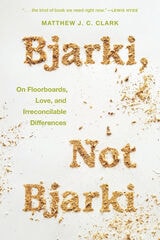
Bjarki, Not Bjarki
On Floorboards, Love, and Irreconcilable DifferencesMatthew J. C. Clark
University of Iowa Press, 2023
These are the words of Bjarki Thor Gunnarsson, the young man who manufactures the widest, purest, most metaphorical pine floorboards on the planet.
As Matthew Clark—a carpenter by trade—begins researching a magazine-style essay about Bjarki and his American Dream Boards, he comes to discover that nothing is quite as it seems. Santa Claus arrives by helicopter. A wedding diamond disappears. A dead coyote jumps to its feet. And then, at a Thai restaurant in central Maine, Bjarki is transformed into an eggplant.
In Bjarki, Not Bjarki, Clark wants nothing less than to understand everything, to make the world a better place, for you and him to love each other, and to be okay. He desires all of this sincerely, desperately even, and at the same time he proceeds with a light heart, playfully, with humor and awe. As Clark reports on the people and processes that transform the forest into your floor, he also ruminates on gift cards, crab rangoon, and Jean Claude Van Damme. He considers North American colonization, masculinity, the definition of disgusting, his own uncertain certainty. When the boards beneath our feet are so unstable, always expanding and cupping and contracting, how can we make sense of the world? What does it mean to know another person and to connect with them, especially in an increasingly polarized America?
Black America in the Shadow of the Sixties
Notes on the Civil Rights Movement, Neoliberalism, and PoliticsClarence Lang
University of Michigan Press, 2015
Black Bourgeois
Class and Sex in the FleshCandice M. Jenkins
University of Minnesota Press, 2019
Exploring the forces that keep black people vulnerable even amid economically privileged lives
At a moment in U.S. history with repeated reminders of the vulnerability of African Americans to state and extralegal violence, Black Bourgeois is the first book to consider the contradiction of privileged, presumably protected black bodies that nonetheless remain racially vulnerable. Examining disruptions around race and class status in literary texts, Candice M. Jenkins reminds us that the conflicted relation of the black subject to privilege is not, solely, a recent phenomenon.
Focusing on works by Toni Morrison, Spike Lee, Danzy Senna, Rebecca Walker, Reginald McKnight, Percival Everett, Colson Whitehead, and Michael Thomas, Jenkins shows that the seemingly abrupt discursive shift from post–Civil Rights to Black Lives Matter, from an emphasis on privilege and progress to an emphasis on vulnerability and precariousness, suggests a pendulum swing between two interrelated positions still in tension. By analyzing how these narratives stage the fraught interaction between the black and the bourgeois, Jenkins offers renewed attention to class as a framework for the study of black life—a necessary shift in an age of rapidly increasing income inequality and societal stratification.
Black Bourgeois thus challenges the assumed link between blackness and poverty that has become so ingrained in the United States, reminding us that privileged subjects, too, are “classed.” This book offers, finally, a rigorous and nuanced grasp of how African Americans live within complex, intersecting identities.
Black Celebrity
Contemporary Representations of Postbellum Athletes and ArtistsEmily Ruth Rutter
University of Delaware Press, 2022
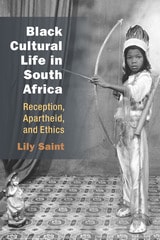
Black Cultural Life in South Africa
Reception, Apartheid, and EthicsLily Saint
University of Michigan Press, 2018
This study provocatively posits that states of oppression, including colonial and postcolonial rule, can elicit ethical responses to imaginative identification through encounters with popular culture, and it asks whether and how they carry over into ethical action. Its consideration of how globalized popular culture “travels” not just in material form, but also through the circuits of the imaginary, opens a new window for exploring the ethical and liberatory stakes of popular culture. Each chapter focuses on a separate genre, yet the overall interdisciplinary approach to the study of genre and argument for an expansion of ethical theory that draws on texts beyond the Western canon speak to growing concerns about studying genres and disciplines in isolation. Freed from oversimplified treatments of popular forms—common to cultural studies and ethical theory alike—this book demonstrates that people can do things with mass culture that reinvigorate ethical life.
Lily Saint’s new volume will interest Africanists across the humanities and the social sciences, and scholars of Anglophone literary, globalization, and cultural studies; race; ethical theories and philosophies; film studies; book history and material cultures; and the burgeoning field of comics and graphic novels.
Black Girl Autopoetics
Agency in Everyday Digital PracticeAshleigh Greene Wade
Duke University Press, 2024
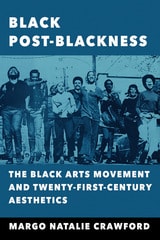
Black Post-Blackness
The Black Arts Movement and Twenty-First-Century AestheticsMargo Natalie Crawford
University of Illinois Press, 2017
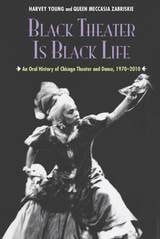
Black Theater Is Black Life
An Oral History of Chicago Theater and Dance, 1970-2010Harvey Young and Queen Meccasia Zabriskie
Northwestern University Press, 2013
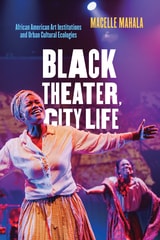
Black Theater, City Life
African American Art Institutions and Urban Cultural EcologiesMacelle Mahala
Northwestern University Press, 2022
Black Theater, City Life looks at Karamu House Theatre, the August Wilson African American Cultural Center, Pittsburgh Playwrights’ Theatre Company, the Lorraine Hansberry Theatre, the African American Shakespeare Company, the Atlanta Black Theatre Festival, and Kenny Leon’s True Colors Theatre Company to demonstrate how each organization articulates the cultural specificities, sociopolitical realities, and histories of African Americans. These companies have faced challenges that mirror the larger racial and economic disparities in arts funding and social practice in America, while their achievements exemplify such institutions’ vital role in enacting an artistic practice that reflects the cultural backgrounds of their local communities. Timely, significant, and deeply researched, this book spotlights the artistic and civic import of Black theaters in American cities.