Results by title
90 books match the query 'Activism' and 6 start with b

Badass Feminist Politics
Exploring Radical Edges of Feminist Theory, Communication, and ActivismSarah Jane Blithe
Rutgers University Press, 2022
In the late 2010s, the United States experienced a period of widespread silencing. Protests of unsafe drinking water have been met with tear gas; national park employees, environmentalists, and scientists have been ordered to stop communicating publicly. Advocates for gun control are silenced even as mass shootings continue. Expressed dissent to political power is labeled as “fake news.” DREAMers, Muslims, Trans military members, women, black bodies, the LGBTQI+ community, Latina/o/x communities, rape survivors, sex workers, and immigrants have all been systematically silenced. During this difficult time and despite such restrictions, advocates and allies persist and resist, forming dialogues that call to repel inequality in its many forms. Addressing the oppression of women of color, white women, women with (dis)abilities, and LBTQI+ individuals across cultures and contexts remains a central posit of feminist struggle and requires “a distinctly feminist politics of recognition.” However, as second wave debates about feminism have revealed, there is no single way to express a feminist politic. Rather, living feminist politics requires individual interpretation and struggle, collective discussion and disagreement, and recognizing difference among women as well as points of convergence in feminist struggle.
Badass Feminist Politics includes a diverse range of engaging feminist political projects to not only analyze the work being done on the ground but provide an overview for action that can be taken on by those seeking to engage in feminist activism in their own communities. Contributors included here are working for equality and equity and resisting violent, racist, homophobic, transphobic, xenophobic, and sexist language and action during this tension-filled political moment. Collectively, the book explores what it means to live and communicate feminist politics in everyday choices and actions, and how we can facilitate learning by analyzing these examples. Taking up current issues and new theoretical perspectives, the authors offer novel perspectives into what it means to live feminist politics. This book is a testament to resilience, resistance, communication, and forward thinking about what these themes all mean for new feminist agendas. Learning how to resist oppressive structures through words and actions is particularly important for students. Badass Feminist Politics features scholars from non-dominant groups taking up issues of marginalization and oppression, which can help people accomplish their social justice goals of inclusivity on the ground and in the classroom.
Badass Feminist Politics includes a diverse range of engaging feminist political projects to not only analyze the work being done on the ground but provide an overview for action that can be taken on by those seeking to engage in feminist activism in their own communities. Contributors included here are working for equality and equity and resisting violent, racist, homophobic, transphobic, xenophobic, and sexist language and action during this tension-filled political moment. Collectively, the book explores what it means to live and communicate feminist politics in everyday choices and actions, and how we can facilitate learning by analyzing these examples. Taking up current issues and new theoretical perspectives, the authors offer novel perspectives into what it means to live feminist politics. This book is a testament to resilience, resistance, communication, and forward thinking about what these themes all mean for new feminist agendas. Learning how to resist oppressive structures through words and actions is particularly important for students. Badass Feminist Politics features scholars from non-dominant groups taking up issues of marginalization and oppression, which can help people accomplish their social justice goals of inclusivity on the ground and in the classroom.
[more]

Be Water
Collective Improvisation in Hong Kong's Anti-Extradition ProtestsMing-sho Ho
Temple University Press, 2025
During the eventful summer of 2019 in Hong Kong, the Be Water Revolution formed to resist the proposed extradition of fugitives to mainland China’s courts. With its name derived from martial arts master Bruce Lee’s adage to be “formless and shapeless like water,” the movement turned out to be the city’s largest episode of contentious politics and was unique for using impromptu communication among participants and the absence of central leadership.
In Be Water, Ming-sho Ho examines the dynamics of the city-wide uprising from the perspective of agency power. He seeks to understand how numerous and anonymous Hongkongers contributed to this epoch-making campaign as well as how they responded to the full-scale state repression that enveloped them. Ho praises and questions the durability of the inventive Be Water Revolution and how the activists encouraged protests spontaneously, through interpersonal networks and by voluntarily collaborating with strangers at great personal risk.
Ho posits a new concept of “collective improvisation” to make sense of such a decentralized yet creative way of protesting. Be Water seeks to understand the rise and long afterlife of this movement and illustrate its efficacy. As Ho shows, these dynamics of collective improvisation have implications for contemporary protest movements around the world.
[more]
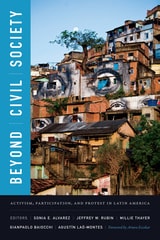
Beyond Civil Society
Activism, Participation, and Protest in Latin AmericaSonia E. Alvarez, Jeffrey W. Rubin, Millie Thayer, Gianpaolo Baiocchi, and Agustín Laó-Montes, editors
Duke University Press, 2017
The contributors to Beyond Civil Society argue that the conventional distinction between civic and uncivic protest, and between activism in institutions and in the streets, does not accurately describe the complex interactions of forms and locations of activism characteristic of twenty-first-century Latin America. They show that most contemporary political activism in the region relies upon both confrontational collective action and civic participation at different moments. Operating within fluid, dynamic, and heterogeneous fields of contestation, activists have not been contained by governments or conventional political categories, but rather have overflowed their boundaries, opening new democratic spaces or extending existing ones in the process. These essays offer fresh insight into how the politics of activism, participation, and protest are manifest in Latin America today while providing a new conceptual language and an interpretive framework for examining issues that are critical for the future of the region and beyond.
Contributors. Sonia E. Alvarez, Kiran Asher, Leonardo Avritzer, Gianpaolo Baiocchi, Andrea Cornwall, Graciela DiMarco, Arturo Escobar, Raphael Hoetmer, Benjamin Junge, Luis E. Lander, Agustín Laó-Montes, Margarita López Maya, José Antonio Lucero, Graciela Monteagudo, Amalia Pallares, Jeffrey W. Rubin, Ana Claudia Teixeira, Millie Thayer
Contributors. Sonia E. Alvarez, Kiran Asher, Leonardo Avritzer, Gianpaolo Baiocchi, Andrea Cornwall, Graciela DiMarco, Arturo Escobar, Raphael Hoetmer, Benjamin Junge, Luis E. Lander, Agustín Laó-Montes, Margarita López Maya, José Antonio Lucero, Graciela Monteagudo, Amalia Pallares, Jeffrey W. Rubin, Ana Claudia Teixeira, Millie Thayer
[more]

Blood Loss
A Love Story of AIDS, Activism, and ArtKeiko Lane
Duke University Press, 2024
In 1991, sixteen-year-old activist Keiko Lane joined the Los Angeles chapters of Queer Nation and ACT UP. Their members protested legislation aimed at dismantling rights for LGBTQ people, people living with HIV, and immigrants while fighting for needle-exchange programs, reproductive justice, safer-sex education, hospice funding, and the right to die with dignity. At the same time, the activists were a queer chosen family of friends and lovers who took care of one another in sickness and in health. Sometimes they helped each other die. By the time Lane turned twenty-two, most had died of AIDS. In her evocative memoir, Lane weaves together love stories and afterlives of queer resistance and survival against the landscape of the Rodney King Rebellion, the movement for queer rights, and the censorship of queer artists and sexualities. Lane interrogates the social construction of power against and in queer communities of color and the recovery of sexual agency in the midst and aftermath of violence. Luminous and powerfully moving, Blood Loss explores survival after those we love have died.
[more]
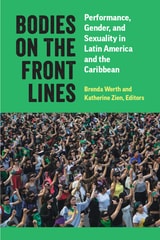
Bodies on the Front Lines
Performance, Gender, and Sexuality in Latin America and the CaribbeanBrenda Werth and Katherine Zien, Editors
University of Michigan Press, 2024
Revolutionary feminisms and queer and trans activist movements are traversing Latin America and the Caribbean. Bodies on the Front Lines situates recent performances and protest actions within legacies of homegrown gender and sexual rights activism from the South. Performances — enacted in public spaces and intimate venues, across national borders, and through circulating hashtags and digital media — play crucial roles in the elaboration, auto-theorization, translation, and reception of feminist, queer, and trans activism. Movements such as Argentina's NiUnaMenos (Not One Less) have brought together hundreds of thousands of protesters and ‘artivists’ on the streets of major cities in Latin America and beyond to denounce gender violence and demand gender, sexual, and reproductive rights.
The volume’s contributors draw from rich legacies of theater, performance, and activism in the region, as well as decolonial and intersectional theorizing, to demonstrate the ways that performance practices enable activists to sustain their movements. The chapters engage diverse perspectives from Argentina, Brazil, Bolivia, Chile, Colombia, Cuba, the Dominican Republic, transnational Central America, Peru, Puerto Rico, and Mexico.
Rather than taking an approach that simplifies complexities among states, Bodies on the Front Lines takes seriously the geopolitical stakes of examining Latin America and the Caribbean as a heterogeneous site of nations and networks. In chapters covering this wide geographical area, leading scholars in the fields of theater and performance studies showcase the aesthetic, social, and political work of performance in generating and fortifying gender and sexual activism in the Americas.
[more]

Bridging Scholarship and Activism
Reflections from the Frontlines of Collaborative ResearchBernd Reiter
Michigan State University Press, 2015
This timely book brings together activist scholars from a number of disciplines (political science, geography, sociology, anthropology, and communications) to provide new insights into a growing trend in publicly engaged research and scholarship. Bridging Scholarship and Activism creatively redefines what constitutes activism without limiting it to a narrow range of practices. Acknowledging that the current conjuncture of neoliberal globalization has created constraints on as well as possibilities for activist scholarly engagement, the book argues that racism and its intersections with gender and class oppression are salient forces to be interrogated and confronted in the predicaments and struggles activist scholarship targets. The book’s ultimate goal is to create a decolonized and democratized forum in which activist scholars from the Global South converse and cross-fertilize ideas and projects with their counterparts from the United States and other North Atlantic metropolitan-based academy. The coeditors and contributors attempt to decenter hegemonic knowledge and to create some of the necessary (if not sufficient) conditions for a more pluriversal (rather than orthodox “universal”) context for producing enabling knowledge, without the naiveté and romanticism that has characterized earlier projects in critical and radical social science.
CONTENTS:
Introduction, Ulrich Oslender and Bernd Reiter
Part One. The Promises and Pitfalls of Collaborative Research
CONTENTS:
Introduction, Ulrich Oslender and Bernd Reiter
Part One. The Promises and Pitfalls of Collaborative Research
- Of Academic Embeddedness: Communities of Choice and How to Make Sense of Activism and Research Abroad, Bernd Reiter
- New Shapes of Revolution, Gustavo Esteva
- The Accidental Activist Scholar: A Memoir on Reactive Boundary and Identity Work for Social Change within the Academy, Rob Benford
- Leaving the Field: How to Write about Disappointment and Frustration in Collaborative Research, Ulrich Oslender
- Invisible Heroes, Eshe Lewis
- El Muntuen America, Manuel Zapata Olivella
- Activism as History Making: The Collective and the Personal in Collaborative Research with the Process of Black Communities in Colombia, Arturo Escobar
- Out of Bounds: Negotiating Researcher Positionality in Brazil, Elizabeth Hordge-Freeman
- Between Soapboxes and Shadows: Activism, Theory, and the Politics of Life and Death in Salvador, Bahia, Brazil, Christen A. Smith
- State Violence and the Ethnographic Encounter: Feminist Research and Racial Embodiment, Keisha-Khan Y. Perry
- The Challenges Resulting from Combining Scientific Production and Social-Political Activism in the Brazilian Academy, Fernando Conceição
- The Challenge of Doing Applied/Activist Anti-Racist Anthropology in Revolutionary Cuba, Gayle L. McGarrity
- Conclusion, Ulrich Oslender and Bernd Reiter
- About the Authors
[more]