Results by title
471 books match the query 'Aesthetics' and 24 start with b

Baudelaire and the Poetics of Modernity
Patricia A. Ward
Vanderbilt University Press, 2000
Charles Baudelaire, possibly the most influential author of nineteenth-century France, created a poetics of modernity and a thematics of the city; he transcended genre by moving between poetry and prose. He is also the most accessible of modern French poets to an American readership. These essays examine Baudelaire's poetics and the complex relationship between the poet and his twentieth-century literary heirs, including Rene Char, Yves Bonnefoy, and Michel Deguy.
The contributors, who include Deguy and Bonnefoy, are all distinguished writers or critics noted for their own poetry or for their scholarship on Baudelaire and in French studies. Their essays go to the heart of what makes Baudelaire so important: his modernity and his influence from the very beginning on other poets, including those outside of France. The essays are written in English, with citations from Baudelaire and other sources in both French and English.

Bead Talk
Indigenous Knowledge and Aesthetics from the FlatlandsCarmen Robertson
University of Manitoba Press, 2024
Beautiful Democracy
Aesthetics and Anarchy in a Global EraRuss Castronovo
University of Chicago Press, 2007
Beautiful TV
The Art and Argument of Ally McBealBy Greg M. Smith
University of Texas Press, 2007
During its five-year run from 1997 to 2002, the popular TV show Ally McBeal engaged viewers in debates over what it means to be a woman or a man in the modern workplace; how romance factors into the therapeutic understanding of relationships; what value eccentricity has and how much oddity society should tolerate; and what utility fantasy has in the pragmatic world. In addition to these social concerns, however, Ally McBeal stood out for being well-constructed, narratively complex, and stylistically rich—in short, beautiful TV.
Starting from the premise that much of television today is "drop-dead gorgeous" and that TV should be studied for its formal qualities as well as its social impact, Greg M. Smith analyzes Ally McBeal in terms of its aesthetic principles and narrative construction. He explores how Ally's innovative use of music, special effects, fantasy sequences, voiceovers, and flashbacks structures a distinctive fictional universe, while it also opens up new possibilities for televisual expression. Smith also discusses the complex narrative strategies that Ally's creator David E. Kelley used to develop a long-running storyline and shows how these serial narrative practices can help us understand a wide range of prime-time TV serials.
By taking seriously the art and argument of Ally McBeal, Beautiful TV conclusively demonstrates that aesthetic and narrative analysis is an indispensable key for unlocking the richness of contemporary television.
Beautiful/Ugly
African and Diaspora AestheticsSarah Nuttall, ed.
Duke University Press, 2006
Highlighting how ideas of beauty are manifest and how they mutate, travel, and combine across time and distance, continental and diasporic writers examine the work of a Senegalese sculptor inspired by Leni Riefenstahl’s photographs of Nuba warriors; a rich Afro-Brazilian aesthetic incorporating aspects of African, Jamaican, and American cultures; and African Americans’ Africanization of the Santería movement in the United States. They consider the fraught, intricate spaces of the urban landscape in postcolonial South Africa; the intense pleasures of eating on Réunion; and the shockingly graphic images on painted plywood boards advertising “morality” plays along the streets of Ghana. And they analyze the increasingly ritualized wedding feasts in Cameroon as well as the limits of an explicitly “African” aesthetics. Two short stories by the Mozambican writer Mia Couto gesture toward what beauty might be in the context of political failure and postcolonial disillusionment. Together the essays suggest that beauty is in some sense future-oriented and that taking beauty in Africa and its diasporas seriously is a way of rekindling hope.
Contributors. Rita Barnard, Kamari Maxine Clarke, Mia Couto, Mark Gevisser, Simon Gikandi, Michelle Gilbert, Isabel Hofmeyr, William Kentridge, Dominique Malaquais, Achille Mbembe, Cheryl-Ann Michael, Celestin Monga, Sarah Nuttall, Patricia Pinho, Rodney Place, Els van der Plas, Pippa Stein, Françoise Vergès
Beauty and the Good
Recovering the Classical Tradition from Plato to Duns ScotusAlice M. Ramos
Catholic University of America Press, 2021
Belated Modernity and Aesthetic Culture
Inventing National LiteratureGregory Jusdanis
University of Minnesota Press, 1991
How does literature function in the formation of a nation-state? What are its pivotal contributions to national discourse and the production of ideological collective will? And, ultimately, how is literature institutionalized and aestheticized?
Belated Modernity and Aesthetic Culture: Inventing National Literature addresses these questions and considers the role literature plays in the construction of a national cultural. Gregory Jusdanis examines the emergence of art and literature in Western Europe in the eighteenth century and traces their introduction to Greece, a stratified, noncapitalist society that was hostile to Enlightenment and secularism. This groundbreaking work explores the importation of national literatures into a largely non-Western society and the inherent resistance they faced.Arguing for the literary status of national culture at its inception, Jusdanis brilliantly demonstrates that in literature, the specific meanings in narratives and fiction form the process of nation building. Culture, history, and literature, he says, merge in those narratives, which in turn provide the imaginary mirror in which a nation reflects itself.
Between Film and Screen
Modernism's Photo SynthesisGarrett Stewart
University of Chicago Press, 2000
In this ambitious, sophisticated study, Garrett Stewart discusses the photogram not only as the undertext of screen images but also in its unexpected links to the early modernist writings of James, Conrad, Forster, Joyce, and others. Engaging the work of such media theorists as Eisenstein, Benjamin, Kracauer, Bazin, Baudry, Cavell, Deleuze, and Jameson, this study pursues the suppressed photogram as it ripples the narrative surface of several dozen films from Lang and Chaplin through Bergman, Coppola, and beyond. To locate the exact repercussions of such effects, Stewart includes over three hundred frame enlargements drawn from genres as different as science fiction, film noir, and recent Victorian costume drama.
Between Montmartre and the Mudd Club
Popular Music and the Avant-GardeBernard Gendron
University of Chicago Press, 2002
When and how did popular music earn so much cultural capital? To find out, Bernard Gendron investigates five key historical moments when popular music and avant-garde art transgressed the rigid boundaries separating high and low culture to form friendly alliances. He begins at the end of the nineteenth century in Paris's Montmartre district, where cabarets showcased popular music alongside poetry readings in spaces decorated with modernist art works. Two decades later, Parisian poets and musicians "slumming" in jazz clubs assimilated jazz's aesthetics in their performances and compositions. In the bebop revolution in mid-1940s America, jazz returned the compliment by absorbing modernist devices and postures, in effect transforming itself into an avant-garde art form. Mid-1960s rock music, under the leadership of the Beatles, went from being reviled as vulgar music to being acclaimed as a cutting-edge art form. Finally, Gendron takes us to the Mudd Club in the late 1970s, where New York punk and new wave rockers were setting the aesthetic agenda for a new generation of artists.
Between Montmartre and the Mudd Club should be on the shelves of anyone interested in the intersections between high and low culture, art and music, or history and aesthetics.
Between Two Pines
Ushering in a Sustainable Future Through an Art-Science PracticeEdgar Cardenas
Michigan Publishing Services, 2019
“I am truly thankful that Dr. Edgar Cardenas’s thoughtful research is now available in this beautiful book. I have recommended his work to more people, both in my personal and professional spheres of my life, than I can count, and I’m glad to have this provocative and elegant publication to put into people’s hands. Cardenas shows us how each of us really can make a difference.”
“Between Two Pines anticipates and leads the discussion of scholarship around questions of land and landscape. This work brilliantly and ethically refocuses our vision, from distanced scrutiny to connection and proximity, rooted in daily care-taking and ecological efforts. Thoughtfully imaged, the photographs offer an aesthetic that is based in balanced, enduring reflection, rather than on the grand view. These beautiful images reveal discoveries that bridge the arts, ecology, and sociology, and will serve to reconnect every reader with the world in their backyard and beyond.”
“Drawing from a long photographic tradition of examining the relationship between humans and their environment, Edgar Cardenas has found a voice that is as compassionate as it is poignant. Yet he is not content for his photographs to be mere observations, recording the relationship. Between Two Pines is a call to action – a platform by which we might imagine together, with all of the tools in our tool kit, a sustainable future.”
Between the Iceberg and the Ship
Selected EssaysAnne Stevenson
University of Michigan Press, 1998
Feminist critics will find much to invigorate and infuriate them in these essays. Stevenson believes that the "takeover" of poetry by critical theorists has, in recent years, all but brought about its demise in England and America. But she also fears that the media's doctrine of mass marketability may have a detrimental effect on the future of poetry. Her essays on Plath, Bishop, Irish poetry, and other subjects are as witty as they are challenging, upsetting many of the easy assumptions of our putatively "postmodern" era.
Anne Stevenson is the author of numerous books, including Bitter Fame: A Life of Sylvia Plath, The Other House, Four and a Half Dancing Men, and most recently, Collected Poems 1955- 1995.
Beyond the Sovereign Self
Aesthetic Autonomy from the Avant-Garde to Socially Engaged ArtGrant H. Kester
Duke University Press, 2024
Big Culture
Toward an Aesthetics of MagnitudeDavid Wittenberg
University of Chicago Press, 2025
Big Culture asks a simple question: why do big things give us big feelings? Skyscrapers, disasters, and other large phenomena can elicit fear, attraction, and awe. David Wittenberg argues that these feelings cannot be explained through objects’ size alone. Instead, he contends that an encounter with bigness is a primal, even violent sensation like little else that we experience in our well-proportioned adult lives.
Drawing on examples as commonplace and as singular as atomic bombs, cinematic effects, pornographic “macrophilia,” monstrous creatures, and more, Wittenberg demonstrates how big things tap into our earliest experiences of the world, reigniting our most fundamental feelings about reality. In doing so, Wittenberg offers a new aesthetics of magnitude and of the special role that bigness plays in our everyday perception of objects and images.
Bilingual Aesthetics
A New Sentimental EducationDoris Sommer
Duke University Press, 2004
Sommer encourages readers to entertain the creative possibilities inherent in multilingualism. With her characteristic wit and love of language, she focuses on humor—particularly bilingual jokes—as the place where tensions between and within cultures are played out. She draws on thinking about humor and language by a range of philosophers and others, including Sigmund Freud, Immanuel Kant, Ludwig Wittgenstein, Hannah Arendt, and Mikhail Bakhtin. In declaring the merits of allowing for crossed signals, Sommer sends a clear message: Making room for more than one language is about value added, not about remediation. It is an expression of love for a contingent and changing world.
Bioaesthetics
Making Sense of Life in Science and the ArtsCarsten Strathausen
University of Minnesota Press, 2017
In recent years, bioaesthetics has used the latest discoveries in evolutionary studies and neuroscience to provide new ways of looking at art and aesthetics. Carsten Strathausen’s remarkable exploration of this emerging field is the first comprehensive account of its ideas, as well as a timely critique of its limitations.
Strathausen familiarizes readers with the basics of bioaesthetics, grounding them in its philosophical underpinnings while articulating its key components. Importantly, he delves into the longstanding problem of the “two cultures” that separate the arts and the sciences. Seeking to make bioaesthetics a more robust way of thinking, Strathausen then critiques it for failing to account for science’s historical and cultural assumptions. At its worst, he says, biologism reduces artworks to mere automatons that rubber-stamp pre-established scientific truths.
Written with a sensitive understanding of science’s strengths, and willing to refute its best arguments, Bioaesthetics helps readers separate the sensible from the specious. At a time when humanities departments are shrinking—and when STEM education is on the rise—Bioaesthetics makes vital points about the limitations of science, while lodging a robust defense of the importance of the humanities.
Bleak Joys
Aesthetics of Ecology and ImpossibilityMatthew Fuller
University of Minnesota Press, 2019
A philosophical and cultural distillation of the bleak joys in today’s ambivalent ecologies and patterns of life
Bleak Joys develops an understanding of complex entities and processes—from plant roots to forests to ecological damage and its calculation—as aesthetic. It is also a book about “bad” things, such as anguish and devastation, which relate to the ecological and technical but are also constitutive of politics, the ethical, and the formation of subjects.
Avidly interdisciplinary, Bleak Joys draws on scientific work in plant sciences, computing, and cybernetics, as well as mathematics, literature, and art in ways that are not merely illustrative of but foundational to our understanding of ecological aesthetics and the condition in which the posthumanities are being forged. It places the sensory world of plants next to the generalized and nonlinear infrastructure of irresolvability—the economics of indifference up against the question of how to make a home on Planet Earth in a condition of damaged ecologies. Crosscutting chapters on devastation, anguish, irresolvability, luck, plant, and home create a vivid and multifaceted approach that is as remarkable for its humor as for its scholarly complexity.
Engaging with Deleuze, Guattari, and Bakhtin, among others, Bleak Joys captures the modes of crises that constitute our present ecological and political condition, and reckons with the means by which they are not simply aesthetically known but aesthetically manifest.
Body and Soul
Essays on PoetryMark Jarman
University of Michigan Press, 2002
The essays "Where Poems Take Place" and "A Shared Humanity" consider the relation between setting or situation and representation. The psychological roots of narrative are considered in "The Primal Storyteller." But the main interest of these essays is how and why narrative is used as a form. The influence of Robinson Jeffers's style of narrative is argued in "Slip, Shift, and Speed Up: The Influence of Robinson Jeffers's Narrative Syntax." In "The Trace of a Story Line" an argument is made that the poets Philip Levine and Charles Wright employ narration or storytelling in their poetry as a mode of meaning. Other essays consider Donald Davie, Philip Larkin, Herbert Lomas, Louis Simpson, Lyn Hejinian, Tess Gallagher, and Ellen Bryant Voigt.
Mark Jarman's poetry has appeared in many publications, including the American Poetry Review and the New Yorker. He has won the Lenore Marshall/Nation Prize of the Academy of American Poets, a Guggenheim fellowship, and multiple grants from the National Endowment for the Arts. He is Professor of English, Vanderbilt University.
Border Cinema
Reimagining Identity through AestheticsEdited by Monica Hanna and Rebecca A. Sheehan
Rutgers University Press, 2019
Borderless Fashion Practice
Contemporary Fashion in the Metamodern AgeVanessa Gerrie
Rutgers University Press, 2023
Bound by Creativity
How Contemporary Art Is Created and JudgedHannah Wohl
University of Chicago Press, 2021
Bound by Creativity reveals how artists develop conceptions of their distinctive creative visions through experimentation and social interactions. Ultimately, we come to appreciate how judgment is integral to the creative process, both resulting in the creation of original works while also limiting an artist’s ability to break new ground. Exploring creativity through the lens of judgment sheds new light on the production of cultural objects, markets, and prestige.
Brain of the Earth’s Body
Art, Museums, and the Phantasms of ModernityDonald Preziosi
University of Minnesota Press, 2003

Brazil's Sex Wars
The Aesthetics of Queer Activism in São PauloJoseph Jay Sosa
University of Texas Press, 2024
An ethnography and media analysis of LGBT+ activism in São Paulo during Brazil’s conservative turn from 2010 to 2018.
For decades, LGBT+ activists across the globe have secured victories by persuasively articulating rights to sexual autonomy. Brazilian activists, some of the world’s most energetic, have kept pace. But since 2010, a backlash has set in, as defenders of “tradition” and “family” have countered LGBT+ rights discourses using a rights-based language of their own.
To understand this shifting ground, Joseph Jay Sosa collaborated with Brazilian LGBT+ activists, who use the language of rights while knowing that rights are not what they seem. Drawing on the symbolic and affective qualities of rights, activists mobilize slogans, bodies, and media to articulate an alternative democratic sensorium. Beyond conventional notions of rights as tools for managing the obligations of states vis-à-vis citizens, activists show how rights operate aesthetically—enjoining the public to see and feel as activists do. Sosa tracks the fate of LGBT+ rights in a growing authoritarian climate that demands “human rights for the right humans.” Interpreting conflicts between advocates and opponents over LGBT+ autonomy as not just an ideological struggle but an aesthetic one, Brazil’s Sex Wars rethinks a style of politics that seems both utterly familiar and counterintuitive.
Brushed in Light
Calligraphy in East Asian CinemaMarkus Nornes
University of Michigan Press, 2021
Drawing on a millennia of calligraphy theory and history, Brushed in Light examines how the brushed word appears in films and in film cultures of Korea, Japan, Taiwan, Hong Kong, and PRC cinemas. This includes silent era intertitles, subtitles, title frames, letters, graffiti, end titles, and props. Markus Nornes also looks at the role of calligraphy in film culture at large, from gifts to correspondence to advertising. The book begins with a historical dimension, tracking how calligraphy is initially used in early cinema and how it is continually rearticulated by transforming conventions and the integration of new technologies. These chapters ask how calligraphy creates new meaning in cinema and demonstrate how calligraphy, cinematography, and acting work together in a single film. The last part of the book moves to other regions of theory. Nornes explores the cinematization of the handwritten word and explores how calligraphers understand their own work.
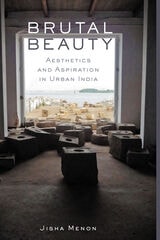
Brutal Beauty
Aesthetics and Aspiration in Urban IndiaJisha Menon
Northwestern University Press, 2022
Jisha Menon conveys the affective life of the city through multiple aesthetic projects that express a range of urban feelings, including aspiration, panic, and obsolescence. As developers and policymakers remodel the city through tumultuous construction projects, urban beautification, privatization, and other templated features of “world‑class cities,” urban citizens are also changing—transformed by nostalgia, narcissism, shame, and the spaces where they dwell and work. Sketching out scenes of urban aspiration and its dark underbelly, Menon delineates the creative and destructive potential of India’s lurch into contemporary capitalism, uncovering the interconnectedness of local and global power structures as well as art’s capacity to absorb and critique liberalization’s discontents. She argues that neoliberalism isn’t just an economic, social, and political phenomenon; neoliberalism is also a profoundly aesthetic project.