Results by title
314 books match the query 'African' and 12 start with b
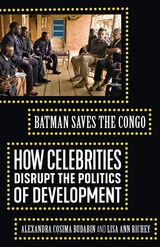
Batman Saves the Congo
How Celebrities Disrupt the Politics of DevelopmentAlexandra Cosima Budabin
University of Minnesota Press, 2021
How celebrity strategic partnerships are disrupting humanitarian space
Can a celebrity be a “disrupter,” promoting strategic partnerships to bring new ideas and funding to revitalize the development field—or are celebrities just charismatic ambassadors for big business? Examining the role of the rich and famous in development and humanitarianism, Batman Saves the Congo argues that celebrities do both, and that understanding why and how yields insight into the realities of neoliberal development.
In 2010, entertainer Ben Affleck, known for his superhero performance as Batman, launched the Eastern Congo Initiative to bring a new approach to the region’s development. This case study is central to Batman Saves the Congo. Affleck’s organization operates with special access, diversified funding, and significant support of elites within political, philanthropic, development, and humanitarian circuits. This sets it apart from other development organizations. With his convening power, Affleck has built partnerships with those inside and outside development, staking bipartisan political ground that is neither charity nor aid but “good business.” Such visible and recognizable celebrity humanitarians are occupying the public domain yet not engaging meaningfully with any public, argues Batman Saves the Congo. They are an unruly bunch of new players in development who amplify business solutions.
As elite political participants, celebrities shape development practices through strategic partnerships that are both an innovative way to raise awareness and funding for neglected causes and a troubling trend of unaccountable elite leadership in North–South relations. Batman Saves the Congo helps illuminate the power of celebritized business solutions and the development contexts they create.
Beautiful/Ugly
African and Diaspora AestheticsSarah Nuttall, ed.
Duke University Press, 2006
Highlighting how ideas of beauty are manifest and how they mutate, travel, and combine across time and distance, continental and diasporic writers examine the work of a Senegalese sculptor inspired by Leni Riefenstahl’s photographs of Nuba warriors; a rich Afro-Brazilian aesthetic incorporating aspects of African, Jamaican, and American cultures; and African Americans’ Africanization of the Santería movement in the United States. They consider the fraught, intricate spaces of the urban landscape in postcolonial South Africa; the intense pleasures of eating on Réunion; and the shockingly graphic images on painted plywood boards advertising “morality” plays along the streets of Ghana. And they analyze the increasingly ritualized wedding feasts in Cameroon as well as the limits of an explicitly “African” aesthetics. Two short stories by the Mozambican writer Mia Couto gesture toward what beauty might be in the context of political failure and postcolonial disillusionment. Together the essays suggest that beauty is in some sense future-oriented and that taking beauty in Africa and its diasporas seriously is a way of rekindling hope.
Contributors. Rita Barnard, Kamari Maxine Clarke, Mia Couto, Mark Gevisser, Simon Gikandi, Michelle Gilbert, Isabel Hofmeyr, William Kentridge, Dominique Malaquais, Achille Mbembe, Cheryl-Ann Michael, Celestin Monga, Sarah Nuttall, Patricia Pinho, Rodney Place, Els van der Plas, Pippa Stein, Françoise Vergès
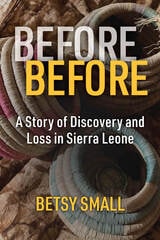
Before Before
A Story of Discovery and Loss in Sierra LeoneBetsy Small
University of Michigan Press, 2025
2025 Foreword INDIES Finalist for Political and Social Sciences
- 2026 Nautilus Silver Book Award in World Cultures' Transformational Growth & Development
Sierra Leone is often sensationalized as a place of extreme violence and suffering—of blood diamonds, child soldiers, war amputations, and Ebola and now the highly addictive drug Kush. Before Before captures daily life in a different country, one Betsy Small first encountered as a Peace Corps worker between 1984–1987, and then rediscovered when she returned decades later with her daughter. Living in Tokpombu, a remote community of forty rice-farming families, the author faced struggles that changed her forever and witnessed the growing tensions in this rainforest village—between the young and old, between the traditions of oral history and honoring the ancestors valued by the elders and the siren call of the illicit diamond mines faced by the youth.
Before Before offers a rare portrait of everyday people, with particular focus on the lives of women and girls, before the brutal war of 1991 tore the country apart. Through Small’s account of immersion in another world as she witnessed injustice and was welcomed as a friend, readers are invited to explore the shared ground of our humanity.
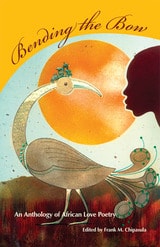
Bending the Bow
An Anthology of African Love PoetryEdited by Frank M. Chipasula
Southern Illinois University Press, 2008
From the ancient Egyptian inventors of the love lyric to contemporary poets, Bending the Bow: An Anthology of African Love Poetry gathers together both written and sung love poetry from Africa.
This anthology is a work of literary archaeology that lays bare a genre of African poetry that has been overshadowed by political poetry. Frank Chipasula has assembled a historically and geographically comprehensive wealth of African love poetry that spans more than three thousand years. By collecting a continent’s celebrations and explorations of the nature of love, he expands African literature into the sublime territory of the heart.
Bending the Bow traces the development of African love poetry from antiquity to modernity while establishing a cross-millennial dialogue. The anonymously written love poems fromPharaonic Egypt that open the anthology both predate Biblical love poetry and reveal the longevity of written love poetry in Africa. The middle section is devoted to sung love poetry from all regions of the continent. These great works serve as the foundation for modern poetry and testify to love poetry’s omnipresence in Africa. The final section, showcasing forty-eight modern African poets, celebrates the genre’s continuing vitality. Among those represented are Muyaka bin Hajji and Shaaban Robert,two major Swahili poets; Gabriel Okara, the innovative though underrated Nigerian poet; Léopold Sédar Senghor, the first president of Senegal and a founder of the Negritude Movement in francophone African literature; Rashidah Ismaili from Benin; Flavien Ranaivo from Madagascar; and Gabeba Baderoon from South Africa.
Ranging from the subtly suggestive to the openly erotic, this collection highlights love’s endurance in a world too often riven by contention. Bending the Bow bears testimony to poetry’s role as conciliator while opening up a new area of study for scholars and students.

Between Rebels and Relief
Negotiating Humanitarian Access in the Democratic Republic of the CongoMyfanwy James
University of Michigan Press, 2027
Between Rebels and Relief follows the frontline humanitarians who negotiate access with rebel groups in North Kivu, in the eastern Democratic Republic of the Congo, to foreground the work of local aid workers who are the backbone of humanitarian operations. Myfanwy James examines how global endeavors are built on the personal networks, knowledge, and skills of local personnel who are rarely given credit. Based on ethnographic research on Médecins Sans Frontières (Doctors Without Borders), James uncovers the brokerage, translation, and creative identity work that keeps medical relief operations running, and the crucial role of locally hired staff in navigating violent political terrains and building trust with armed groups.
Humanitarian agencies draw upon the personal profiles of different staff who learn to position themselves strategically for different audiences, casting and recasting themselves as a form of tactical agency in uncertain violent terrains. Identities are put to work—they become tools, influencing who can wield power, who can gain trust, and who is at particular risk of violence. Yet this produces a central paradox: To uphold a universalist mandate, humanitarian organizations leverage and reproduce the very borders between people—of race, gender, ethnicity, and personal history—that their egalitarian values seek to transcend.
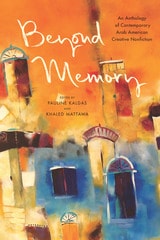
Beyond Memory
An Anthology of Contemporary Arab American Creative NonfictionPauline Kaldas
University of Arkansas Press, 2020
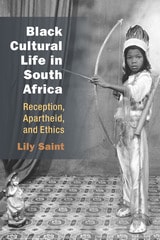
Black Cultural Life in South Africa
Reception, Apartheid, and EthicsLily Saint
University of Michigan Press, 2018
This study provocatively posits that states of oppression, including colonial and postcolonial rule, can elicit ethical responses to imaginative identification through encounters with popular culture, and it asks whether and how they carry over into ethical action. Its consideration of how globalized popular culture “travels” not just in material form, but also through the circuits of the imaginary, opens a new window for exploring the ethical and liberatory stakes of popular culture. Each chapter focuses on a separate genre, yet the overall interdisciplinary approach to the study of genre and argument for an expansion of ethical theory that draws on texts beyond the Western canon speak to growing concerns about studying genres and disciplines in isolation. Freed from oversimplified treatments of popular forms—common to cultural studies and ethical theory alike—this book demonstrates that people can do things with mass culture that reinvigorate ethical life.
Lily Saint’s new volume will interest Africanists across the humanities and the social sciences, and scholars of Anglophone literary, globalization, and cultural studies; race; ethical theories and philosophies; film studies; book history and material cultures; and the burgeoning field of comics and graphic novels.
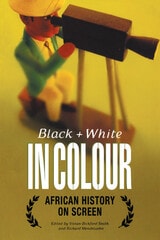
Black and White in Colour
African History on ScreenVivian Bickford-Smith
Ohio University Press, 2007
Black and White in Colour: African History on Screen considers how the African past has been represented in a wide range of historical films. Written by a team of eminent international scholars, the volume provides extensive coverage of both place and time and deals with major issues in the written history of Africa. Themes include the slave trade, imperialism and colonialism, racism, and anticolonial resistance. Many of the films will be familiar to readers: they include Out of Africa, Hotel Rwanda, Breaker Morant, Cry Freedom, The Battle of Algiers, and Chocolat.
This collection of essays is a highly original and useful contribution to African historiography, as well as a significant addition to the growing body of work within the emerging subdiscipline of “film and history.” It will appeal to those interested in African history and the ways in which films use the past to raise questions about the present.
Contributors: Mahir Saul, Ralph A. Austen, Robert Baum, Robert Harms, Nigel Worden, Carolyn Hamilton and Litheko Modisane, Richard Mendelsohn, Shamil Jeppie, Bill Nasson, Nigel Penn, Ruth Watson, Patrick Harries, David Moore, Teresa Barnes, Vivian Bickford-Smith, Mohamed Adhikari, and David Philips.
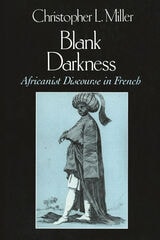
Blank Darkness
Africanist Discourse in FrenchChristopher L. Miller
University of Chicago Press, 1986
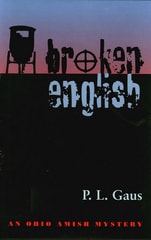
Broken English
An Amish Country MysteryP. L. Gaus
Ohio University Press, 2000
Broken English is a tale of honor, deception, and revenge, one in which circumstances and the search for justice test the mettle of the closest of friends and reveal the desperate measures of the strongest of foes. Following on the critical and popular success of P. L. Gaus’ acclaimed Amish mystery series, this new edition of Broken English includes an exclusive interview with the author, discussion questions for reading groups, and a detailed map and driving guide to Holmes County, Ohio, with everything one needs to visit the iconic scenes depicted in the story.
The peaceful town of Millersburg, Ohio, in the heart of Amish country, is rocked by the vicious murder of a woman at the hands of an ex-convict. When a local reporter covering the story turns up dead, while the convict is already behind bars, suspicion falls on David Hawkins, the first victim’s father. With Hawkins nowhere to be found among the protective Amish community that had taken him in as one of its own, Professor Michael Branden, Sheriff Bruce Robertson, and Pastor Cal Troyer set out to uncover the elusive truth in this otherwise quiet corner of the world.
Broken Lives and Other Stories
Ris Af#79Anthonia C. Kalu
Ohio University Press, 2003
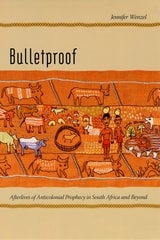
Bulletproof
Afterlives of Anticolonial Prophecy in South Africa and BeyondJennifer Wenzel
University of Chicago Press, 2009
In 1856 and 1857, in response to a prophet’s command, the Xhosa people of southern Africa killed their cattle and ceased planting crops; the resulting famine cost tens of thousands of lives. Much like other millenarian, anticolonial movements—such as the Ghost Dance in North America and the Birsa Munda uprising in India—these actions were meant to transform the world and liberate the Xhosa from oppression. Despite the movement’s momentous failure to achieve that goal, the event has continued to exert a powerful pull on the South African imagination ever since. It is these afterlives of the prophecy that Jennifer Wenzel explores in Bulletproof.
Wenzel examines literary and historical texts to show how writers have manipulated images and ideas associated with the cattle killing—harvest, sacrifice, rebirth, devastation—to speak to their contemporary predicaments. Widening her lens, Wenzel also looks at how past failure can both inspire and constrain movements for justice in the present, and her brilliant insights into the cultural implications of prophecy will fascinate readers across a wide variety of disciplines.