Results by title
234 books match the query 'Americas (North, Central, South, West Indies)' and 5 start with b

Beyond Geography
The Western Spirit Against the WildernessFrederick Turner
Rutgers University Press, 1992
First published in 1980, Beyond Geography continues to influence and impress its readers. This new edition, prepared for the Columbus quincentennial, includes a new introduction by T. H. Watkins and a new preface by the author. As the public debates Columbus's legacy, it is important for us to learn of the spiritual background of European domination of the Americas, for the Europeans who conquered the Americas substituted history for myth as a way of understanding life.

Bike Lanes Are the End of Us
Alexander S. Dawson
Vanderbilt University Press, 2027
Bike lanes are aspirational projects. They speak to a series of dreams about what North American cities could be, especially in and around an environmentalist and Europhilic vision (the latter having a very long history in the Americas). And yet, cycling infrastructure is built on or alongside the roads and modes of transport that came before it and maps onto preexisting forms of racial and spatial inequality. In many North American communities where social ties have long been fraying, efforts to build bike lanes have replicated the social crises that we see in other spaces.
Amsterdam’s oft-cited bike lanes are integrated within a system of regional trains, buses, and subways, allowing riders to park their bikes and engage in multimodal commuting, and are in turn the product of a social safety net that is among the most robust on the planet. However, in American settings, these projects have been slow to launch and their results have been uneven, in part due to spatial inequality in our cities, and in part because suburbanites and people with means have grown more attached to their private cars, rather than less so, in recent decades.
Recent controversial bike lane initiatives in Mexico City and Vancouver show how such projects not only create uproar among monied urbanites but may actually displace entire modes of transportation used primarily by marginalized residents (especially in the case of Mexico City), when the wish to imitate European models defeats efforts to see a North American city for what it is. In comparing Mexico City and Vancouver, Bike Lanes Are the End of Us traces how bike lane politics collide with distinct racial, spatial, and infrastructural realities to produce “green” reforms that can reinforce existing inequalities just as readily as they promise greater mobility.
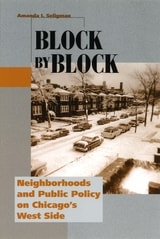
Block by Block
Neighborhoods and Public Policy on Chicago's West SideAmanda I. Seligman
University of Chicago Press, 2005
Seligman's study reveals that the responses of white West Siders to racial changes occurring in their neighborhoods were both multifaceted and extensive. She shows that, despite rehabilitation efforts, deterioration in these areas began long before the color of their inhabitants changed from white to black. And ultimately, the riots that erupted on Chicago's West Side and across the country in the mid-1960s stemmed not only from the tribulations specific to blacks in urban centers but also from the legacy of accumulated neglect after decades of white occupancy. Seligman's careful and evenhanded account will be essential to understanding that the "flight" of whites to the suburbs was the eventual result of a series of responses to transformations in Chicago's physical and social landscape, occurring one block at a time.
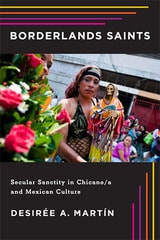
Borderlands Saints
Secular Sanctity in Chicano/a and Mexican CultureMartín, Desirée A
Rutgers University Press, 2013
Winner of the 2014 Latina/o Studies Section - LASA Outstanding Book Award
In Borderlands Saints, Desirée A. Martín examines the rise and fall of popular saints and saint-like figures in the borderlands of the United States and Mexico. Focusing specifically on Teresa Urrea (La Santa de Cabora), Pancho Villa, César Chávez, Subcomandante Marcos, and Santa Muerte, she traces the intersections of these figures, their devotees, artistic representations, and dominant institutions with an eye for the ways in which such unofficial saints mirror traditional spiritual practices and serve specific cultural needs.
Popular spirituality of this kind engages the use and exchange of relics, faith healing, pilgrimages, and spirit possession, exemplifying the contradictions between high and popular culture, human and divine, and secular and sacred. Martín focuses upon a wide range of Mexican and Chicano/a cultural works drawn from the nineteenth century to the present, covering such diverse genres as the novel, the communiqué, drama, the essay or crónica, film, and contemporary digital media. She argues that spiritual practice is often represented as narrative, while narrative—whether literary, historical, visual, or oral—may modify or even function as devotional practice.
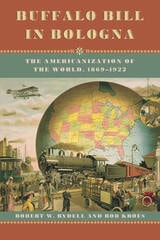
Buffalo Bill in Bologna
The Americanization of the World, 1869-1922Robert W. Rydell and Rob Kroes
University of Chicago Press, 2005
Buffalo Bill in Bologna reveals that the process of globalizing American mass culture began as early as the mid-nineteenth century. In fact, by the end of World War I, the United States already boasted an advanced network of culture industries that served to promote American values. Rydell and Kroes narrate how the circuses, amusement parks, vaudeville, mail-order catalogs, dime novels, and movies developed after the Civil War—tools central to hastening the reconstruction of the country—actually doubled as agents of American cultural diplomacy abroad. As symbols of America's version of the "good life," cultural products became a primary means for people around the world, especially in Europe, to reimagine both America and themselves in the context of America's growing global sphere of influence. Paying special attention to the role of the world's fairs, the exporting of Buffalo Bill's Wild West show to Europe, the release of The Birth of a Nation, and Woodrow Wilson's creation of the Committee on Public Information, Rydell and Kroes offer an absorbing tour through America's cultural expansion at the turn of the century. Buffalo Bill in Bologna is thus a tour de force that recasts what has been popularly understood about this period of American and global history.