95 books match the query 'Art & Politics' and 5 start with b
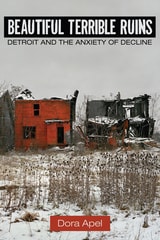
cover of Beautiful Terrible Ruins: Detroit and the Anxiety of Decline

Beautiful Terrible Ruins

Detroit and the Anxiety of Decline

Apel, Dora

Rutgers University Press, 2015
Once the manufacturing powerhouse of the nation, Detroit has become emblematic of failing cities everywhere—the paradigmatic city of ruins—and the epicenter of an explosive growth in images of urban decay. In Beautiful Terrible Ruins, art historian Dora Apel explores a wide array of these images, ranging from photography, advertising, and television, to documentaries, video games, and zombie and disaster films.  
 
Apel shows how Detroit has become pivotal to an expanding network of ruin imagery, imagery ultimately driven by a pervasive and growing cultural pessimism, a loss of faith in progress, and a deepening fear that worse times are coming. The images of Detroit’s decay speak to the overarching anxieties of our era: increasing poverty, declining wages and social services, inadequate health care, unemployment, homelessness, and ecological disaster—in short, the failure of capitalism. Apel reveals how, through the aesthetic distancing of representation, the haunted beauty and fascination of ruin imagery, embodied by Detroit’s abandoned downtown skyscrapers, empty urban spaces, decaying factories, and derelict neighborhoods help us to cope with our fears. But Apel warns that these images, while pleasurable, have little explanatory power, lulling us into seeing Detroit’s deterioration as either inevitable or the city’s own fault, and absolving the real agents of decline—corporate disinvestment and globalization. Beautiful Terrible Ruins helps us understand the ways that the pleasure and the horror of urban decay hold us in thrall. 
 
 
[more]
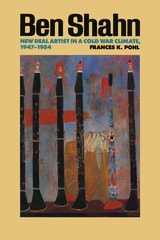
cover of Ben Shahn: New Deal Artist in a Cold War Climate, 1947-1954

Ben Shahn

New Deal Artist in a Cold War Climate, 1947-1954

By Frances Pohl

University of Texas Press, 1989

In the first, most intense years of the Cold War (1947–1954), New Deal liberals often found themselves in great disfavor. Ben Shahn's experience presents something of a paradox, however, since his paintings appealed in different ways to both liberals and conservatives. Blacklisted by CBS during the McCarthy era and yet, ironically, incorporated into presidential "campaigns of truth" aimed at improving the U.S. image abroad, Ben Shahn is a pivotal figure, revealing the complexities and contradictions inherent in this highly polarized moment in American history.

In this pathbreaking study, Frances Pohl traces the political and artistic struggles Ben Shahn became embroiled in as he tried to remain a socially concerned artist during the early Cold War period. She shows how he rejected the argument, voiced by many Abstract Expressionists, that art and politics should not mix, yet at the same time searched for a way to depict, in universal and allegorical terms, the broad human condition rather than simply specific instances of injustice. Perhaps most important, she makes critical connections between U.S. social and political history and the art it provoked, thus illuminating both the later career of Ben Shahn and the Cold War era in American cultural history.
[more]
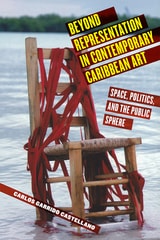
cover of Beyond Representation in Contemporary Caribbean Art: Space, Politics, and the Public Sphere

Beyond Representation in Contemporary Caribbean Art

Space, Politics, and the Public Sphere

Carlos Garrido Castellano

Rutgers University Press, 2019
The Caribbean has been traditionally associated with externally devised mappings and categories, thus appearing as a passive entity to be consumed and categorized. Challenging these forces and representations, Carlos Garrido Castellano argues that something more must be added to the discussion in order to address contemporary Caribbean visual creativity. Beyond Representation in Contemporary Caribbean Art arises from several years of field research and curatorial activity in museums, universities, and cultural institutions of Jamaica, Trinidad, Martinique, Guadeloupe, Cuba, Dominican Republic, Puerto Rico, and the United States. This book explores the ways in which Caribbean individuals and communities have recurred to art and visual creativity to create and sustain public spaces of discussion and social interaction. The book analyzes contemporary Caribbean art in relation to broader discussions of citizenship, cultural agency, critical geography, migration, and social justice. Covering a broad range of artistic projects, including curatorial practice, socially engaged art, institutional politics, public art, and performance, this book is about the imaginative ways in which Caribbean subjects and communities rearrange the sociocultural framework(s) they inhabit and share. 
[more]
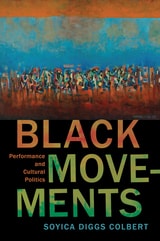
cover of Black Movements: Performance and Cultural Politics

Black Movements

Performance and Cultural Politics

Colbert, Soyica Diggs

Rutgers University Press, 2017

Received the 2018 Honorable Mention for the Joe A. Callaway Prize for the Best Book on Drama or Theatre​

Black Movements analyzes how artists and activists of recent decades reference earlier freedom movements in order to imagine and produce a more expansive and inclusive democracy. The post–Jim Crow, post–apartheid, postcolonial era has ushered in a purportedly color blind society and along with it an assault on race-based forms of knowledge production and coalition formation. Soyica Diggs Colbert argues that in the late twentieth century race went “underground,” and by the twenty-first century race no longer functioned as an explicit marker of second-class citizenship.

The subterranean nature of race manifests itself in discussions of the Trayvon Martin shooting that focus on his hoodie, an object of clothing that anyone can choose to wear, rather than focusing on structural racism; in discussions of the epidemic proportions of incarcerated black and brown people that highlight the individual’s poor decision making rather than the criminalization of blackness; in evaluations of black independence struggles in the Caribbean and Africa that allege these movements have accomplished little more than creating a black ruling class that mirrors the politics of its former white counterpart. Black Movements intervenes in these discussions by highlighting the ways in which artists draw from the past to create coherence about blackness in present and future worlds.

Through an exploration of the way that black movements create circuits connecting people across space and time, Black Movements offers important interventions into performance, literary, diaspora, and African American studies.
[more]
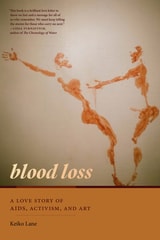
cover of Blood Loss: A Love Story of AIDS, Activism, and Art

Blood Loss

A Love Story of AIDS, Activism, and Art

Keiko Lane

Duke University Press, 2024

In 1991, sixteen-year-old activist Keiko Lane joined the Los Angeles chapters of Queer Nation and ACT UP. Their members protested legislation aimed at dismantling rights for LGBTQ people, people living with HIV, and immigrants while fighting for needle-exchange programs, reproductive justice, safer-sex education, hospice funding, and the right to die with dignity. At the same time, the activists were a queer chosen family of friends and lovers who took care of one another in sickness and in health. Sometimes they helped each other die. By the time Lane turned twenty-two, most had died of AIDS. In her evocative memoir, Lane weaves together love stories and afterlives of queer resistance and survival against the landscape of the Rodney King Rebellion, the movement for queer rights, and the censorship of queer artists and sexualities. Lane interrogates the social construction of power against and in queer communities of color and the recovery of sexual agency in the midst and aftermath of violence. Luminous and powerfully moving, Blood Loss explores survival after those we love have died.
[more]