Results by title
197 books match the query 'Arts' and 8 start with b
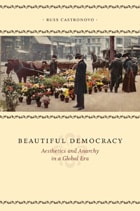
Beautiful Democracy
Aesthetics and Anarchy in a Global EraRuss Castronovo
University of Chicago Press, 2007
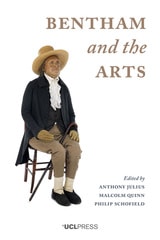
Bentham and the Arts
Edited by Anthony Julius, Malcolm Quinn, and Philip Schofield
University College London, 2020
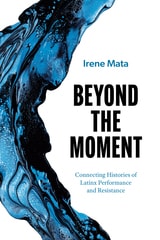
Beyond the Moment
Connecting Histories of Latinx Performance and ResistanceIrene Mata
University of Texas Press, 2026
Exploring cultural resistance by creating and archiving Latinx performance art
Performance is often seen as ephemeral, a condition that seemingly reduces its activist possibilities. After all, not everyone can take part or bear witness. Beyond the Moment shows how Latinx artists have responded with a theater of dissent that endures—performance art that also documents and can itself be archived, creating opportunities for sustained solidarity and resistance.
Through close readings of works such as Coco Fusco’s multi-genre performance A Field Guide for Female Interrogators, Irene Mata theorizes what she calls “textual mentoring.” This method involves tracing previous moments of resistance, archiving the creative process itself, and transforming the performance into a pedagogical tool. By means of textual mentoring, a work like The Panza Monologues becomes a lesson in confronting systemic oppression through collaborative storytelling. Mata also shows how the 2012 No Papers, No Fear Ride for Justice, a multistate immigrant-rights action, relies on a vocabulary of refusal of movements of the past—like the Freedom Rides of the Civil Rights era—and continues its activism beyond its immediate performance context by digitally archiving its process. With an emphasis on intersectional critique, Beyond the Moment positions performance as a radical form of resistance that educates and inspires across generations and movements.
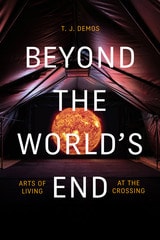
Beyond the World's End
Arts of Living at the CrossingT. J. Demos
Duke University Press, 2020
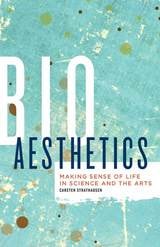
Bioaesthetics
Making Sense of Life in Science and the ArtsCarsten Strathausen
University of Minnesota Press, 2017
In recent years, bioaesthetics has used the latest discoveries in evolutionary studies and neuroscience to provide new ways of looking at art and aesthetics. Carsten Strathausen’s remarkable exploration of this emerging field is the first comprehensive account of its ideas, as well as a timely critique of its limitations.
Strathausen familiarizes readers with the basics of bioaesthetics, grounding them in its philosophical underpinnings while articulating its key components. Importantly, he delves into the longstanding problem of the “two cultures” that separate the arts and the sciences. Seeking to make bioaesthetics a more robust way of thinking, Strathausen then critiques it for failing to account for science’s historical and cultural assumptions. At its worst, he says, biologism reduces artworks to mere automatons that rubber-stamp pre-established scientific truths.
Written with a sensitive understanding of science’s strengths, and willing to refute its best arguments, Bioaesthetics helps readers separate the sensible from the specious. At a time when humanities departments are shrinking—and when STEM education is on the rise—Bioaesthetics makes vital points about the limitations of science, while lodging a robust defense of the importance of the humanities.
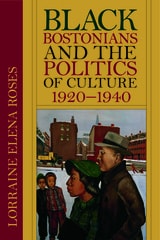
Black Bostonians and the Politics of Culture, 1920-1940
Lorraine Elena Roses
University of Massachusetts Press, 2017
In the 1920s and 1930s Boston became a rich and distinctive site of African American artistic production, unfolding at the same time as the Harlem Renaissance and encompassing literature, theater, music, and visual art. Owing to the ephemeral nature of much of this work, many of the era's primary sources have been lost.
In this book, Lorraine Elena Roses employs archival sources and personal interviews to recover this artistic output, examining the work of celebrated figures such as Dorothy West, Helene Johnson, Meta Warrick Fuller, and Allan Rohan Crite, as well as lesser-known artists including Eugene Gordon, Ralf Coleman, Gertrude “Toki” Schalk, and Alvira Hazzard. Black Bostonians and the Politics of Culture, 1920–1940 demonstrates how this creative community militated against the color line not solely through powerful acts of civil disobedience but also by way of a strong repertoire of artistic projects.
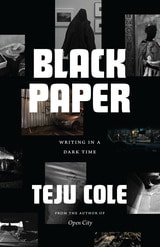
Black Paper
Writing in a Dark TimeTeju Cole
University of Chicago Press, 2021
“Darkness is not empty,” writes Teju Cole in Black Paper, a book that meditates on what it means to sustain our humanity—and witness the humanity of others—in a time of darkness. One of the most celebrated essayists of his generation, Cole here plays variations on the essay form, modeling ways to attend to experience—not just to take in but to think critically about what we sense and what we don’t.
Wide-ranging but thematically unified, the essays address ethical questions about what it means to be human and what it means to bear witness, recognizing how our individual present is informed by a collective past. Cole’s writings in Black Paper approach the fractured moment of our history through a constellation of interrelated concerns: confrontation with unsettling art, elegies both public and private, the defense of writing in a time of political upheaval, the role of the color black in the visual arts, the use of shadow in photography, and the links between literature and activism. Throughout, Cole gives us intriguing new ways of thinking about blackness and its numerous connotations. As he describes the carbon-copy process in his epilogue: “Writing on the top white sheet would transfer the carbon from the black paper onto the bottom white sheet. Black transported the meaning.”
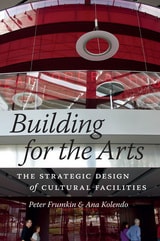
Building for the Arts
The Strategic Design of Cultural FacilitiesPeter Frumkin and Ana Kolendo
University of Chicago Press, 2014
With Building for the Arts, Peter Frumkin and Ana Kolendo explore how artistic vision, funding partnerships, and institutional culture work together—or fail to—throughout the process of major cultural construction projects. Drawing on detailed case studies and in-depth interviews at museums and other cultural institutions varying in size and funding arrangements, including the Art Institute of Chicago, Atlanta Opera, and AT&T Performing Arts Center in Dallas, Frumkin and Kolendo analyze the decision-making considerations and challenges and identify four factors whose alignment characterizes the most successful and sustainable of the projects discussed: institutional requirements, capacity of the institution to manage the project while maintaining ongoing operations, community interest and support, and sufficient sources of funding. How and whether these factors are strategically aligned in the design and execution of a building initiative, the authors argue, can lead an organization to either thrive or fail. The book closes with an analysis of specific tactics that can enhance the chances of a project’s success.
A practical guide grounded in the latest scholarship on nonprofit strategy and governance, Building for the Arts will be an invaluable resource for professional arts staff and management, trustees of arts organizations, development professionals, and donors, as well as those who study and seek to understand them.