Results by title
82 books match the query 'Arts and society' and 6 start with b
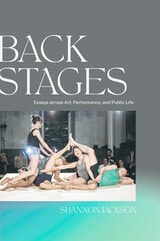
Back Stages
Essays across Art, Performance, and Public LifeShannon Jackson
Northwestern University Press, 2022
Shannon Jackson explores a range of disciplinary, institutional, and political puzzles that engage the social and aesthetic practice of performance in this collection of twenty essential essays spanning her career. Back Stages starts by considering the historical connection between performance practice and movements of social reform, while later writings analyze disciplinary debates on the place of performance in higher education and within the contemporary field of socially engaged art, tracking fraught and allied relationships to literary studies, art history, visual culture, theater, social theory, and critical theory.
At a time of increased aesthetic experimentation and political debate within the art world, these essays alight on artists, groups, and cultural organizations whose experiments have challenged conventions of curation and critique, including Theaster Gates, Paul Ramírez Jonas, Harrell Fletcher, and My Barbarian. Throughout, Jackson navigates the political ambivalences of performance, from the late nineteenth to the twenty-first century, tracking shifts in participatory art that seek to resist capitalism, even as such performance work paradoxically risks neoliberal appropriation by a post-Fordist experience economy.
Back Stages surfaces unexpected cross-disciplinary connections and provides new opportunities for mutual engagement within a wide network of educational, artistic, and civic sectors. A substantial introduction excavates the critical links between the essays and a variety of disciplines and movements.
[more]
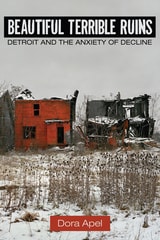
Beautiful Terrible Ruins
Detroit and the Anxiety of DeclineApel, Dora
Rutgers University Press, 2015
Once the manufacturing powerhouse of the nation, Detroit has become emblematic of failing cities everywhere—the paradigmatic city of ruins—and the epicenter of an explosive growth in images of urban decay. In Beautiful Terrible Ruins, art historian Dora Apel explores a wide array of these images, ranging from photography, advertising, and television, to documentaries, video games, and zombie and disaster films.
Apel shows how Detroit has become pivotal to an expanding network of ruin imagery, imagery ultimately driven by a pervasive and growing cultural pessimism, a loss of faith in progress, and a deepening fear that worse times are coming. The images of Detroit’s decay speak to the overarching anxieties of our era: increasing poverty, declining wages and social services, inadequate health care, unemployment, homelessness, and ecological disaster—in short, the failure of capitalism. Apel reveals how, through the aesthetic distancing of representation, the haunted beauty and fascination of ruin imagery, embodied by Detroit’s abandoned downtown skyscrapers, empty urban spaces, decaying factories, and derelict neighborhoods help us to cope with our fears. But Apel warns that these images, while pleasurable, have little explanatory power, lulling us into seeing Detroit’s deterioration as either inevitable or the city’s own fault, and absolving the real agents of decline—corporate disinvestment and globalization. Beautiful Terrible Ruins helps us understand the ways that the pleasure and the horror of urban decay hold us in thrall.
[more]
Black Paper
Writing in a Dark TimeTeju Cole
University of Chicago Press, 2021
A profound book of essays from a celebrated master of the form.
“Darkness is not empty,” writes Teju Cole in Black Paper, a book that meditates on what it means to sustain our humanity—and witness the humanity of others—in a time of darkness. One of the most celebrated essayists of his generation, Cole here plays variations on the essay form, modeling ways to attend to experience—not just to take in but to think critically about what we sense and what we don’t.
Wide-ranging but thematically unified, the essays address ethical questions about what it means to be human and what it means to bear witness, recognizing how our individual present is informed by a collective past. Cole’s writings in Black Paper approach the fractured moment of our history through a constellation of interrelated concerns: confrontation with unsettling art, elegies both public and private, the defense of writing in a time of political upheaval, the role of the color black in the visual arts, the use of shadow in photography, and the links between literature and activism. Throughout, Cole gives us intriguing new ways of thinking about blackness and its numerous connotations. As he describes the carbon-copy process in his epilogue: “Writing on the top white sheet would transfer the carbon from the black paper onto the bottom white sheet. Black transported the meaning.”
[more]
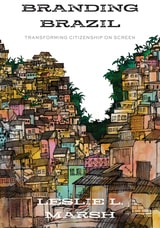
Branding Brazil
Transforming Citizenship on ScreenLeslie L. Marsh
Rutgers University Press, 2021
Branding Brazil examines a panorama of contemporary cultural productions including film, television, photography, and alternative media to explore the transformation of citizenship in Brazil from 2003 to 2014. A utopian impulse drove the reproduction of Brazilian cultural identity for local and global consumption; cultural production sought social and economic profits, especially greater inclusion of previously marginalized people and places. Marsh asserts that three communicative strategies from branding–promising progress, cultivating buy-in, and resolving contradictions–are the most salient and recurrent practices of nation branding during this historic period. More recent political crises can be understood partly in terms of backlash against marked social and political changes introduced during the branding period. Branding Brazil takes a multi-faceted approach, weaving media studies with politics and cinema studies to reveal that more than a marketing term or project emanating from the state, branding was a cultural phenomenon.
[more]
Breathing Aesthetics
Jean-Thomas Tremblay
Duke University Press, 2022
In Breathing Aesthetics Jean-Thomas Tremblay argues that difficult breathing indexes the uneven distribution of risk in a contemporary era marked by the increasing contamination, weaponization, and monetization of air. Tremblay shows how biopolitical and necropolitical forces tied to the continuation of extractive capitalism, imperialism, and structural racism are embodied and experienced through respiration. They identify responses to the crisis in breathing in aesthetic practices ranging from the film work of Cuban American artist Ana Mendieta to the disability diaries of Bob Flanagan, to the Black queer speculative fiction of Renee Gladman. In readings of these and other minoritarian works of experimental film, endurance performance, ecopoetics, and cinema-vérité, Tremblay contends that articulations of survival now depend on the management and dispersal of respiratory hazards. In so doing, they reveal how an aesthetic attention to breathing generates historically, culturally, and environmentally situated tactics and strategies for living under precarity.
[more]
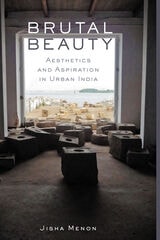
Brutal Beauty
Aesthetics and Aspiration in Urban IndiaJisha Menon
Northwestern University Press, 2022
Brutal Beauty: Aesthetics and Aspiration in Urban India follows a postcolonial city as it transforms into a bustling global metropolis after the liberalization of the Indian economy. Taking the once idyllic “garden city” of Bangalore in southern India as its point of departure, the book explores how artists across India and beyond foreground neoliberalism as a “structure of feeling” permeating aesthetics, selfhood, and everyday life.
Jisha Menon conveys the affective life of the city through multiple aesthetic projects that express a range of urban feelings, including aspiration, panic, and obsolescence. As developers and policymakers remodel the city through tumultuous construction projects, urban beautification, privatization, and other templated features of “world‑class cities,” urban citizens are also changing—transformed by nostalgia, narcissism, shame, and the spaces where they dwell and work. Sketching out scenes of urban aspiration and its dark underbelly, Menon delineates the creative and destructive potential of India’s lurch into contemporary capitalism, uncovering the interconnectedness of local and global power structures as well as art’s capacity to absorb and critique liberalization’s discontents. She argues that neoliberalism isn’t just an economic, social, and political phenomenon; neoliberalism is also a profoundly aesthetic project.
Jisha Menon conveys the affective life of the city through multiple aesthetic projects that express a range of urban feelings, including aspiration, panic, and obsolescence. As developers and policymakers remodel the city through tumultuous construction projects, urban beautification, privatization, and other templated features of “world‑class cities,” urban citizens are also changing—transformed by nostalgia, narcissism, shame, and the spaces where they dwell and work. Sketching out scenes of urban aspiration and its dark underbelly, Menon delineates the creative and destructive potential of India’s lurch into contemporary capitalism, uncovering the interconnectedness of local and global power structures as well as art’s capacity to absorb and critique liberalization’s discontents. She argues that neoliberalism isn’t just an economic, social, and political phenomenon; neoliberalism is also a profoundly aesthetic project.
[more]