Results by title
117 books match the query 'Asian Americans' and 3 start with b
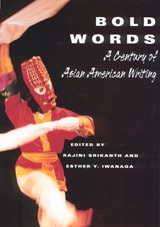
Bold Words
A Century of Asian American WritingEdited by Rajini Srikanth
Rutgers University Press, 2001
A century of Asian American writing has generated a forceful cascade of "bold words." This anthology covers writings by Asian Americans in all genres, from the early twentieth century to the present. Some sixty authors of Chinese, Filipino, Japanese, Korean, South Asian, and Southeast Asian American origin are represented, with an equal split between male and female writers. The collection is divided into four sections-memoir, fiction, poetry, and drama-prefaced by an introductory essay from a well-known practitioner of that genre: Meena Alexander on memoir, Gary Pak on fiction, Eileen Tabios on poetry, and Roberta Uno on drama. The selections depict the complex realities and wide range of experiences of Asians in the United States. They illuminate the writers' creative responses to issues as diverse as resistance, aesthetics, biculturalism, sexuality, gender relations, racism, war, diaspora, and family. Rajini Srikanth teaches at the University of Massachusetts, Boston. She is the coeditor of the award-winning anthology Contours of the Heart: South Asians Map North America and the collection A Part, Yet Apart: South Asians in Asian America. Esther Y. Iwanaga teaches Asian American literature and literature-based writing courses at Wellesley College and the University of Massachusetts, Boston.
[more]
Building Filipino Hawai'i
Roderick Labrador
University of Illinois Press, 2015
Drawing on ten years of interviews and ethnographic and archival research, Roderick Labrador delves into the ways Filipinos in Hawai'i have balanced their pursuit of upward mobility and mainstream acceptance with a desire to keep their Filipino identity.
In particular, Labrador speaks to the processes of identity making and the politics of representation among immigrant communities striving to resist marginalization in a globalized, transnational era. Critiquing the popular image of Hawai'i as a postracial paradise, he reveals how Filipino immigrants talk about their relationships to the place(s) they left and the place(s) where they've settled, and how these discourses shape their identities. He also shows how the struggle for community empowerment, identity territorialization, and the process of placing and boundary making continue to affect how minority groups construct the stories they tell about themselves, to themselves and others.
In particular, Labrador speaks to the processes of identity making and the politics of representation among immigrant communities striving to resist marginalization in a globalized, transnational era. Critiquing the popular image of Hawai'i as a postracial paradise, he reveals how Filipino immigrants talk about their relationships to the place(s) they left and the place(s) where they've settled, and how these discourses shape their identities. He also shows how the struggle for community empowerment, identity territorialization, and the process of placing and boundary making continue to affect how minority groups construct the stories they tell about themselves, to themselves and others.
[more]
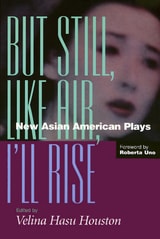
But Still Like Air
edited by Velina Hasu Houston, foreword by Roberta Uno
Temple University Press, 1997
In this pathbreaking volume, Velina Hasu Houston gathers together eleven plays that speak in the "hybridized, unique American voices of Asian descent -- and often dissent." These writers resist the bigotry that attempts to target them solely as people of color as well as the homogenizing tendencies of a multiculturalism that fails to recognize the varied make-up of Asian America. Anthologized for the first time, these plays testify to the rich complexity of Asian American experience while they also demonstrate the different styles and thematic concerns of the individual playwrights.
What are Asian American plays about? Family conflicts, sexuality, social upheaval, betrayal ... the stuff of all drama. Whether the characters are a middle-aged Taiwanese woman who is married to an Irish American and who dreams of opening a Chinese restaurant, a Chinese American female bond trader trying to survive a corporate takeover, or an ABC (American Born Chinese) gay man whose lover has AIDS, their Asian-ness is only a part of their story.
As a playwright, Houston is keenly aware of the rigid formulas that often exclude writers of color and women women writers from mainstream theater. But Still, Like air, I'll Rise brings forth vibrant new work that challenges producers and audiences to broaden their expectations, to attend to the unfamiliar voices that expresses the universal and particular vision of Asian American playwrights.
[more]