Results by title
58 books match the query 'Basketball' and 8 start with b
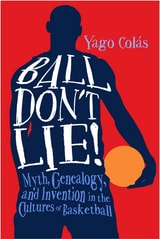
Ball Don't Lie
Myth, Genealogy, and Invention in the Cultures of BasketballYago Colás
Temple University Press, 2016
Pro basketball player Rasheed Wallace often exclaimed the pragmatic truth “Ball don’t lie!” during a game. It is a protest against a referee’s bad calls. But the slogan, which originated in pickup games, brings the reality of a racialized urban playground into mainstream American popular culture.
In Ball Don’t Lie!, Yago Colás traces the various forms of power at work in the intersections between basketball and language from the game’s invention to the present day. He critiques existing popular myths concerning the history of basketball, contextualizes them, and presents an alternative history of the sport inspired by innovations. Colás emphasizes the creative prerogative of players and the ways in which their innovations shape—and are shaped by—broader cultural and social phenomena.
Ball Don't Lie! shows that basketball cannot be reduced to a single, fixed or timeless essence but instead is a continually evolving exhibition of physical culture that flexibly adapts to and sparks changes in American society.
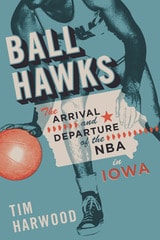
Ball Hawks
The Arrival and Departure of the NBA in IowaTim Harwood
University of Iowa Press, 2018
Believe it or not, Waterloo, Iowa, had an NBA team during the league’s first season, 1949 to 1950. Broadcaster and independent sports historian Tim Harwood uncovers the fascinating story of the Waterloo Hawks and the Midwest’s influence on professional basketball. Beginning with the professional leagues that led up to the creation of the National Basketball Association, Harwood recounts big games and dramatic buzzer-beaters, and the players who made them.
The first season of the NBA was far from a success. Teams had a hard time attracting fans, with games often played in half-empty arenas. When Waterloo residents learned that the team was struggling financially, they rallied behind the Hawks and purchased shares of the team in a bid to keep it afloat. Unfortunately, that community-based effort was not enough; owners of teams in larger markets pressured the league to push Waterloo—and other smaller towns like Anderson, Indiana, and Sheboygan, Wisconsin—out of the league.
Though the Hawks disappeared after their lone NBA campaign, Waterloo and other midwestern teams were nonetheless integral to getting the NBA off the ground, and their legacy continues today through some of the current franchises that relocated to larger markets. Combining newspaper accounts and personal interviews with surviving players, Harwood weaves a fascinating story of the underdog team, in the unlikeliest of places, that helped make professional basketball the worldwide success it is today.
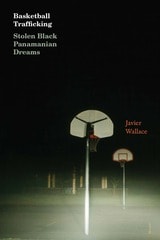
Basketball Trafficking
Stolen Black Panamanian DreamsJavier Wallace
Duke University Press, 2025
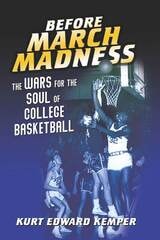
Before March Madness
The Wars for the Soul of College BasketballKurt Edward Kemper
University of Illinois Press, 2020
Kurt Edward Kemper tells the dramatic story of the clashes that shook college basketball at mid-century—and how the repercussions continue to influence college sports to the present day. Taking readers inside the competing factions, he details why historically black colleges and regional schools came to embrace commercialization. As he shows, the NCAA's strategy of co-opting its opponents gave each group just enough just enough to play along—while the victory of the big-time athletics model handed the organization the power to seize control of college sports.
An innovative history of an overlooked era, Before March Madness looks at how promises, power, and money laid the groundwork for an American sports institution.
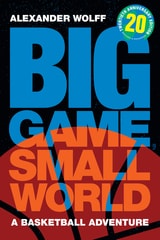
Big Game, Small World
A Basketball AdventureAlexander Wolff
Duke University Press, 2022
During the late 1990s, eminent basketball journalist Alexander Wolff traveled the globe to determine how a game invented by a Canadian clergyman became an international phenomenon. Big Game, Small World presents Wolff’s dispatches from sixteen countries spread across five continents and multiple US states. In them, he asks: What can the game tell us about the world? And what can the world tell us about the game? Whether traveling to Bhutan to challenge its king to a pickup game, exploring the women’s game in Brazil, or covering the Afrobasket tournament in Luanda, Angola, during a civil war, Wolff shows how basketball has the power to define an individual, a culture, and even a country.
This updated twentieth anniversary edition features a new preface in which Wolff outlines the contemporary rise of athlete-activists while discussing the increasing dominance within the NBA of marquee international players like Luka Dončić and Giannis Antetokounmpo. A loving celebration of basketball, Big Game, Small World is one of the most insightful books ever written about the game.
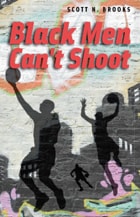
Black Men Can't Shoot
Scott N. Brooks
University of Chicago Press, 2009
The myth of the natural black athlete is widespread, though it’s usually talked about only when a sports commentator or celebrity embarrasses himself by bringing it up in public. Those gaffes are swiftly decried as racist, but apart from their link to the long history of ugly racial stereotypes about black people—especially men—they are also harmful because they obscure very real, hard-fought accomplishments. As Black Men Can’t Shoot demonstrates, such successes on the basketball court don’t happen just because of natural gifts—instead, they grow out of the long, tough, and unpredictable process of becoming a known player.
Scott Norman Brooks spent four years coaching summer league basketball in Philadelphia. And what he saw, heard, and felt working with the young black men on his team tells us much about how some kids are able to make the extraordinary journey from the ghetto to the NCAA. He tells the story of two young men, Jermaine and Ray, following them through their high school years and chronicling their breakthroughs and frustrations on the court as well as their troubles at home. Black Men Can’t Shoot is a moving coming-of-age story that counters the belief that basketball only exploits kids and lures them into following empty dreams—and shows us that by playing ball, some of these young black men have already begun their education even before they get to college.
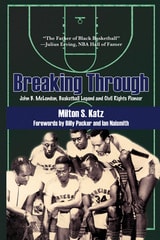
Breaking Through
John B. McLendon, Basketball Legend and Civil Rights PioneerMilton S. Katz
University of Arkansas Press, 2007
Winner, William Rockhill Nelson Award
John B. McLendon was the last living protégé of basketball’s inventor, Dr. James Naismith, and one of the “top ten basketball coaches of the century” in Billy Packer’s opinion. McLendon’s amazing records in college and pro basketball earned him a spot in the Basketball Hall of Fame (the first black coach to be inducted), and his coaching philosophy has had a huge influence on basketball coaches. Breaking Through is also a powerful and inspirational story about segregation and a champion’s struggle for equality in 1940s and 50s America.
Black Magic, ESPN’s Peabody Award–winning documentary about players and coaches who attended historically black colleges and universities, covers many of the events in McLendon’s life that Katz writes about in his book.
John McLendon was elected to the Naismith Memorial Basketball Hall of Fame in 2016.
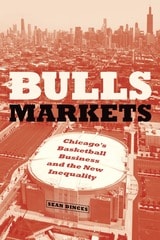
Bulls Markets
Chicago's Basketball Business and the New InequalitySean Dinces
University of Chicago Press, 2018
The 1990s were a glorious time for the Chicago Bulls, an age of historic championships and all-time basketball greats like Scottie Pippen and Michael Jordan. It seemed only fitting that city, county, and state officials would assist the team owners in constructing a sparkling new venue to house this incredible team that was identified worldwide with Chicago. That arena, the United Center, is the focus of Bulls Markets, an unvarnished look at the economic and political choices that forever reshaped one of America’s largest cities—arguably for the worse.
Sean Dinces shows how the construction of the United Center reveals the fundamental problems with neoliberal urban development. The pitch for building the arena was fueled by promises of private funding and equitable revitalization in a long-blighted neighborhood. However, the effort was funded in large part by municipal tax breaks that few ordinary Chicagoans knew about, and that wound up exacerbating the rising problems of gentrification and wealth stratification. In this portrait of the construction of the United Center and the urban life that developed around it, Dinces starkly depicts a pattern of inequity that has become emblematic of contemporary American cities: governments and sports franchises collude to provide amenities for the wealthy at the expense of poorer citizens, diminishing their experiences as fans and—far worse—creating an urban environment that is regulated and surveilled for the comfort and protection of that same moneyed elite.