72 books match the query 'Being' and 11 start with b

cover of Being a Minor Writer

Being a Minor Writer

Gail Gilliland

University of Iowa Press, 1994

There are countless theoretical arguments that attempt to define “major” and “minor” literatures, but this lively and deeply felt work is one of the first to speak from the authority of the experience of being minor—of being the “minor writer” who, according to the definition of “author” given by Michel Foucault, does not possess a “name.” This book, then, is an impassioned critical and ethical defense of the act of writing for purposes other than critical acclaim.

In the tradition of Horace's

Ars Poetica,

Gilliland uses comments by a broad range of writers, as well as her own experience as a minor woman writer, to consider the basic Horatian questions of purpose, choice of subject matter and genre, diction, characterization, setting, and style. She points out that in the absence of major recognition, the minor writer is continually confronted by the existential question, why do I (still) write? This book offers not only a challenge to existing critical theories but an argument in favor of being—for

still

being, for continuing

anyway

with one's life and art

[more]
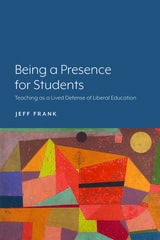
cover of Being a Presence for Students: Teaching as a Lived Defense of Liberal Education

Being a Presence for Students

Teaching as a Lived Defense of Liberal Education

Jeff Frank

Lever Press, 2019

This book offers a lived defense of liberal education. How does a college professor, on a daily basis, help students feel the value of liberal education and get the most from that education? We answer this question, as professors, each day in the classroom. John William Miller, a philosophy professor at Williams College from 1924-1960 and someone noted for his exceptional teaching, developed one form that this lived defense can take. Though Miller published very little while he was alive, the archives at Williams College hold unpublished notes and essays of this master teacher. In this book, Jeff Frank offers an extended commentary on one of these unpublished essays where Miller develops his thinking on liberal education. Frank refines the idea that presence is central to liberal education and offers suggestions for how professors can become an educative presence for students. The goal of this book is an invitation to other professors who value liberal education to think with Miller about how to foster their own lived defense of liberal education, each day, in their own classrooms. The tone of the book is meant to be invitational, at times even conversational, and the book concludes with some direct suggestions for how professors can live their own defense of liberal education.
[more]
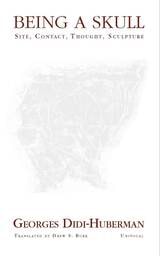
cover of Being a Skull: Site, Contact, Thought, Sculpture

Being a Skull

Site, Contact, Thought, Sculpture

Georges Didi-Huberman

University of Minnesota Press, 2016

What would a sculpture look like that has as its task to touch thought? For the French philosopher and Art Historian, Georges Didi-Huberman, this is the central question that permeates throughout the work of Italian artist Giuseppe Penone. Through a careful study of Penone’s work regarding a sculptural and haptic process of contact with place, thought, and artistic practice, Didi-Huberman takes the reader on a journey through various modes of thinking by way of being. Taking Penone’s artwork “Being the river” as a thematic starting point, Didi-Huberman sketches a sweeping view of how artists through the centuries have worked with conceptions of the skull, that is, the mind, and ruminates on where thought is indeed located. 

From Leonardo da Vinci to Albrecht Dürer, Didi-Huberman guides us to the work of Penone and from there, into the attempts of a sculptor whose works strives to touch thought. What we uncover is a sculptor whose work becomes a series of traces of the site of thought. Attempting to trace, by way of a series of frottages, reports, and developments, this imperceptible zone of contact. The result is a kind of fossil of the brain: the site of thought, namely, the site for getting lost and for disproving space. Sculpting at the same time what inhabits as well as what incorporates us.

[more]
cover of Being a Teen Library Services Advocate

Being a Teen Library Services Advocate

Linda Braun

American Library Association, 2012
[more]
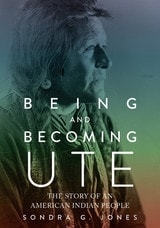
cover of Being and Becoming Ute: The Story of an American Indian People

Being and Becoming Ute

The Story of an American Indian People

Sondra G. Jones

University of Utah Press, 2019

Sondra Jones traces the metamorphosis of the Ute people from a society of small, interrelated bands of mobile hunter-gatherers to sovereign, dependent nations—modern tribes who run extensive business enterprises and government services. Weaving together the history of all Ute groups—in Colorado, Utah, and New Mexico—the narrative describes their traditional culture, including the many facets that have continued to define them as a people. Jones emphasizes how the Utes adapted over four centuries and details events, conflicts, trade, and social interactions with non-Utes and non-Indians. Being and Becoming Ute examines the effects of boarding—and public—school education; colonial wars and commerce with Hispanic and American settlers; modern world wars and other international conflicts; battles over federally instigated termination, tribal identity, and membership; and the development of economic enterprises and political power. The book also explores the concerns of the modern Ute world, including social and medical issues, transformed religion, and the fight to maintain Ute identity in the twenty-first century.
 
Neither a portrait of a people frozen in a past time and place nor a tragedy in which vanishing Indians sank into oppressed oblivion, the history of the Ute people is dynamic and evolving. While it includes misfortune, injustice, and struggle, it reveals the adaptability and resilience of an American Indian people.
[more]
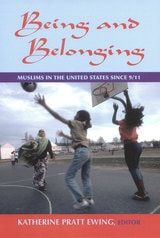
cover of Being and Belonging: Muslims in the United States since 9/11

Being and Belonging

Muslims in the United States since 9/11

Katherine Pratt Ewing

Russell Sage Foundation, 2008
The terrorist attacks of September 11, 2001, instantly transformed many ordinary Muslim and Arab Americans into suspected terrorists. In the weeks and months following the attacks, Muslims in the United States faced a frighteningly altered social climate consisting of heightened surveillance, interrogation, and harassment. In the long run, however, the backlash has been more complicated. In Being and Belonging, Katherine Pratt Ewing leads a group of anthropologists, sociologists, and cultural studies experts in exploring how the events of September 11th have affected the quest for belonging and identity among Muslims in America—for better and for worse. From Chicago to Detroit to San Francisco, Being and Belonging takes readers on an extensive tour of Muslim America—inside mosques, through high school hallways, and along inner city streets.  Jen'nan Ghazal Read compares the experiences of Arab Muslims and Arab Christians in Houston and finds that the events of 9/11 created a "cultural wedge" dividing Arab Americans along religious lines. While Arab Christians highlighted their religious affiliation as a means of distancing themselves from the perceived terrorist sympathies of Islam, Muslims quickly found that their religious affiliation served as a barrier, rather than a bridge, to social and political integration. Katherine Pratt Ewing and Marguerite Hoyler document the way South Asian Muslim youth in Raleigh, North Carolina, actively contested the prevailing notion that one cannot be both Muslim and American by asserting their religious identities more powerfully than they might have before the terrorist acts, while still identifying themselves as fully American. Sally Howell and Amaney Jamal distinguish between national and local responses to terrorism. In striking contrast to the erosion of civil rights, ethnic profiling, and surveillance set into motion by the federal government, well-established Muslim community leaders in Detroit used their influence in law enforcement, media, and social services to empower the community and protect civil rights. Craig Joseph and Barnaby Riedel analyze how an Islamic private school in Chicago responded to both September 11 and the increasing ethnic diversity of its student body by adopting a secular character education program to instruct children in universal values rather than religious doctrine. In a series of poignant interviews, the school's students articulate a clear understanding that while 9/11 left deep wounds on their community, it also created a valuable opportunity to teach the nation about Islam. The rich ethnographies in this volume link 9/11 and its effects to the experiences of a group that was struggling to be included in the American mainstream long before that fateful day. Many Muslim communities never had a chance to tell their stories after September 11. In Being and Belonging, they get that chance.
[more]
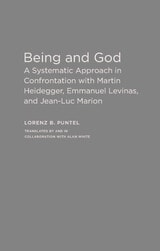
cover of Being and God: A Systematic Approach in Confrontation with Martin Heidegger, Emmanuel Levinas, and Jean-Luc Marion

Being and God

A Systematic Approach in Confrontation with Martin Heidegger, Emmanuel Levinas, and Jean-Luc Marion

Lorenz B. Puntel and Alan White

Northwestern University Press, 2011
Being and God argues that defensible philosophical theorization concerning the topic “God” is both possible and necessary within the framework of an adequate systematic philosophy—which must include a theory of Being—but is not possible in the absence of such a framework. The book provides critiques of philosophical approaches to this topic that have not relied on such frameworks; targets include the most important and influential treatments presented by historical, contemporary analytic, and contemporary continental philosophers. The book also further develops the systematic framework presented in Puntel’s Structure and Being (2008), extending a line of argumentation to show that the absolutely necessary dimension of Being is, when more fully explicated, appropriately named “God.”
[more]
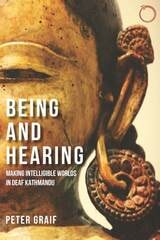
cover of Being and Hearing: Making Intelligible Worlds in Deaf Kathmandu

Being and Hearing

Making Intelligible Worlds in Deaf Kathmandu

Peter Graif

HAU, 2018

How do deaf people in different societies perceive and conceive the world around them?  Drawing on three years of anthropological fieldwork in Nepali deaf communities, Being and Hearing shows how questions of cultural difference are profoundly shaped by local habits of perception. Beginning with the premise that philosophy and cultural intuition are separated only by genre and pedigree, Peter Graif argues that Nepali deaf communities—in their social sensibilities, political projects, and aesthetics of expression—present innovative answers to the very old question of what it means to be different.
 
From pranks and protests, to diverse acts of love and resistance, to renewed distinctions between material and immaterial, deaf communities in Nepal have crafted ways to foreground the habits of perception that shape both their own experiences and how they are experienced by the hearing people around them. By exploring these often overlooked strategies, Being and Hearing makes a unique contribution to ethnography and comparative philosophy.
[more]
cover of Being and Predication

Being and Predication

Ralph M. McInerny

Catholic University of America Press, 2018
Brings together articles that influenced the scholarly work of Ralph McInerny.
[more]
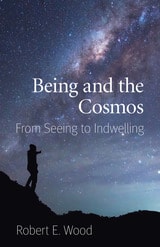
cover of Being and the Cosmos

Being and the Cosmos

Robert E. Wood

Catholic University of America Press, 2018

Robert Wood’s aim in Being and the Cosmos<\i> is to reestablish a speculative view of the cosmos that goes back to the ancient Greeks and that corresponds to the holism of contemporary physics. There are two sets of problems in contemporary thought that militate against any such attempt. Most widespread is scientific reductionism in biology and neuroscience that explains awareness in terms of the mechanisms that underlie it. The second is the widespread attack in philosophy itself on speculative holism by deconstruction and anti-foundationalism.

In Being and the Cosmos<\i>, the tack against both is to make explicit the character of the mind that sees and thinks, that actively takes up commitment to the truth available in the disciplines involved. The basic ground of this position rests upon the functioning of the notion of Being that opens up the question of the character of the Whole and the human being’s place in it. Thus position the treatment of the notion of Being as foundation and as orientation toward the Whole between the attack on reductionism and on deconstruction and anti-foundationalism. Wood concludes with a multidimensional sketch of an evolutionary view of the cosmos whose initial phases contain the potentialities for life, sensibility, and intellect as cosmic telos. The holism of contemporary physics has to be reconfigured in terms of this observation. Both reductionists and dualists should know that matter itself has to be re-minded and that mind itself matters.
[more]
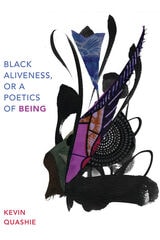
cover of Black Aliveness, or A Poetics of Being

Black Aliveness, or A Poetics of Being

Kevin Quashie

Duke University Press, 2021

In Black Aliveness, or A Poetics of Being, Kevin Quashie imagines a Black world in which one encounters Black being as it is rather than only as it exists in the shadow of anti-Black violence. As such, he makes a case for Black aliveness even in the face of the persistence of death in Black life and Black study. Centrally, Quashie theorizes aliveness through the aesthetics of poetry, reading poetic inhabitance in Black feminist literary texts by Lucille Clifton, Audre Lorde, June Jordan, Toni Morrison, and Evie Shockley, among others, showing how their philosophical and creative thinking constitutes worldmaking. This worldmaking conceptualizes Blackness as capacious, relational beyond the normative terms of recognition—Blackness as a condition of oneness. Reading for poetic aliveness, then, becomes a means of exploring Black being rather than nonbeing and animates the ethical question “how to be.” In this way, Quashie offers a Black feminist philosophy of being, which is nothing less than a philosophy of the becoming of the Black world.
[more]