Results by title
53 books match the query 'Bodies' and 26 start with b
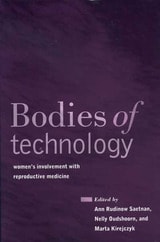
BODIES OF TECHNOLOGY
Women’s Involvement with Reproductive MedicineEdited by Ann R. Saetnan, Nelly Oudshoorn, and Marta Kirejczyk
The Ohio State University Press, 2000
Bodies of Technology is based on the premise that technology and society mutually shape one another, and on a concern for women’s health and autonomy. A basic question is one of cultural appropriation: Do technologies take on different shapes, different practices, and have different impacts as they spread from one place to another? By juxtaposing a number of culturally and historically contextualized studies of similar technologies, the editors demonstrate that although technologies globalize by spreading among cultures, they are also localized by the cultures they encounter.
The first part of the book investigates how potential users of hormone-based contraceptives are represented as these technologies are developed in laboratories and field tests. The next section explores the political and economic processes that regulate access to and practices of assisted fertilization. The final section focuses on individual users engaging with fetal diagnostic technologies in clinical practice. Taken as a whole, the book points out the need and the possibilities for women to become directly involved in the shaping of technologies that so strongly affect their health and their daily lives.

Bishops and Bodies
Reproductive Care in American Catholic HospitalsLori Freedman
Rutgers University Press, 2023
One out of every six patients in the United States is treated in a Catholic hospital that follows the policies of the U.S. Conference of Catholic Bishops. These policies prohibit abortion, sterilization, contraception, some treatments for miscarriage and gender confirmation, and other reproductive care, undermining hard-won patients’ rights to bodily autonomy and informed decision-making. Drawing on rich interviews with patients and providers, this book reveals both how the bishops’ directives operate and how people inside Catholic hospitals navigate the resulting restrictions on medical practice. In doing so, Bishops and Bodies fleshes out a vivid picture of how The Church’s stance on sex, reproduction, and “life” itself manifests in institutions that affect us all.
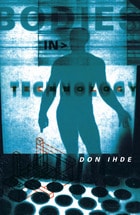
Bodies In Technology
Don Ihde
University of Minnesota Press, 2001
An original exploration of the ways cyberspace affects human experience.
New technologies suggest new ideas about embodiment: our "reach" extends to global sites through the Internet; we enter cyberspace through the engines of virtual reality. In this book, a leading philosopher of technology explores the meaning of bodies in technology-how the sense of our bodies and of our orientation in the world is affected by the various information technologies.
Bodies in Technology begins with an analysis of embodiment in cyberspace, then moves on to consider ways in which social theorists have interpreted or overlooked these conditions. An astute and sensible judge of these theories, Don Ihde is a uniquely provocative and helpful guide through contemporary thinking about technology and embodiment, drawing on sources and examples as various as video games, popular films, the workings of e-mail, and virtual reality techniques.Charting the historical, philosophical, and practical territory between virtual reality and real life, this work is an important contribution to the national conversation on the impact technology-and information technology in particular-has on our lives in a wired, global age.
Bodies and Ruins
Imagining the Bombing of Germany, 1945 to the PresentDavid F. Crew
University of Michigan Press, 2017
Bodies and Ruins examines a range of local publications that carried photographic images of German cities destroyed in the air war, images that soon entered the visual memory of World War II. Despite its obvious importance, historians have paid very little attention to the visual representation of the bombing war. This book follows the search for what were considered to be the “right” stories and the “right” pictures of the bombing war in local publications and picture books from 1945 to the present, and is intended for historians as well as general readers interested in World War II, the Allied bombing of German cities, the Holocaust, the history of memory and photographic/visual history.

Bodies as Evidence
Security, Knowledge, and PowerMark Maguire, Ursula Rao, and Nils Zurawski, editors
Duke University Press, 2018
Contributors. Carolina Alonso-Bejarano, Gregory Feldman, Francisco J. Ferrándiz, Daniel M. Goldstein, Ieva Jusionyte, Amade M’charek, Mark Maguire, Joseph P. Masco, Ursula Rao, Antonius C. G. M. Robben, Joseba Zulaika, Nils Zurawski
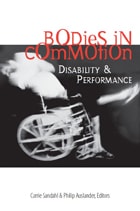
Bodies in Commotion
Disability and PerformanceEdited by Carrie Sandahl and Philip Auslander
University of Michigan Press, 2005
-Martin F. Norden, University of Massachusetts-Amherst
This groundbreaking collection imagines disabled bodies as "bodies in commotion"-bodies that dance across artistic and discursive boundaries, challenging our understanding of both disability and performance. In the book's essays, leading critics and artists explore topics that range from theater and dance to multi-media performance art, agit-prop, American Sign Language theater, and wheelchair sports. Bodies in Commotion is the first collection to consider the mutually interpretive qualities of these two emerging fields, producing a dynamic new resource for artists, activists, and scholars.
Bodies in Contact
Rethinking Colonial Encounters in World HistoryTony Ballantyne and Antoinette Burton, eds.
Duke University Press, 2005
Bodies in Contact brings together important scholarship on colonial gender studies gathered from journals around the world. Breaking with approaches to world history as the history of “the West and the rest,” the contributors offer a panoramic perspective. They examine aspects of imperial regimes including the Ottoman, Mughal, Soviet, British, Han, and Spanish, over a span of six hundred years—from the fifteenth century through the mid-twentieth. Discussing subjects as diverse as slavery and travel, ecclesiastical colonialism and military occupation, marriage and property, nationalism and football, immigration and temperance, Bodies in Contact puts women, gender, and sexuality at the center of the “master narratives” of imperialism and world history.
Contributors. Joseph S. Alter, Tony Ballantyne, Antoinette Burton, Elisa Camiscioli, Mary Ann Fay, Carter Vaughn Findley, Heidi Gengenbach, Shoshana Keller, Hyun Sook Kim, Mire Koikari, Siobhan Lambert-Hurley, Melani McAlister, Patrick McDevitt, Jennifer L. Morgan, Lucy Eldersveld Murphy, Rosalind O’Hanlon, Rebecca Overmyer-Velázquez, Fiona Paisley, Adele Perry, Sean Quinlan, Mrinalini Sinha, Emma Jinhua Teng, Julia C. Wells
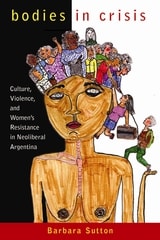
Bodies in Crisis
Culture, Violence, and Women's Resistance in Neoliberal ArgentinaSutton, Barbara
Rutgers University Press, 2010
Through the lens of women's body consciousness in a Global South country, and drawing on multifaceted stories and a politically embedded approach, Bodies in Crisis suggests that social policy, economic systems, cultural ideologies, and political resistance are ultimately fleshly matters.
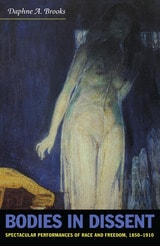
Bodies in Dissent
Spectacular Performances of Race and Freedom, 1850–1910Daphne A. Brooks
Duke University Press, 2006
Brooks pieces together reviews, letters, playbills, fiction, and biography in order to reconstruct not only the contexts of African American performance but also the reception of the stagings of “bodily insurgency” which she examines. Throughout the book, she juxtaposes unlikely texts and entertainers in order to illuminate the complicated transatlantic cultural landscape in which black performers intervened. She places Adah Isaacs Menken, a star of spectacular theatre, next to Sojourner Truth, showing how both used similar strategies of physical gesture to complicate one-dimensional notions of race and gender. She also considers Henry Box Brown’s public re-enactments of his escape from slavery, the Pan-Africanist discourse of Bert Williams’s and George Walker’s musical In Dahomey (1902–04), and the relationship between gender politics, performance, and New Negro activism in the fiction of the novelist and playwright Pauline Hopkins and the postbellum stage work of the cakewalk dancer and choreographer Aida Overton Walker. Highlighting the integral connections between performance and the construction of racial identities, Brooks provides a nuanced understanding of the vitality, complexity, and influence of black performance in the United States and throughout the black Atlantic.
Bodies in Flux
Scientific Methods for Negotiating Medical UncertaintyChrista Teston
University of Chicago Press, 2017
Bodies in Flux explores the inventive ways humans and nonhumans work together to manufacture medical evidence. Each chapter draws on rhetorical theory to investigate a specific scientific method for negotiating medical uncertainty in cancer care, including evidential visualization, assessment, synthesis, and computation. Case studies unveil how doctors rely on visuals when deliberating about a patient’s treatment options, how members of the FDA use inferential statistics to predict a drug’s effectiveness, how researchers synthesize hundreds of clinical trials into a single evidence-based recommendation, and how genetic testing companies compute and commoditize human health. Teston concludes by advocating for an ethic of care that pushes back against the fetishization of certainty—an ethic of care that honors human fragility and bodily flux.
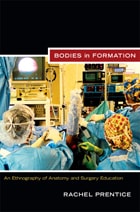
Bodies in Formation
An Ethnography of Anatomy and Surgery EducationRachel Prentice
Duke University Press, 2012
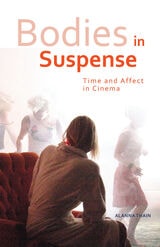
Bodies in Suspense
Time and Affect in CinemaAlanna Thain
University of Minnesota Press, 2017
Bodies in Suspense presents a powerful new way to think through postdigital cinema and the affective turn in critical theory. According to Alanna Thain, suspense films allow us to experience the relation between two bodies: that of the film and that of the viewer. Through the “time machine” of suspense, film form, gender, genre, and spectatorship are revealed in innovative and different ways. These films not only engage us directly in ethical concerns, but also provide a key for understanding corporeal power in the digital era.
Offering a new framework for understanding cinematic suspense, Bodies in Suspense argues that the “body in time” enables us to experience the temporal dimension of the body directly. This is the first book to link two contemporary frames of analysis: questions of cinematic temporality and contemporary affect theory. Thain conducts close readings of influential suspense films by Alfred Hitchcock, David Lynch, Christian Marclay, Rian Johnson, and Lou Ye, and sets forth a compelling new theory of cinema, reading for the productivity of the “crime of time” that stages the duplicity of cinematic bodies. Through these films that foreground doubled characters and looping, Thain explores Gilles Deleuze’s claim that “the direct time-image is the phantom which has always haunted cinema.”
A vital new addition to film theory, corporeality and affect theory, feminist theory, and the philosophy of time—and one of the first books to explore David Lynch’s Hollywood trilogy—Bodies in Suspense asks us to pay attention, above all, to the ways in which the condition of spectatorship creates a doubling sensation with important philosophical repercussions.
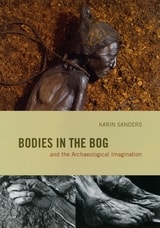
Bodies in the Bog and the Archaeological Imagination
Karin Sanders
University of Chicago Press, 2009
Bodies of Information
Intersectional Feminism and the Digital HumanitiesElizabeth Losh
University of Minnesota Press, 2018
A wide-ranging, interconnected anthology presents a diversity of feminist contributions to digital humanities
In recent years, the digital humanities has been shaken by important debates about inclusivity and scope—but what change will these conversations ultimately bring about? Can the digital humanities complicate the basic assumptions of tech culture, or will this body of scholarship and practices simply reinforce preexisting biases? Bodies of Information addresses this crucial question by assembling a varied group of leading voices, showcasing feminist contributions to a panoply of topics, including ubiquitous computing, game studies, new materialisms, and cultural phenomena like hashtag activism, hacktivism, and campaigns against online misogyny.
Taking intersectional feminism as the starting point for doing digital humanities, Bodies of Information is diverse in discipline, identity, location, and method. Helpfully organized around keywords of materiality, values, embodiment, affect, labor, and situatedness, this comprehensive volume is ideal for classrooms. And with its multiplicity of viewpoints and arguments, it’s also an important addition to the evolving conversations around one of the fastest growing fields in the academy.
Contributors: Babalola Titilola Aiyegbusi, U of Lethbridge; Moya Bailey, Northeastern U; Bridget Blodgett, U of Baltimore; Barbara Bordalejo, KU Leuven; Jason Boyd, Ryerson U; Christina Boyles, Trinity College; Susan Brown, U of Guelph; Lisa Brundage, CUNY; micha cárdenas, U of Washington Bothell; Marcia Chatelain, Georgetown U; Danielle Cole; Beth Coleman, U of Waterloo; T. L. Cowan, U of Toronto; Constance Crompton, U of Ottawa; Amy E. Earhart, Texas A&M; Nickoal Eichmann-Kalwara, U of Colorado Boulder; Julia Flanders, Northeastern U Library; Sandra Gabriele, Concordia U; Brian Getnick; Karen Gregory, U of Edinburgh; Alison Hedley, Ryerson U; Kathryn Holland, MacEwan U; James Howe, Rutgers U; Jeana Jorgensen, Indiana U; Alexandra Juhasz, Brooklyn College, CUNY; Dorothy Kim, Vassar College; Kimberly Knight, U of Texas, Dallas; Lorraine Janzen Kooistra, Ryerson U; Sharon M. Leon, Michigan State; Izetta Autumn Mobley, U of Maryland; Padmini Ray Murray, Srishti Institute of Art, Design, and Technology; Veronica Paredes, U of Illinois; Roopika Risam, Salem State; Bonnie Ruberg, U of California, Irvine; Laila Shereen Sakr (VJ Um Amel), U of California, Santa Barbara; Anastasia Salter, U of Central Florida; Michelle Schwartz, Ryerson U; Emily Sherwood, U of Rochester; Deb Verhoeven, U of Technology, Sydney; Scott B. Weingart, Carnegie Mellon U.
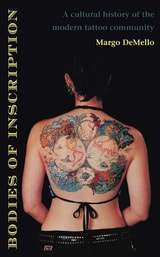
Bodies of Inscription
A Cultural History of the Modern Tattoo CommunityMargo DeMello
Duke University Press, 2004
Community publications, tattoo conventions, articles in popular magazines, and DeMello’s numerous interviews illustrate the interplay between class, culture, and history that orchestrated a shift from traditional Americana and biker tattoos to new forms using Celtic, tribal, and Japanese images. DeMello’s extensive interviews reveal the divergent yet overlapping communities formed by this class-based, American-style repackaging of the tattoo. After describing how the tattoo has moved from a mark of patriotism or rebellion to a symbol of exploration and status, the author returns to the predominantly middle-class movement that celebrates its skin art as spiritual, poetic, and self-empowering. Recognizing that the term “community” cannot capture the variations and class conflict that continue to thrive within the larger tattoo culture, DeMello finds in the discourse of tattooed people and their artists a new and particular sense of community and explores the unexpected relationship between this discourse and that of other social movements.
This ethnography of tattooing in America makes a substantive contribution to the history of tattooing in addition to relating how communities form around particular traditions and how the traditions themselves change with the introduction of new participants. Bodies of Inscription will have broad appeal and will be enjoyed by readers interested in cultural studies, American studies, sociology, popular culture, and body art.
Bodies of Knowledge
Embodied Rhetorics in Theory and PracticeA. Abby Knoblauch
Utah State University Press, 2021
The pieces in Bodies of Knowledge draw explicit attention to the impact of the body on text, the impact of the body in text, the impact of the body as text, and the impact of the body upon textual production. The contributors investigate embodied rhetorics through the lenses of race and ethnicity, gender and sexuality, disability and pain, technologies and ecologies, clothing and performance, and scent, silence, and touch. In doing so, they challenge the (false) notion that academic knowledge—that is, “real” knowledge—is disembodied and therefore presumed white, middle class, cis-het, able-bodied, and male. This collection lays bare how myriad bodies invent, construct, deliver, and experience the processes of knowledge building.
Experts in the field of writing studies provide the necessary theoretical frameworks to better understand productive (and unproductive) uses of embodied rhetorics within the academy and in the larger social realm. To help meet the theoretical and pedagogical needs of the discipline, Bodies of Knowledge addresses embodied rhetorics and embodied writing more broadly though a rich, varied, and intersectional approach. These authors address larger questions around embodiment while considering the various impacts of the body on theories and practices of rhetoric and composition.
Contributors: Scot Barnett, Margaret Booker, Katherine Bridgman, Sara DiCaglio, Kristie S. Fleckenstein, Vyshali Manivannan, Temptaous Mckoy, Julie Myatt, Julie Nelson, Ruth Osorio, Kate Pantelides, Caleb Pendygraft, Nadya Pittendrigh, Kellie Sharp-Hoskins, Anthony Stagliano, Megan Strom
Bodies of Knowledge
Sexuality, Reproduction, and Women's Health in the Second WaveWendy Kline
University of Chicago Press, 2010
Throughout the 1970s and ’80s, women argued that unless they gained access to information about their own bodies, there would be no equality. In Bodies of Knowledge, Wendy Kline considers the ways in which ordinary women worked to position the female body at the center of women’s liberation.
As Kline shows, the struggle to attain this knowledge unified women but also divided them—according to race, class, sexuality, or level of professionalization. Each of the five chapters of Bodies of Knowledge examines a distinct moment or setting of the women’s movement in order to give life to the ideas, expectations, and pitfalls encountered by the advocates of women’s health: the making of Our Bodies, Ourselves (1973); the conflicts surrounding the training and practice of women’s pelvic exams; the emergence of abortion as a feminist issue; the battles over contraceptive regulation at the 1983 Depo-Provera FDA hearings; and the rise of the profession of midwifery. Including an epilogue that considers the experiences of the daughters of 1970s feminists, Bodies of Knowledge is an important contribution to the study of the bodies—that marked the lives—of feminism’s second wave.
Bodies of Knowledge
The Medicalization of Reproduction in GreeceEugenia Georges
Vanderbilt University Press, 2008
Recipient of the 2006 Norman L. and Roselea J. Goldberg Prize for the best project in the area of medicine.
The author, a second-generation Greek American, returned to Greece with her young daughter to do fieldwork over the course of a decade. Focusing on Rhodes, an island that blends continuity with the past and rapid social change in often unexpected ways, she interviewed over a hundred women, doctors, and midwives about issues of reproduction.
The result is a detailed portrait of how a longstanding system of "local" gynecological and obstetrical knowledge under the control of women was rapidly displaced in the the period following World War II, and how the technologically-intensive biomedical model that took its place in turn assumed its own distinctive signature.
Bodies of Knowledge is a vivid ethnographic study of how a presumably globalizing and homogenizing process like medicalization can be reshaped as women and medical experts alike selectively accept or reject new practices and technologies. Georges found, for example, that women in Rhodes have enthusiastically embraced some new technologies, like fetal imaging during pregnancy, but rejected others, like medical contraception. They are also avid consumers of popular childbirth manuals.
This book is the recipient of the 2006 Norman L. and Roselea J. Goldberg Prize for the best project in the area of medicine.
Bodies of Modernism
Physical Disability in Transatlantic Modernist LiteratureMaren Tova Linett
University of Michigan Press, 2016
Bodies of Resistance
New Phenomenologies of Politics, Agency, and CultureLaura Doyle
Northwestern University Press, 2001
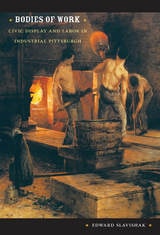
Bodies of Work
Civic Display and Labor in Industrial PittsburghEdward Slavishak
Duke University Press, 2008
Slavishak focuses on the workers whose bodies came to epitomize Pittsburgh, the men engaged in the arduous physical labor demanded by the city’s metals, glass, and coal industries. At the same time, he emphasizes how conceptions of Pittsburgh as quintessentially male limited representations of women in the industrial workplace. The threat of injury or violence loomed large for industrial workers at the turn of the twentieth century, and it recurs throughout Bodies of Work: in the marketing of artificial limbs, statistical assessments of the physical toll of industrial capitalism, clashes between labor and management, the introduction of workplace safety procedures, and the development of a statewide workmen’s compensation system.
Bodies of the Text
Dance as Theory, Literature as DanceEdited by Ellen W Goellner
Rutgers University Press, 1995
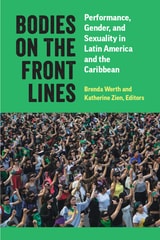
Bodies on the Front Lines
Performance, Gender, and Sexuality in Latin America and the CaribbeanBrenda Werth and Katherine Zien, Editors
University of Michigan Press, 2024
The volume’s contributors draw from rich legacies of theater, performance, and activism in the region, as well as decolonial and intersectional theorizing, to demonstrate the ways that performance practices enable activists to sustain their movements. The chapters engage diverse perspectives from Argentina, Brazil, Bolivia, Chile, Colombia, Cuba, the Dominican Republic, transnational Central America, Peru, Puerto Rico, and Mexico.
Rather than taking an approach that simplifies complexities among states, Bodies on the Front Lines takes seriously the geopolitical stakes of examining Latin America and the Caribbean as a heterogeneous site of nations and networks. In chapters covering this wide geographical area, leading scholars in the fields of theater and performance studies showcase the aesthetic, social, and political work of performance in generating and fortifying gender and sexual activism in the Americas.
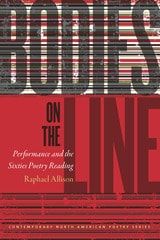
Bodies on the Line
Performance and the Sixties Poetry ReadingRaphael Allison
University of Iowa Press, 2014
By comparing these two dominant styles of reading, Allison argues that attention to sixties poetry readings reveals poets struggling between the kind of immediacy and presence that readings suggested and a private retreat from such performance-based publicity, one centered on the text itself. Recordings of Robert Frost, Charles Olson, Gwendolyn Brooks, Larry Eigner, and William Carlos Williams—all of whom emphasized voice, breath, and spoken language and who were inveterate professional readers in the sixties—expose this struggle in often surprising ways. In deconstructing assertions about the role and importance of the poetry reading during this period, Allison reveals just how dramatic, political, and contentious poetry readings could be. By discussing how to "hear" as well as "read" poetry, Bodies on the Line offers startling new vantage points from which to understand American poetry since the 1960s as both performance and text.
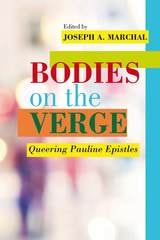
Bodies on the Verge
Queering Pauline EpistlesJoseph A. Marchal
SBL Press, 2019
A collection that resets the terms of interpreting the Pauline letters
Interpretation of Paul's letters often proves troubling, since people frequently cite them when debating controversial matters of gender and sexuality. Rather than focusing on the more common defensive responses to those expected prooftexts that supposedly address homosexuality, the essays in this collection reflect the range, rigor, vitality, and creativity of other interpretive options influenced by queer studies. Thus key concepts and practices for understanding these letters in terms of history, theology, empire, gender, race, and ethnicity, among others, are rethought through queer interventions within both ancient settings and more recent history and literature.
Features:
- New options for how to interpret and use Paul's letters, particularly in light of their use in debates about sexuality and gender
- Developing approaches in queer studies that help with understanding and using Pauline letters and interpretations differently
- Key reflections on the two "clobber passages" (Rom 1:26-27 and 1 Cor 6:9) that demonstrate the relevance of a far wider range of texts throughout the Pauline corpus
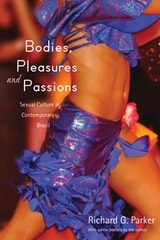
Bodies, Pleasures, and Passions
Sexual Culture in Contemporary Brazil, Second EditionRichard G. Parker
Vanderbilt University Press, 2009
Originally published in the early 1990s, Bodies, Pleasures, and Passions quickly became a classic ethnographic study of the social, cultural and historical construction of sexuality and sexual diversity. Drawing on extensive field research and interviews, together with the analysis of historical and literary texts, anthropologist Richard Parker mapped out the multiple cultural systems that structure gender, sexuality, and erotic practices in Brazil, and helped to open up a new wave of social science research on sexuality.
Using ethnographic methods focusing on sexual meanings as an alternative to traditional surveys of sexual behavior, Parker argues that sexual life can only be fully understood through an analysis of the cultural logics that shape experience. Drawing on the tradition of interpretive anthropology, he focuses on the diverse sexual scripts that have been articulated in Brazilian culture and examines the often contradictory ways in which these scripts shape the sexual experience of different individuals. He highlights the sexual socialization of children and young people, and the changing sexual realities of adults living in a rapidly changing world. He underlines the ways in which complex cultural forms such as carnaval can be understood as stories that Brazilians tell themselves about themselves and about the meaning of sexuality in contemporary Brazilian life.