475 books match the query 'Catholic' and 17 start with b
cover of Baptism of Desire and Christian Salvation

Baptism of Desire and Christian Salvation

Anthony R. Lusvardi

Catholic University of America Press, 2024
Belief in the necessity of baptism for salvation is rooted in the New Testament and was forcefully affirmed by the Church Fathers, yet today this belief is treated with unease if not ignored altogether. Over the course of centuries, Catholic theology has wrestled with a doctrine—baptism of desire—that both preserves this fundamental principle and allows for salvation in hard cases, such as catechumens dying unexpectedly. Baptism of Desire and Christian Salvation traces this doctrine’s varied history, from its genesis in a fourth century funeral oration given by Ambrose of Milan to its uneasy position in the Anonymous Christianity of Karl Rahner. More than a history, however, this book raises questions about the nature of religious ritual and the sacraments, the mission of the Church, and the essence of salvation. Arguing that theologians of the past two centuries have tended to downplay the role of the sacraments when discussing salvation, Lusvardi suggests that baptism should remain our theological starting point. Engaging with the theological tradition and at times challenging the conventional wisdom, Baptism of Desire and Christian Salvation shows how such a sacramental approach can offer credible—and sometimes surprising—responses to questions related to the salvation of non-Christians, the fate of unbaptized infants, and the relevance of the Church’s mission today.
[more]
cover of Be Opened! The Catholic Church and Deaf Culture

Be Opened! The Catholic Church and Deaf Culture

Lana Portolano

Catholic University of America Press, 2021
Be Opened! The Catholic Church and Deaf Culture offers readers a people’s history of deafness and sign language in the Catholic Church. Paying ample attention to the vocation stories of deaf priests and pastoral workers, Portolano traces the transformation of the Deaf Catholic community from passive recipients of mercy to an active language minority making contributions in today’s globally diverse church. Background chapters familiarize readers with early misunderstandings about deaf people in the church and in broader society, along with social and religious issues facing deaf people throughout history. A series of connected narratives demonstrate the strong Catholic foundations of deaf education in sign language, including sixteenth-century monastic schools for deaf children and nineteenth-century French education in sign language as a missionary endeavor. The author explains how nineteenth-century schools for deaf children, especially those founded by orders of religious sisters, established small communities of Deaf Catholics around the globe. A series of portraits illustrates the work of pioneering missionaries in several different countries—“apostles to the Deaf”—who helped to establish and develop deaf culture in these communities through adult religious education and the sacraments in sign language. In several chapters focused on the twentieth century, the author describes key events that sparked a modern transformation in Deaf Catholic culture. As linguists began to recognize sign languages as true human languages, deaf people borrowed the practices of Civil Rights activists to gain equality both as citizens and as members of the church. At the same time, deaf people drew inspiration and cultural validation from key documents of Vatican II, and leadership of the Deaf Catholic community began to come from the deaf community rather than to it through missionaries. Many challenges remain, but this book clearly presents Deaf Catholic culture as an important and highly visible embodiment of Catholic heritage.
[more]
cover of Bearing False Witness: Debunking Centuries of Anti-Catholic History

Bearing False Witness

Debunking Centuries of Anti-Catholic History

Rodney Stark

Templeton Press, 2016

As we all know and as many of our well-established textbooks have argued for decades, the Inquisition was one of the most frightening and bloody chapters in Western history; Pope Pius XII was anti-Semitic and rightfully called “Hitler’s Pope,” the Dark Ages were stunting the progress of knowledge to be redeemed only by the secular spirit of the Enlightenment. The religious Crusades were an early example of the rapacious Western thirst for riches and power. But what if these long held beliefs were all wrong?

In this stunning, powerful, and ultimately persuasive book, Rodney Stark, one of the most highly regarded sociologists of religion and bestselling author of The Rise of Christianity (HarperSanFrancisco 1997), argues that some of our most firmly held ideas about history, ideas that paint the Catholic Church in the least favorable light are, in fact, fiction. Why have we held these wrongheaded ideas so firmly and for so long? And if our beliefs are wrong, what is the truth?

In each chapter, Stark takes on a well-established anti-Catholic myth, gives a fascinating history of how each myth became conventional wisdom and presents a startling picture of the real truth. For example, instead of the Spanish Inquisition being an anomaly of torture and murder of innocent people persecuted for “imaginary” crimes such as witchcraft and blasphemy, Stark argues that not only did the Spanish Inquisition spill very little blood, but it was a major force in support of moderation and justice.

Stark dispels the myth of Pope Pius XII being apathetic or even helpful to the Nazi movement, such as to merit the title “Hitler’s Pope,” and instead shows that the campaign to link Pope Pius XII to Hitler was initiated by the Soviet Union, presumably in hopes of neutralizing the Vatican in post-World War II affairs. Many praised Pope Pius XIIs vigorous and devoted efforts to saving Jewish lives during the war.

Instead of understanding the Dark Ages as a millennium of ignorance and backwardness inspired by the Catholic Church’s power, Stark argues that the whole notion of the “Dark Ages” was an act of pride perpetuated by anti-religious intellectuals who were determined to claim that theirs was the era of “Enlightenment.”

In the end, readers of Bearing False Witness will have a more accurate history of the Catholic Church and will also understand why it became unfairly maligned for so long. Bearing False Witness is a compelling and sobering account of how egotism and ideology often work together to give us a false truth.
[more]
cover of Becoming What We Are: Classical and Christian Readings of Modernity

Becoming What We Are

Classical and Christian Readings of Modernity

Jude P. Dougherty

Catholic University of America Press, 2023
Becoming What We Are is a collection of essays and reviews written in the last decade by the late Jude Dougherty, which covey a perspective on contemporary events and literature, written from a classical and Christian perspective. These essays convey a worldview much in need of restating when, according to Dougherty, Western society seems to have lost its bearings, in its legislative assemblies and in its judicial systems as well. Dougherty writes as a philosopher, specifically as one who has devoted most of his life to the study of metaphysics. In these pages Dougherty examines the Jacobians, the empirical world of Hume, Locke and Hobbes, and Kant, the metaphysics of Plato, Aristotle, the Stoics and Aquinas that opens one to God and provides on with a moral compass, and critiques the work of Karl Marx, Sigmund Freud and John Dewey. Becoming What We Are spends some time inquiring into the character of a few great men viz. George Washington, Charles De Gaulle and Moses Maimonides. Dougherty draws upon and shows respect for numerous contemporary authors who are engaged in research and analysis similar to his. The intent is, with the aid of others to restate some ancient but neglected truths. But more than that to show that true science is possible, that nature and human nature yield to human enquiry, that science is not to be confused with description and prediction.
[more]
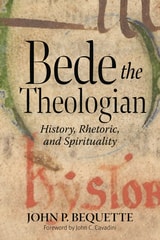
cover of Bede the Theologian: History, Rhetoric, and Spirituality

Bede the Theologian

History, Rhetoric, and Spirituality

John P. Bequette

Catholic University of America Press, 2022
Revered by contemporaries and posterity for both his sanctity and his scholarship, Bede (672-735) is a pivotal figure in the history of the Church. Known primarily as an historian for his Ecclesiastical History of the English People, Bede was also an accomplished pedagogue, hagiographer, and biblical scholar. Bede the Theologian: History, Rhetoric, and Spirituality takes a fresh look at this classic Christian thinker, exploring the gamut of Bede’s literary corpus. The book investigates key themes, including Bede’s understanding of the theological significance of time, his conception of the relationship between the temporal and eternal orders within history, his theological use of rhetoric, his foray into narrative theology, and his spirituality. The purpose of this volume is to introduce the reader to principal theological themes in Bede’s thought. Bequette’s thesis is that Bede was a theologian writing in continuity with the Christian tradition and yet making creative, original contributions to that tradition for the sake of his contemporaries, both in the monastery and in the culture at large. The method involves a close reading and analysis of key texts within Bede’s corpus of writings. These texts include the Ecclesiastical History of the English People, the Life of St Cuthbert, and several of Bede’s biblical commentaries (On the Tabernacle, On the Temple) his homilies, and didactic treatises (On the Reckoning of Time, Concerning Figures and Tropes in Sacred Scripture). Bede the Theologian: History, Rhetoric, and Spirituality constitutes a scholarly study of Bede’s thought as an integral whole, identifying key themes and ideas that pervade his writings. Thus, it can serve as an introduction to Bede’s thought for non-specialists in the areas of theology, religious studies, and other areas of the humanities.
[more]
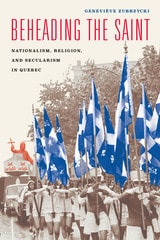
cover of Beheading the Saint: Nationalism, Religion, and Secularism in Quebec

Beheading the Saint

Nationalism, Religion, and Secularism in Quebec

Geneviève Zubrzycki

University of Chicago Press, 2016

Through much of its existence, Québec’s neighbors called it the “priest-ridden province.” Today, however, Québec society is staunchly secular, with a modern welfare state built on lay provision of social services—a transformation rooted in the “Quiet Revolution” of the 1960s.
            In Beheading the Saint, Geneviève Zubrzycki studies that transformation through a close investigation of the annual Feast of St. John the Baptist of June 24. The celebrations of that national holiday, she shows, provided a venue for a public contesting of the dominant ethno-Catholic conception of French Canadian identity and, via the violent rejection of Catholic symbols, the articulation of a new, secular Québécois identity. From there, Zubrzycki extends her analysis to the present, looking at the role of Québécois identity in recent debates over immigration, the place of religious symbols in the public sphere, and the politics of cultural heritage—issues that also offer insight on similar debates elsewhere in the world.
[more]
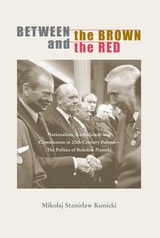
cover of Between the Brown and the Red: Nationalism, Catholicism, and Communism in Twentieth-Century Poland—The Politics of Boleslaw Piasecki

Between the Brown and the Red

Nationalism, Catholicism, and Communism in Twentieth-Century Poland—The Politics of Boleslaw Piasecki

Mikolaj Stanislaw Kunicki

Ohio University Press, 2012

Between the Brown and the Red captures the multifaceted nature of church-state relations in communist Poland, relations that oscillated between mutual confrontation, accommodation, and dialogue. Ironically, under communism the bond between religion and nation in Poland grew stronger. This happened in spite of the fact that the government deployed nationalist themes in order to portray itself as more Polish than communist. Between the Brown and the Red also introduces one of the most fascinating figures in the history of twentieth-century Poland and the communist world.

In this study of the complex relationships between nationalism, communism, authoritarianism, and religion in twentieth-century Poland, Mikołaj Kunicki shows the ways in which the country’s communist rulers tried to adapt communism to local traditions, particularly ethnocentric nationalism and Catholicism. Focusing on the political career of Bolesław Piasecki, a Polish nationalist politician who began his surprising but illuminating journey as a fascist before the Second World War and ended it as a procommunist activist, Kunicki demonstrates that Polish communists reinforced an ethnocentric self-definition of Polishness and—as Piasecki’s case demonstrates—thereby prolonged the existence of Poland’s nationalist Right.
[more]
cover of Beyond Betrayal: The Priest Sex Abuse Crisis, the Voice of the Faithful, and the Process of Collective Identity

Beyond Betrayal

The Priest Sex Abuse Crisis, the Voice of the Faithful, and the Process of Collective Identity

Patricia Ewick and Marc W. Steinberg

University of Chicago Press, 2019

In 2002, the national spotlight fell on Boston’s archdiocese, where decades of rampant sexual misconduct from priests—and the church’s systematic cover-ups—were exposed by reporters from the Boston Globe. The sordid and tragic stories of abuse and secrecy led many to leave the church outright and others to rekindle their faith and deny any suggestions of institutional wrongdoing. But a number of Catholics vowed to find a middle ground between these two extremes: keeping their faith while simultaneously working to change the church for the better.

Beyond Betrayal charts a nationwide identity shift through the story of one chapter of Voice of the Faithful (VOTF), an organization founded in the scandal’s aftermath. VOTF had three goals: helping survivors of abuse; supporting priests who were either innocent or took risky public stands against the wrongdoers; and pursuing a broad set of structural changes in the church. Patricia Ewick and Marc W. Steinberg follow two years in the life of one of the longest-lived and most active chapters of VOTF, whose thwarted early efforts at ecclesiastical reform led them to realize that before they could change the Catholic Church, they had to change themselves. The shaping of their collective identity is at the heart of Beyond Betrayal, an ethnographic portrait of how one group reimagined their place within an institutional order and forged new ideas of faith in the wake of widespread distrust.
[more]
cover of Beyond the Crises: The Pontificate of Benedict XVI

Beyond the Crises

The Pontificate of Benedict XVI

Regoli

St. Augustine's Press, 2023

"I have felt like Saint Peter with the Apostles in the boat on the Sea of Galilee: the Lord has given us so many days of sun and of light winds, days when the catch was abundant; there were also moments when the waters were rough and the winds against us, as throughout the Church’s history, and the Lord seemed to be sleeping. But I have always known that the Lord is in that boat, and I have always known that the barque of the Church is not mine but his. Nor does the Lord let it sink; it is he who guides it, surely also through those whom he has chosen, because he so wished. This has been, and is, a certainty which nothing can shake."
––Benedict XVI, General Audience, 27 February 2013

Roberto Regoli offers a keen and comprehensive preview of Pope Benedict XVI's pontificate, which will be better understood only after time has passed and more becomes available. As an historian, Regoli provides ample context to frame the theology and pastoral priorities of a pope, professor, priest, and figure of history who has been shaped by his times, and who will undoubtedly be remembered as deeply orienting the Church toward the future. The perspective and questions offered by Regoli will likewise be a key component to the scholarship surrounding Pope Benedict's pontificate for decades to come, and he significantly broadens what has already been compiled by Anglophone writers.
[more]
cover of Biblical and Theological Foundation of the Family

Biblical and Theological Foundation of the Family

Joseph C. Atkinson

Catholic University of America Press, 2014
This ground-breaking work establishes a solid biblical and theological foundation on which a theology of the family can be constructed. It thus fills a critical lack in the current literature on the family. The wide range of sources, including Jewish, Catholic, Orthodox, and Protestant, give this work a genuine ecumenical dimension. Biblical and Theological Foundations of the Family will become indispensable for anyone wanting to engage in serious study of the structure and meaning of the family and its place in the salvific will of God.
[more]
cover of Bioethics: A Catholic Primer

Bioethics

A Catholic Primer

Thomas Cavanaugh

Catholic University of America Press, 2026
Bioethics: A Catholic Primer is a succinct, precise, and accurate treatment of the Catholic moral tradition in medicine. Professors teaching an undergraduate bioethics course will use it as a primary text or as an ancillary text in a general ethics course that has a medical ethics section. Professors in both situations will find it an attractive alternative or addition to current offerings. This applies especially to those teaching at a Catholic-affiliated college or university. Professors teaching in pre-health­care professional, pre-medical, and in nursing programs (both undergraduate and graduate) will adopt this text both as a primary text and as an ancillary text, depending on their needs. Because of its slender, compact, yet rewarding content, professors will find it appealing to assign. Moreover, students will not find its size daunting. Its accuracy, precision, and small size will make it appealing to a more general audience. Moreover, by its brevity, it will gain an audience interested in Catholic med­ical ethics, yet often overwhelmed by the very size of the volumes available. People interested in an overarching, accurate, yet brief treatment of the Catholic moral tradition in medicine will read this slim volume (for exam­ple, members on ethics committees at Catholic hospitals). Others (faculty, students, patients, pastors, physicians, and nurses) will read it themselves and confidently share it with their friends and loved ones, knowing that they will find in it a rewarding, slender, accessible treatment of a rich moral tradition.
[more]
cover of Bishops and Bodies: Reproductive Care in American Catholic Hospitals

Bishops and Bodies

Reproductive Care in American Catholic Hospitals

Lori Freedman

Rutgers University Press, 2023

Winner of the 2024 Donald W. Light Award for Applied Medical Sociology, American Sociological Association's Section on Medical Sociology

One out of every six patients in the United States is treated in a Catholic hospital that follows the policies of the U.S. Conference of Catholic Bishops. These policies prohibit abortion, sterilization, contraception, some treatments for miscarriage and gender confirmation, and other reproductive care, undermining hard-won patients’ rights to bodily autonomy and informed decision-making. Drawing on rich interviews with patients and providers, this book reveals both how the bishops’ directives operate and how people inside Catholic hospitals navigate the resulting restrictions on medical practice. In doing so, Bishops and Bodies fleshes out a vivid picture of how The Church’s stance on sex, reproduction, and “life” itself manifests in institutions that affect us all.
[more]
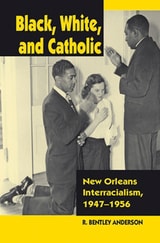
cover of Black, White, and Catholic: New Orleans Interracialism, 1947-1956

Black, White, and Catholic

New Orleans Interracialism, 1947-1956

R. Bentley Anderson

Vanderbilt University Press, 2005

Most histories of the Civil Rights Movement start with all the players in place--among them organized groups of African Americans, White Citizens' Councils, nervous politicians, and religious leaders struggling to find the right course. Anderson, however, takes up the historical moment right before that, when small groups of black and white Catholics in the city of New Orleans began efforts to desegregate the archdiocese, and the Society of Jesus (Jesuits) began, in fits and starts, to integrate quietly the New Orleans Province.

Anderson leads readers through the tumultuous years just after World War II when the Roman Catholic Church in the American South struggled to reconcile its commitment to social justice with the legal and social heritage of Jim Crow society. Though these early efforts at reform, by and large, failed, they did serve to galvanize Catholic supporters and opponents of the Civil Rights Movement and provided a model for more successful efforts at desegregation in the '60s.

As a Jesuit himself, Anderson has access to archives that remain off-limits to other scholars. His deep knowledge of the history of the Catholic Church also allows him to draw connections between this historical period and the present. In the resistance to desegregation, Anderson finds expression of a distinctly American form of Catholicism, in which lay people expect Church authorities to ratify their ideas and beliefs in an almost democratic fashion. The conflict he describes is as much between popular and hierarchical models of the Church as between segregation and integration.


This book has been made possible through a grant from the Louisiana Endowment for the Humanities, a state affiliate of the National Endowment for the Humanities.
[more]
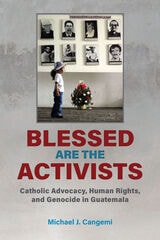
cover of Blessed Are the Activists: Catholic Advocacy, Human Rights, and Genocide in Guatemala

Blessed Are the Activists

Catholic Advocacy, Human Rights, and Genocide in Guatemala

Michael J. Cangemi

University of Alabama Press, 2024

Documents the history of Catholic activism to mitigate human rights abuses in Guatemala and the failed US policies in the country and region during the 1970s and 1980s
 
Blessed Are the Activists examines US Catholic activists’ influence on US-Guatemalan relations during the Guatemalan civil war’s most violent years in the 1970s and 1980s. Cangemi argues that Catholic activists’ definition of human rights, advocacy methods, and structure caused them to act as a transnational human rights NGO that engaged Guatemalan and US government officials on human rights issues, reported on Guatemala’s human rights violations, and criticized US foreign policy decisions as a contributing factor in Guatemala’s inequality, poverty, and violence. His work foregrounds how Catholic activists emphasized dignity for Guatemala’s poorest citizens and the connections they made between justice, solidarity, and peace and brought Guatemala’s violence, poverty, and inequality to greater global attention, often at great personal risk.

Cangemi pays considerable attention to multiple facets of the strained US-Guatemala diplomatic relationship, including how and why Guatemala’s military dictatorship exposed the internal flaws within the Carter administration’s decision to link military aid to human rights and how internal foreign policy debates in the Carter and Reagan administrations helped to intensify Guatemala’s bloody civil war. He also includes interviews conducted with Guatemalan genocide survivors and refugees to provide firsthand accounts of the consequences of those policymaking decisions. Finally, he offers readers an in-depth examination of the US Catholic press’s sharp rebukes of US policies on Guatemala and all of Central America when the broader Roman Catholic Church began to move farther toward the ideological right under John Paul II.

Blessed Are the Activists offers rich, original research and a gripping narrative. With Guatemala and other countries in Latin America still experiencing human rights abuses, this book will continue to provide context. It will appeal to a broad swath of readers, from scholars to the general public and students.
 
[more]
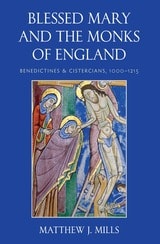
cover of Blessed Mary and the Monks of England, 1000-1215

Blessed Mary and the Monks of England, 1000-1215

Matthew J. Mills

Catholic University of America Press, 2024
In the study of historical Mariology, the monastic communities of England before and after the Norman conquest receive too little attention. Classic surveys, such as Hilda Graef’s, Mary: A History of Doctrine and Devotion (2 vols, orig. 1963, 1965), highlight key figures and developments; and a fine book by Mary Clayton, The Cult of the Virgin Mary in Anglo-Saxon England (1990), takes scholarship as far as the early-eleventh century. The present volume, building upon such works, delves more deeply into the prayerful, intellectual and artistic contemplation of Mary during the age of monasticism, roughly the two hundred years prior to the advent of the mendicant orders in the thirteenth century. In the history of England, this was a time of high drama: conquest, power struggle, martyrdom; for English monasticism, it was marked by suppression, reform and renewal, patronage, and new currents of prayer and thought. Against this backdrop, Matthew Mills uncovers many vibrant contributions to Marian doctrine and devotion by theologians and communities living according to the sixth-century Rule of St Benedict: the Benedictines and their successors, the Cistercians, who arrived in England in 1128. In a thematic unfolding of Mary’s life and identity, from conception to assumption and intercession, a picture emerges of a Mariology shaped by the constant of monastic liturgy, anchored in deep biblical and patristic wisdom, cherished and transmitted by the Englishman, St Bede (d. 735), and animated by profound love. Towering figures, St Anselm (d. 1109) and St Ælred (d. 1167), are placed within a wider landscape, alongside lesser-known but still significant individuals, including the Cistercian abbot, John of Forde (d. 1214), royal confessor and pioneer of Marian exegesis of the Song of Songs. England’s monastic Mariology was colored by Greek as well as Latin influences and touched by key experiences of the contemporary church at large: apocalyptic disappointment, eleventh-century reform (sometimes called, ‘Gregorian’), sacramentalism, intense yearning for salvation. This book also sheds light upon the significance of Mary for medieval monks’ understanding of their own profession; their mother and their lady, she was, in addition, their icon and exemplar of life in St Benedict’s ‘school for the Lord’s service’ (Rule, Prol. 45).
[more]
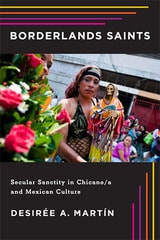
cover of Borderlands Saints: Secular Sanctity in Chicano/a and Mexican Culture

Borderlands Saints

Secular Sanctity in Chicano/a and Mexican Culture

Martín, Desirée A

Rutgers University Press, 2013

Winner of the 2014 Latina/o Studies Section - LASA Outstanding Book Award

In Borderlands Saints, Desirée A. Martín examines the rise and fall of popular saints and saint-like figures in the borderlands of the United States and Mexico. Focusing specifically on Teresa Urrea (La Santa de Cabora), Pancho Villa, César Chávez, Subcomandante Marcos, and Santa Muerte, she traces the intersections of these figures, their devotees, artistic representations, and dominant institutions with an eye for the ways in which such unofficial saints mirror traditional spiritual practices and serve specific cultural needs.

Popular spirituality of this kind engages the use and exchange of relics, faith healing, pilgrimages, and spirit possession, exemplifying the contradictions between high and popular culture, human and divine, and secular and sacred. Martín focuses upon a wide range of Mexican and Chicano/a cultural works drawn from the nineteenth century to the present, covering such diverse genres as the novel, the communiqué, drama, the essay or crónica, film, and contemporary digital media. She argues that spiritual practice is often represented as narrative, while narrative—whether literary, historical, visual, or oral—may modify or even function as devotional practice.

[more]
cover of Born Again: The Christian Right Globalized

Born Again

The Christian Right Globalized

Jennifer S. Butler

Pluto Press, 2006

The Christian Right wields massive political power in the United States and beyond. This is the first book to reveal the growing influence of the Christian Right within the United Nations.

This book reveals how Christian conservative groups are able to shape policy in every corner of the world. Drawing on interviews with religious leaders, it reveals how today's most powerful Christian Right organisations are building interfaith coalitions, connecting Catholic, Mormon and Muslim allies to advance a conservative agenda.

The US under Bush Jr. has given them a significant voice in shaping US policy on issues including women's rights, reproductive health, human cloning, children's rights and AIDS.

In short, the Christian Right is globalising -- a phenomenon that promises to challenge progressive social policy on a world-wide scale - as well as transform the Christian Right itself.
[more]