86 books match the query 'Chile' and 4 start with b

cover of Battling for Hearts and Minds: Memory Struggles in Pinochet's Chile, 1973–1988

Battling for Hearts and Minds

Memory Struggles in Pinochet's Chile, 1973–1988

Steve J. Stern

Duke University Press, 2006

Battling for Hearts and Minds is the story of the dramatic struggle to define collective memory in Chile during the violent, repressive dictatorship of General Augusto Pinochet, from the 1973 military coup in which he seized power through his defeat in a 1988 plebiscite. Steve J. Stern provides a riveting narration of Chile’s political history during this period. At the same time, he analyzes Chileans’ conflicting interpretations of events as they unfolded. Drawing on testimonios, archives, Truth Commission documents, radio addresses, memoirs, and written and oral histories, Stern identifies four distinct perspectives on life and events under the dictatorship. He describes how some Chileans viewed the regime as salvation from ruin by Leftists (the narrative favored by Pinochet’s junta), some as a wound repeatedly reopened by the state, others as an experience of persecution and awakening, and still others as a closed book, a past to be buried and forgotten.

In the 1970s, Chilean dissidents were lonely “voices in the wilderness” insisting that state terror and its victims be recognized and remembered. By the 1980s, the dissent had spread, catalyzing a mass movement of individuals who revived public dialogue by taking to the streets, creating alternative media, and demanding democracy and human rights. Despite long odds and discouraging defeats, people of conscience—victims of the dictatorship, priests, youth, women, workers, and others—overcame fear and succeeded in creating truthful public memories of state atrocities. Recounting both their efforts and those of the regime’s supporters to win the battle for Chileans’ hearts and minds, Stern shows how profoundly the struggle to create memories, to tell history, matters.

Battling for Hearts and Minds is the second volume in the trilogy The Memory Box of Pinochet’s Chile. The third book will examine Chileans’ efforts to achieve democracy while reckoning with Pinochet’s legacy.
[more]
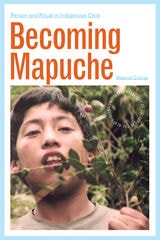
cover of Becoming Mapuche: Person and Ritual in Indigenous Chile

Becoming Mapuche

Person and Ritual in Indigenous Chile

Magnus Course

University of Illinois Press, 2011
Magnus Course blends convincing historical analysis with sophisticated contemporary theory in this superb ethnography of the Mapuche people of southern Chile. Based on many years of ethnographic fieldwork, Becoming Mapuche takes readers to the indigenous reserves where many Mapuche have been forced to live since the beginning of the twentieth century. In addition to accounts of the intimacies of everyday kinship and friendship, Course also offers the first complete ethnographic analyses of the major social events of contemporary rural Mapuche life--eluwün funerals, the ritual sport of palin, and the great ngillatun fertility ritual. The volume includes a glossary of terms in Mapudungun.
[more]
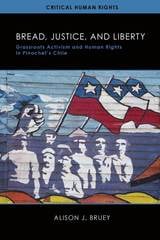
cover of Bread, Justice, and Liberty: Grassroots Activism and Human Rights in Pinochet's Chile

Bread, Justice, and Liberty

Grassroots Activism and Human Rights in Pinochet's Chile

Alison J. Bruey

University of Wisconsin Press, 2020

In Santiago's urban shantytowns, a searing history of poverty and Chilean state violence have prompted grassroots resistance movements among the poor and working class from the 1940s to the present. Underscoring this complex continuity, Alison J. Bruey offers a compelling history of the struggle for social justice and democracy during the Pinochet dictatorship and its aftermath.

As Bruey shows, crucial to the popular movement built in the 1970s were the activism of both men and women and the coalition forged by liberation-theology Catholics and Marxist-Left militants. These alliances made possible the mass protests of the 1980s that paved the way for Chile's return to democracy, but the changes fell short of many activists' hopes. Their grassroots demands for human rights encompassed not just an end to state terror but an embrace of economic opportunity and participatory democracy for all.

Deeply grounded by both extensive oral history interviews and archival research, Bread, Justice, and Liberty offers innovative contributions to scholarship on Chilean history, social movements, popular protest and democratization, neoliberal economics, and the Cold War in Latin America.

[more]
cover of Buying into the Regime: Grapes and Consumption in Cold War Chile and the United States

Buying into the Regime

Grapes and Consumption in Cold War Chile and the United States

Heidi Tinsman

Duke University Press, 2014

Buying into the Regime is a transnational history of how Chilean grapes created new forms of consumption and labor politics in both the United States and Chile. After seizing power in 1973, Augusto Pinochet embraced neoliberalism, transforming Chile’s economy. The country became the world's leading grape exporter. Heidi Tinsman traces the rise of Chile's fruit industry, examining how income from grape production enabled fruit workers, many of whom were women, to buy the commodities—appliances, clothing, cosmetics—flowing into Chile, and how this new consumerism influenced gender relations, as well as pro-democracy movements. Back in the United States, Chilean and U.S. businessmen aggressively marketed grapes as a wholesome snack. At the same time, the United Farm Workers and Chilean solidarity activists led parallel boycotts highlighting the use of pesticides and exploitation of labor in grape production. By the early-twenty-first century, Americans may have been better informed, but they were eating more grapes than ever.
[more]