496 books match the query 'Christian Theology' and 16 start with b
cover of Baptism of Desire and Christian Salvation

Baptism of Desire and Christian Salvation

Anthony R. Lusvardi

Catholic University of America Press, 2024
Belief in the necessity of baptism for salvation is rooted in the New Testament and was forcefully affirmed by the Church Fathers, yet today this belief is treated with unease if not ignored altogether. Over the course of centuries, Catholic theology has wrestled with a doctrine—baptism of desire—that both preserves this fundamental principle and allows for salvation in hard cases, such as catechumens dying unexpectedly. Baptism of Desire and Christian Salvation traces this doctrine’s varied history, from its genesis in a fourth century funeral oration given by Ambrose of Milan to its uneasy position in the Anonymous Christianity of Karl Rahner. More than a history, however, this book raises questions about the nature of religious ritual and the sacraments, the mission of the Church, and the essence of salvation. Arguing that theologians of the past two centuries have tended to downplay the role of the sacraments when discussing salvation, Lusvardi suggests that baptism should remain our theological starting point. Engaging with the theological tradition and at times challenging the conventional wisdom, Baptism of Desire and Christian Salvation shows how such a sacramental approach can offer credible—and sometimes surprising—responses to questions related to the salvation of non-Christians, the fate of unbaptized infants, and the relevance of the Church’s mission today.
[more]
cover of Become Like the Angels

Become Like the Angels

Benjamin P. Blosser

Catholic University of America Press, 2012
Become Like the Angels explores Origen's legacy and, in particular, his teachings about the origin, nature, and destiny of the human person. By way of a historical critical approach, Benjamin P. Blosser discusses the influence of Middle Platonic philosophy on the human soul and then compares it with Origen's teaching.
[more]
cover of Becoming God: The Doctrine of Theosis in Nicholas of Cusa

Becoming God

The Doctrine of Theosis in Nicholas of Cusa

Nancy J. Hudson

Catholic University of America Press, 2007
The doctrine of theosis means a salvation that is the deification of the saved. The saved actually become God. This unusual doctrine lies at the heart of Nicholas of Cusa's (1401-1464) mystical metaphysics. It is here examined for the first time as a theme in its own right, along with its implications for Cusanus's doctrine of God, his theological anthropology, and his epistemology.
[more]
cover of Bede the Theologian: History, Rhetoric, and Spirituality

Bede the Theologian

History, Rhetoric, and Spirituality

John P. Bequette

Catholic University of America Press, 2022
Revered by contemporaries and posterity for both his sanctity and his scholarship, Bede (672-735) is a pivotal figure in the history of the Church. Known primarily as an historian for his Ecclesiastical History of the English People, Bede was also an accomplished pedagogue, hagiographer, and biblical scholar. Bede the Theologian: History, Rhetoric, and Spirituality takes a fresh look at this classic Christian thinker, exploring the gamut of Bede’s literary corpus. The book investigates key themes, including Bede’s understanding of the theological significance of time, his conception of the relationship between the temporal and eternal orders within history, his theological use of rhetoric, his foray into narrative theology, and his spirituality. The purpose of this volume is to introduce the reader to principal theological themes in Bede’s thought. Bequette’s thesis is that Bede was a theologian writing in continuity with the Christian tradition and yet making creative, original contributions to that tradition for the sake of his contemporaries, both in the monastery and in the culture at large. The method involves a close reading and analysis of key texts within Bede’s corpus of writings. These texts include the Ecclesiastical History of the English People, the Life of St Cuthbert, and several of Bede’s biblical commentaries (On the Tabernacle, On the Temple) his homilies, and didactic treatises (On the Reckoning of Time, Concerning Figures and Tropes in Sacred Scripture). Bede the Theologian: History, Rhetoric, and Spirituality constitutes a scholarly study of Bede’s thought as an integral whole, identifying key themes and ideas that pervade his writings. Thus, it can serve as an introduction to Bede’s thought for non-specialists in the areas of theology, religious studies, and other areas of the humanities.
[more]
cover of Before Amoris Laetitia: The Sources of the Controversy

Before Amoris Laetitia

The Sources of the Controversy

Jaroslaw Kupczak

Catholic University of America Press, 2021
The publication of Pope Francis’ post-synodal apostolic exhortation, Amoris Laetitia started the most important theological debate in the Catholic Church since the end of the Second Vatican Council. The cardinals, bishops, theologians, priests, lay Catholics found themselves on the opposite sides of this crucial and complicated discussion. This book attempts to shed some light on this debate by tracing its genealogy. Since Amoris Laetitia is a post-synodal document, the large part of the book is devoted to the theological analysis of the two Synods of Bishops convoked by Pope Francis in the first years of his pontificate: the extraordinary in October 2014 and the ordinary that took place a year later. The main topics for the two synods were determined, however, in the speech given by Cardinal Walter Kasper during the cardinals consistory in February 2014 whose main aim was to prepare the possibility of admitting divorced persons who live in second unions to Holy Communion. The arguments of Cardinal Kasper are presented in the first chapter of the book and confronted with the most significant statements of the Magisterium of the Church on the issue of admittance to the Holy Communion. This book is a study at the intersection of Church history, the history of theology, and systematic theology: dogmatic and moral. Kupczak is interested in the chronology of the events connected to the two synods on the family but in the context of theological problems discussed therein: the theological significance of contemporary cultural changes; the relation of the Church to the world; the understanding of the indissolubility of the sacramental marriage and the Eucharist; the methods of ethically assessing human acts, particularly the concept of so-called intrinsically evil acts (intrinsece malum); and the relation of conscience to the general moral norm. The non-partisan ambition of this book is to serve as a “road map”— a help in navigation for the reader in the complicated discussions leading to publication of Amoris Laetitia. The uniqueness of this book consists in combining the historical analysis of the events leading to the publication of Amoris Laetitia with research of the theological discussion that ensued. Since Amoris Laetitia is a post-synodal exhortation, this book rests on the assumption that crucial for its understanding is a thorough analysis of its genealogy. Only in the light of this historical and theological perspective the debates surrounding Amoris Laetitia may be understood.
[more]
cover of Before Truth: Lonergan, Aquinas, and the Problem of Wisdom

Before Truth

Lonergan, Aquinas, and the Problem of Wisdom

Jeremy Wilkins

Catholic University of America Press, 2018
It’s frequently said that we live in a “post-truth” age. That obviously can’t be true, but it does name a real problem on our hands. Getting things right is hard, especially if they’re complicated. It takes preparation, diligence, and honesty. Wisdom, according to Thomas Aquinas, is the quality of right judgment. This book is about the problem of becoming wise, the problem “before truth.” It is about that problem particularly as it comes up for religious, philosophical, and theological truth claims. Before Truth: Lonergan, Aquinas, and the Problem of Wisdom proposes that Bernard Lonergan’s approach to these problems can help us become wise. One of the special problems facing Christian believers today is our awareness of how much our tradition has developed. This development has occurred along a path shot through with contingencies. Theologians have to be able to articulate how and why doctrines, institutions, and practices that have developed—and are still developing—should nevertheless be worthy of our assent and devotion.
[more]
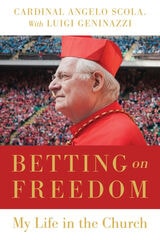
cover of Betting on Freedom: My Life in the Church

Betting on Freedom

My Life in the Church

Carinal Angelo Scola

Catholic University of America Press, 2021
In this wide-ranging conversation with the Italian journalist Luigi Geninazzi, Cardinal Angelo Scola discusses both the salient moments of his own life and the path and situation of the Church and society in Europe over the last half-century. The Cardinal recounts his life, speaking of the extraordinary gift of particular friendships he has had, starting with Luigi Giussani, founder of the ecclesial movement Communion and Liberation (CL), and moving on to discuss Hans Urs von Balthasar, Henri De Lubac, and Joseph Ratzinger. A figure who bridges the past three pontificates, Scola discusses his relationships with St. John Paul II, by whom he was nominated a bishop at the relatively young age of forty nine; Benedict XVI, with whom he has had an intense intellectual friendship for decades; and Pope Francis, of whom he speaks with affection and hope. At the center of this rich fresco of anecdotes and reflections stands a crucial question: what is the true path of the Church today? Between those who reduce Christianity to a mere civil religion and those who propose a purist return to the Gospel, the cardinal indicates a "third way" by betting on the freedom of the human person to recognize the supreme value of Christ. This is at the same time a bet on the active commitment of believers to contribute, starting from faith, to the birth of a new Europe, inevitably more diverse but no loss of its identity.
[more]
cover of Bioethics: A Catholic Primer

Bioethics

A Catholic Primer

Thomas Cavanaugh

Catholic University of America Press, 2026
Bioethics: A Catholic Primer is a succinct, precise, and accurate treatment of the Catholic moral tradition in medicine. Professors teaching an undergraduate bioethics course will use it as a primary text or as an ancillary text in a general ethics course that has a medical ethics section. Professors in both situations will find it an attractive alternative or addition to current offerings. This applies especially to those teaching at a Catholic-affiliated college or university. Professors teaching in pre-health­care professional, pre-medical, and in nursing programs (both undergraduate and graduate) will adopt this text both as a primary text and as an ancillary text, depending on their needs. Because of its slender, compact, yet rewarding content, professors will find it appealing to assign. Moreover, students will not find its size daunting. Its accuracy, precision, and small size will make it appealing to a more general audience. Moreover, by its brevity, it will gain an audience interested in Catholic med­ical ethics, yet often overwhelmed by the very size of the volumes available. People interested in an overarching, accurate, yet brief treatment of the Catholic moral tradition in medicine will read this slim volume (for exam­ple, members on ethics committees at Catholic hospitals). Others (faculty, students, patients, pastors, physicians, and nurses) will read it themselves and confidently share it with their friends and loved ones, knowing that they will find in it a rewarding, slender, accessible treatment of a rich moral tradition.
[more]
cover of Biomedicen and Beatitude: An Introduction to Catholic Bioethics, Second Edition

Biomedicen and Beatitude

An Introduction to Catholic Bioethics, Second Edition

Nicanor Pier Giorgio Austriaco

Catholic University of America Press, 2021
This timely and up to date new edition of Biomedicine and Beatitude features an entirely new chapter on the ethics of bodily modification. It is also updated throughout to reflect the pontificate of Pope Francis, recent concerns including ethical issues raised by the COVID-19 pandemic, and feedback from the many instructors who used the first edition in the classroom.
[more]
cover of Blessed Mary and the Monks of England, 1000-1215

Blessed Mary and the Monks of England, 1000-1215

Matthew J. Mills

Catholic University of America Press, 2024
In the study of historical Mariology, the monastic communities of England before and after the Norman conquest receive too little attention. Classic surveys, such as Hilda Graef’s, Mary: A History of Doctrine and Devotion (2 vols, orig. 1963, 1965), highlight key figures and developments; and a fine book by Mary Clayton, The Cult of the Virgin Mary in Anglo-Saxon England (1990), takes scholarship as far as the early-eleventh century. The present volume, building upon such works, delves more deeply into the prayerful, intellectual and artistic contemplation of Mary during the age of monasticism, roughly the two hundred years prior to the advent of the mendicant orders in the thirteenth century. In the history of England, this was a time of high drama: conquest, power struggle, martyrdom; for English monasticism, it was marked by suppression, reform and renewal, patronage, and new currents of prayer and thought. Against this backdrop, Matthew Mills uncovers many vibrant contributions to Marian doctrine and devotion by theologians and communities living according to the sixth-century Rule of St Benedict: the Benedictines and their successors, the Cistercians, who arrived in England in 1128. In a thematic unfolding of Mary’s life and identity, from conception to assumption and intercession, a picture emerges of a Mariology shaped by the constant of monastic liturgy, anchored in deep biblical and patristic wisdom, cherished and transmitted by the Englishman, St Bede (d. 735), and animated by profound love. Towering figures, St Anselm (d. 1109) and St Ælred (d. 1167), are placed within a wider landscape, alongside lesser-known but still significant individuals, including the Cistercian abbot, John of Forde (d. 1214), royal confessor and pioneer of Marian exegesis of the Song of Songs. England’s monastic Mariology was colored by Greek as well as Latin influences and touched by key experiences of the contemporary church at large: apocalyptic disappointment, eleventh-century reform (sometimes called, ‘Gregorian’), sacramentalism, intense yearning for salvation. This book also sheds light upon the significance of Mary for medieval monks’ understanding of their own profession; their mother and their lady, she was, in addition, their icon and exemplar of life in St Benedict’s ‘school for the Lord’s service’ (Rule, Prol. 45).
[more]
cover of Blessed Rage for Order: The New Pluralism in Theology

Blessed Rage for Order

The New Pluralism in Theology

David Tracy

University of Chicago Press, 1995
In Blessed Rage for Order, David Tracy examines the cultural context in which theological pluralism emerged. Analyzing orthodox, liberal, neo-orthodox, and radical models of theology, Tracy formulates a new 'revisionist' model. He considers which methods promise the most certain results for a revisionist theology and applies his model to the principal questions in contemporary theology, including the meanings of religion, theism, and of christology.
[more]
cover of Blood in the Fields: Óscar Romero, Catholic Social Teaching, and Land Reform

Blood in the Fields

Óscar Romero, Catholic Social Teaching, and Land Reform

Matthew Philipp Whelan

Catholic University of America Press, 2020

On March 24, 1980, a sniper shot and killed Archbishop Óscar Romero as he celebrated mass. Today, nearly four decades after his death, the world continues to wrestle with the meaning of his witness. Blood in the Fields: Óscar Romero, Catholic Social Teaching, and Land Reform treats Romero’s role in one of the central conflicts that seized El Salvador during his time as archbishop and that plunged the country into civil war immediately after his death: the conflict over the concentration of agricultural land and the exclusion of the majority from access to land to farm. Drawing extensively on historical and archival sources, Blood in the Fields examines how and why Romero advocated for justice in the distribution of land, and the cost he faced in doing so. In contrast to his critics, who understood Romero’s calls for land reform as a communist-inspired assault on private property, Blood in the Fields shows how Romero relied upon what Catholic Social Teaching calls the common destination of created goods, drawing out its implications for what property is and what possessing it entails. For Romero, the pursuit of land reform became part of a more comprehensive politics of common use, prioritizing access of all peoples to God’s gift of creation. In this way, Blood in the Fields reveals how close consideration of this conflict over land opened up into a much more expansive moral and theological landscape, in which the struggle for justice in the distribution of land also became a struggle over what it meant to be human, to live in society with others, and even to be a follower of Christ. Understanding this conflict and its theological stakes helps clarify the meaning of Romero’s witness and the way God’s work to restore creation in Christ is cruciform.
[more]
cover of Born Again: The Christian Right Globalized

Born Again

The Christian Right Globalized

Jennifer S. Butler

Pluto Press, 2006

The Christian Right wields massive political power in the United States and beyond. This is the first book to reveal the growing influence of the Christian Right within the United Nations.

This book reveals how Christian conservative groups are able to shape policy in every corner of the world. Drawing on interviews with religious leaders, it reveals how today's most powerful Christian Right organisations are building interfaith coalitions, connecting Catholic, Mormon and Muslim allies to advance a conservative agenda.

The US under Bush Jr. has given them a significant voice in shaping US policy on issues including women's rights, reproductive health, human cloning, children's rights and AIDS.

In short, the Christian Right is globalising -- a phenomenon that promises to challenge progressive social policy on a world-wide scale - as well as transform the Christian Right itself.
[more]
cover of Bound for Beatitude A Thomistic Study in Eschatology and Ethics

Bound for Beatitude A Thomistic Study in Eschatology and Ethics

Reinhard Hütter

Catholic University of America Press, 2019
Bound for Beatitude is about St. Thomas Aquinas’s theology of beatitude and the journey thereto. Consequently, the work’s topic is the meaning and purpose of human life embedded in that of the whole cosmos. This study is not an antiquarian exercise in the thought of some sundry medieval thinker, but an exercise of ressourcement in the philosophical and theological wisdom of one of the most profound theologians of the Catholic Church, one whom the Church has canonized, granted the title “Doctor of the Church,” and for a long time regarded as the common doctor. This exercise of ressourcement takes its methodological cues from the common doctor; hence, it is an integrated exercise of philosophical, dogmatic, and moral theology. Its specific theological topic, the ultimate human end, perfect happiness, beatitude, and the journey thereto—stands at the very heart of St. Thomas’s theology. Far from being passé, his theology of beatitude is of urgent pertinence as the crisis of humanity and of creation and the exile of God seems to approach its apogee. By way of a presentation, interpretation, and defense of Thomas Aquinas’s doctrine of beatitude and the journey thereto, Bound for Beatitude advances an argument based on four theses: (1) The loss of a theology of beatitude has greatly impoverished contemporary theology. In order to succeed and flourish, theology must recover a sound teleological orientation. (2) In order to recover a sound teleological orientation, theology must recover metaphysics as its privileged instrument. (3) Thomas Aquinas provides a still pertinent model for how theology might achieve these goals in a metaphysically profound theology of beatitude and the beatific vision. Finally, (4) Aquinas’s rich and sophisticated account of the virtues charts the journey to beatitude in a way that still has analytic force and striking relevance in the early twenty-first century.
[more]
cover of Bread from Heaven: An Introduction to the Theology of the Eucharist

Bread from Heaven

An Introduction to the Theology of the Eucharist

Bernhard Blankenhorn

Catholic University of America Press, 2021
Bread from Heaven offers a contemporary theological synthesis on the Eucharist that brings together classical and critical biblical exegesis, debates on the early history of the Christian liturgy, patristic doctrine, the teachings offered by the Councils of Florence, Trent and Vatican II, and the Church’s lex orandi, all within a framework provided by the Eucharistic theology of Thomas Aquinas. The volume begins with Christ’s Bread of Life discourse in John 6, in light of the Old Testament theme of the manna, and the Synoptic accounts of the Last Supper. These biblical texts offer solid foundation for a theology of Eucharistic sacrifice, presence and Communion. It then continues with a historical and systematic study of the institution of the Eucharist by Christ, with special attention given to the emergence of the first Eucharistic prayers. Then follows a survey of key Christological and ecclesiological themes which undergird Eucharistic theology. The chapters on Eucharistic sacrifice and presence form the heart of the work. Here, the focus moves to key conciliar, patristic and Thomistic insights on these themes. Bread from Heaven clarifies misunderstandings of Eucharistic sacrifice and renders transubstantiation accessible to beginners. Blankenhorn concludes with a study of the consecration, the minister of the Eucharist and the fruits of communion. The chapter on the debate over the words of institution and the epiclesis gives a fresh perspective that integrates both eastern and western tradition. The study of the Eucharistic celebrant strikes a balance between a spirituality of the priest as acting in persona Christi and of the priest as praying in persona ecclesiae. The concluding chapter centers on the Eucharist’s unitive, mystical fruits in the Church. This textbook is ideal for an advanced undergraduate or graduate course on Eucharistic theology. It also seeks to advance the debate on several controversial historical and speculative issues in sacramental theology.
[more]
cover of By knowledge & by love: charity and knowledge in the moral theology of St. Thomas Aquinas

By knowledge & by love

charity and knowledge in the moral theology of St. Thomas Aquinas

Michael S. Sherwin

Catholic University of America Press, 2005

By Knowledge and By Love represents a major contribution to Thomistic moral theology and philosophy by providing a thoughtful examination of Aquinas' psychology of action and his theology of charity.
[more]