Results by title
76 books match the query 'Church and state' and 5 start with b
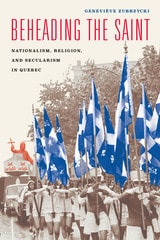
Beheading the Saint
Nationalism, Religion, and Secularism in QuebecGeneviève Zubrzycki
University of Chicago Press, 2016
In Beheading the Saint, Geneviève Zubrzycki studies that transformation through a close investigation of the annual Feast of St. John the Baptist of June 24. The celebrations of that national holiday, she shows, provided a venue for a public contesting of the dominant ethno-Catholic conception of French Canadian identity and, via the violent rejection of Catholic symbols, the articulation of a new, secular Québécois identity. From there, Zubrzycki extends her analysis to the present, looking at the role of Québécois identity in recent debates over immigration, the place of religious symbols in the public sphere, and the politics of cultural heritage—issues that also offer insight on similar debates elsewhere in the world.

Between Church and State
The Lives of Four French Prelates in the Late Middle AgesBernard Guenée
University of Chicago Press, 1990
Guenée chooses as his frame the momentous period from the height of Saint Louis's reign in the mid-thirteenth century to the beginning of the Italian wars two hundred years later. During this time of schism in the church, of war between nascent states, and of treachery among princes, Bernard Gui (1261-1331), Gilles Le Muisit (1272-1353), Pierre D'Ailly (1351-1420), and Thomas Basin (1412-1490) all rose from modest circumstances to the dignity of office. Guenée shows us how these prelates used their talent, ambition, patrons, zeal, and experience to juggle the competing demands of obedience to church and state; to overcome competition from an upcoming new generation; and to cope with plague, war, and violence. Free of jargon yet steeped in learning, Between Church and State reveals the career patterns and politics of an era while forging a new model for points of departure in historical scholarship.
Between the Temple and the Tax Collector
The Intersection of Mormonism and the StateSamuel D. Brunson
University of Illinois Press, 2025
The founding and development of the Church of Jesus Christ of Latter-day Saints run parallel to the rise of the modern tax system and administrative state. Samuel D. Brunson looks at the relationships between the Church and various federal, state, local, and international tax regimes.
The church and its members engage with the state as taxpayers and as members of a faith exempt from taxes. As Brunson shows, LDS members and the Church have at various times enacted, enforced, and collected taxes while also challenging taxes in the courts and politics. Brunson delves into the ways LDS members used their status as taxpayers to affirm themselves as citizens and how outsiders have attacked the Church’s tax-exempt status to delegitimize it. Throughout, Brunson uses the daily interactions between the Latter-day Saints and taxation to explain important and inevitable holes in the wall between church and state.
Enlightening and informed, Between the Temple and the Tax Collector provides general readers and experts alike with a new perspective on a fundamental issue.
Bishops, Councils, and Consensus in the Visigothic Kingdom, 589-633
Rachel L. Stocking
University of Michigan Press, 2001
This eloquently presented, exhaustive study concludes that legislation, however persistently enacted, was unequal to the task of remedying a lack of unity and other social and political ills. Notions of consensus are explored as a way of maintaining community cohesion and order in the absence of strong central authorities. Other issues the author confronts are Catholic tolerance and intolerance toward heterodox and non-Christian "others;" the transformation and transmission of ancient ideals and social structures from the Roman to the later medieval worlds; and the position of medieval Spain in relation to the mainstream of western European history.
This nuanced study is a must-read for anyone interested in medieval life, politics, religion, and the precarious nature of the medieval state.
Rachel Stocking is Professor of History, Southern Illinois University at Carbondale.
Borders of Belief
Religious Nationalism and the Formation of Identity in Ireland and TurkeyGregory J. Goalwin
Rutgers University Press, 2022