206 books match the query 'City Planning & Urban Development' and 9 start with b
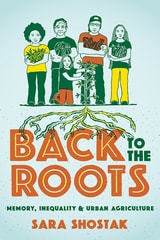
cover of Back to the Roots: Memory, Inequality, and Urban Agriculture

Back to the Roots

Memory, Inequality, and Urban Agriculture

Sara Shostak

Rutgers University Press, 2021
Across the Commonwealth of Massachusetts, urban farmers and gardeners are reclaiming cultural traditions linked to food, farming, and health; challenging systemic racism and injustice in the food system; demanding greater community control of resources in marginalized neighborhoods; and moving towards their visions of more equitable urban futures. As part of this urgent work, urban farmers and gardeners encounter and reckon with both the cultural meanings and material legacies of the past. Drawing on their narratives, Back to the Roots demonstrates that urban agriculture is a critical domain for explorations of, and challenges to, the long standing inequalities that shape both the materiality of cities and the bodies of their inhabitants.
 
[more]
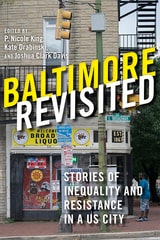
cover of Baltimore Revisited: Stories of Inequality and Resistance in a U.S. City

Baltimore Revisited

Stories of Inequality and Resistance in a U.S. City

Edited by P. Nicole King, Kate Drabinski, and Joshua Clark Davis

Rutgers University Press, 2019

Nicknamed both “Mobtown” and “Charm City” and located on the border of the North and South, Baltimore is a city of contradictions. From media depictions in The Wire to the real-life trial of police officers for the murder of Freddie Gray, Baltimore has become a quintessential example of a struggling American city. Yet the truth about Baltimore is far more complicated—and more fascinating.
 
To help untangle these apparent paradoxes, the editors of Baltimore Revisited have assembled a collection of over thirty experts from inside and outside academia. Together, they reveal that Baltimore has been ground zero for a slew of neoliberal policies, a place where inequality has increased as corporate interests have eagerly privatized public goods and services to maximize profits. But they also uncover how community members resist and reveal a long tradition of Baltimoreans who have fought for social justice.
 
The essays in this collection take readers on a tour through the city’s diverse neighborhoods, from the Lumbee Indian community in East Baltimore to the crusade for environmental justice in South Baltimore. Baltimore Revisited examines the city’s past, reflects upon the city’s present, and envisions the city’s future.
[more]
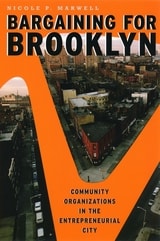
cover of Bargaining for Brooklyn: Community Organizations in the Entrepreneurial City

Bargaining for Brooklyn

Community Organizations in the Entrepreneurial City

Nicole P. Marwell

University of Chicago Press, 2007

When middle-class residents fled American cities in the 1960s and 1970s, government services and investment capital left too. Countless urban neighborhoods thus entered phases of precipitous decline, prompting the creation of community-based organizations that sought to bring direly needed resources back to the inner city. Today there are tens of thousands of these CBOs—private nonprofit groups that work diligently within tight budgets to give assistance and opportunity to our most vulnerable citizens by providing services such as housing, child care, and legal aid.

Through ethnographic fieldwork at eight CBOs in the Brooklyn neighborhoods of Williamsburg and Bushwick, Nicole P. Marwell discovered that the complex and contentious relationships these groups form with larger economic and political institutions outside the neighborhood have a huge and unexamined impact on the lives of the poor. Most studies of urban poverty focus on individuals or families, but Bargaining for Brooklyn widens the lens, examining the organizations whose actions and decisions collectively drive urban life.

[more]
cover of Beautiful Terrible Ruins: Detroit and the Anxiety of Decline

Beautiful Terrible Ruins

Detroit and the Anxiety of Decline

Apel, Dora

Rutgers University Press, 2015
Once the manufacturing powerhouse of the nation, Detroit has become emblematic of failing cities everywhere—the paradigmatic city of ruins—and the epicenter of an explosive growth in images of urban decay. In Beautiful Terrible Ruins, art historian Dora Apel explores a wide array of these images, ranging from photography, advertising, and television, to documentaries, video games, and zombie and disaster films.  
 
Apel shows how Detroit has become pivotal to an expanding network of ruin imagery, imagery ultimately driven by a pervasive and growing cultural pessimism, a loss of faith in progress, and a deepening fear that worse times are coming. The images of Detroit’s decay speak to the overarching anxieties of our era: increasing poverty, declining wages and social services, inadequate health care, unemployment, homelessness, and ecological disaster—in short, the failure of capitalism. Apel reveals how, through the aesthetic distancing of representation, the haunted beauty and fascination of ruin imagery, embodied by Detroit’s abandoned downtown skyscrapers, empty urban spaces, decaying factories, and derelict neighborhoods help us to cope with our fears. But Apel warns that these images, while pleasurable, have little explanatory power, lulling us into seeing Detroit’s deterioration as either inevitable or the city’s own fault, and absolving the real agents of decline—corporate disinvestment and globalization. Beautiful Terrible Ruins helps us understand the ways that the pleasure and the horror of urban decay hold us in thrall. 
 
 
[more]
cover of Being Interdisciplinary: Adventures in Urban Science and Beyond

Being Interdisciplinary

Adventures in Urban Science and Beyond

Alan Wilson

University College London, 2022

An accessible and enjoyable guide to interdisciplinary research from a leading academic in urban science.

In Being Interdisciplinary, Alan Wilson draws on five decades as a leading figure in urban science to set out a systems approach to interdisciplinarity for those conducting research in this and other fields. He argues that most research is interdisciplinary at its base and that a systems perspective is particularly appropriate for collaboration because it fosters an outlook that sees beyond disciplines. A systems approach enables researchers to identify the game-changers of the past as a basis for thinking outside of convention, for learning how to do something new and how to be ambitious.
 
Building on this systems focus, the book first establishes the basics of interdisciplinarity. Then, by drawing on the author’s wide experience in interdisciplinary research—as a researcher in urban science, a university professor and vice-chancellor, a civil servant, and an institute director, it illustrates general principles and a framework from which researchers can build their own interdisciplinary approach. In the last section, the book tackles questions of managing and organizing research from individual to institutional scales.

 
[more]
cover of Believing in Cleveland: Managing Decline in “The Best Location in the Nation”

Believing in Cleveland

Managing Decline in “The Best Location in the Nation”

J. Mark Souther

Temple University Press, 2017

Detractors have called it "The Mistake on the Lake." It was once America’s "Comeback City." According to author J. Mark Souther, Cleveland has long sought to defeat its perceived civic malaise. Believing in Cleveland chronicles how city leaders used imagery and rhetoric to combat and, at times, accommodate urban and economic decline.

Souther explores Cleveland's downtown revitalization efforts, its neighborhood renewal and restoration projects, and its fight against deindustrialization. He shows how the city reshaped its image when it was bolstered by sports team victories. But Cleveland was not always on the upswing. Souther places the city's history in the postwar context when the city and metropolitan area were divided by uneven growth. In the 1970s, the city-suburb division was wider than ever.

Believing in Cleveland recounts the long, difficult history of a city that entered the postwar period as America's sixth largest, then lost ground during a period of robust national growth. But rather than tell a tale of decline, Souther provides a fascinating story of resilience for what some folks called "The Best Location in the Nation."
[more]
cover of Boomtown Columbus: Ohio’s Sunbelt City and How Developers Got Their Way

Boomtown Columbus

Ohio’s Sunbelt City and How Developers Got Their Way

Kevin R. Cox

The Ohio State University Press, 2021

Columbus, Ohio, and its ample cloud cover may be on the eastern edge of the Midwest, but the city’s unfettered suburbanization and rapid postwar expansion recall its Sunbelt peers. To understand why—and the social and economic stakes of this all-too-common model of urban growth—pioneering geographer Kevin R. Cox takes us through the postwar history of development in Columbus, a city that has often welcomed corporate influence at the expense of livability and equal opportunity for its residents.
How have development interests become entwined with government? How has a policy of annexation reformed the city’s map? Why have airline service and major league prestige lagged behind its status as a regional center? And what, if anything, makes this city with a reputation for being average stand apart? In Boomtown Columbus, Cox applies both scholarly expertise and his personal experience as a long-time resident of the city to look at the real-life costs of policy. The resulting narrative will fascinate not only locals but anyone with a stake in understanding American cities and a path toward urban livability for all.
 
[more]
cover of Boss Cox’s Cincinnati: Urban Politics in the Progressive Era

Boss Cox’s Cincinnati

Urban Politics in the Progressive Era

Zane L. Miller

The Ohio State University Press, 2000

In the late nineteenth century, a new era began in American urban history, characterized by an explosion of both the populations and the proportions of cities, obliterating their traditional social and physical characteristics. Commercial businesses relocated, slums emerged around the core, and new residential areas were established along the periphery. The period was one of extreme disorder—labor and ethnic unrest, election violence, rising crime rates—but it was also a time of political innovation and civic achievement.

In documenting the changes Cincinnati experienced during  the Progressive Era, Zane L. Miller provides a clear perspective on the processes of urbanization that transformed the American city. His focus is political because politics provided continuity amid the diversity of city life. The most important aspect of political continuity in Cincinnati and in other cities was "bossism," often depicted as an example of corruption, but which was in many cities part of the quest for a new urban order. In Cincinnati, Boss George B. Cox's machine was a response to the disorder of the times; interestingly, the machine actually helped to control disorder, paving the way for later reforms. Miller carefully explores both the nature and the significance of bossism, showing how it and municipal reform were both essential components of the modern urban political system.

Originally published in 1968, Boss Cox's Cincinnati is considered a classic in the field of urban studies.

[more]
cover of Budapest and New York: Studies in Metropolitan Transformation, 1870-1930

Budapest and New York

Studies in Metropolitan Transformation, 1870-1930

Thomas Bender

Russell Sage Foundation, 1994

Little over a century ago, New York and Budapest were both flourishing cities engaging in spectacular modernization. By 1930, New York had emerged as an innovating cosmopolitan metropolis, while Budapest languished under the conditions that would foster fascism. Budapest and New York explores the increasingly divergent trajectories of these once-similar cities through the perspectives of both Hungarian and American experts in the fields of political, cultural, social and art history. Their original essays illuminate key aspects of urban life that most reveal the turn-of-the-century evolution of New York and Budapest: democratic participation, use of public space, neighborhood ethnicity, and culture high and low. What comes across most strikingly in these essays is New York's cultivation of social and political pluralism, a trend not found in Budapest. Nationalist ideology exerted tremendous pressure on Budapest's ethnic groups to assimilate to a single Hungarian language and culture. In contrast, New York's ethnic diversity was transmitted through a mass culture that celebrated ethnicity while muting distinct ethnic traditions, making them accessible to a national audience. While Budapest succumbed to the patriotic imperatives of a nation threatened by war, revolution, and fascism, New York, free from such pressures, embraced the variety of its people and transformed its urban ethos into a paradigm for America. Budapest and New York is the lively story of the making of metropolitan culture in Europe and America, and of the influential relationship between city and nation. In unifying essays, the editors observe comparisons not only between the cities, but in the scholarly outlooks and methodologies of Hungarian and American histories. This volume is a unique urban history. Begun under the unfavorable conditions of a divided world, it represents a breakthrough in cross-cultural, transnational, and interdisciplinary historical work.
[more]