Results by title
138 books match the query 'Civil War' and 7 start with b
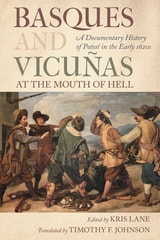
Basques and Vicuñas at the Mouth of Hell
A Documentary History of Potosí in the Early 1620sKris Lane
University of Nevada Press, 2024
As mines flooded and Indigenous workers died or fled, the city descended into a maelstrom of swordfights, gun battles, ambushes, sniper attacks, and summary executions. Though its roots were economic, the Basque-Vicuña conflict strained the sinews of Habsburg global governance even as it exposed festering local tensions, only some of which were unique to Potosí.
This rich collection of original sources, all of them archival documents housed in Bolivia, Spain, the United Kingdom, and the United States, consists of contemporary eyewitness accounts from several perspectives, allowing readers to play historian. All sources have been expertly translated and carefully annotated in a manner that will engage students and scholars alike. Basques and Vicuñas at the Mouth of Hell includes an extensive introduction, seven vital documents in translation, and appendices on everyday life in 1620s Potosí and on the historiography of this watershed episode of colonial violence.
Battles and Leaders of the Civil War, Volume 5
Edited by Peter Cozzens
University of Illinois Press, 2001
Indispensable must-reads for all Civil War buffs and historians, bringing together little-known and never before gathered first-hand accounts, articles, maps, and illustrations
The first four volumes of Battles and Leaders of the Civil War, published in the late nineteenth century, became the best-selling and most frequently cited works ever published on the Civil War. Volume 5, assembled by the acclaimed military historian Peter Cozzens, carries on the tradition of its namesake, offering a dazzling new collection of fresh material written by military and civilian leaders, North and South, on a broad array of war-related topics. Featured articles include General Grant on the second battle of Bull Run, General Beauregard on the Shiloh campaign, General Sherman on the conference at City Point, Joshua Chamberlain on the Fredericksburg campaign, and many more. Also presented are dozens of maps and more than one hundred illustrations.
Battles and Leaders of the Civil War, Volume 6
Edited by Peter Cozzens
University of Illinois Press, 2001
Black Flag Over Dixie
Racial Atrocities and Reprisals in the Civil WarEdited by Gregory J. W. Urwin
Southern Illinois University Press, 2004
Black Flag over Dixie: Racial Atrocities and Reprisals in the Civil War highlights the central role that race played in the Civil War by examining some of the ugliest incidents that played out on its battlefields. Challenging the American public’s perception of the Civil War as a chivalrous family quarrel, twelve rising and prominent historians show the conflict to be a wrenching social revolution whose bloody excesses were exacerbated by racial hatred.
Edited by Gregory J. W. Urwin, this compelling volume focuses on the tendency of Confederate troops to murder black Union soldiers and runaway slaves and divulges the details of black retaliation and the resulting cycle of fear and violence that poisoned race relations during Reconstruction. In a powerful introduction to the collection, Urwin reminds readers that the Civil War was both a social and a racial revolution. As the heirs and defenders of a slave society’s ideology, Confederates considered African Americans to be savages who were incapable of waging war in a civilized fashion. Ironically, this conviction caused white Southerners to behave savagely themselves. Under the threat of Union retaliation, the Confederate government backed away from failing to treat the white officers and black enlisted men of the United States Colored Troops as legitimate combatants. Nevertheless, many rebel commands adopted a no-prisoners policy in the field. When the Union’s black defenders responded in kind, the Civil War descended to a level of inhumanity that most Americans prefer to forget.
In addition to covering the war’s most notorious massacres at Olustee, Fort Pillow, Poison Spring, and the Crater, Black Flag over Dixie examines the responses of Union soldiers and politicians to these disturbing and unpleasant events, as well as the military, legal, and moral considerations that sometimes deterred Confederates from killing all black Federals who fell into their hands. Twenty photographs and a map of massacre and reprisal sites accompany the volume.
The contributors are Gregory J. W. Urwin, Anne J. Bailey, Howard C. Westwood, James G. Hollandsworth Jr., David J. Coles, Albert Castel, Derek W. Frisby, Weymouth T. Jordan Jr., Gerald W. Thomas, Bryce A. Suderow, Chad L. Williams, and Mark Grimsley.
Black Troops, White Commanders and Freedmen during the Civil War
Howard C. Westwood
Southern Illinois University Press, 2008
Recounting the experiences of black soldiers in the Civil War
In the ten probing essays collected in this volume, Howard C. Westwood recounts the often bitter experiences of black men who were admitted to military service and the wrenching problems associated with the shifting status of African Americans during the Civil War.
Black Troops, White Commanders and Freedmen during the Civil War covers topics ranging from the roles played by Lincoln and Grant in beginning black soldiery to the sensitive issues that arose when black soldiers (and their white officers) were captured by the Confederates. The essays relate the exploits of black heroes such as Robert Smalls, who single-handedly captured a Confederate steamer, as well as the experiences of the ignoble Reverend Fountain Brown, who became the first person charged with violating the Emancipation Proclamation.
Although many thousands were enlisted as soldiers, blacks were barred from becoming commissioned officers and for a long time they were paid far less than their white counterparts. These and other blatant forms of discrimination understandably provoked discontent among black troops which, in turn, sparked friction with their white commanders. Westwood's fascinating account of the artillery company from Rhode Island amply demonstrates how frustrations among black soldiers came to be seen as "mutiny" by some white officers.
Blockaders, Refugees, and Contrabands
Civil War on Florida's Gulf Coast, 1861-1865George E. Buker
University of Alabama Press, 2004
Broadcasting the Civil War in El Salvador
A Memoir of Guerrilla RadioBy Carlos Henriquez Consalvi ("Santiago")
University of Texas Press, 2010
During the 1980s war in El Salvador, Radio Venceremos was the main news outlet for the Frente Farabundo Martí para la Liberación Nacional (FMLN), the guerrilla organization that challenged the government. The broadcast provided a vital link between combatants in the mountains and the outside world, as well as an alternative to mainstream media reporting. In this first-person account, "Santiago," the legend behind Radio Venceremos, tells the story of the early years of that conflict, a rebellion of poor peasants against the Salvadoran government and its benefactor, the United States.
Originally published as La Terquedad del Izote, this memoir also addresses the broader story of a nationwide rebellion and its international context, particularly the intensifying Cold War and heavy U.S. involvement in it under President Reagan. By the war's end in 1992, more than 75,000 were dead and 350,000 wounded—in a country the size of Massachusetts. Although outnumbered and outfinanced, the rebels fought the Salvadoran Army to a draw and brought enough bargaining power to the negotiating table to achieve some of their key objectives, including democratic reforms and an overhaul of the security forces.
Broadcasting the Civil War in El Salvador is a riveting account from the rebels' point of view that lends immediacy to the Salvadoran conflict. It should appeal to all who are interested in historic memory and human rights, U.S. policy toward Central America, and the role the media can play in wartime.