Results by title
173 books match the query 'Collective Memory' and 9 start with b
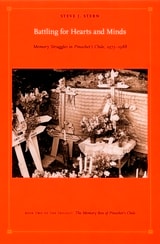
Battling for Hearts and Minds
Memory Struggles in Pinochet's Chile, 1973–1988Steve J. Stern
Duke University Press, 2006
In the 1970s, Chilean dissidents were lonely “voices in the wilderness” insisting that state terror and its victims be recognized and remembered. By the 1980s, the dissent had spread, catalyzing a mass movement of individuals who revived public dialogue by taking to the streets, creating alternative media, and demanding democracy and human rights. Despite long odds and discouraging defeats, people of conscience—victims of the dictatorship, priests, youth, women, workers, and others—overcame fear and succeeded in creating truthful public memories of state atrocities. Recounting both their efforts and those of the regime’s supporters to win the battle for Chileans’ hearts and minds, Stern shows how profoundly the struggle to create memories, to tell history, matters.
Battling for Hearts and Minds is the second volume in the trilogy The Memory Box of Pinochet’s Chile. The third book will examine Chileans’ efforts to achieve democracy while reckoning with Pinochet’s legacy.
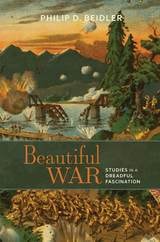
Beautiful War
Studies in a Dreadful FascinationPhilip D. Beidler
University of Alabama Press, 2016
Beautiful War: Studies in a Dreadful Fascination is a wide-ranging exploration of armed conflict as depicted in art that illustrates the constant presence of war in our everyday lives. Philip D. Beidler investigates the unending assimilation and pervasive presence of the idea of war in popular culture, the impulses behind the making of art out of war, and the unending and debatably aimless trajectories of war itself.
Beidler’s critical scope spans from Shakespeare’s plays, through the Victorian battle paintings of Lady Butler, into the post-World War I writings of F. Scott Fitzgerald and Virginia Woolf, and up to twenty-first-century films such as The Hurt Locker and Extremely Loud and Incredibly Close. As these works of art have become ubiquitous in contemporary culture, the many faces of war clearly spill over into our art and media, and Beidler argues that these portrayals in turn shift the perception of war from a savage truth to a concept.
Beautiful War argues that the representation of war in the arts has always been, and continues to be, an incredibly powerful force. Incorporating painting, music, photography, literature, and film, Beidler traces a disturbing but fundamental truth: that war has always provided an aesthetic inspiration while serving ends as various and complex as ideological or geopolitical history, public memory, and mass entertainment.
Beautiful War is a bold and vivid account of the role of war and military conflict as a subject of art that offers much of value to literary and cultural critics, historians, veterans, students of art history and communication studies, and those interested in expanding their understanding of art and media’s influence on contemporary values and memories of the past.
Before the Fire Dogs Steal the Sun
An ElegyCrystal Mun-hye Baik
Duke University Press, 2026

Being German Canadian
History, Memory, GenerationsAlexander Freund
University of Manitoba Press, 2021
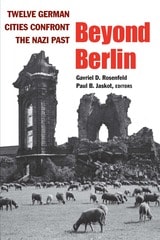
Beyond Berlin
Twelve German Cities Confront the Nazi PastGavriel D. Rosenfeld and Paul B. Jaskot, Editors
University of Michigan Press, 2015
Beyond Berlin breaks new ground in the ongoing effort to understand how memorials, buildings, and other spaces have figured in Germany's confrontation with its Nazi past. The contributors challenge reigning views of Germany's postwar memory work by examining how specific urban centers apart from the nation's capital have wrestled with their respective Nazi legacies. A wide range of West and East German cities is profiled in the volume: prominent metropolises like Hamburg, dynamic regional centers like Dresden, gritty industrial cities like Wolfsburg, and idyllic rural towns like Quedlinburg. In employing historical, art historical, anthropological, and geographical methodologies to examine these and other important urban centers, the volume's case studies shed new light upon the complex ways in which the confrontation with the Nazi past has directly shaped the German urban landscape since the end of the Second World War.
"Beyond Berlin is one of the most fascinating, deeply probing collections ever published on Germany's ongoing confrontation with its Nazi past. Its editors, Gavriel Rosenfeld and Paul Jaskot, have taken the exploration of Germany's urban memorial landscape to its highest level yet."
---James E. Young, Professor and Chair, Department of Judaic and Near Eastern Studies, University of Massachusetts Amherst, and author of The Texture of Memory and At Memory's Edge
"This is a top-notch collection of essays that positions itself in the populated field of memory studies by bringing together original contributions representing the best of new scholarship on architecture, urban design, monuments, and memory in East and West Germany. Taken together, the essays remind readers that the Nazi past is always present when German architects, urban planners, and politicians make decisions to tear down, rebuild, restore, and memorialize."
---S. Jonathan Wiesen, Department of History, Southern Illinois University, Carbondale
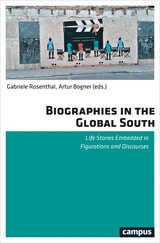
Biographies in the Global South
Life Stories Embedded in Figurations and DiscoursesEdited by Gabriele Rosenthal and Artur Bogner
Campus Verlag, 2017
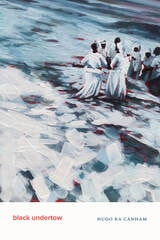
Black Undertow
Hugo ka Canham
Duke University Press, 2026
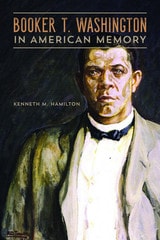
Booker T. Washington in American Memory
Kenneth M. Hamilton
University of Illinois Press, 2017
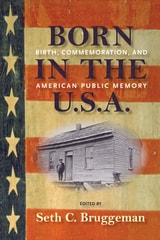
Born in the U.S.A.
Birth, Commemoration, and American Public MemorySeth C. Bruggeman
University of Massachusetts Press, 2012
Beyond asking why it is that Americans care about birthplaces and how they choose which ones to commemorate, Born in the U.S.A. offers insights from historians, curators, interpretive specialists, and others whose experience speaks directly to the challenges of managing historical sites. Each essay points to new ways of telling old stories at these mainstays of American memory. The case of the modern house museum receives special attention in a provocative concluding essay by Patricia West.
In addition to West and the editor, contributors include Christine Arato, Dan Currie, Keith A. Erekson, David Glassberg, Anna Thompson Hajdik, Zachary J. Lechner, Paul Lewis, Hilary Iris Lowe, Cynthia Miller, Laura Lawfer Orr, Robert Paynter, Angela Phelps, and Paul Reber.