83 books match the query 'College students' and 6 start with b
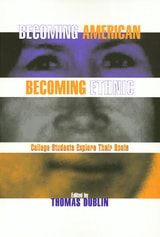
cover of Becoming American Becoming Ethnic

Becoming American Becoming Ethnic

edited by Thomas Dublin

Temple University Press, 1996

More than at any time since the 1920's the issues of immigration and ethnicity have become central to discussions of American society and identity. Becoming American, Becoming Ethnic addresses this contemporary debate, bringing together essays written over the past eighteen years by college students exploring their ethnic roots—from the experiences of their forbears to the place of ethnicity in their lives.

The students range from descendants of Europeans whose families immigrated several generations ago to Asian and Latin American immigrants of more recent decades to African-Americans and Hispanics—some have more than one ethnic heritage to grapple with, while others have migrated from one place to another within the United States. Together their voices create a dialogue about the interplay of ethnic traditions and values with American culture.

These are moving personal reflections on the continuities and changes in the ethnic experience in the United States and on the evolving meaning of ethnicity over time and across generations. Despite vocal concerns in recent years about ethnic divisiveness, these student writings show how much many young Americans share even in their differences.


In the series Critical Perspectives on the Past, edited by Susan Porter Benson, Stephen Brier, and Roy Rosenzweig.
 

[more]
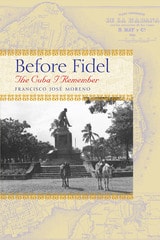
cover of Before Fidel: The Cuba I Remember

Before Fidel

The Cuba I Remember

By Francisco José Moreno

University of Texas Press, 2007

Before Fidel Castro seized power, Cuba was an ebullient and chaotic society in a permanent state of turmoil, combining a raucous tropical nature with the evils of arbitrary and corrupt government. Yet this fascinating period in Cuban history has been largely forgotten or misrepresented, even though it set the stage for Castro's dramatic takeover in 1959. To reclaim the Cuba that he knew—and add color and detail to the historical record—distinguished political scientist Francisco José Moreno here offers his recollections of the Cuba in which he came of age personally and politically.

Moreno takes us into the little-known world of privileged, upper-middle-class, white Cubans of the 1930s through the 1950s. His vivid depictions of life in the family and on the streets capture the distinctive rhythms of Cuban society and the dynamics between parents and children, men and women, and people of different races and classes. The heart of the book describes Moreno's political awakening, which culminated during his student years at the University of Havana. Moreno gives a detailed, insider's account of the anti-Batista movement, including the Ortodoxos and the Triple A. He recaptures the idealism and naiveté of the movement, as well as its ultimate ineffectiveness as it fell before the juggernaut of the Castro Revolution. His own disillusionment and wrenching decision to leave Cuba rather than accept a commission in Castro's army poignantly closes the book.
[more]
cover of Belonging and Identity in STEM Higher Education

Belonging and Identity in STEM Higher Education

Edited by Camille Kandiko Howson and Martyn Kingsbury

University College London, 2024

Recommendations for enhancing belonging in STEM higher education.

In Belonging and Identity in STEM Higher Education, Camille Kandiko Howson and Martyn Kingsbury examine the role of science, technology, engineering, and mathematics (STEM) pedagogies in facilitating belonging, variable impacts across student characteristics, and the experiences of STEM students in higher education. Through case study contributions, the book analyzes the unique educational environments for STEM staff and students throughout Europe and Asia, challenging the assumptions that STEM fields are inherently unemotional and impersonal disciplines.
 
[more]
cover of Beyond Winning: National Scholarship Competitions and the Student Experience

Beyond Winning

National Scholarship Competitions and the Student Experience

Suzanne McCray

University of Arkansas Press, 2005
Each year thousands of students apply for competitive national and international scholarships such as the Rhodes, Marshall, Gates Cambridge, and Fulbright. The competition for these awards is intense, and students look to scholarship advisors for support. Many universities have created an office or designated part of an office to assist these students, which has provided greater access for students who may not have applied previously or successfully. It has also increased the competition. The twelve essays in this collection from the 2003 National Association of Fellowships Advisors Conference held at the University of Denver. Essays by the heads of the Rhodes, Marshall, Gates, and Truman Scholarship foundations provide a sense of the philosophy and direction of their programs. The essays provide information on new initiatives, insights into the history and significance of the programs, and insider tips for application and interview preparation. Other essays focus on the advising and application process from successful advisors at various universities, how the U.K. higher educational system differs from that in the United States, and the key issue of ethics in the application process. All the essays demonstrate that the scholarship application experience itself is a valuable one that is more about learning and service than it is about winning.
[more]
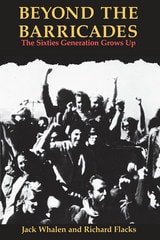
cover of Beyond the Barricades: The Sixties Generation Grows Up

Beyond the Barricades

The Sixties Generation Grows Up

Jack Whalen

Temple University Press, 1990

"'The Big Chill' told only half the story of where Sixties activists ended up. Whalen and Flacks... honestly chronicle the other half." --Abbie Hoffman "What happens to youthful idealism as people leave their youth behind? ...Where do young revolutionaries go when the revolution doesn't happen?" Amid the social and political turmoil of the late 1960s, student demonstrations on college campuses and in nearby communities looked like a prelude to apocalypse. By 1970 radical students at the University of California, Santa Barbara (UCSB), were involved in burning the Bank of America branch in Isla Vista and a series of riots and demonstrations that culminated in hundreds of arrests, numerous injuries, and one student death. To some campus observers, the violence and property damage were nothing more than a meaningless rampage--privileged students running amok. To those actively involved in the student movement and the Radical Union, the second American revolution was at hand. The disparate views of these events persist some twenty years later. In Beyond the Barricades, Whalen and Flacks challenge the conventional wisdom, which holds that the Sixties Generation soon outgrew their political ideals and channeled their energies into building lucrative careers and accumulating material goods. For nine years, the authors have maintained contact with eighteen men and women who participated in the UCSB student movement, asking probing questions about the long-term significance of political commitment to individual lives. They have also tracked fourteen former students who were part of the sorority/fraternity subculture in an attempt to discern whether the paths of the two student groups tend to converge as they grow older. This study grows out of the student activists' own assessments of the events at UCSB and the lives they have shaped in subsequent years. It demonstrates that student activists did not abandon their beliefs or become disillusioned with the prospects for social change as they left the university and ventured into the adult world. Indeed, their present political convictions and vocational commitments are largely consistent with their past views--even as they have had to adapt to changes in their personal needs and in the social climate. In asking where the students are now, the authors illuminate something about how our society has been affected--culturally, institutionally, psychologically--by the movements and conflicts of the sixties. Whalen and Flacks "offer these stories in the same spirit that apparently guided [the] respondents: as contributions to the ongoing discourse on how we might live according to our dreams!" "Whalen and Flacks are true Sixties sociologists--hip white knights who ride out to slay the ideal-crushing dragon of ‘The Big Chill.' In all, a heart-on-the-sleeve, hopeful study that should appeal to social psychologists and Sixties sympathizers." --Kirkus Reviews "In the first systematic study of the sequels to New Left radicalism, Whalen and Flacks bring alive the real choices of real activists. This is a lucid and enlightening book, full of stimulating ideas about continuities and fragilities in American radicalism." --Todd Gitlin, author of The Sixties: Years of Hope, Days of Rage "As Whalen and Flacks know, ‘The Big Chill' was a lie. The earthquake called the Sixties changed lives--and this pioneering study explains why, showing how the generation schooled in activism has been struggling to keep faith with the ideal of social justice and democracy." --James Miller, author of Democracy is in the Streets "Beyond the Barricades...is, in short, very good sociology of the intimate close-up sort. And it helps us to understand that most of the so-called yuppies are not (as we have cynically been led to believe) ex-hippies or student radicals, but rather very probably come from that majority of 1960s students who were never either." --Bennett M. Berger, University of California, San Diego
[more]
cover of Bright College Years: Inside the American College Today

Bright College Years

Inside the American College Today

Anne Matthews

University of Chicago Press, 1998

As the price of higher education escalates and the number of Americans seeking a college degree steadily rises, it is now more important then ever to think about higher education in a different way. In Bright College Years, Anne Matthews paints a provocative yet evenhanded portrait of the American campus. With each chapter dedicated to sections of the academic year, Matthews puts students, professors, and administrators under the magnifying glass. She conducts her investigation in four-year universities all across the country, from enormous state schools like the University of Texas to specialized colleges like Cal Tech. Bright College Years is a fascinating look at the changing face of the American university that will be of interest to prospective students, their parents, and anyone interested in higher education.

"Matthews writes with sympathy and substantial understanding of the dilemmas colleges face these days."—Tara Fitzpatrick, Chicago Tribune

"A wide-ranging, well-written and lively account of contemporary academia."—Christian Wiman, Dallas Morning News

"Notable Book of the Year." New York Times

"An eye-opening, startling exposé;. . . . Matthews' energetic and well-written report provides a dismal yet concise insider portrait of college life."—Booklist
[more]