Results by title
167 books match the query 'Colorado' and 11 start with b
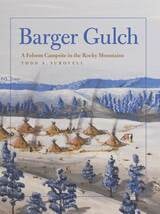
Barger Gulch
A Folsom Campsite in the Rocky MountainsTodd A. Surovell
University of Arizona Press, 2022
The best archaeological sites are those that present problems and inspire research, writes Surovell. From the start, the Folsom site called Barger Gulch Locality B was one of those sites; it was a problem-rich environment. Many Folsom sites are sparse scatters of stone and bone, a reflection of a mobile lifestyle that leaves little archaeological materials. The people at Barger Gulch left behind tens of thousands of pieces of chipped stone; they appeared to have spent quite a bit of time there in comparison to other places they inhabited.
Summarizing findings from nine seasons of excavations, Surovell explains that the site represents a congregation of mobile hunter-gatherers who spent winter along Barger Gulch, a tributary of the Colorado River. Surovell uses spatial patterns in chipped stone to infer the locations of hearths and house features. He examines the organization of household interiors and discusses differential use of interior and exterior spaces. Data allow inference about the people who lived at the site, including aspects of the identity of flintknappers and household versus group mobility. The site shows evidence of a Paleoindian camp circle, child flintknapping, household production of weaponry, and the fission/fusion dynamics of group composition that is typical of nomadic peoples.
Barger Gulch provides key findings on Paleoindian technological variation and spatial and social organization.
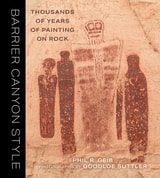
Barrier Canyon Style
Thousands of Years of Painting on RockPhil R. Geib and Goodloe Suttler
University of Utah Press, 2024
Barrier Canyon Style begins with a vicarious tour of twenty of the most important BCS sites. High-quality photographs by Goodloe Suttler accompany text by Phil R. Geib, an expert in rock imagery and archaic time-period archaeology. The volume provides explanations of motif classifications and their meanings, as well as details on the chronology of human occupation in the area, the array of techniques used by Native people to leave marks upon rock surfaces, and a consideration of styles and subject matter observable in these artworks.
Beast
Benjamin B. Lindsey
University Press of Colorado, 2009
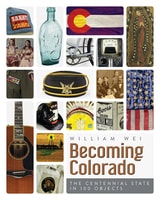
Becoming Colorado
The Centennial State in 100 ObjectsWilliam Wei
University Press of Colorado, 2021
In Becoming Colorado, historian William Wei paints a vivid portrait of Colorado history using 100 of the most compelling artifacts from Colorado’s history. These objects reveal how Colorado has evolved over time, allowing readers to draw multiple connections among periods, places, and people. Collectively, the essays offer a treasure trove of historical insight and unforgettable detail.
Beginning with Indigenous people and ending in the early years of the twenty-first century, Wei traces Colorado’s story by taking a close look at unique artifacts that bring to life the cultures and experiences of its people. For each object, a short essay accompanies a full-color photograph. These accessible accounts tell the human stories behind the artifacts, illuminating each object’s importance to the people who used it and its role in forming Colorado’s culture. Together, they show how Colorado was shaped and how Coloradans became the people they are. Theirs is a story of survival, perseverance, enterprise, and luck.
Providing a fresh lens through which to view Colorado’s past, Becoming Colorado tells an inclusive story of the Indigenous and the immigrant, the famous and the unknown, the vocal and the voiceless—for they are all Coloradans.
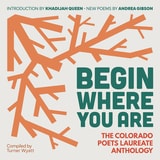
Begin Where You Are
The Colorado Poets Laureate AnthologyTurner Wyatt
University Press of Colorado, 2025
This book contains celebrated works from Thomas Hornsby Ferril and others, alongside never-before-published pieces from Bobby LeFebre, Joseph Hutchison, David Mason, and Mary Crow. Contemporary poets offer perspectives on how serving as Colorado poet laureate shaped their writing and worlds.
Spearheaded by award-winning social entrepreneur Turner Wyatt, this book is a movement with a mission: A portion of the proceeds will fund poetry programming in underserved Colorado schools, libraries, and rural areas, making each purchase an investment in expanding access to this essential art form.
Featured poets: Andrea Gibson, Bobby LeFebre, Joseph Hutchison, David Mason, Mary Crow, Thomas Hornsby Ferril, Milford E. Shields, Margaret Clyde Robertson, Nellie Burget Miller, Alice Polk Hill

Below Grass Roots
A NovelFrank Waters
Ohio University Press, 2002
In Below Grass Roots, the second book in Frank Waters’s Pikes Peak saga, turn-of-the-century Colorado Springs is prospering with the mining boom and a growing tourist industry. Patriarch Joseph Rogier becomes ever more obsessed with the treasures of the towering mountain and tries to enlist his son-in-law Jonathan Cable in his mining schemes. Cable instead leaves for Navajo country with his young son. Rogier, convinced that new wealth lies deep within the mountain, below grass roots, sinks his mines and what remains of his fortune ever deeper into the mountain’s granite.
As in the other two novels in this semiautobiographical saga, Waters’s masterful narrative draws on his own keen perception of the human condition to bring us this compelling tale of struggle and hope in the American West.
Pike’s Peak is composed of three condensed novels: The Wild Earth’s Nobility, Below Grass Roots, and The Dust within the Rock.
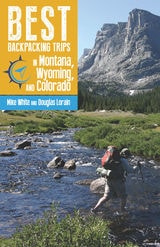
Best Backpacking Trips in Montana, Wyoming, and Colorado
Mike White
University Press of Colorado, 2019
Best Backpacking Trips in Montana, Wyoming, and Colorado provides everything you need to know to organize and execute the best backpacking trips in the Mountain West. Mike White and Douglas Lorain, who have walked every mile of the trails described inside, take readers and hikers into some of the wildest and most scenic backcountry landscapes in the nation and help them design the ultimate trip.
Focusing on one-week excursions, the book offers details on all the aspects of trip planning—trail narratives, technical data, maps, gear, food, information on regulations and permits, and more. But it is more than a basic guidebook. Trip information is enriched by valuable and interesting sidebars on history and ecology that will increase appreciation for these natural areas and the people who were instrumental in their discovery or protection.
In Best Backpacking Trips in Montana, Wyoming, and Colorado, White and Lorain pass on their knowledge of quality hikes, planning and preparation, and the unique satisfaction of multi-day backpacking. This guide, put into practice, will result in the trip of a lifetime.
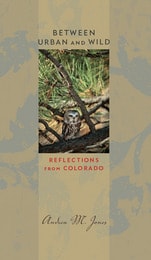
Between Urban and Wild
Reflections from ColoradoAndrea M. Jones
University of Iowa Press, 2013
Although not intended as a manual for landowners, Between Urban and Wild nonetheless offers useful and engaging perspectives on the realities of settling and living in a partially wild environment. Throughout her ongoing journey of being home, Jones’s close observations of the land and its native inhabitants are paired with the suggestion that even small landholders can act to protect the health of their properties. Her brief meditations capture and honor the subtleties of the natural world while illuminating the importance of working to safeguard it.
Probing the contradictions of a lifestyle that burdens the health of the land that she loves, Jones’s writing is permeated by her gentle, earnest conviction that living at the urban-wild interface requires us to set aside self-interest, consider compromise, and adjust our expectations and habits—to accommodate our surroundings rather than force them to accommodate us.
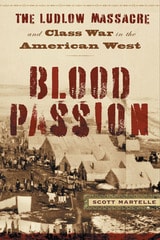
Blood Passion
The Ludlow Massacre and Class War in the American West, First Paperback EditionScott Martelle
Rutgers University Press, 2008
By early April 1914, Colorado Governor Elias Ammons thought the violence in his state’s strike-bound southern coal district had eased enough that he could begin withdrawing the Colorado National Guard, deployed six months earlier as military occupiers. But Ammons misread the signals, and on April 20, 1914, a full-scale battle erupted between the remaining militiamen and armed strikers living in a tent colony at the small railroad town of Ludlow. Eight men were killed in the fighting, which culminated in the burning of the colony. The next day, the bodies of two women and eleven children were found suffocated in a below-ground shelter. The “Ludlow Massacre,” as it quickly became known, launched a national call-to-arms for union supporters to join a ten-day guerrilla war along more than two hundred miles of the eastern Rockies. The convulsion of arson and violence killed more than thirty people and didn’t end until President Woodrow Wilson sent in the U.S. Army. Overall at least seventy-five men, women, and children were killed in seven months, likely the nation’s deadliest labor struggle.
In Blood Passion, journalist Scott Martelle explores this little-noted tale of political corruption and repression and immigrants’ struggles against dominant social codes of race, ethnicity, and class. More than a simple labor dispute, the events surrounding Ludlow embraced some of the most volatile social movements of the early twentieth century, pitting labor activists, socialists, and anarchists against the era’s powerful business class, including John D. Rockefeller, Jr., and helped give rise to the modern twins of corporate public relations and political “spin.” But at its heart, Blood Passion is the dramatic story of small lives merging into a movement for change and of the human struggle for freedom and dignity.
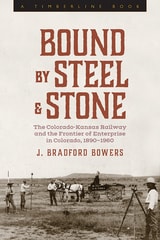
Bound by Steel and Stone
The Colorado-Kansas Railway and the Frontier of Enterprise in Colorado, 1890-1960J. Bradford Bowers
University Press of Colorado, 2022
Offering the Colorado-Kansas Railway as an example of how shortline railroads helped to integrate the rural landscape with the larger urban and economic world, Bowers reveals the constant adaptations driven by changing economic forces and conditions. He puts the railway in context of the wider environmental and political landscapes, the growing quarrying and mining business, the expansion of agriculture and irrigation, Progressive-era political reforms, and land development. In the new frontier of enterprise in the early twentieth-century American West, the railroad highlights the successes and failures of the men inspired to pursue these new opportunities as well as the story of one woman who held these fragile industries together well into the second half of the twentieth century.
Bound by Steel and Stone is an insightful addition to the history of industrialization and economic development in Colorado and the American West.
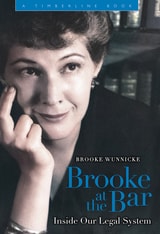
Brooke at the Bar
Inside Our Legal SystemBrooke Wunnicke
University Press of Colorado, 2023
Brooke shares vignettes of her early life—California in the Great Depression, college at Stanford, law school in Colorado during World War II, and the 1946 opening of her Cheyenne law office, a precedent for women in law. She vividly describes memorable and amusing experiences with clients, witnesses, lawyers, juries, and judges and explains some significant cases. She recounts important and dynamic events from her twelve years as Denver’s chief appellate deputy district attorney, an era during which she was an inestimable mentor to many young lawyers who became prominent in the private and public sectors.
Brooke passionately believed “the law has been and will continue to be civilization’s hope.” In her book’s final part, she demystifies many legal terms and procedures and describes the parts of a civil jury trial—including information for jurors and witnesses—and provides an enthusiastic and clear refresher on the US Constitution and Bill of Rights.
Brooke at the Bar is a unique and historically important contribution that will be of interest to general readers, scholars, and students interested in US law, political science, government, women’s history, twentieth-century western history, civil rights, and legal communities, including those in Wyoming and Colorado, where Brooke was “at the Bar.”