Results by title
144 books match the query 'Communication' and 5 start with b

Bad Aboriginal Art
Tradition, Media, and Technological HorizonsEric Michaels
University of Minnesota Press, 1994
Bad Aboriginal Art is the extraordinary account of Eric Michaels’ period of residence and work with the Warlpiri Aborigines of western Central Australia, where he studied the impact of television on remote Aboriginal communities.
Sharp, exact, and unrelentingly honest, Michaels records with an extraordinary combination of distance and immersion the intervention of technology into a remote Aboriginal community and that community’s forays into the technology of broadcasting. Michaels’s analyses in Bad Aboriginal Art will disrupt and redirect current debates surrounding the theory and practice of anthropology, ethnography, film and video making, communications policy, and media studies - no less than his work has already disrupted and redirected the cultural technologies of both the Warlpiri and Australian technocrats.
Badass Feminist Politics
Exploring Radical Edges of Feminist Theory, Communication, and ActivismSarah Jane Blithe
Rutgers University Press, 2022
Badass Feminist Politics includes a diverse range of engaging feminist political projects to not only analyze the work being done on the ground but provide an overview for action that can be taken on by those seeking to engage in feminist activism in their own communities. Contributors included here are working for equality and equity and resisting violent, racist, homophobic, transphobic, xenophobic, and sexist language and action during this tension-filled political moment. Collectively, the book explores what it means to live and communicate feminist politics in everyday choices and actions, and how we can facilitate learning by analyzing these examples. Taking up current issues and new theoretical perspectives, the authors offer novel perspectives into what it means to live feminist politics. This book is a testament to resilience, resistance, communication, and forward thinking about what these themes all mean for new feminist agendas. Learning how to resist oppressive structures through words and actions is particularly important for students. Badass Feminist Politics features scholars from non-dominant groups taking up issues of marginalization and oppression, which can help people accomplish their social justice goals of inclusivity on the ground and in the classroom.

Black Identity
Rhetoric, Ideology, and Nineteenth-Century Black NationalismDexter B. Gordon
Southern Illinois University Press, 2006
Exploring the role of rhetoric in African American identity and political discourse
Dexter B. Gordon’s Black Identity: Rhetoric, Ideology, and Nineteenth-Century Black Nationalism explores the problem of racial alienation and the importance of rhetoric in the formation of black identity in the United States. Faced with alienation and disenfranchisement as a part of their daily experience, African Americans developed collective practices of empowerment that cohere as a constitutive rhetoric of black ideology. Exploring the origins of that rhetoric, Gordon reveals how the ideology of black nationalism functions in contemporary African American political discourse.
Rooting his study in the words and works of nineteenth-century black abolitionists such as Maria Stewart, David Walker, and Henry Garnet, Gordon explores the rapprochement between rhetorical theory, race, alienation, and the role of public memory in identity formation. He argues that abolitionists used language in their speeches, pamphlets, letters, petitions, and broadsides that established black identity in ways that would foster liberation and empowerment. The arguments presented here constitute the only sustained treatment of nineteenth-century black activists from a rhetorical perspective.
Gordon demonstrates the pivotal role of rhetoric in African American efforts to create a viable public voice. Understanding nineteenth-century black alienation—and its intersection with twentieth-century racism—is crucial to understanding the continued sense of alienation that African Americans express about their American experience. Gordon explains how the ideology of black nationalism disciplines and describes African American life for its own ends, exposing a central piece of the ideological struggle for the soul of America. The book is both a platform for further discussion and an invitation for more voices to join the discourse as we search for ways to comprehend the sense of alienation experienced and expressed by African Americans in contemporary society.

Black and White Styles in Conflict
Thomas Kochman
University of Chicago Press, 1981
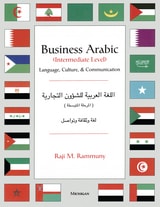
Business Arabic, Intermediate Level
Language, Culture and CommunicationRaji M. Rammuny
University of Michigan Press, 2000
The volume expects students to have control of basic vocabulary and grammatical structures that are typically covered in the first two years of Arabic instruction. Grammatical notes are given for review purposes, where necessary.