Results by title
126 books match the query 'Communism' and 5 start with b
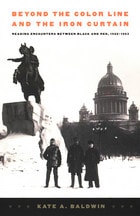
Beyond the Color Line and the Iron Curtain
Reading Encounters between Black and Red, 1922-1963Kate A. Baldwin
Duke University Press, 2002
Langston Hughes, W. E. B. Du Bois, Claude McKay, and Paul Robeson each lived or traveled extensively in the Soviet Union between the 1920s and the 1960s, and each reflected on Communism and Soviet life in works that have been largely unavailable, overlooked, or understudied. Kate A. Baldwin takes up these writings, as well as considerable material from Soviet sources—including articles in Pravda and Ogonek, political cartoons, Russian translations of unpublished manuscripts now lost, and mistranslations of major texts—to consider how these writers influenced and were influenced by both Soviet and American culture. Her work demonstrates how the construction of a new Soviet citizen attracted African Americans to the Soviet Union, where they could explore a national identity putatively free of class, gender, and racial biases. While Hughes and McKay later renounced their affiliations with the Soviet Union, Baldwin shows how, in different ways, both Hughes and McKay, as well as Du Bois and Robeson, used their encounters with the U. S. S. R. and Soviet models to rethink the exclusionary practices of citizenship and national belonging in the United States, and to move toward an internationalism that was a dynamic mix of antiracism, anticolonialism, social democracy, and international socialism.
Recovering what Baldwin terms the "Soviet archive of Black America," this book forces a rereading of some of the most important African American writers and of the transnational circuits of black modernism.
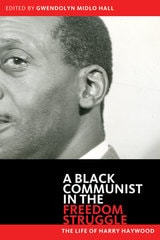
Black Communist in the Freedom Struggle
The Life of Harry HaywoodHarry Haywood
University of Minnesota Press, 2012
Mustering out of the U.S. army in 1919, Harry Haywood stepped into a battle that was to last the rest of his life. Within months, he found himself in the middle of one of the bloodiest race riots in U.S. history and realized that he’d been fighting the wrong war—the real enemy was right here at home. This book is Haywood’s eloquent account of coming of age as a black man in twentieth-century America and of his political awakening in the Communist Party.
For all its cultural and historical interest, Harry Haywood’s story is also noteworthy for its considerable narrative drama. The son of parents born into slavery, Haywood tells how he grew up in Omaha, Nebraska, found his first job as a shoeshine boy in Minneapolis, then went on to work as a waiter on trains and in restaurants in Chicago. After fighting in France during the war, he studied how to make revolutions in Moscow during the 1920s, led the Communist Party’s move into the Deep South in 1931, helped to organize the campaign to free the Scottsboro Boys, worked with the Sharecroppers’ Union, supported protests in Chicago against Mussolini’s invasion of Ethiopia, fought with the International Brigades in Spain, served in the Merchant Marines during World War II, and continued to fight for the right of self-determination for the Afro-American nation in the United States until his death in 1985.
This new edition of his classic autobiography, Black Bolshevik, introduces American readers to the little-known story of a brilliant thinker, writer, and activist whose life encapsulates the struggle for freedom against all odds of the New Negro generation that came of age during and after World War I.
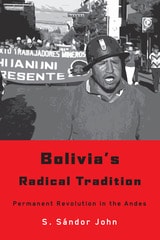
Bolivia's Radical Tradition
Permanent Revolution in the AndesS. Sándor John
University of Arizona Press, 2012
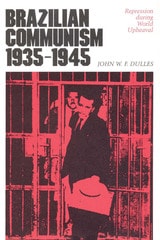
Brazilian Communism, 1935-1945
Repression during World UpheavalBy John W. F. Dulles
University of Texas Press, 1983
The Brazilian Communist Party was one of the largest Communist parties in Latin America until its split and dissolution in the 1990s. Although not granted legal status as a political party of Brazil until 1985, the Partido Comunista Brasileiro (PCB) has been tolerated by that country's regime.
Such governmental tolerance of the PCB was not always the case. In the past, the regime of Getúlio Vargas practiced savage forms of repression against Brazilian leftists, whose "Red extremism" was cited by both government leaders and the press as sufficient cause for Vargas' adoption of the most extreme measures.
Brazilian Communism, 1935–1945 is an objective and remarkably comprehensive account of the Brazilian Communist Party's struggle to survive those days of repression.
From his prison cell, PCB leader Luís Carlos Prestes guided the Party's quarreling factions. All who were associated with the Left shared a common enemy: the police, who used the most brutal forms of torture to extract information about leftist activities. Young Elza Fernandes, companion of the PCB's secretary general, was one whom the police interrogated. Suspecting that she had betrayed them, the Party itself arranged her murder.
Dulles' vivid account of this violent chapter in Latin American history is based on exclusive interviews with leading activists of the period and exhaustive research in the archives of both the PCB and the Brazilian police. The results make fascinating reading for Latin Americanists, historians of World War II, and students of international Communism alike.
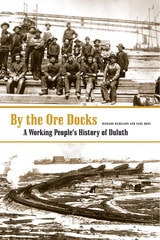
By The Ore Docks
A Working People’s History Of DuluthRichard Hudelson
University of Minnesota Press, 2006
In By the Ore Docks, Richard Hudelson and Carl Ross trace seventy years in the lives of Duluth’s multi-ethnic working class—Scandinavians, Finns, Italians, Poles, Irish, Jews, and African Americans—and chronicle, along with the events of the times, the city’s vibrant neighborhoods, religious traditions, and communities. But they also tell the dramatic story of how a populist worker’s coalition challenged the “legitimate American” business interests of the city, including the major corporation U.S. Steel.
From the Knights of Labor in the 1880s to the Industrial Workers of the World, the AFL and CIO, and the Democratic Farmer-Labor party, radical organizations and their immigrant visionaries put Duluth on the national map as a center in the fight for worker’s rights—a struggle inflamed by major strikes in the copper and iron mines.
By the Ore Docks is at once an important history of Duluth and a story of its working people, common laborers as well as union activists like Ernie Pearson, journalist Irene Paull, and Communist party gubernatorial candidate Sam Davis. Hudelson and Ross reveal tension between Duluth’s ethnic groups, while also highlighting the ability of the people to overcome those differences and shape the legacy of the city’s unsettled and remarkable past.
Richard Hudelson is professor of philosophy at the University of Wisconsin, Superior. He is the author of, among other works, Marxism and Philosophy in the Twentieth Century and The Rise and Fall of Communism.
Carl Ross (1913–2004) was a labor activist and the author of The Finn Factor in American Labor, Culture, and Society. He was director of the Twentieth-Century Radicalism in Minnesota Project of the Minnesota Historical Society.