Results by title
105 books match the query 'Community life' and 9 start with b
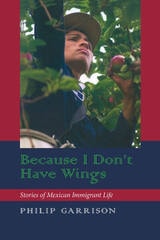
Because I Don't Have Wings
Stories of Mexican Immigrant LifePhilip Garrison
University of Arizona Press, 2006
Philip Garrison has spent most of his life in this region and shares in vivid prose tales of immigrant life, both contemporary and historical, revealing the dual lives of first-generation Mexican immigrants who move smoothly between the Yakima Valley and their homes in Mexico. And with a scholar’s eye he examines figures of speech that reflect mexicano feelings about immigrant life, offering glimpses of adaptation through offhand remarks, family spats, and town gossip.
Written with irony but bursting with compassion, Because I Don’t Have Wings features vivid characters, telling anecdotes, and poignant reflections on life, unfolding an immigrant’s world strikingly different from the one we usually read about. Adaptation, persistence, and survival, we learn, are traits that mexicano culture values. We also learn that, over time, mexicano immigrants don’t merely adapt to the culture of el norte, they transform it.
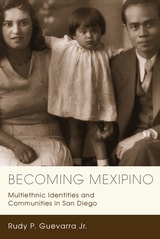
Becoming Mexipino
Multiethnic Identities and Communities in San DiegoGuevarra, Rudy P
Rutgers University Press, 2012
Through racially restrictive covenants and other forms of discrimination, both groups, regardless of their differences, were confined to segregated living spaces along with African Americans, other Asian groups, and a few European immigrant clusters. Within these urban multiracial spaces, Mexicans and Filipinos coalesced to build a world of their own through family and kin networks, shared cultural practices, social organizations, and music and other forms of entertainment. They occupied the same living spaces, attended the same Catholic churches, and worked together creating labor cultures that reinforced their ties, often fostering marriages. Mexipino children, living simultaneously in two cultures, have forged a new identity for themselves. Their lives are the lens through which these two communities are examined, revealing the ways in which Mexicans and Filipinos interacted over generations to produce this distinct and instructive multiethnic experience. Using archival sources, oral histories, newspapers, and personal collections and photographs, Guevarra defines the niche that this particular group carved out for itself.
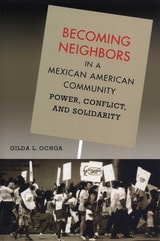
Becoming Neighbors in a Mexican American Community
Power, Conflict, and SolidarityBy Gilda L. Ochoa
University of Texas Press, 2004
On the surface, Mexican Americans and Mexican immigrants to the United States seem to share a common cultural identity but often make uneasy neighbors. Discrimination and assimilationist policies have influenced generations of Mexican Americans so that some now fear that the status they have gained by assimilating into American society will be jeopardized by Spanish-speaking newcomers. Other Mexican Americans, however, adopt a position of group solidarity and work to better the social conditions and educational opportunities of Mexican immigrants.
Focusing on the Mexican-origin, working-class city of La Puente in Los Angeles County, California, this book examines Mexican Americans' everyday attitudes toward and interactions with Mexican immigrants—a topic that has so far received little serious study. Using in-depth interviews, participant observations, school board meeting minutes, and other historical documents, Gilda Ochoa investigates how Mexican Americans are negotiating their relationships with immigrants at an interpersonal level in the places where they shop, worship, learn, and raise their families. This research into daily lives highlights the centrality of women in the process of negotiating and building communities and sheds new light on identity formation and group mobilization in the U.S. and on educational issues, especially bilingual education. It also complements previous studies on the impact of immigration on the wages and employment opportunities of Mexican Americans.
Becoming Villagers
Comparing Early Village SocietiesEdited by Matthew S. Bandy and Jake R. Fox
University of Arizona Press, 2010
Based on a Society for American Archaeology symposium and subsequent Amerind Advanced Seminar in 2006, Becoming Villagers examines this transformation at various places and times across the globe by focusing not on the origins of agriculture and village life but rather on their consequences. The goal of the volume is to identify regularities in the ways that societies developed in the centuries and millennia following a transition to village life. Using cases that range from China to Bolivia and from the Near East to the American Southwest, leading archaeologists situate their specific areas of specialization in a broad comparative context.
They consider the forces acting to divide and fragment early villages and the social technologies and practices by which those obstacles were, in some cases, overcome. Finally, the volume examines the long-term historical trajectories of these early village societies.
This transformative collection makes a powerful case for a renewed and invigorated archaeological focus on large-scale comparative studies. It will be an essential read for anyone interested not only in early village societies but also in the ways in which archaeology relates to anthropology, other social sciences, and history.
CONTENTS:
- “Becoming Villagers: The Evolution of Early Village Societies,” Matthew S. Bandy and Jake R. Fox
- “Population Growth, Village Fissioning, and Alternative Early Village Trajectories,” Matthew S. Bandy
- “A Scale Model of Seven Hundred Years of Farming Settlements in Southwestern Colorado,” Timothy A. Kohler and Mark D. Varien
- “‘Great Expectations,’ or the Inevitable Collapse of the Early Neolithic in the Near East,” Nigel Goring-Morris and Anna Belfer-Cohen
- “‘Ritualization’ in Early Village Society: The Case of the Lake Titicaca Basin Formative,” Amanda B. Cohen
- “The Sacred and the Secular Revisited: The Essential Tensions of Early Village Society in the Southeastern United States,” Thomas Pluckhahn
- “Substantial Structures, Few People, and the Question of Early Villages in the Mimbres Region of the North American Southwest,” Patricia A. Gilman
- “Sea Changes in Stable Communities: What Do Small Changes in Practices at Catalhoyuk and Chiripa Imply about Community Making?” Christine A. Hastorf
- “The Emergence of Early Villages in the American Southwest: Cultural Issues and Historical Perspectives,” Richard H. Wilshusen and James M. Potter
- “A Persistent Early Village Settlement System on the Bolivian Southern Altiplano,” Jake R. Fox
- “First Towns in the Americas: Searching for Agriculture, Population Growth, and Other Enabling Conditions,” John E. Clark, Jon L. Gibson, and James Zeidler
- “The Evolution of Early Yangshao Period Village Organization in the Middle Reaches of Northern China's Yellow River Valley,” Christian E. Peterson and Gideon Shelach
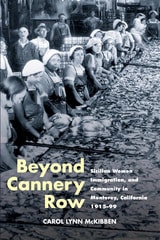
Beyond Cannery Row
Sicilian Women, Immigration, and Community in Monterey, California, 1915-99Carol Lynn McKibben
University of Illinois Press, 2005
McKibben's analysis of gender and gender roles shows that it was the women in this community who had the insight, the power, and the purpose to respond and even prosper amid changing economic conditions. Vividly evoking the immigrants' everyday experiences through first-person accounts and detailed description, McKibben demonstrates that the cannery work done by Sicilian immigrant women was crucial in terms of the identity formation and community development. These changes allowed their families to survive the challenges of political conflicts over citizenship in World War II and intermarriage with outsiders throughout the migration experience. The women formed voluntary associations and celebrated festas that effectively linked them with each other and with their home villages in Sicily. Continuous migration created a strong sense of transnationalism among Sicilians in Monterey, which has enabled them to continue as a viable ethnic community today.
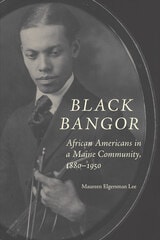
Black Bangor
African Americans in a Maine Community, 1880-1950Maureen Elgersman Lee
University of New Hampshire Press, 2005
Blacks have lived and worked in Maine as early as the seventeenth century, but historically have constituted less than one percent of Maine's population. Probably for this reason, books on Blacks in New England have largely ignored the experience of African American Mainers. Black Bangor is the first major published study of a Black community in Maine.
This tightly woven case study examines the African American community in Bangor during its heyday, 1880–1950, the period that saw an unprecedented migration of Blacks to that city. Blacks migrated to Bangor not just from other New England states, but from the Caribbean and Canadian Maritime Provinces as well, creating a heterogeneous community with roots in two hemispheres. Constituting an “ultraminority” in Bangor (according to the census, Blacks never numbered more than 300 souls during this period), this diverse community nonetheless came together to establish an impressive range of institutions, including local chapters of the NAACP and Odd Fellows, as well as of Mothers and Junior Mothers Clubs. Concentrated in an area known as the Parker Street neighborhood, Black women in Bangor became domestics and cooks, caterers and beauticians, clerks and stenographers. Men worked as loggers, teamsters, porters, chefs, and barbers; a few owned businesses.
Organized thematically, with sections on migration, labor, daily life, and community, Black Bangor's topics include not just migration patterns, work, and religious and cultural organizations, but also African American homes, furniture, clothing, and foodways. Elgersman Lee also examines race relations and depictions of Blacks in the local media, and draws comparisons between the experiences of Bangor's African American population and those of Blacks in other New England cities.
This fascinating and exhaustive study will appeal to anyone from Maine, as well as those interested in African American history and the rich texture of the region's cultural life.
Black on the Block
The Politics of Race and Class in the CityMary Pattillo
University of Chicago Press, 2007
“To see how diversity creates strange and sometimes awkward bedfellows . . . turn to Mary Pattillo's Black on the Block.”—Boston Globe

Bridging the Distance
Common Issues of the Rural WestDavid B. Danbom
University of Utah Press, 2015
The essays in Bridging the Distance are fresh, informative, and insightful examinations of the complex problems facing the rural West. This is a book that will spur both conversations and the search for solutions.
Building Diaspora
Filipino Cultural Community Formation on the InternetIgnacio, Emily N
Rutgers University Press, 2004
In Building Diaspora, Emily Noelle Ignacio explores how Filipinos have used these subtle, cyber, but very real social connections to construct and reinforce a sense of national, ethnic, and racial identity with distant others. Through an extensive analysis of newsgroup debates, listserves, and website postings, she illustrates the significant ways that computer-mediated communication has contributed to solidifying what can credibly be called a Filipino diaspora. Lively cyber-discussions on topics including Eurocentrism, Orientalism, patriarchy, gender issues, language, and "mail-order-brides" have helped Filipinos better understand and articulate their postcolonial situation as well as their relationship with other national and ethnic communities around the world. Significant attention is given to the complicated history of Philippine-American relations, including the ways Filipinos are racialized as a result of their political and economic subjugation to U.S. interests.
As Filipinos and many other ethnic groups continue to migrate globally, Building Diaspora makes an important contribution to our changing understanding of "homeland." The author makes the powerful argument that while home is being further removed from geographic place, it is being increasingly territorialized in space.