Results by title
851 books match the query 'Congresses' and 27 start with b
Banking Reform in Central Europe and the Former Soviet Union
Jacek Rostowski
Central European University Press, 1995
From Berlin to the Bering Strait, the business of banking has sprung to life. This analysis considers the impact of banking reform on macroeconomic stabilization and the suitability of universal banks, the role of banking regulation and the advantages of 'narrow banks' during transition, the cleaning up of bad debts, and the reform of the payments system.
The book assesses the lessons which can be drawn from reforms in Central Europe for the later reformers in the former Soviet Union and the Balkans. It considers the impact of banking reform on macroeconomic stabilization and the suitability of German-type universal banks; the role of banking regulation and the advantages of 'narrow banks' during transition; the cleaning-up of bad debts; bank privatization and reform of the payments system. Five chapters follow which review the experience of some of the 'second-wave' countries: Estonia, Georgia, Romania, Russia and Ukraine.
Bankruptcy's Universal Pragmatist
Festschrift in Honor of Jay WestbrookChristoph G. Paulus and John A. E. Pottow, Editors
Michigan Publishing Services, 2021
Battle Against Extinction
Native Fish Management in the American WestEdited by W. L. Minckley and James E. Deacon; Foreword by Stewart L. Udall
University of Arizona Press, 1991
Nearly a third of the native fish fauna of North America lives in the arid West; this book traces their decline toward extinction as a result of human interference and the threat to their genetic diversity posed by decreases in their populations. What can be done to slow or end this tragedy? As the most comprehensive treatment ever attempted on the subject, Battle Against Extinction shows how conservation efforts have been or can be used to reverse these trends.
In covering fishes in arid lands west of the Mississippi Valley, the contributors provide a species-by-species appraisal of their status and potential for recovery, bringing together in one volume nearly all of the scattered literature on western fishes to produce a monumental work in conservation biology. They also ponder ethical considerations related to the issue, ask why conservation efforts have not proceeded at a proper pace, and suggest how native fish protection relates to other aspects of biodiversity planetwide. Their insights will allow scientific and public agencies to evaluate future management of these animal populations and will offer additional guidance for those active in water rights and conservation biology.
First published in 1991, Battle Against Extinction is now back in print and available as an open-access e-book thanks to the Desert Fishes Council.
Behavioral and Distributional Effects of Environmental Policy
Edited by Carlo Carraro and Gilbert E. Metcalf
University of Chicago Press, 2001
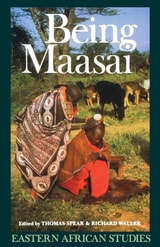
Being Maasai
Ethnicity and Identity In East AfricaThomas Spear
Ohio University Press, 1993
Everyone “knows” the Maasai as proud pastoralists who once dominated the Rift Valley from northern Kenya to central Tanzania.
But many people who identity themselves as Maasai, or who speak Maa, are not pastoralist at all, but farmers and hunters. Over time many different people have “become” something else. And what it means to be Maasai has changed radically over the past several centuries and is still changing today.
This collection by historians, archaeologists, anthropologists and linguists examines how Maasai identity has been created, evoked, contested, and transformed from the time of their earliest settlement in Kenya to the present, as well as raising questions about the nature of ethnicity generally.
Between Contacts and Colonies
Archaeological Perspectives on the Protohistoric SoutheastEdited by Cameron B. Wesson and Mark A. Rees
University of Alabama Press, 2002
This collection of essays brings together diverse approaches to the analysis of Native American culture in the protohistoric period
For most Native American peoples of the Southeast, almost two centuries passed between first contact with European explorers in the 16th century and colonization by whites in the 18th century—a temporal span commonly referred to as the Protohistoric period. A recent flurry of interest in this period by archaeologists armed with an improved understanding of the complexity of culture contact situations and important new theoretical paradigms has illuminated a formerly dark time frame.
This volume pulls together the current work of archaeologists, historians, and anthropologists to demonstrate a diversity of approaches to studying protohistory. Contributors address different aspects of political economy, cultural warfare, architecture, sedentism, subsistence, foods, prestige goods, disease, and trade. From examination of early documents by René Laudonnière and William Bartram to a study of burial goods distribution patterns; and from an analysis of Caddoan research in Arkansas and Louisiana to an interesting comparison of Apalachee and Powhatan elites, this volume ranges broadly in subject matter. What emerges is a tantalizingly clear view of the protohistoric period in North America.
Between Past and Future
The Revolution of 1989 and Their AftermathSorin Antohi
Central European University Press, 2000

Beyond Binary Histories
Re-imagining Eurasia to c. 1830Victor Lieberman, Editor
University of Michigan Press, 1999
The collaborators of this project show, in varying degrees, that political centralization in these areas reflected and inspired the creation of vernacular literatures at the expense of more universal languages. They illustrate that societies in widely separated areas, with no obvious links, became more literate, mobile, specialized, and commercial at roughly the same time. And they point out that administrative development in many of these same areas showed curiously synchronized cycles. Finally, having defined Eurasian parallels and sketched their limits, they push on to explore the underlying dynamics of these discoveries, scrutinizing the role of guns, global climate, markets, new information networks, institutional pressures, and sixteenth-century messianism.
Insofar as similarities between some European and Asian areas exceeded those between different sectors of Asia, this collection invites historians to reject continental perspectives in favor of more thematic, contextually-specific categories. But at the same time, it raises the possibility of a broad "early modern" period for Eurasia at large.
The contributors are Mary Elizabeth Berry (University of California, Berkeley), Peter Carey (University of Oxford), James B. Collins (Georgetown University), Valerie Kivelson (University of Michigan), R. I. Moore (University of Newcastle upon Tyne), Sanjay Subrahmanyam (Ecole des Hautes Etudes en Sciences Sociales, Paris), John K. Whitemore (University of Michigan), and David K. Wyatt (Cornell University).

Beyond Pluralism
The Conception of Groups and Group Identities in AmericaEdited by Wendy F. Katkin, Ned Landsman, and Andrea Tyree
University of Illinois Press, 1998
melting pot, people come in all persuasions. This volume attempts to bridge
the gap that has developed between pluralists and multiculturalists, advocates
of the academic canon and defenders of diversity, celebrants of ethnic
heritage and critics of racial ascription. Contributors explore the nation's
pluralistic framework as a historical creation, looking at group relations
in the United States and how they have been conceptualized in the past.
Beyond Preservation
Restoring and Inventing LandscapesDwight Baldwin
University of Minnesota Press, 1994
Beyond Preservation was first published in 1993. Minnesota Archive Editions uses digital technology to make long-unavailable books once again accessible, and are published unaltered from the original University of Minnesota Press editions.
Addressing current ecological issues, from the philosophical to the practical, Frederick Turner and William R. Jordan III Here offer a new paradigm for understanding the relationship between the humans and nature. Challenging the idea that preserving nature is the only solution to environmental problems, they advocate going beyond preservation to restoration and actual construction of our landscape. Fifteen respondents reflect on the implications and consequences of Turner’s and Jordan’s bold proposals.“Ecological restoration is the most helpful and provocative contribution to our thinking about nature to come along in many years, and Beyond Preservation is without a doubt the best book on the subject to date.” Michael Polan, Harper’sContributors include Gary W. Barrett, Ann Cline, David L. Gorchov, William Jordan III, G. Stanley Kane, Jack Temple Kirby, Dora G. Lodwick, Orie L. Loucks, Kimberly E. Medley, Constance Pierce, Ellen Price, Frederick Turner, John E. Wierwille, and Gene E. Willeke.
Beyond The Good Earth
Transnational Perspectives on Pearl S. BuckJay Cole
West Virginia University Press, 2019
How well do we really know Pearl S. Buck? Many think of Buck solely as the Nobel laureate and Pulitzer Prize–winning author of The Good Earth, the novel that explained China to Americans in the 1930s. But Buck was more than a novelist and interpreter of China. As the essays in Beyond The Good Earth show, she possessed other passions and projects, some of which are just now coming into focus.
Who knew, for example, that Buck imagined and helped define multiculturalism long before it became a widely known concept? Or that she founded an adoption agency to locate homes for biracial children from Asia? Indeed, few are aware that she advocated successfully for a genocide convention after World War II and was ahead of her time in envisioning a place for human rights in American foreign policy. Buck’s literary works, often dismissed as simple portrayals of Chinese life, carried a surprising degree of innovation as she experimented with the styles and strategies of modernist artists.
In Beyond The Good Earth, scholars and writers from the United States and China explore these and other often overlooked topics from the life of Pearl S. Buck, positioning her career in the context of recent scholarship on transnational humanitarian activism, women’s rights activism, and civil rights activism.
Beyond Winning
National Scholarship Competitions and the Student ExperienceSuzanne McCray
University of Arkansas Press, 2005
Beyond the City Limits
Urban Policy and Economics Restructuring in Comparative Perspectiveedited by John R. Logan and Todd Swanstrom
Temple University Press, 1991
This book challenges the notion that there is a single, global process of economic restructuring to which cities must submit. The studies in this volume compare urban development in the United States, Western Europe, and Japan, demonstrating that there is significant variety in urban economic restructuring. The contributors emphasize that the economic forces transforming cities from industrial concentrations to postindustrial service centers do not exist apart from politics: all nation-states are heavily involved in the restructuring process.
Contributors: Pierre Clavel, Susan Fainstein, Richard Child Hill, Nancy Kleniewski, Harvey L. Molotch, Michael Parkinson, Edmond Preteceille, Saskia Sassen, H. V. Savitch, John Walton, and the editors.
In the series Conflicts in Urban and Regional Development, edited by John R. Logan and Todd Swanstrom.
Bioarchaeological Studies of Life in the Age of Agriculture
A View from the SoutheastEdited by Patricia M. Lambert
University of Alabama Press, 2000
Investigations of skeletal remains from key archaeological sites reveal new data and offer insights on prehistoric life and health in the Southeast.
The shift from foraging to farming had important health consequences for prehistoric peoples, but variations in health existed within communities that had made this transition. This new collection draws on the rich bioarchaeological record of the Southeastern United States to explore variability in health and behavior within the age of agriculture. It offers new perspectives on human adaptation to various geographic and cultural landscapes across the entire Southeast, from Texas to Virginia, and presents new data from both classic and little-known sites.
The contributors question the reliance on simple cause-and-effect relationships in human health and behavior by addressing such key bioarchaeological issues as disease history and epidemiology, dietary composition and sufficiency, workload stress, patterns of violence, mortuary practices, and biological consequences of European contact. They also advance our understanding of agriculture by showing that uses of maize were more varied than has been previously supposed.
Representing some of the best work being done today by physical anthropologists, this volume provides new insights into human adaptation for both archaeologists and osteologists. It attests to the heterogeneous character of Southeastern societies during the late prehistoric and early historic periods while effectively detailing the many factors that have shaped biocultural evolution.

Biology of the Arctic Charr
Proceedings of the International Symposium on Arctic CharrLionel Johnson
University of Manitoba Press, 1984

Biotelemetry X
Charles Amlaner
University of Arkansas Press, 1989
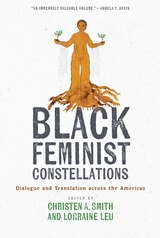
Black Feminist Constellations
Dialogue and Translation across the AmericasEdited by Christen A. Smith and Lorraine Leu
University of Texas Press, 2023
A collection of essays, interviews, and conversations by and between scholars, activists, and artists from Latin America and the Caribbean that paints a portrait of Black women's experiences across the region.
Black women in Latin America and the Caribbean suffer a triple erasure: as Black people, as women, and as non-English speakers in a global environment dominated by the Anglophone North. Black Feminist Constellations is a passionate and necessary corrective. Focused on and written by Black women of the southern Americas, the original works composing this volume make legible the epistemologies that sustain radical scholarship, art, and political organizing by Black women everywhere.
In essays, poems, and dialogues, the writers in Black Feminist Constellations reimagine liberation from the perspectives of radical South American and Caribbean Black women thinkers. The volume’s methodologically innovative approach reflects how Black women come together to theorize the world and challenges the notion that the university is the only site where knowledge can emerge. A major work of intellectual history, Black Feminist Constellations amplifies rarely heard voices, centers the uncanonized, and celebrates the overlooked work of Black women.

Black Holes and Relativistic Stars
Edited by Robert M. Wald
University of Chicago Press, 1998
Volume contributors: Valeria Ferrari, John L. Friedman, James B. Hartle, Stephen W. Hawking, Gary T. Horowitz, Werner Israel, Roger Penrose, Martin J. Rees, Rafael D. Sorkin, Saul A. Teukolsky, Kip S. Thorne, and Robert M. Wald.
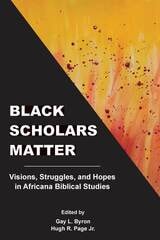
Black Scholars Matter
Visions, Struggles, and Hopes in Africana Biblical StudiesGay L. Byron
SBL Press, 2022
Distinctive, Powerful, Transformational
This book collects the presentations of twelve leading Africana scholars who participated in the groundbreaking #Black Scholars Matter virtual symposium held in August 2020 that was organized by the Society of Biblical Literature's Black Scholars Matter Task Force in coordination with the SBL’s Committee on Underrepresented Racial and Ethnic Minorities in the Profession. These scholars share their perspectives on biblical studies and their experiences in the discipline on a range of topics, including blatant and subtle forms of bias and racism; mentoring; lessons of struggle, sacrifice, and lack of support; reflections on the obstacles of national tragedies, geographical locations, and academic disciplines; and the challenges of creating a more welcoming environment for the next generation of Black biblical scholars. Eight additional contributors and stakeholders that have administrative and decision-making responsibilities within theological and other settings address the need for institutional and personal accountability. Contributors include Efraín Agosto, Cheryl B. Anderson, Randall C. Bailey, Gay L. Byron, Ronald Charles, Stephanie Buckhanon Crowder, Steed Vernyl Davidson, Sharon Watson Fluker, John F. Kutsko, Vanessa Lovelace, Madipoane Masenya (Ngwan'a Mphahlele), Raj Nadella, Hugh R. Page Jr., Adele Reinhartz, Kimberly D. Russaw, Abraham Smith, Shively T. J. Smith, Mai-Anh Le Tran, Renita J. Weems, and Vincent L. Wimbush.

Borderscapes
Hidden Geographies and Politics at Territory’s EdgePrem Kumar Rajaram
University of Minnesota Press, 2007
Connecting critical issues of state sovereignty with empirical concerns, Borderscapes interrogates the limits of political space. The essays in this volume analyze everyday procedures, such as the classifying of migrants and refugees, security in European and American detention centers, and the DNA sampling of migrants in Thailand, showing the border as a moral construct rich with panic, danger, and patriotism.
Conceptualizing such places as immigration detention camps and refugee camps as areas of political contestation, this work forcefully argues that borders and migration are, ultimately, inextricable from questions of justice and its limits.
Contributors: Didier Bigo, Institut d’Études Politiques, Paris; Karin Dean; Elspeth Guild, U of Nijmegen; Emma Haddad; Alexander Horstmann, U of Münster; Alice M. Nah, National U of Singapore; Suvendrini Perera, Curtin U of Technology, Australia; James D. Sidaway, U of Plymouth, UK; Nevzat Soguk, U of Hawai‘i; Decha Tangseefa, Thammasat U, Bangkok; Mika Toyota, National U of Singapore.
Prem Kumar Rajaram is assistant professor of sociology and social anthropology at the Central European University, Budapest, Hungary.
Carl Grundy-Warr is senior lecturer of geography at the National University of Singapore.
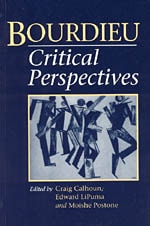
Bourdieu
Critical PerspectivesEdited by Craig Calhoun, Edward LiPuma, and Moishe Postone
University of Chicago Press, 1993
American reception of his works, however, has lacked a full understanding of their place within the broad context of French human science. His individual works separated by distinct boundaries between social science fields in American academia, Bourdieu's cohesive thought has come to this country in fragments.
Bourdieu: Critical Perspectives provides a unified and balanced appraisal of Bourdieu's varied works by both proponents and skeptics. The essays are written from the varied viewpoints of cultural anthropology, ethnomethodology and other varieties of sociology, existential and Wittgensteinian philosophies, linguistics, media studies, and feminism. They work around three main themes: Bourdieu's effort to transcend gaps between practical knowledge and universal structures, his central concept of "reflexivity," and the relations between social structure, systems of classification, and language.
Ultimately, the contributors raise a variety of crucial theoretical questions and address problems that are important not only to understanding Bourdieu but to advancing empirical work of the kind he has pioneered. In an essay written especially for this volume, Bourdieu describes his own "mode of intellectual production" and the reasons he sees for its common misunderstanding.
The contributors are Hubert Dreyfus, Paul Rabinow, Charles Taylor, Aaron Cicourel, James Collins, William Hanks, Beate Krais, Nicholas Garnham, Scott Lash, Roger Brubaker, and Loic Wacquant, and the editors.

Bridges to Fantasy
Essays from the Eaton Conference on Science Fiction and Fantasy LiteratureGeorge E Slusser
Southern Illinois University Press, 1982
Thirteen original essays written specifically for the second Eaton Conference on Science Fiction and Fantasy Literature, held February 23–24, 1980, at the University of California, Riverside.
These essays demonstrate the variety of fantasy forms and their pervasiveness throughout the ages and will stimulate further study of this complex and elusive mode. The essays—by Harold Bloom, writer and DeVane Professor of the Humanities at Yale University; Larry McCaffery, Assistant Professor of English at San Diego State University; Marta E. Sánchez, Instructor of English at the University of California, San Diego; Arlen J. Hansen, Professor of English at the University of the Pacific, Stockton; David Clayton, Instructor of Comparative Literatureat the University of California, San Diego; Robert Sale, writer and Professor of English at the University of Washington; G. Richard Thompson, Professor of English at Purdue University, West Lafayette; Robert A. Collins, Coordinator of the annual Swann Conference on the Fantastic and Instructor at Florida Atlantic University, Boca Raton; John Gerlach, Associate Professor of English at Cleveland State University; David Ketterer, writer and Professor of English at Concordia University, Montreal; George R. Guffey, Professor of English at the University of California, Los Angeles; Jack P. Rawlins, Associate Professor of English at California State University, Chico; and Gary Kern, writer and translator of early Soviet literature—examine fantasy on many levels of interest: as an element of human thought, as a constant factor in the social and intellectual environment, and as a generator of form in art and literature.
Bridges to Science Fiction
George E Slusser
Southern Illinois University Press, 1980
Ten new critical essays written for presentation at the first Eaton Conference on Science Fiction and Fantasy Literature held 24–25February 1979,at the University of California, Riverside.
While critical discussion of science fiction has become increasingly sophisticated during the past decade, there remains a tendency among some teachers and readers to consider science fiction as an independent phenomenon that exists unconnected to the mainstream of our cultural inheritance. These essays—by Harry Levin, Irving Babbitt Professor of Comparative Literature at Harvard University; Kent T. Kraft, Assistant Professor of Comparative Literature at the University of Georgia, Athens; Stephen Potts, writer and instructor at San Diego State University; Gregory Benford, writer and Associate Professor of Physics at the University of California, Irvine; Robert Hunt, an editor at Glencoe Publishing; Eric S. Rabkin, Professor of English at the University of Michigan; Patrick Parrinder, instructor at the University of Reading, England; Thomas Keeling, Lecturer in English at the University of California, Los Angeles; Carl D. Malmgren, instructor at the University of Oregon, Eugene; and Thomas Hanzo, Professor of English and Chairman of the department at the University of California, Davis—suggest the connections that exist between science fiction and other aspects of Western cultural tradition.
Ranging in interest from the specifically philosophical to the specifically literary, the essays relate science fiction to such topics as medieval cosmological discourse, classical empirical philosophy, fairy tale, epic, and Gothic fiction. Emerging from the volume as a whole are both a coherent view of science fiction as a genre and a heightened sense of its complex relation to our cultural heritage.
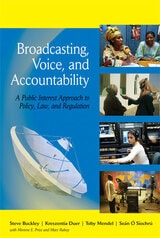
Broadcasting, Voice, and Accountability
A Public Interest Approach to Policy, Law, and RegulationSteve Buckley, Kreszentia Duer, Toby Mendel, and Seán Ó Siochrú
University of Michigan Press, 2008
---Ruth Teer-Tomaselli, UNESCO Chair in Communication for Southern Africa, Culture, Communication and Media Studies, University of KwaZulu-Natal
digitalculturebooks is an imprint of the University of Michigan Press and the Scholarly Publishing Office of the University of Michigan Library dedicated to publishing innovative and accessible work exploring new media and their impact on society, culture, and scholarly communication. Visit the website at www.digitalculture.org.

Budapest and New York
Studies in Metropolitan Transformation, 1870-1930Thomas Bender
Russell Sage Foundation, 1994
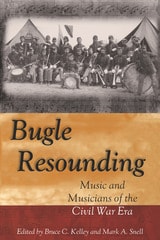
Bugle Resounding
Music and Musicians of the Civil War EraEdited by Bruce C. Kelley & Mark A. Snell
University of Missouri Press, 2004
Although numerous academic resources examine the music and musicians of the Civil War era, the research is spread across a variety of disciplines and is found in a wide array of scholarly journals, books, and papers. It is difficult to assimilate this diverse body of research, and few sources are dedicated solely to a rigorous and comprehensive investigation of the music and the musicians of this era. This anthology, which grew out of the first two National Conferences on Music of the Civil War Era, is an initial attempt to address that need.
Those conferences established the first academic setting solely devoted to exploring the effects of the Civil War on music and musicians. Bridging musicology and history, these essays represent the forefront of scholarship in music of the Civil War era. Each one makes a significant contribution to research in the music of this era and will ultimately encourage more interdisciplinary research on a subject that has relevance both for its own time and for ours. The result is a readable, understandable volume on one of the few understudied—yet fascinating—aspects of the Civil War era.
Business Cycles, Indicators, and Forecasting
Edited by James H. Stock and Mark W. Watson
University of Chicago Press, 1993