Results by title
123 books match the query 'Courts' and 2 start with b
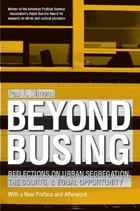
Beyond Busing
Reflections on Urban Segregation, the Courts, and Equal OpportunityPaul R. Dimond
University of Michigan Press, 2005
A compelling insider's account of the fight for educational desegregation, from one of its most dedicated and outspoken heroes. A new afterword explains the author's controversial belief that the moment for litigating educational equality has passed, clear-sightedly critiquing his own courtroom strategies and the courts' responses, before closing with an assessment of the economic and social changes that he feels have already moved us "beyond busing."
"An extraordinarily informative and thoughtful book describing the process of bringing Brown [v. Board of Education] North and the impact this process had upon national attitudes toward desegregation."
--Drew S. Days III, Yale Law Journal
"An original analysis of a tough subject. A must-read for all who care about opportunity for all our children."
--Donna E. Shalala, President, University of Miami
"Paul Dimond remains a passionate and caring voice for inner-city students, whether in his advocacy of school desegregation, school choice plans, or school finance reform. He illuminates these issues as one who participated in the major education cases and as a perceptive scholar."
--Mark Yudof, Chancellor, The University of Texas System
"A must-read for anyone who wants to understand America's continued failure to give inner-city children a quality education or to do something about it!"
--Sheryll Cashin, Author of The Failures of Integration: How Race and Class Are Undermining the American Dream
"Dimond is particularly good at relating his slice of legal history to the broader developments of the 1970s, and his occasional remarks about trial tactics are amusing and instructive. Dimond's
honesty about both his successes and failures makes his book required reading for civil rights lawyers."
--Lawrence T. Gresser, Michigan Law Review
"A fascinating first-hand account of 1970s northern school desegregation decisions."
--Neal E. Devins, American Bar Foundation Research Journal
"Dimond reminds the liberal reader of the promise that lies in the empowerment of ordinary families to choose their own schools."
--John E. Coons, Professor of Law, Emeritus, University of California, Berkeley
Paul R. Dimond is counsel to Miller, Canfield, Paddock and Stone, Michigan's largest law firm; chairman of McKinley, a national commercial real estate investment and management firm; and chairman or member of the board of trustees of numerous education, community, and civic organizations. He spent four years as President Clinton's Special Assistant for Economic Policy.
[more]

Bioethics in the Courts
Analyszing the Bioethical Jurisprudence of International and National CourtsJudit Sandor
Central European University Press, 2027
Courts worldwide are increasingly asked to resolve disputes that turn on bioethical questions: the moral status of embryos, the use of artificial reproductive technologies, or the boundaries of bodily autonomy. Yet the relationship between bioethics and judicial reasoning remains poorly understood. This volume examines how bioethical principles enter court decisions, identifying four distinct modes of interaction between the two fields and the challenges judges face in addressing scientific and moral complexity without specialist training. Drawing on case law from the European Court of Human Rights, the Court of Justice of the European Union, Brazil, South Africa, and Malaysia, the book traces a broader shift from judicial avoidance to more active engagement with bioethics. Bringing together leading legal and bioethical scholars, this timely collection offers the first sustained account of how courts across legal traditions navigate the widening gap between biomedical innovation and existing law, and the moral environment in which both operate. Amid the erosion of the rules-based international order, bioethics can help courts strengthen the humanistic approach in health care and biomedical research.
[more]