Results by title
115 books match the query 'Criminal Law' and 4 start with b
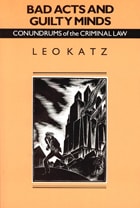
Bad Acts and Guilty Minds
Conundrums of the Criminal LawLeo Katz
University of Chicago Press, 1987
"Bad Acts and Guilty Minds . . . revives the mind, it challenges superficial analyses, it reminds us that underlying the vast body of statutory and case law, there is a rationale founded in basic notions of fairness and reason. . . . It will help lawyers to better serve their clients and the society that permits attorneys to hang out their shingles."—Edward N. Costikyan, New York Times Book Review

Beyond Criminology
Taking Harm SeriouslyEdited by Paddy Hillyard, Christina Pantazis, Dave Gordon and Steve Tombs
Pluto Press, 2004
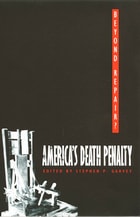
Beyond Repair?
America's Death PenaltyStephen P. Garvey, ed.
Duke University Press, 2003
A number of the essays scrutinize thinking about capital punishment. They examine why, following almost two decades of strong public support for the death penalty, public opinion in favor of it has recently begun to decline. Beyond Repair? presents some of the findings of the Capital Jury Project, a nationwide research initiative that has interviewed over one thousand people who served as jurors in capital trials. It looks at what goes through the minds of jurors asked to consider imposing the death penalty, how qualified they are to make such an important decision, and how well they understand the judge’s instructions. Contributors also investigate the risk of executing the innocent, the role that race plays in determining which defendants are sentenced to death, and the effect of expanded restrictions on access to federal appellate relief. The postscript contemplates the peculiarities of our contemporary system of capital punishment, including the alarming variance in execution rates from state to state.
Filled with current insights and analysis, Beyond Repair? will provide valuable information to attorneys, political scientists, criminologists, and all those wanting to participate knowledgeably in the debates about the death penalty in America.
Contributors. Ken Armstrong, John H. Blume, Theodore Eisenberg, Phoebe C. Ellsworth, Stephen P. Garvey, Samuel R. Gross, Sheri Lynn Johnson, Steve Mills, William A. Schabas, Larry W. Yackle, Franklin E. Zimring
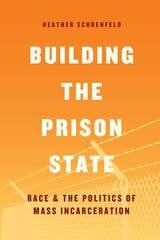
Building the Prison State
Race and the Politics of Mass IncarcerationHeather Schoenfeld
University of Chicago Press, 2018
Reframing the story of mass incarceration, Heather Schoenfeld illustrates how the unfinished task of full equality for African Americans led to a series of policy choices that expanded the government’s power to punish, even as they were designed to protect individuals from arbitrary state violence. Examining civil rights protests, prison condition lawsuits, sentencing reforms, the War on Drugs, and the rise of conservative Tea Party politics, Schoenfeld explains why politicians veered from skepticism of prisons to an embrace of incarceration as the appropriate response to crime. To reduce the number of people behind bars, Schoenfeld argues that we must transform the political incentives for imprisonment and develop a new ideological basis for punishment.