190 books match the query 'Critical theory' and 9 start with b
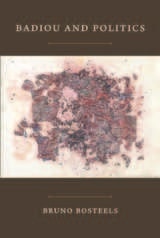
cover of Badiou and Politics

Badiou and Politics

Bruno Bosteels

Duke University Press, 2011
Badiou and Politics offers a much-anticipated interpretation of the work of the influential French philosopher Alain Badiou. Countering ideas of the philosopher as a dogmatic, absolutist, or even mystical thinker enthralled by the force of the event as a radical break, Bruno Bosteels reveals Badiou’s deep and ongoing investment in the dialectic. Bosteels draws on all of Badiou’s writings, from the philosopher’s student days in the 1960s to the present, as well as on Badiou’s exchanges with other thinkers, from his avowed “masters” Louis Althusser and Jacques Lacan, to interlocutors including Gilles Deleuze, Slavoj Žižek, Daniel Bensaïd, Jacques Derrida, Ernesto Laclau, and Judith Butler. Bosteels tracks the philosopher’s political activities from the events of May 1968 through his embrace of Maoism and the work he has done since the 1980s, helping to mobilize France’s illegal immigrants or sans-papiers. Ultimately, Bosteels argues for understanding Badiou’s thought as a revival of dialectical materialism, and he illuminates the philosopher’s understanding of the task of theory: to define a conceptual space for thinking emancipatory politics in the present.
[more]
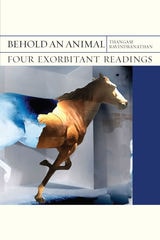
cover of Behold an Animal: Four Exorbitant Readings

Behold an Animal

Four Exorbitant Readings

Thangam Ravindranathan

Northwestern University Press, 2019

As animals recede from our world, what tale is being told by literature’s creatures? Behold an Animal: Four Exorbitant Readings examines incongruous animals in the works of four major contemporary French writers: an airborne horse in a novel by Jean-Philippe Toussaint, extinct orangutans in Éric Chevillard, stray dogs in Marie NDiaye, vanishing (bits of) hedgehogs in Marie Darrieussecq. Resisting naturalist assumptions that an animal in a story is simply—literally or metaphorically—an animal, Thangam Ravindranathan understands it rather as the location of something missing. The animal is a lure: an unfinished figure fleeing the frame, crossing bounds of period, genre, even medium and language. Its flight traces an exorbitant (self-)portrait in which thinking admits to its commerce with life and flesh. It is in its animals, at the same time unbearably real and exquisitely unreal, that literature may today be closest to philosophy. 

This book’s primary focus is the contemporary French novel and continental philosophy. In addition to Toussaint, Chevillard, NDiaye, and Darrieussecq, it engages the work of Jean de La Fontaine, Eadweard Muybridge, Edgar Allan Poe, Lewis Carroll, Samuel Beckett, and Francis Ponge. 
[more]
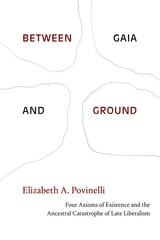
cover of Between Gaia and Ground: Four Axioms of Existence and the Ancestral Catastrophe of Late Liberalism

Between Gaia and Ground

Four Axioms of Existence and the Ancestral Catastrophe of Late Liberalism

Elizabeth A. Povinelli

Duke University Press, 2021
In Between Gaia and Ground Elizabeth A. Povinelli theorizes the climatic, environmental, viral, and social catastrophe present as an ancestral catastrophe through which that Indigenous and colonized peoples have been suffering for centuries. In this way, the violence and philosophies the West relies on now threaten the West itself. Engaging with the work of Glissant, Deleuze and Guattari, Césaire, and Arendt, Povinelli highlights four axioms of existence—the entanglement of existence, the unequal distribution of power, the collapse of the event as essential to political thought, and the legacies of racial and colonial histories. She traces these axioms' inspiration in anticolonial struggles against the dispossession and extraction that have ruined the lived conditions for many on the planet. By examining the dynamic and unfolding forms of late liberal violence, Povinelli attends to a vital set of questions about changing environmental conditions, the legacies of violence, and the limits of inherited Western social theory. Between Gaia and Ground also includes a glossary of the keywords and concepts that Povinelli has developed throughout her work.
[more]
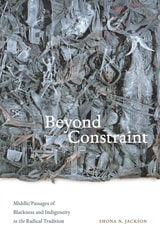
cover of Beyond Constraint: Middle/Passages of Blackness and Indigeneity in the Radical Tradition

Beyond Constraint

Middle/Passages of Blackness and Indigeneity in the Radical Tradition

Shona N. Jackson

Duke University Press, 2024

In Beyond Constraint, Shona N. Jackson offers a new approach to labour and its analysis by demonstrating the fundamental relation between black and Indigenous People’s sovereign, free, and coerced labour in the Americas. Through the writings of Cedric Robinson, Walter Rodney, C. L. R. James, and Sylvia Wynter, Jackson confronts the elision of Indigenous People’s labour in the black radical tradition. She argues that this elision is an effect of the structural relation of antiblackness to anti-indigeneity through which native and black bodies are arranged on either side of a split between unproductive labour and productive work necessary for capital accumulation and for how we read capital in political economic critique. This division between labour and work forces the radical tradition to sustain the break between black and Indigenous peoples as part of its critical strategies of liberation. To address this impasse, Jackson reads the tradition against the grain for openings to indigeneity and a method for recovering lost labours.
[more]
cover of Beyond the Public Sphere: Film and the Feminist Imaginary

Beyond the Public Sphere

Film and the Feminist Imaginary

María Pía Lara

Northwestern University Press, 2021

In Beyond the Public Sphere: Film and the Feminist Imaginary, the renowned philosopher and critical theorist María Pía Lara challenges the notion that the bourgeois public sphere is the most important informal institution between social and political actors and the state.

Drawing on a wide range of films—including The Milk of Sorrow, Ixcanul, Wadja, The Stone of Patience, Marnie, A Streetcar Named Desire, and Talk to Her—Lara dissects cinematic images of women’s struggles and their oppression. She builds on this analysis, developing a concept of the feminist social imaginary as a broader and more complex space that provides a way of thinking through the possibilities for emancipatory social transformation in response to forms of domination perpetuated by patriarchal capitalism.
[more]
cover of Black Empire: The Masculine Global Imaginary of Caribbean Intellectuals in the United States, 1914–1962

Black Empire

The Masculine Global Imaginary of Caribbean Intellectuals in the United States, 1914–1962

Michelle Ann Stephens

Duke University Press, 2005

In Black Empire, Michelle Ann Stephens examines the ideal of “transnational blackness” that emerged in the work of radical black intellectuals from the British West Indies in the early twentieth century. Focusing on the writings of Marcus Garvey, Claude McKay, and C. L. R. James, Stephens shows how these thinkers developed ideas of a worldwide racial movement and federated global black political community that transcended the boundaries of nation-states. Stephens highlights key geopolitical and historical events that gave rise to these writers’ intellectual investment in new modes of black political self-determination. She describes their engagement with the fate of African Americans within the burgeoning U.S. empire, their disillusionment with the potential of post–World War I international organizations such as the League of Nations to acknowledge, let alone improve, the material conditions of people of color around the world, and the inspiration they took from the Bolshevik Revolution, which offered models of revolution and community not based on nationality.

Stephens argues that the global black political consciousness she identifies was constituted by both radical and reactionary impulses. On the one hand, Garvey, McKay, and James saw freedom of movement as the basis of black transnationalism. The Caribbean archipelago—a geographic space ideally suited to the free movement of black subjects across national boundaries—became the metaphoric heart of their vision. On the other hand, these three writers were deeply influenced by the ideas of militarism, empire, and male sovereignty that shaped global political discourse in the early twentieth century. As such, their vision of transnational blackness excluded women’s political subjectivities. Drawing together insights from American, African American, Caribbean, and gender studies, Black Empire is a major contribution to ongoing conversations about nation and diaspora.
[more]
cover of Black Enlightenment

Black Enlightenment

Surya Parekh

Duke University Press, 2023

In Black Enlightenment Surya Parekh reimagines the Enlightenment from the position of the Black subject. Parekh examines the works of such Black writers as the free Jamaican Francis Williams (1697–1762), Afro-British thinker Ignatius Sancho (1729?–1780), and Afro-American poet Phillis Wheatley (1753?–1784), placing them alongside those of their white European contemporaries David Hume (1711-1776) and Immanuel Kant (1724-1804). By rethinking the Enlightenment and its canons, Parekh complicates common understandings of the Enlightenment wherein Black subjects could exist only in negation to white subjects. Black Enlightenment points to the anxiety of race in Hume, Kant, and others while showing the importance of Black Enlightenment thought. Parekh prompts us to consider the timeliness of reading Black Enlightenment authors who become “free” in a society hostile to that freedom.
[more]
cover of Black Unhappiness: The Philosophy of W. E. B. Du Bois

Black Unhappiness

The Philosophy of W. E. B. Du Bois

Grant Farred

Duke University Press, 2027
In Black Unhappiness, Grant Farred offers an incisive philosophical investigation of Black Being through the work of W. E. B. Du Bois. Farred takes up a single chapter of Du Bois’ The Souls of Black Folk, “Of the Coming of John,” in which Du Bois allegorizes unhappiness in the lives of John Jones, a fictional Black student of a Northern Negro college, and his sister Jennie. Farred treats this chapter as a philosophical treatise and, through close analysis, articulates the dimensions of John and Jennie’s unhappiness as a critical map for understanding the structure of Black Being in-the-world. Farred engages with a wide array of thinkers like G. W. F. Hegel, Ralph Ellison, Edouard Glissant, Martin Heidegger, and Fredric Jameson to explicate Du Bois’ philosophy of unhappiness in the Reconstruction South. Through a series of meditations and concepts, Farred illuminates the ways that thought and thinking are integral to Black Being, that Black Being is Black consciousness, and that this consciousness is critically, necessarily, and productively unhappy.
[more]
cover of Brutalism

Brutalism

Achille Mbembe

Duke University Press, 2024

In Brutalism, eminent social and critical theorist Achille Mbembe invokes the architectural aesthetic of brutalism to describe our moment, caught up in the pathos of demolition and production on a planetary scale. Just as brutalist architecture creates an affect of overwhelming weight and destruction, Mbembe contends that contemporary capitalism crushes and dominates all spheres of existence. In our digital, technologically focused era, capitalism has produced a becoming-artificial of humanity and the becoming-human of machines. This blurring of the natural and artificial presents a planetary existential threat in which contemporary society’s goal is to precipitate the mutation of the human species into a condition that is at once plastic and synthetic. Mbembe argues that Afro-diasporic thought presents the only solution for breaking the totalizing logic of contemporary capitalism: repairing that which is broken, developing a new planetary consciousness, and reforming a community of humans in solidarity with all living things.
[more]