Results by title
476 books match the query 'Criticism' and 12 start with b
Bakhtin in Contexts
Across the DisciplinesAmy Mandelker
Northwestern University Press, 1995
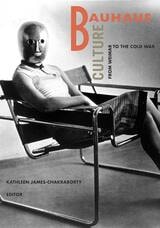
Bauhaus Culture
From Weimar To The Cold WarKathleen James-Chakraborty
University of Minnesota Press, 2006
In this book, editor Kathleen James-Chakraborty and seven other scholars analyze the accomplishments and dispel the myths of the Bauhaus, placing it firmly in a historical context from before the formation of the Weimar Republic through Nazi ascendancy and World War II into the cold war. Together, they investigate its professors’ and students’ interactions with mass culture; establish the complexity of its relationship with Wilhelmine, Nazi, and postwar German politics; and challenge the claim that its architects greatly influenced American architecture in the 1930s.
Their most explosive conclusions address the degree to which some aspects of Bauhaus design continued to flourish during the Third Reich before becoming one of the cold war’s most enduring emblems of artistic freedom. In doing so, Bauhaus Culture calls into question the degree to which this influential school should continue to symbolize an uncomplicated relationship between art, modern technology, and progressive politics.
Contributors: Greg Castillo, Juliet Koss, Rose-Carol Washton Long, John V. Maciuika, Wallis Miller, Winifried Nerdinger, Frederic J. Schwartz.
Kathleen James-Chakraborty is associate professor of architecture at the University of California, Berkeley, and author of German Architecture for a Mass Audience and Erich Mendelsohn and the Architecture of German Modernism.
Beautiful Data
A History of Vision and Reason since 1945Orit Halpern
Duke University Press, 2015

Beautiful Terrible Ruins
Detroit and the Anxiety of DeclineApel, Dora
Rutgers University Press, 2015
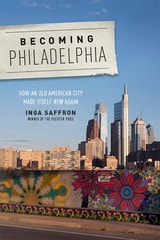
Becoming Philadelphia
How an Old American City Made Itself New AgainInga Saffron
Rutgers University Press, 2020
Becoming Philadelphia collects the best of Saffron’s work, plus a new introduction reflecting on the stunning changes the city has undergone. A fearless crusader who is also a seasoned reporter, Saffron ranges beyond the usual boundaries of architectural criticism to explore how big money and politics intersect with design, profoundly shaping our everyday experience of city life. Even as she celebrates Philadelphia’s resurgence, she considers how it finds itself grappling with the problems of success: gentrification, poverty, privatization, and the unequal distribution of public services.
What emerges in these 80 pieces is a remarkable narrative of a remarkable time. The proverbial first draft of history, these columns tell the story of how a great city shape-shifted before our very eyes.
Before the Law
The Complete Text of PréjugésJacques Derrida
University of Minnesota Press, 2018
Thinking judgment in relation to the work of Jean-François Lyotard
“How to judge—Jean-François Lyotard?” It is from this initial question that one of France’s most heralded philosophers of the twentieth century begins his essay on the origin of the law, of judgment, and the work of his colleague Jean-François Lyotard. If Jacques Derrida begins with the term préjugés, it is in part because of its impossibility to be rendered properly in other languages and also contain all its meanings: to pre-judge, to judge before judging, to hold prejudices, to know “how to judge,” and more still, to be already prejudged oneself.
Striving to contain that which comes before the law, that is in front of the law and also prior to it, how to judge Jean-François Lyotard then becomes perhaps a beneficial attempt for Derrida to explore humanity’s rapport with judgment, origins, and naming. For how does one come to judge the author of the Differend? How does one abstain from judgment to accept the term préjugés as suspending judgment and at once as taking into account the impossibility of speaking before the law, prior to naming or judging? If this task indeed seems insurmountable, it is the site where Lyotard’s work itself is played out. Hence this sincere and intriguing essay presented by Jacques Derrida, published here for the first time in English.
Black and Blue
The Bruising Passion of Camera Lucida, La Jete, Sans soleil, and Hiroshima mon amourCarol Mavor
Duke University Press, 2012
Personal recollections punctuate Mavor's dazzling interpretations of these and many other works of art and criticism. Childhood memories become Proust's "small-scale contrivances," tiny sensations that open onto panoramas. Mavor's mother lost her memory to Alzheimer's, and Black and Blue is framed by the author's memories of her mother and effort to understand what it means to not be recognized by one to whom you were once so known.
Blind Date
Sex and PhilosophyAnne Dufourmantelle. Translated by Catherine Porter.
University of Illinois Press, 2007
Bringing sex and philosophy together on a blind date, Anne Dufourmantelle’s provocative study uses this analogy to uncover and examine philosophy’s blind spot. Delightful and startling comparisons spring from the date: both sex and philosophy are dangerous, both are socially subversive, and both are obsessions. Although sex and philosophy have much in common, however, they have scarcely known one another until now.
Socrates and Diogenes had little to say about sex, and although it was notoriously explored by the Marquis de Sade, this study explains why philosophy has never been fully sexualized nor sex really philosophized. Blind Date highlights the marked deletion of sexual topics and themes from philosophical works, while also opening doors for their union. Inviting readers to remember that thought does not require repressed desire, Dufourmantelle argues that sex is everywhere, and it affects all kinds of thinking.
Blindness and Insight
Essays in the Rhetoric of Contemporary CriticismPaul De Man
University of Minnesota Press, 1983
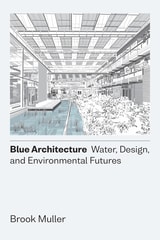
Blue Architecture
Water, Design, and Environmental FuturesBrook Muller
University of Texas Press, 2022
2023 Finalist, PROSE Award in Architecture and Urban Planning
A guide to water-focused and climate-resilient architectural and urban design.
Le Corbusier famously said, “A house is a machine for living in.” We now confront the litany of environmental challenges associated with the legacy of the architectural machine: a changing climate, massive species die-off, diminished air and water quality, and resource scarcities. Brook Muller offers an alternative: water-centric urban design that fosters sustainability, equity, and architectural creativity.
Inspired by the vernacular, such as the levadas of Madeira Island and both the arid and drenched places of the American West, Muller articulates a “hydro-logical” philosophy in which architects and planners begin by conceptualizing interactions between existing waterways and the spaces they intend to develop. From these interactions—and the new technologies and approaches enabling them—aesthetic, spatial, and experiential opportunities follow. Not content merely to work around sensitive ecology, Muller argues for genuinely climate-adapted urban landscapes in which buildings act as ecological infrastructure that actually improve watersheds while delivering functionality and beauty for diverse communities. Rich in images and practical examples, Blue Architecture will change the way we think about our designed world.
Bodies of the Text
Dance as Theory, Literature as DanceEdited by Ellen W Goellner
Rutgers University Press, 1995
Building Little Saigon
Refugee Urbanism in American Cities and SuburbsErica Allen-Kim
University of Texas Press, 2024
2026 Spiro Kostof Book Award, Society of Architectural Historians
An in-depth look at the diverging paths of Vietnamese American communities, or “Little Saigons,” in America’s built environment.
In the final days before the fall of Saigon in 1975, 125,000 Vietnamese who were evacuated or who made their own way out of the country resettled in the United States. Finding themselves in unfamiliar places yet still connected in exile, these refugees began building their own communities as memorials to a lost homeland. Known both officially and unofficially as Little Saigons, these built landscapes offer space for everyday activities as well as the staging of cultural heritage and political events.
Building Little Saigon examines nearly fifty years of city building by Vietnamese Americans—who number over 2.2 million today. Author Erica Allen-Kim highlights architecture and planning ideas adapted by the Vietnamese communities who, in turn, have influenced planning policies and mainstream practices. Allen-Kim traveled to ten Little Saigons in the United States to visit archives, buildings, and public art and to converse with developers, community planners, artists, business owners, and Vietnam veterans. By examining everyday buildings—who made them and what they mean for those who know them—Building Little Saigon shows us the complexities of migration unfolding across lifetimes and generations.